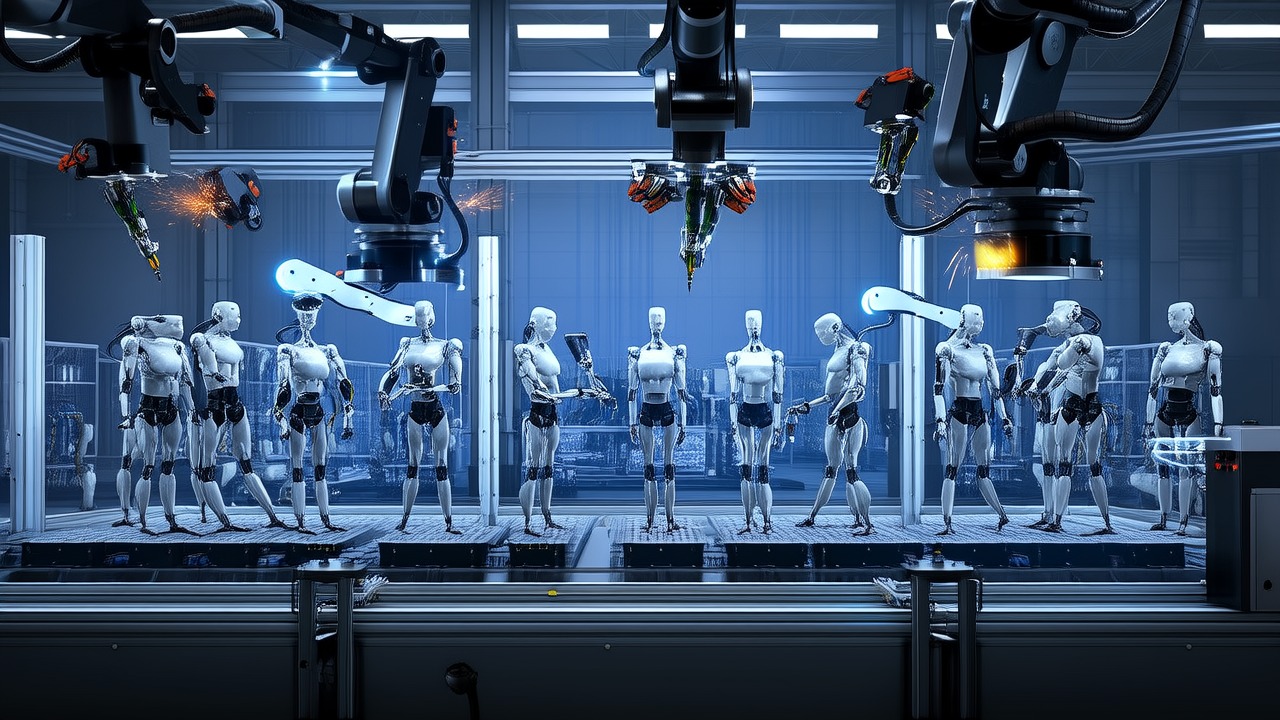
June 2026 marks a decisive inflection point for the humanoid robotics industry. Figure AI announced its BotQ factory has achieved a production rate of one Figure 03 per hour; Boston Dynamics' electric Atlas has begun shipping to initial commercial customers; and NVIDIA unveiled the Isaac GR00T open humanoid robot reference platform. This series of events signals that humanoid robots have formally transitioned from prototype demonstrations into manufacturing and commercial deployment.
According to Humanoid Index data, the global humanoid robotics sector has raised over $8.2 billion in cumulative funding across 31 active companies as of June 2026. Global humanoid robot shipments exceeded 13,000 units in 2025, with Chinese manufacturers accounting for approximately 80-90% of units shipped — Unitree alone shipped 5,500+ units and AgiBot approximately 5,100. The 2026 market size is projected at $5-10 billion.
The Manufacturing Turning Point
Several core indicators mark the transition from laboratory to factory in the first half of 2026:
Figure AI: BotQ Factory Scale-Up
Figure AI completed a $1 billion+ Series C round in September 2025 led by Microsoft, NVIDIA, and Jeff Bezos, reaching a $39 billion valuation. Its BotQ factory in California achieved a production cadence of one Figure 03 per hour in Q2 2026 — while far below automotive manufacturing speeds (several units per minute), this represents a qualitative leap from hand assembly to automated production for highly complex humanoid robots.
The Figure 03 features several key upgrades: a redesigned actuator system reducing manufacturing costs by approximately 40%; the Helix AI control system enabling higher degrees of autonomous operation; and battery life extended from 5 to 8 hours compared to the Figure 02. The company has completed initial deployment testing at BMW's Spartanburg plant and is expanding to additional manufacturing and logistics partners.
Boston Dynamics Atlas: Research Platform to Commercial Product
After being acquired by Hyundai Motor Group for $1.1 billion, Atlas has formally transitioned from research platform to commercial product. The first 2026-production Atlas units are shipping to Hyundai's Metaplant and Google DeepMind. While specific deployment details remain confidential, these Atlas units will handle material handling and complex environment testing tasks on EV production lines and in advanced AI research laboratories.
Global Production Distribution
Humanoid robot manufacturing is developing along two parallel tracks:
- China volume dominance: Unitree ($1.4B valuation), AgiBot ($1B+), UBTECH ($5B+ HK-listed) dominate shipment volumes. Unitree targets 10,000-20,000 units in 2026.
- Western premium market: Figure ($39B), Agility Robotics ($2.1B), Apptronik ($5.5B) focus on high-value industrial applications with deep integration.
Ecosystem Formation
NVIDIA's June 2026 launch of the Isaac GR00T reference humanoid robot platform represents a pivotal moment in the industry's structural evolution. This open hardware reference design integrates Unitree's H2 robot body, Singapore-based Sharpa's dexterous hands, and NVIDIA's Blackwell computing platform.
GR00T's strategic significance:
- Standardization: Provides a unified R&D platform lowering entry barriers for research institutions and startups
- Ecosystem control: Positions NVIDIA as the central computing platform supplier for humanoid robotics
- Security architecture: Chip-level secure boot and confidential computing prevent unauthorized code access
Additionally, Sharpa's North robotic hand achieves 0.02-second reaction time — crossing the 0.05-second threshold that marks the boundary between reactive robots and anticipatory ones.
The Autonomy Gap
Despite impressive hardware progress, humanoid robots face significant challenges in software autonomy. Factory operations in 2026 combine pre-programmed behavior, human teleoperation, and increasingly sophisticated neural network policies — with the most variable and unstructured tasks still requiring human oversight or teleoperation.
Figure's BMW deployment experience reveals critical issues: robots can achieve high autonomy for specific assembly line tasks (parts handling, sorting), but when task environments change (part position shifts, tool changes), human intervention remains necessary. This reveals a significant gap between current reality and the "general-purpose humanoid autonomy" vision promoted by NVIDIA and others.
From an economic standpoint, humanoids are already commercially viable for specific roles in high-cost labor markets (USA, Western Europe) even at current hardware costs of $100,000-250,000 per unit. In lower-cost markets, hardware costs must decline substantially before unit economics become positive.
Market Projections and Investment Logic
Morgan Stanley projects approximately 90% of humanoid robots by mid-century will serve industrial and commercial purposes. The global humanoid robot market is expected to grow at 45% annually, reaching $13 billion+ by 2029.
Key 2026 funding dynamics:
- Apptronik completed $520M Series A in February 2026 ($5.5B valuation), backed by Google and Mercedes-Benz
- Standard Bots reached $1B valuation after $200M Series C
- At least 8 of 31 funded companies have active commercial pilot deployments
The humanoid robotics sector is transitioning from the "peak of inflated expectations" toward the "plateau of productivity." Near-term risks (2026-2028) center on software autonomy progress lagging behind hardware improvements; medium-to-long-term (2028-2032), general-purpose autonomy should gradually materialize as foundation models iterate and operational data accumulates.
Observatory Analysis
The humanoid robotics industry in mid-2026 bears striking similarities to the electric vehicle industry in the early 2020s: massive capital influx, multiple companies competing for platform standardization, supply chains forming, and intense debate about when true large-scale deployment will arrive.
A critical difference: EVs substituted into an existing mature market (automobiles), while humanoids create an entirely new market — one whose size and growth rate depend entirely on technology capability improvement. This makes investment timeline uncertainty significantly higher than EVs.
Competitive tiers: Figure, Tesla Optimus, and Boston Dynamics Atlas form the first tier; China's Unitree and AgiBot constitute the cost-leading second tier; NVIDIA attempts to become the "operating system layer" through the GR00T platform — reminiscent of the Wintel alliance model in the PC era, though robot hardware is far more complex.
Key watchpoints for the next 12 months: Figure 03 deployment progress beyond BMW, Tesla Optimus Gen 3 official launch, and whether NVIDIA's GR00T platform attracts sufficient third-party developers to create ecosystem effects.
Disclaimer: The information contained in this article is for reference only and does not constitute investment advice or business decision-making basis. Data and time-sensitive information are accurate as of the publication date and may change with subsequent developments. Neither the author nor POC.HK assumes any responsibility for losses resulting from the use of this information.