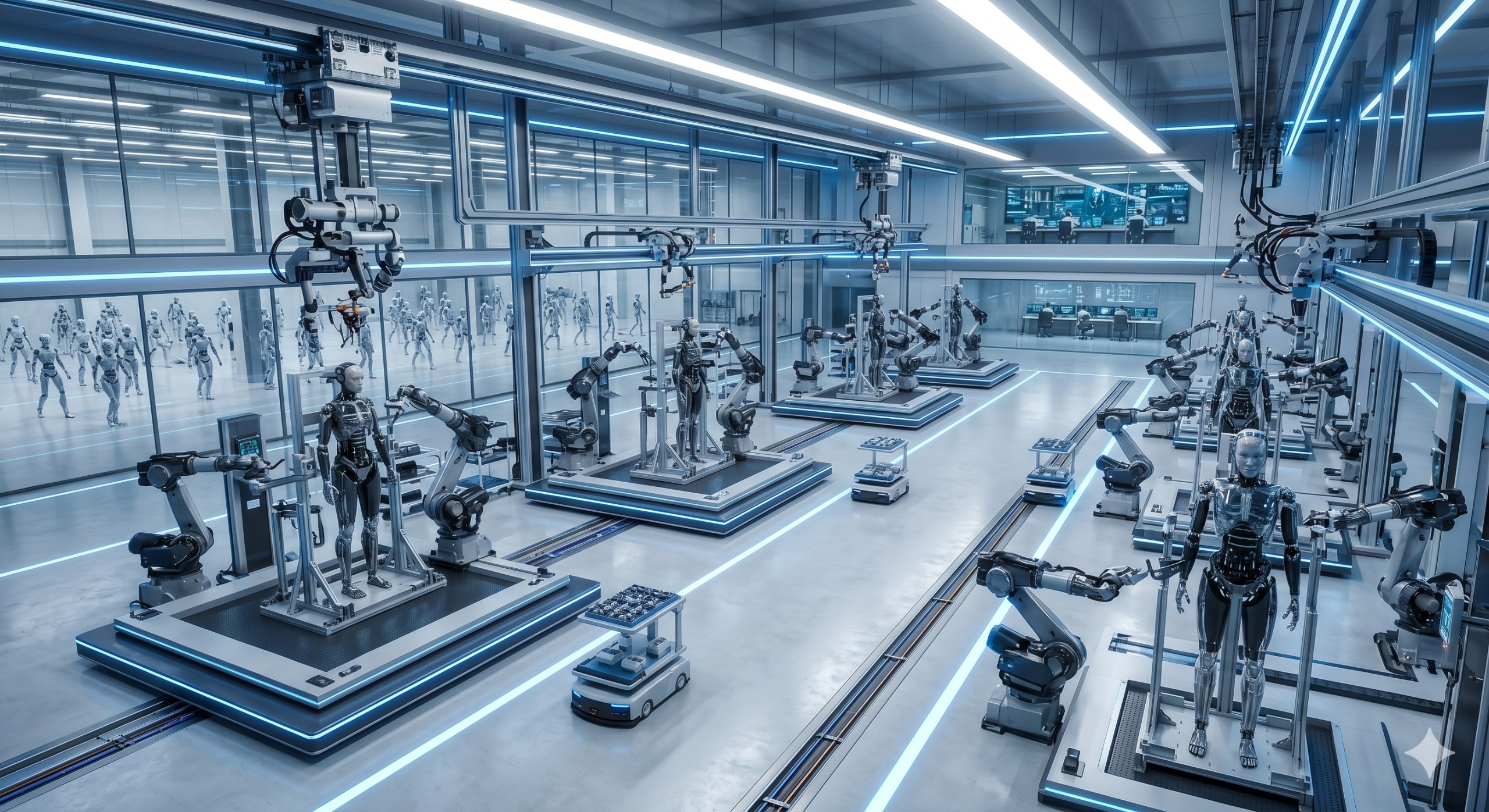
The Year of Mass Production for Humanoid Robots: Can 2026 Be the Industrialization Watershed?
2026 is being defined by the industry as the "first year of mass production for humanoid robots." This is not mere market hype — from Tesla Optimus entering planned mass production, to Figure AI completing its first commercial deliveries, to Unitree launching consumer-grade humanoid robots at disruptively low prices, a convergence of real industry signals is underway. But to determine whether this truly represents an industrialization watershed, we must look beyond news headlines and examine the underlying technology maturity, cost curves, and genuine market demand.
Observatory Analysis
Technology Maturity Comparison Across Three Mass Production Routes
Three clear technical routes have emerged:
Route One: General-Purpose Industrial Humanoid Robots. Represented by Figure AI's Figure 02, focused on industrial manufacturing scenarios. The Figure 02 stands 170 cm tall, weighs 60 kg, has 16-degree-of-freedom arms and 6-degree-of-freedom legs, with approximately 5 hours of battery life. Its core competitiveness lies in its vision-language model (VLM)-enhanced control system, capable of understanding natural language instructions and adapting to unstructured environments in real-time. The first batch of production units deployed at BMW's Spartanburg factory has already completed over 1,000 hours of actual production line operation, primarily handling weld point inspection and component handling. Figure AI claims 2026 production will reach 1,000 units, with a target price of approximately $20,000-50,000.
Route Two: Minimalist Low-Cost Humanoid Robots. Unitree's H1 caused market shockwaves at a price below 90,000 RMB (approximately $12,000). This robot stands 1.8 meters tall, weighs 47 kg, has a maximum movement speed of 3.3 m/s, and can perform dynamic actions such as jumping and backflips. Although the H1's dexterous manipulation capabilities are limited (hands are simple grippers incapable of fine grasping), its low-price strategy is creating new markets in education, research, and entertainment. Unitree shipped approximately 300 units in 2025, with an expected 2,000+ in 2026, making it the world's largest bipedal robot supplier by shipment volume.
Route Three: Tesla Optimus's Ecosystem-Scale Production. Tesla Optimus (Gen 2) began internal testing at the Texas Gigafactory in late 2025, primarily handling battery module handling and simple assembly tasks. Tesla's advantage comes from its manufacturing scale effects — the same production lines, supply chain management capabilities, and cost control philosophy (such as gigacasting) are being applied to robot production. Elon Musk's production targets are 1,000-5,000 units in 2026, with a long-term goal of 1 million units — but this depends on simulation training compute from Tesla Dojo supercomputers and the transfer of FSD technology to robot control.
Real Cost Calculations
The core obstacle to moving humanoid robots from prototype to mass production is cost. The BOM (Bill of Materials) structure of an industrial-grade humanoid robot is roughly:
- Joint actuators (frameless torque motors + harmonic reducers): approximately 35-40% of total cost
- Perception sensors (IMU, torque sensors, stereo vision cameras): approximately 15-20%
- Computing units (edge AI chips): approximately 10-15%
- Battery and power management: approximately 10%
- Structural parts and materials: approximately 8-10%
- Software development cost amortization: approximately 5-10%
Using the Figure 02 as an example, current mass production cost is approximately $50,000-80,000. The target selling price of $20,000 means joint actuator costs need to drop by over 60%. This is not a fantasy — the history of the electric vehicle industry shows that when production scales from hundreds to tens of thousands, core component costs can decline by 40-60%. Harmonic Drive, the leading joint actuator company, has already tripled its production capacity in 2025 to meet humanoid robot demand.
Real Deployment Bottlenecks in Industrial Scenarios
Despite optimistic news reporting, several critical issues are under-discussed in actual deployment:
-
Battery anxiety: Current mass-production humanoid robots all have 2-5 hours of battery life. In an 8-hour factory shift, this means each robot needs 2-3 backup batteries or deployment of automatic charging stations — both increase operational complexity.
-
Insufficient task generalization: All current commercial applications of humanoid robots are concentrated in highly structured tasks — handling, inspection, simple assembly. Once task combinations change (e.g., production line product changeover), reprogramming or remote operation is often required. True general-purpose operation capability remains an academic research topic.
-
Lagging safety certification: Safety standards for humanoid robots in human factory environments have not yet been established. ISO 10218 (industrial robot safety standard) and ISO/TS 15066 (collaborative robot safety standard) were both developed before the widespread adoption of humanoid robots. ISO is currently developing specialized humanoid robot safety specifications, expected for completion in 2027-2028. This means all current industrial deployments operate in a "regulatory gray zone."
Geographic Landscape of the Global Supply Chain
The humanoid robot supply chain exhibits marked regional differentiation. Looking at key components: China holds cost advantages in joint motors, reducers, and batteries, with Shenzhen and Shanghai already forming humanoid robot hardware supply chain clusters; the US maintains leadership in AI software, training compute, and system integration; Japan and Germany retain irreplaceable positions in high-precision reducers and actuators. This landscape means that in the short term, Chinese solutions with low-cost hardware advantages will lead in shipment volume, while American solutions with software intelligence and ecosystem advantages will lead in unit value and application depth.
Looking Ahead
Short-to-medium term (2026-2028): Accelerating penetration of structured industrial scenarios
Humanoid robot deployment in industrial scenarios will follow the path of "simple first, complex later; structured first, unstructured later." By the end of 2028, global humanoid robot installations in manufacturing are expected to reach 50,000-100,000 units. The core driving forces come from three aspects: first, the maturation of the RaaS (Robotics as a Service) model — companies like Figure and 1X Technologies have launched per-hour pricing, reducing customer upfront investment to near zero; second, improved AI training efficiency — imitation learning and reinforcement learning toolchains are standardizing, shortening robot deployment time from months to weeks; third, competitive pressure — manufacturing enterprises that adopt humanoid robots first will gain efficiency advantages that force peers to follow.
Medium-to-long term (2028-2032): Cross-industry application explosion
When annual humanoid robot production exceeds 100,000 units, manufacturing costs will drop significantly, leading to notable penetration in the following industries: logistics and warehousing ( handling, picking), retail services (shelf management, inventory counting), construction ( handling and simple construction tasks), and healthcare (patient transport and care assistance). It is worth noting that home service robots may take longer — dexterous manipulation and general navigation in unstructured environments remain unconquered technical challenge.
Long-term outlook (2033+): Humanoid robots as a computing platform
If Tesla's vision can be realized, humanoid robots will ultimately become not just an automation device but a general-purpose computing and interaction platform. Imagine a device with a humanoid form capable of driving a car, operating tools, engaging in natural conversation with humans, and sharing learning experiences through cloud connectivity — this is essentially the convergence of autonomous driving, large language models, and robot control technologies. At that point, the market definition of humanoid robots will extend beyond the automation equipment market to become a new general-purpose computing platform, like personal computers and smartphones before them.
But before that, the 2026 mass production targets must undergo real market testing. Optimistic projections always forecast faster cost declines and higher penetration rates; the reality is that every humanoid robot leaving the factory must prove its economic value. Whether the first year of mass production lives up to its name depends not on shipment numbers, but on the irreplaceable value these robots create on real production lines.
POC.HK Future Technology Observatory — Independent Technology Watch Report