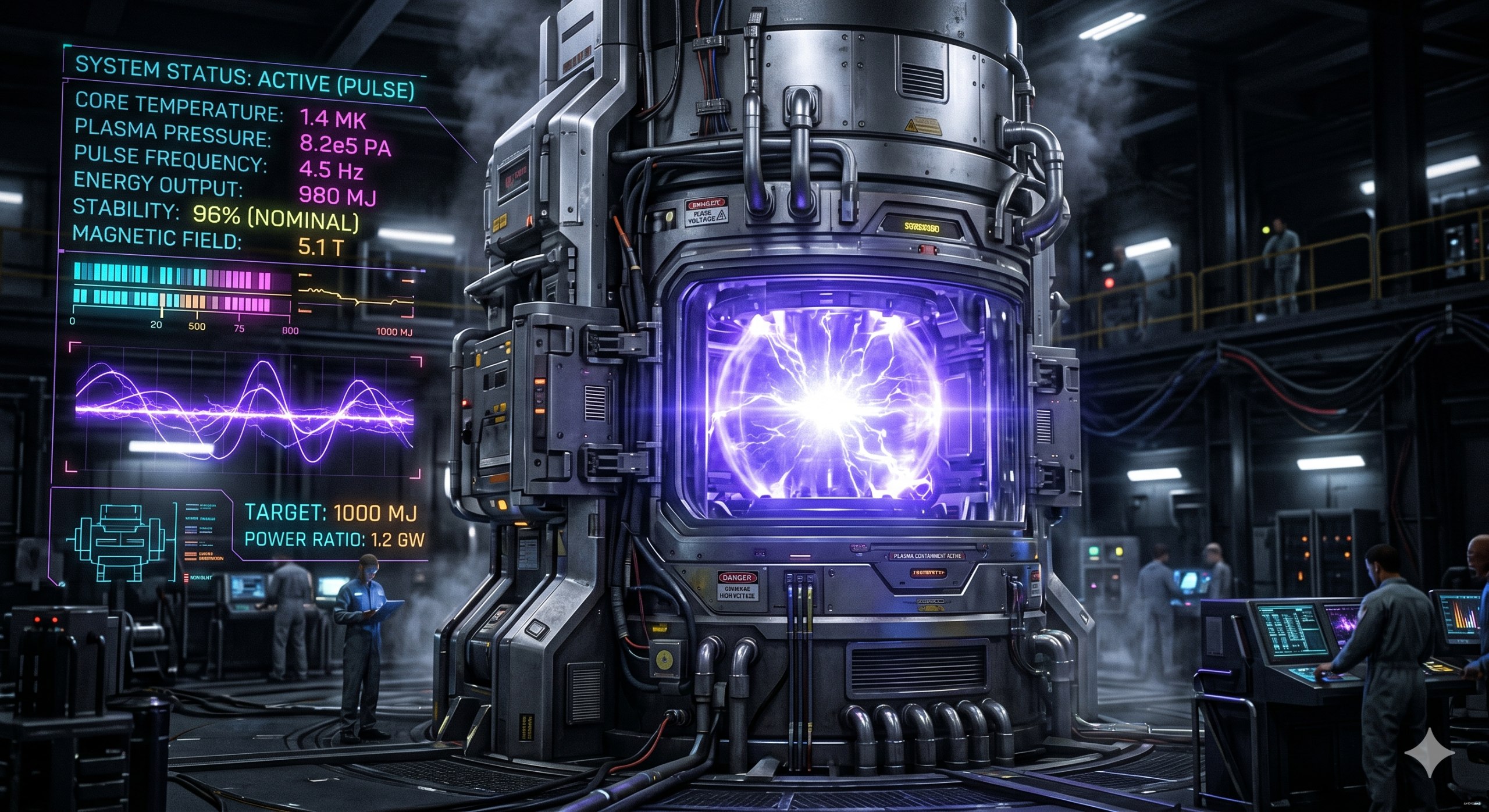
Helion Nears Fusion Breakeven with 60% Q and Sixth-Gen Pulse Generator
Helion Energy, the Washington-state fusion company backed by Sam Altman and Dustin Moskovitz, has announced that its latest test reactor has achieved a Q of 0.6 — meaning it produced 60% of the energy consumed in each fusion pulse. The milestone, achieved with the company's sixth-generation pulse generator, brings Helion closer than any private fusion company has come to the breakeven threshold.
Q = 0.6: What It Means
In fusion energy, Q is the ratio of fusion energy output to the energy input required to sustain the reaction. A Q of 1.0 is breakeven — the point at which the reactor generates as much energy as it consumes. A Q above 1.0 means net energy gain, the holy grail of fusion research.
Helion's Q of 0.6 represents a threefold improvement over its previous best of 0.2, achieved in 2024. The company says it is on track to reach Q > 1.0 by 2027, which would make it the first private fusion company to achieve net energy gain.
To put the achievement in context: the National Ignition Facility at Lawrence Livermore National Laboratory achieved Q > 1.5 in 2022 using inertial confinement fusion, but those experiments produced a single pulse per day and cannot be scaled to continuous power generation. ITER, the international tokamak project, is not expected to demonstrate Q > 10 until the 2030s. Helion's approach aims for pulsed, direct-energy conversion at a commercially viable pulse rate — currently one pulse per 10 seconds.
How Helion's Technology Works
Helion's reactor is fundamentally different from the tokamak and stellarator designs pursued by most fusion efforts. Instead of using magnetic fields to confine a plasma and heat it to fusion temperatures for extended periods, Helion uses a method called field-reversed configuration (FRC) with pulsed magnetic compression.
In each pulse, the reactor injects deuterium and helium-3 fuel into a chamber, where it is heated into a plasma and compressed by powerful magnetic fields. As the plasma reaches fusion conditions, the expanding magnetic field from the reaction is directly induced into the reactor's coils, generating electricity without the need for a steam turbine. This direct energy conversion is a major efficiency advantage over traditional fusion designs, which use heat to boil water and spin a turbine.
The sixth-generation pulse generator (Gen-6) incorporates several key improvements over its predecessor. The magnetic compression coils are now made from high-temperature superconductors, allowing stronger magnetic fields with less resistive loss. The plasma injection system has been redesigned for more precise fuel delivery, and the control systems have been upgraded to fire pulses at 10-second intervals with microsecond-level timing accuracy.
Fuel Economics
A key advantage of Helion's approach is its fuel cycle. The reactor uses deuterium (abundant in seawater) and helium-3 (which the reactor produces through a side reaction). The primary reaction produces no radioactive waste — the end products are helium-4, an inert gas, and high-energy protons that are directly converted to electricity.
Helium-3 is extremely rare on Earth, but Helion's reactor is designed to breed its own helium-3 through a secondary deuterium-deuterium fusion reaction within the same chamber. The company claims that after an initial charge of helium-3, the reactor can sustain itself on deuterium alone.
This fuel cycle is a significant differentiator from tokamaks, which use tritium — a radioactive isotope of hydrogen that must be bred from lithium and poses handling challenges. Helion's approach eliminates the need for a tritium breeding blanket and the associated regulatory complexity.
Commercial Timeline
Helion has signed a power purchase agreement with Microsoft for electricity from its first commercial reactor, originally targeting 2028 but now expected to begin deliveries in 2029-2030. The company has raised over $1 billion in private funding, including a $500 million round led by Sam Altman.
The path to commercialization involves two more milestones: reaching Q > 1.0 in the Gen-7 reactor (expected 2027), and demonstrating sustained pulsed operation at 1 pulse per second in the Gen-8 commercial design. At 1 pulse per second, a single Helion reactor would produce approximately 50 megawatts of electricity.
Challenges Remain
Despite the progress, significant challenges remain. Achieving Q > 1.0 in a pulsed system is not the same as sustaining net energy over hours or days. The Gen-6 reactor has run for pulses lasting only milliseconds, and extending pulse duration while maintaining Q will require solving materials challenges related to heat flux, neutron damage, and magnetic coil fatigue.
The company also faces regulatory hurdles. The US Nuclear Regulatory Commission has not yet established a licensing framework for fusion reactors — Helion's design uses a different regulatory category than fission reactors, but the rules are still being written.
Perhaps the biggest challenge is credibility. The fusion industry has a long history of overpromising, and Helion has been notably secretive about its results. The Q = 0.6 announcement came with limited published data, and independent verification has not yet been performed. Critics note that Helion has been predicting breakeven "within two years" since 2021.
The Big Picture
Helion's Q = 0.6 achievement is genuinely significant. No other private fusion company has publicly demonstrated this level of performance in a pulsed reactor. If the company can bridge the remaining gap from Q = 0.6 to Q > 1.0, it will have demonstrated the physics basis for pulsed fusion energy.
The question is whether the engineering challenges of moving from physics demonstration to commercial power plant can be solved on the timeline Helion projects. Fusion has a way of taking longer than optimists expect. But for the first time in decades, the optimists have real data to point to.
Disclaimer: This article is for informational purposes only and does not constitute financial, technical, or investment advice. The views expressed are based on publicly available information as of the date of publication. Readers should conduct their own research and consult with qualified professionals before making any decisions based on this content.