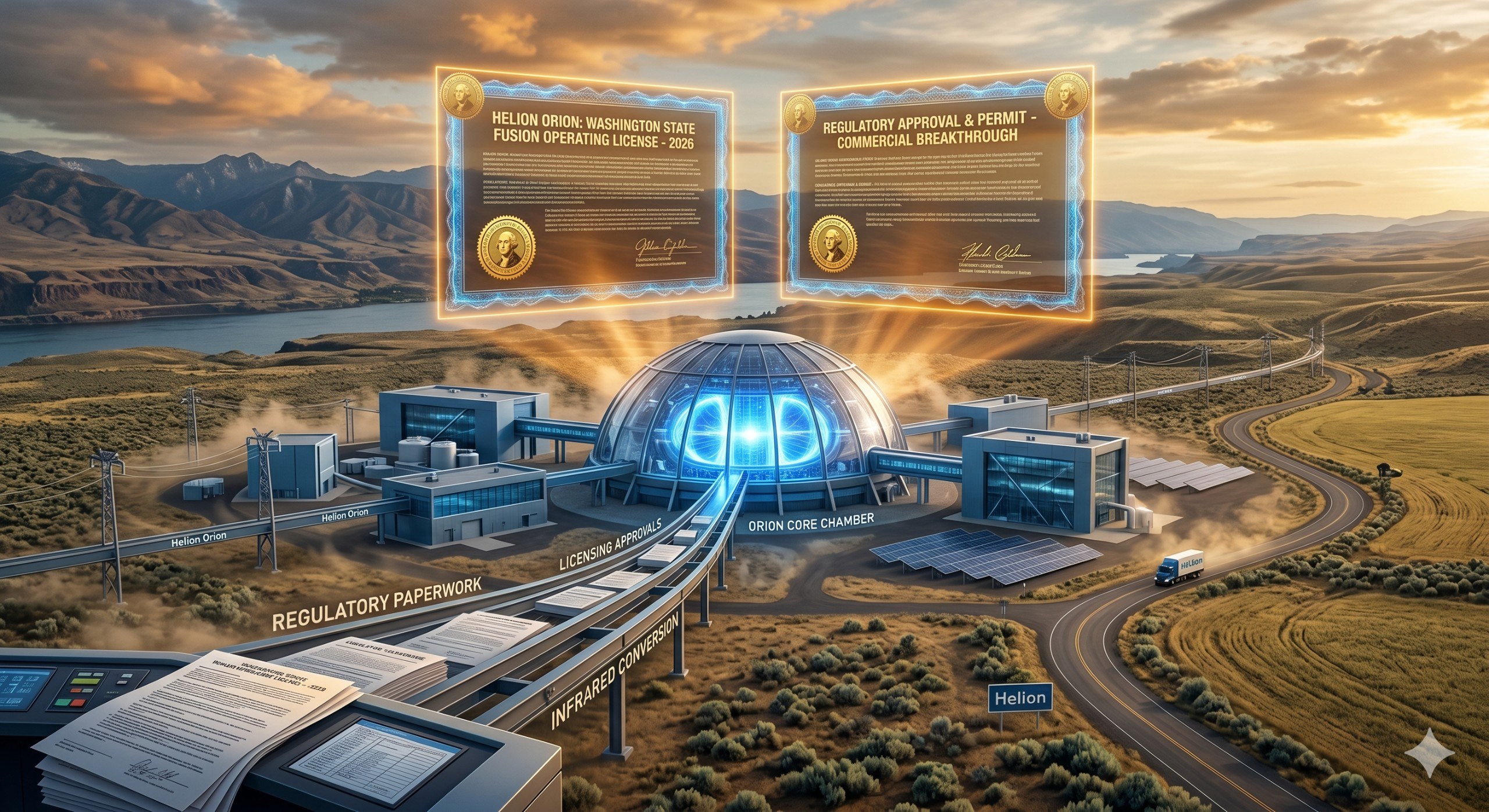
On June 16, 2026, the Washington State Department of Health issued two historic documents to Helion Energy: a Radioactive Material License (RML) and a Radioactive Air Emissions License (RAEL). These are the world’s first regulatory licenses ever granted for a commercial fusion power plant. The Orion facility in Malaga, Washington—designed to produce 50 MW of power—has officially transitioned from “theoretically possible” to “regulatorily permissible.”
The Essence of the Licenses: Building a Regulatory Bridge from Research to Industry
Understanding the significance of these licenses requires examining the regulatory framework behind them. The U.S. Nuclear Regulatory Commission (NRC), through the ADVANCE Act passed in 2024, explicitly placed fusion under the byproduct materials framework—meaning fusion facilities are regulated alongside particle accelerators and hospital radiological equipment, rather than under the stringent rules governing nuclear fission reactors. Washington State subsequently passed HB 1924 and HB 1018, providing the state-level legal foundation for fusion regulation.
The RML license Helion received validates the Orion facility’s radioactive material management, personnel training qualifications, and safety programs. The RAEL license authorizes routine gaseous emissions during fusion operations. Together, these licenses establish a critical precedent: they prove that under the existing “byproduct materials” regulatory framework, a commercial fusion plant can obtain legitimate operational authorization.
This represents a breakthrough signal for the entire fusion industry. Before Helion, one of the greatest uncertainties facing fusion startups was not technical feasibility but the question: “Even if the technology works, will regulators allow us to operate?” Helion’s licenses provide the first affirmative answer. Other fusion companies—Commonwealth Fusion Systems, TAE Technologies, General Fusion—now have a regulatory pathway to follow.
Orion’s Technology Path: Pulsed Non-Ignition Magnetized Target Fusion
Helion’s technical approach stands apart in the fusion landscape. Unlike mainstream tokamak designs—such as CFS’s SPARC/ARC—or laser inertial confinement fusion—pursued by Focused Energy and XCimer Energy—Helion employs a Field-Reversed Configuration (FRC) magnetized target fusion scheme.
The operating principle: two plasma rings (FRCs) collide from opposite ends of the machine at over 1 million km/h, compressed by magnetic fields to instantly reach fusion conditions. The design does not use traditional steam turbines to generate electricity. Instead, plasma compression directly compresses magnetic fields, producing electricity directly—eliminating one of the most expensive and inefficient components of fusion power generation.
Helion uses deuterium and helium-3 as fuel rather than deuterium-tritium mixtures. This means its reaction produces minimal neutron radiation, dramatically reducing shielding and remote maintenance requirements. However, helium-3 is extremely rare on Earth. Helion’s business model partially depends on producing helium-3 as a byproduct of deuterium-deuterium reactions during operation, thereby self-cycling its fuel.
Helion’s sixth-generation prototype, Polaris, is currently under testing and is designed to achieve Q>1 (energy output exceeding input). If Polaris successfully demonstrates Q>1, Orion’s design will receive its most direct physical validation.
The Microsoft PPA: Fusion’s First Customer
In 2023, Helion signed the world’s first fusion Power Purchase Agreement (PPA) with Microsoft, agreeing to supply power starting in 2028. The business logic of this agreement warrants close analysis. Microsoft, as one of the largest buyers of AI infrastructure, has seen its data center electricity demand grow exponentially—more than 200% between 2023 and 2026.
From Helion’s perspective, the Microsoft PPA provides several strategic benefits: first, it offers revenue visibility for Orion’s construction, reducing project financing difficulty; second, Microsoft’s brand endorsement provides crucial credibility among potential corporate customers; third, Microsoft’s own net-zero commitments mean it is willing to pay a premium for carbon-free baseload power, offering Helion a more favorable pricing environment than wholesale electricity markets.
The Broader Fusion Race
Helion’s regulatory breakthrough comes amid industry-wide acceleration. Just two weeks earlier, on June 4, Commonwealth Fusion Systems published five peer-reviewed papers in the Journal of Plasma Physics, systematically validating the physics foundation of its ARC tokamak fusion plant design and confirming the feasibility of 400 MW continuous net electricity output.
CFS and Helion represent two paradigmatic paths to fusion commercialization. CFS’s ARC follows a more conventional high-temperature superconducting tokamak design—lower technical risk but higher system complexity and cost. Helion’s FRC design carries greater technical risk—direct electricity recovery has never been demonstrated at scale—but offers potentially higher economic returns by eliminating expensive conventional power generation subsystems.
Meanwhile, Focused Energy completed a $240 million Series A in early 2026, XCimer Energy received DOE approval for its fusion plant design, and TAE Technologies continues advancing its neutral-beam-driven FRC approach. The critical differentiator in this race has already shifted from “whose technology is most advanced” to “who can fastest navigate regulatory approval and construction.”
Global Impact of the Regulatory Precedent
Helion’s license impact will not be confined to the United States. The UK has already established a dedicated fusion regulatory framework and released fusion license application guidance in 2025. Japan’s Ministry of Economy, Trade and Industry is drafting a fusion industry promotion bill. In China, while the EAST tokamak at ASIPP remains a research facility, discussions about commercial fusion regulation have begun.
However, global regulatory fragmentation remains a significant barrier to fusion commercialization. If every country develops different safety standards and licensing requirements, cross-border deployment of fusion plants will face enormous compliance costs. Helion’s Washington State licenses may become a de facto international benchmark—regulators in other countries may reference them to develop their own standards.
Outlook and Structural Challenges
Despite cause for celebration, Helion’s regulatory milestone does not eliminate the enormous uncertainties ahead. Orion construction remains in early stages—generator building earthwork only began in spring 2026, and the transmission interconnection agreement with Chelan County PUD is still under negotiation. From regulatory license to actual power generation, multiple phases remain: construction, commissioning, and trial operation.
The most critical technical uncertainty comes from Polaris’s Q>1 test results. If Polaris successfully crosses breakeven, Helion’s financing and construction will accelerate dramatically. If Polaris falls short, Orion’s design may require significant revision, causing substantial delays and cost overruns.
From a broader perspective, fusion’s economic viability remains an open question. Even with technical success, can Orion’s 50 MW levelized cost of energy (LCOE) compete with solar (already below $30/MWh) or wind? Helion’s PPA pricing has never been disclosed, but given fusion’s capital intensity, initial LCOE is likely far higher than renewables. Helion’s commercial bet: it does not need to compete with solar on cost—it needs to provide 24/7 carbon-free baseload power, something intermittent renewables cannot deliver.
Disclaimer: The information in this article is for reference only and does not constitute investment advice or business decision-making basis. Data and time information are current as of the publication date and may change with subsequent developments. Neither the author nor POC.HK assumes any responsibility for losses resulting from the use of this information.