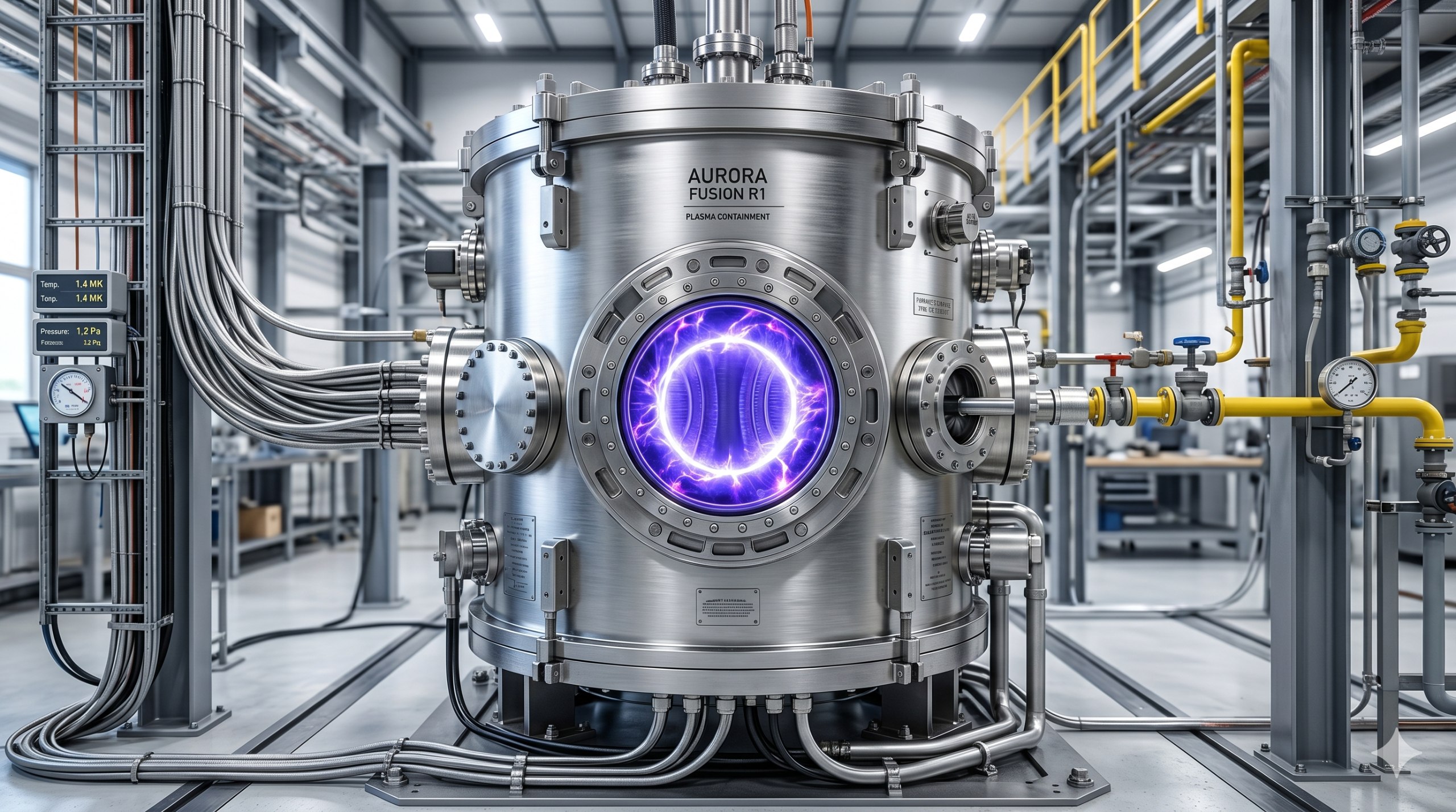
Helion Energy: The Dark Horse of Fusion Commercialization
Helion's Unique Technical Path
Helion Energy stands out in the nuclear fusion startup landscape for its radically different technical approach. Founded in 2013 and headquartered in Everett, Washington, the company has raised approximately $1 billion from prominent investors including Sam Altman (who serves as Chairman), Peter Thiel, and Dustin Moskovitz.
Unlike the tokamak approach used by most government projects and CFS, Helion employs a Field-Reversed Configuration (FRC) combined with magneto-inertial fusion -- a hybrid method that blurs the line between magnetic and inertial confinement.
How It Works
Helion's sixth-generation device Polaris operates through a multi-step process:
- Plasma Formation: Two FRC plasma rings (compact, self-organizing plasma toroids) are formed at opposite ends of a linear cavity
- Acceleration and Collision: Electromagnetic fields accelerate the plasma rings toward each other for a high-speed collision at the center
- Adiabatic Compression: Magnetic fields further compress the merged plasma, reaching extreme temperatures and densities that trigger fusion reactions
- Direct Energy Recovery: Helion's key innovation -- capturing fusion products via magnetic induction to convert kinetic energy directly into electricity, eliminating the need for a traditional steam turbine cycle
This direct energy recovery is what sets Helion apart. Traditional fusion designs (tokamaks, stellarators) produce high-energy neutrons that must heat water to drive turbines. Helion uses deuterium-helium-3 (D-He3) fuel, producing charged particles that can be converted directly into electricity, theoretically achieving much higher efficiency.
Polaris: Everything Rides on This Device
Polaris is Helion's make-or-break device. The company states Polaris is designed to demonstrate net power generation -- meaning it will actually deliver electricity to the grid, not merely achieve plasma energy gain (Q>1).
Key specifications of Polaris:
- Target: First-ever net power from fusion, aiming for approximately 50 MW electrical output
- Timeline: Originally targeted 2025, now expected 2025-2026
- Fuel: Deuterium-helium-3 (D-He3), primarily producing charged particles rather than neutrons
- Size: Significantly more compact than equivalent tokamak devices, fitting in a warehouse-sized facility
The D-He3 fuel choice is strategically significant. While deuterium is abundant and easily obtained, helium-3 is extremely rare on Earth. Helion plans to produce its own helium-3 through secondary deuterium-deuterium (D-D) fusion reactions within the same device, achieving a self-sustaining fuel cycle.
Key Challenges
Despite the compelling vision, Helion faces significant hurdles:
Scientific Verification: No FRC device has ever demonstrated net energy gain. While Helion's previous devices (Trenta, Venti) achieved plasma temperatures exceeding 100 million degrees Celsius, breakeven remains elusive. Polaris must prove that FRC can scale to commercial performance.
Fuel Supply: The dependence on helium-3 is a double-edged sword. If the self-sustaining fuel cycle cannot be achieved, external helium-3 would be prohibitively expensive (currently extremely limited in supply from both lunar and terrestrial sources).
Industry Skepticism: Many mainstream fusion physicists remain skeptical of Helion's claimed efficiency and timeline, noting that the physics of FRC stability and energy recovery introduces more unknowns than the tokamak approach.
Helion Energy's Technical Roadmap
Helion Energy is among the most closely watched private fusion companies globally. Its seventh-generation device Polaris represents the most aggressive timeline in the industry. Helion's FRC approach uses the plasma's own current-generated magnetic field for confinement -- eliminating the need for toroidal field magnets that run through the center of donut-shaped devices -- making the reactor design simpler and more compact.
Using D-He3 fuel, Helion's cycle produces far fewer neutrons than the D-T cycle, dramatically simplifying shielding and material requirements -- though D-He3 requires higher plasma temperatures (on the order of 1 billion degrees Celsius).
Polaris achieved a key milestone in 2026: plasma temperature exceeding the Sun's core temperature for the first time, reaching 180 million degrees Celsius -- approximately 60% of the temperature required for D-He3 fusion burn. Helion targets first net energy gain in 2027, which would make it the first private company globally to achieve fusion net gain.
Helion's unique business model involves selling fusion power systems directly rather than generating electricity -- Helion's design directly converts fusion energy into electricity (through plasma expansion pushing magnets that cut magnetic field lines to induce current) -- eliminating the need for traditional steam turbines and further reducing system complexity and cost.
Financing and Partnerships
Helion completed a new funding round in 2026, bringing cumulative funding to over $1 billion. Investors include Sam Altman, Microsoft's Climate Innovation Fund, and Breakthrough Energy Ventures. Microsoft signed a Power Purchase Agreement with Helion in 2026, committing to purchase 50 MW of electricity from Helion's first commercial fusion plant starting in 2028 -- the world's first and only fusion commercial PPA to date.
While the industry broadly considers the 2028 timeline overly optimistic, Microsoft's contract provides Helion with crucial revenue assurance and credibility backing -- whether actual power generation arrives in 2028 or 2032.
Criticism and Risks
Helion's timeline has faced widespread skepticism from the fusion science community, from FRC plasma confinement stability concerns (FRC's magnetic configuration is inherently unstable, requiring active feedback control that has not yet been validated at commercial scale) to D-He3 fuel availability challenges. The history of fusion teaches that timelines are always longer than optimistic projections suggest.
Team and Leadership
Helion Energy was founded in 2013 by Dr. David Kirtley, who previously served as Chief Scientist at MSNW (a fusion propulsion startup), leading the team that developed FRC plasma heating technology. Helion's technical team has deep plasma physics and engineering backgrounds, with several members having worked for years at US national laboratories including Princeton Plasma Physics Laboratory and Lawrence Livermore National Laboratory.
Sam Altman (CEO of OpenAI) has served as Chairman of Helion's board since 2016 and personally invested over $300 million, making him Helion's largest individual shareholder. Altman positions Helion's investment as "critical to solving the AI-era energy problem -- AI development requires enormous amounts of clean baseload power, and fusion is the only technology that can scale to provide that power."
Valuation and IPO Expectations
Helion's valuation stands at approximately $5 billion after its latest funding round, making it the highest-valued private fusion company globally. Industry analysts predict that if Polaris successfully achieves net energy gain in 2027, Helion's valuation could jump to $20-30 billion, with a potential IPO in 2028. The fusion IPO market remains untested -- no fusion company has gone public in 2026 -- but investment banks have begun exploratory discussions with top fusion startups about IPO possibilities.
This article is for informational purposes only and does not constitute investment advice. Fusion technology remains under development, and actual results may differ materially from descriptions herein.