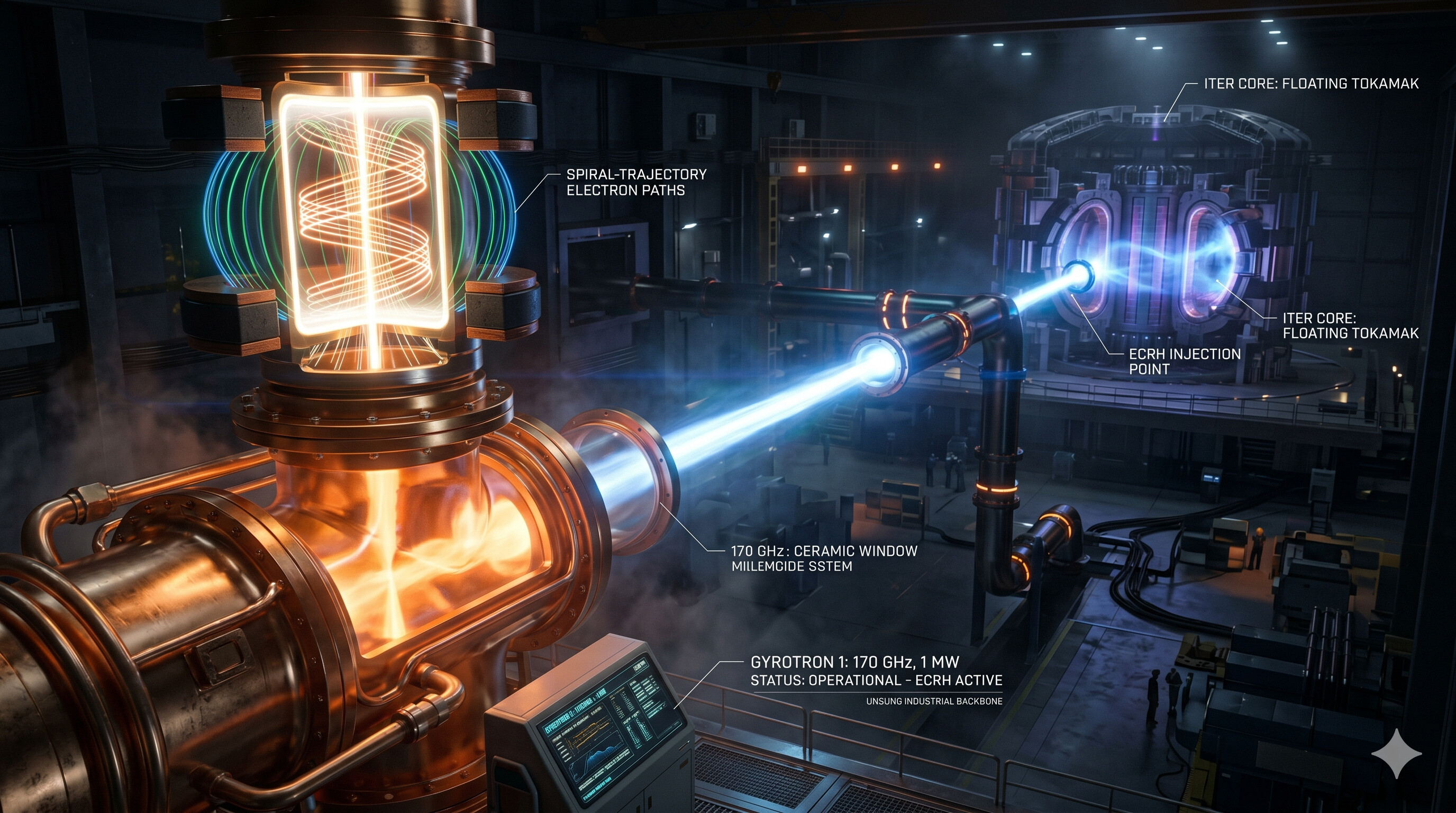
At the heart of every fusion reactor, plasma is heated to over 100 million degrees Celsius — several times hotter than the Sun's core. Confining such superheated plasma within magnetic fields and maintaining its stability requires precise, sustained, high-intensity external heating. This task falls to a little-known but critically important device: the gyrotron.
A gyrotron is a high-power microwave oscillator capable of generating 1 megawatt (MW) class millimeter-wave radiation across a frequency range of 28 to 250 GHz. To put its power scale in perspective: a household microwave oven outputs approximately 1 kilowatt; a gyrotron delivers 1,000 times that. The device exploits the electron cyclotron resonance effect in strong magnetic fields to efficiently convert electrical power into electromagnetic waves. These waves travel through waveguide systems and adjustable mirrors to be precisely injected into the plasma, transferring energy through electron cyclotron resonance heating (ECRH).
How Gyrotrons Work
The gyrotron's core is a resonant cavity placed within a superconducting magnet. An electron gun (Magnetron Injection Gun, MIG) produces a high-energy electron beam that follows a helical trajectory within the magnetic field. When the electron cyclotron frequency matches the cavity's electromagnetic mode, electrons transfer kinetic energy to the electromagnetic wave, producing high-power microwave output.
The critical parameter is precise matching between electron cyclotron frequency and cavity resonant frequency. Since electron cyclotron frequency is proportional to magnetic field strength, varying the magnetic field adjusts the output frequency. State-of-the-art gyrotrons (such as those developed by Japan's QST) have achieved quad-frequency oscillation capability: 104 GHz, 137 GHz, 170 GHz, and 203 GHz, allowing selection of optimal heating frequency for different plasma conditions.
Between 2025 and 2026, gyrotron technology has achieved multiple key breakthroughs. Kyoto Fusioneering (KF) has commercialized gyrotron system supply. As one of the few global entities capable of delivering complete gyrotron systems (including tube, superconducting magnet, matching optics unit, high-voltage power supply, and ancillary equipment), KF's product line covers 28 GHz to 236 GHz, with 1 MW output power, continuous wave (CW) operation, and approximately 50% efficiency. Its partners include Canon Electron Tubes & Devices (gyrotron tube), JASTEC (superconducting magnet), and KYOCERA (ceramic window).
Thales — Europe's largest defense electronics company — maintains parallel leadership. Its TH1509U model (170 GHz, 1 MW, 3,600-second pulses) was developed for ITER and DTT and has completed long-pulse testing. The company's dual-frequency TH1510 (84-126 GHz) operates at Switzerland's EPFL TCV tokamak. In 2024, Thales introduced a patented micro-channel cooling system addressing the 2 kW/cm² heat flux inside gyrotron cavities — comparable to nuclear reactor core heat flux levels.
The Gyrotron's Impact on Fusion Roadmaps
Gyrotron performance parameters directly determine the operational window and timeline of mainstream magnetic confinement fusion devices — tokamaks and stellarators.
ITER — the world's largest tokamak under construction in France — requires 24 gyrotrons operating simultaneously at 170 GHz, 1 MW each, to achieve its initial plasma heating targets. Each gyrotron's microwaves must travel through nearly 100 meters of waveguide before reaching the tokamak's plasma chamber. The delivery schedule for these 24 gyrotrons — primarily from Japan's QST, Europe's Thales, and Russia's Gycom — represents one of the critical paths determining whether ITER achieves its 2035 first-plasma target. Any gyrotron development delay translates directly into ITER schedule slippage.
In the stellarator domain, Germany's Wendelstein 7-X (W7-X) features a 10 MW ECRH system powered by 10 Thales series gyrotrons at 140 GHz, 1 MW each. W7-X's operational success since 2016 depends heavily on this heating system's reliability. Europe is planning to upgrade W7-X heating power from 10 MW to 20 MW, requiring development of next-generation 1.5 MW class gyrotrons.
Private fusion startups — including Commonwealth Fusion Systems (CFS), TAE Technologies, and Helion — also depend on gyrotrons as critical equipment. Though CFS's SPARC device is far smaller than ITER, it similarly requires ECRH for plasma heating and internal instability control. CFS's ARC reactor design (targeting 400 MW power generation) further demands higher-frequency (>200 GHz) and higher-efficiency (>60%) gyrotrons.
Karlsruhe Institute of Technology (KIT) in Germany is pursuing two parallel gyrotron development tracks for future needs. The first is conventional cavity gyrotrons, scaling from 1 MW toward 1.5 MW (partnered with IPP Greifswald). The second is coaxial cavity gyrotrons, targeting 2 MW at 170 GHz for future DEMO fusion power plants. KIT is also investigating operation above 200 GHz to meet DEMO's expected higher frequency requirements, plus multi-staged depressed collector technology to push total efficiency above 60%.
Cost and Supply Chain Bottlenecks
Gyrotron system costs form a non-trivial portion of fusion reactor total expenditure. A complete 1 MW gyrotron system (including tube, superconducting magnet, power supply, and cooling) currently costs an estimated $5 million to $10 million. For ITER's 24-unit requirement, gyrotron equipment alone represents $120 million to $240 million.
The greater challenge, however, lies in supply chain availability. Fewer than five entities worldwide can deliver commercial-grade gyrotron systems: Japan's Canon/Kyoto Fusioneering alliance, Europe's Thales, Russia's Gycom/IAP RAS, and China and Korea's emerging efforts. For an industry anticipating dozens of fusion devices by the 2030s, this supply base is woefully inadequate.
If the fusion industry takes off in the 2030s, following the projections of CFS and other developers, the world may need over 1,000 gyrotron systems deployed by 2040 (each ARC-class reactor may require 4 to 8 gyrotrons). This implies a 100-fold expansion over current production capacity.
POC.HK Observatory Analysis
Gyrotron technology has long occupied a neglected position in fusion narratives. Media and public attention focus on "has Q>1 been achieved?" and "which startup reaches breakeven first," but few ask: what heats the plasma? This attention bias may lead to overly optimistic assessments of fusion timelines.
We believe the gyrotron supply bottleneck — not plasma physics — may become the true constraint on fusion commercialization in the 2030s. ITER's 24 gyrotrons already represent a decade-long procurement plan. If dozens of private fusion devices enter construction simultaneously in the mid-2030s, global gyrotron production capacity will be exhausted overnight.
From an investment perspective, gyrotron supply chain investment opportunities — whether new entrants or existing supplier capacity expansion — may represent the most undervalued segment in the fusion value chain. A fusion reactor's plasma physics design can be replicated from academic literature, but megawatt-class microwave power sources require complex precision manufacturing, long experience accumulation, and dedicated production facilities.
A signal worth tracking: whether any major industrial group (Siemens, Mitsubishi, GE) or fusion startup begins in-house gyrotron development by 2026. Such vertical integration would represent the fusion industry's most direct response to supply chain constraints and a clear signal that fusion commercialization is entering an acceleration phase.
Finally, a frequently overlooked technical intersection: multi-frequency gyrotrons transform plasma heating from a "passive single-frequency system" into a "tunable active tool." By switching frequencies during a pulse, operators can adjust energy deposition location and depth, enabling real-time control of plasma temperature and current profiles. This capability is essential for the long-pulse stable operation required by commercial fusion power plants.
Disclaimer: The information contained in this article is for reference purposes only and does not constitute investment advice or business decision-making basis. Data and time-sensitive information are current as of the publication date and may change with subsequent developments. Neither the author nor POC.HK assumes any responsibility for losses resulting from the use of this information.