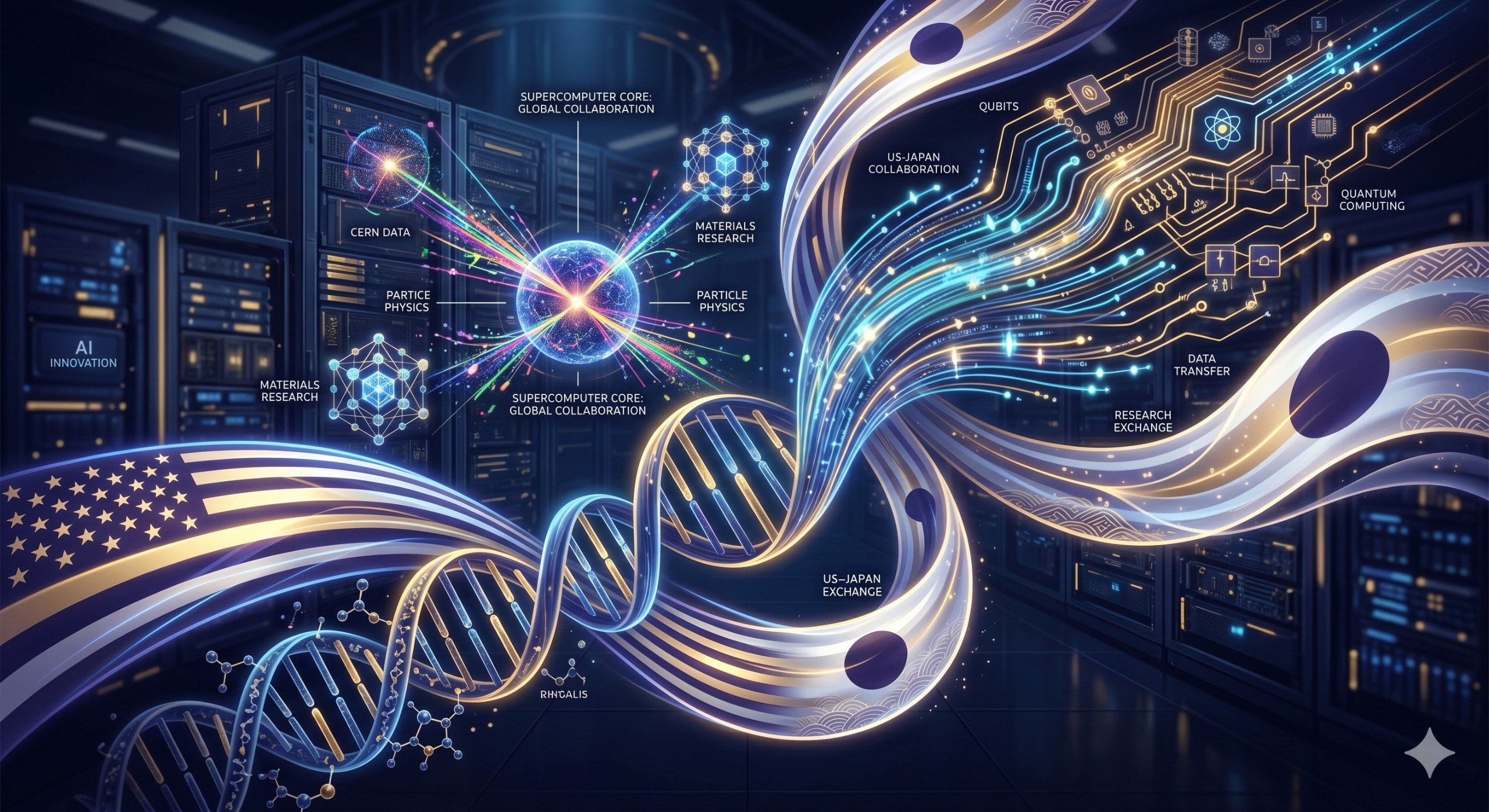
On June 4, 2026, the U.S. Department of Energy and Japan's Ministry of Education, Culture, Sports, Science and Technology (MEXT) and Ministry of Economy, Trade and Industry (METI) announced a historic $1 billion strategic research partnership, making Japan the first international participant in President Trump's Genesis Mission. This five-year framework commits $500 million from each country across 11 joint research teams spanning quantum information science, fusion energy, biotechnology, advanced materials, particle physics, and autonomous laboratory systems.
The Genesis Mission itself was established by Executive Order in November 2025 to accelerate scientific discovery through artificial intelligence and advanced computing. Japan's participation marks the first integration of an allied nation into America's AI-driven scientific discovery framework.
The scale and scope of this partnership far exceed conventional research collaborations. The 11 joint teams involve 12 DOE national laboratories, one DOE Office of Science user facility, and 12 leading Japanese research institutions.
In quantum information science, RIKEN and the University of Tokyo will partner with Argonne National Laboratory and Fermi National Accelerator Laboratory to develop next-generation quantum processor architectures. The focus extends beyond quantum supremacy to practical quantum simulation and quantum metrology.
In fusion energy, AI-accelerated plasma control optimization and HTS material discovery will be key focus areas. Japan's Fugaku supercomputer will support plasma simulations for CFS's SPARC device and TAE Technologies' sixth-generation prototype.
Autonomous laboratory systems represent one of the most transformative elements. RIKEN, the University of Tokyo, the National Institute for Materials Science (NIMS), and DOE national labs will collaborate on laboratories capable of designing, executing, and optimizing experiments with minimal human intervention. An autonomous lab can complete in days what traditional labs require months to accomplish.
Biotechnology collaboration focuses on AI-driven protein design and genomics analysis. Japan's protein structure research infrastructure (including RIKEN's SPring-8 synchrotron facility) combined with US leadership in generative AI could accelerate novel biologic and enzyme catalyst development.
Strategically, this partnership carries significance far beyond its $1 billion price tag.
First, it establishes an international standard for AI-driven scientific discovery. The Genesis Mission elevates AI from a scientific tool to a core methodology — from hypothesis generation through experiment design to result analysis. Japan, as the first partner, will co-develop the standards and best practices for this new paradigm.
Second, it reshapes the US-Japan technology alliance. The partnership moves Japan from technology consumer and supply chain node to co-investor and collaborator in strategic R&D.
Third, it creates subtle competitive dynamics for other major tech powers. As the US and Japan build AI-driven scientific discovery infrastructure, China faces a strategic choice between building parallel infrastructure and seeking integration pathways.
Challenges remain. At roughly $9 million per team per year, funding is sufficient to initiate but not to fully transform discovery velocity. Intellectual property frameworks for AI model training data, materials design ownership, and autonomous system-generated data require ongoing negotiation. Technical infrastructure compatibility between DOE's exascale systems and Fugaku's architecture demands engineering collaboration.
From the Observatory perspective, the Genesis Mission reflects a deeper structural transformation: scientific discovery itself is being industrialized. Traditional science follows an artisanal model — PI proposes hypothesis, graduate student designs experiments, postdoc analyzes data. The AI-driven paradigm systematizes, automates, and scales this process — AI generates hypotheses, robots run experiments, machine learning models analyze results.
This transition means discovery velocity is no longer determined by the number and creativity of human researchers, but by computational infrastructure, training data quality, and AI model performance. It represents a scientific industrial revolution comparable to the microscope, X-ray crystallography, and DNA sequencing.
For Asian tech ecosystems, Japan's participation signals that even without being a primary AI model developer, strategic partnership can provide access to AI-driven discovery infrastructure. This may encourage similar engagement models from other Asian economies.
Disclaimer: This article is for informational purposes only and does not constitute investment advice. Data and time-sensitive information are current as of the publication date and subject to change. Neither the author nor POC.HK assumes responsibility for any losses resulting from the use of this information.