Fusion Startup Landscape Scan
The nuclear fusion sector is experiencing an unprecedented influx of capital. As of 2026, there are over 40 fusion startups worldwide, with cumulative funding exceeding $8 billion. From technical approaches to business models, from funding scales to talent distribution, this field once monopolized by national laboratories is being reshaped by entrepreneurial spirit.
Fusion Startup Landscape Scan
The nuclear fusion sector is experiencing an unprecedented influx of capital. As of 2026, there are over 40 fusion startups worldwide, with cumulative funding exceeding $8 billion. From technical approaches to business models, from funding scales to talent distribution, this field once monopolized by national laboratories is being reshaped by entrepreneurial spirit.
Technology Route Map
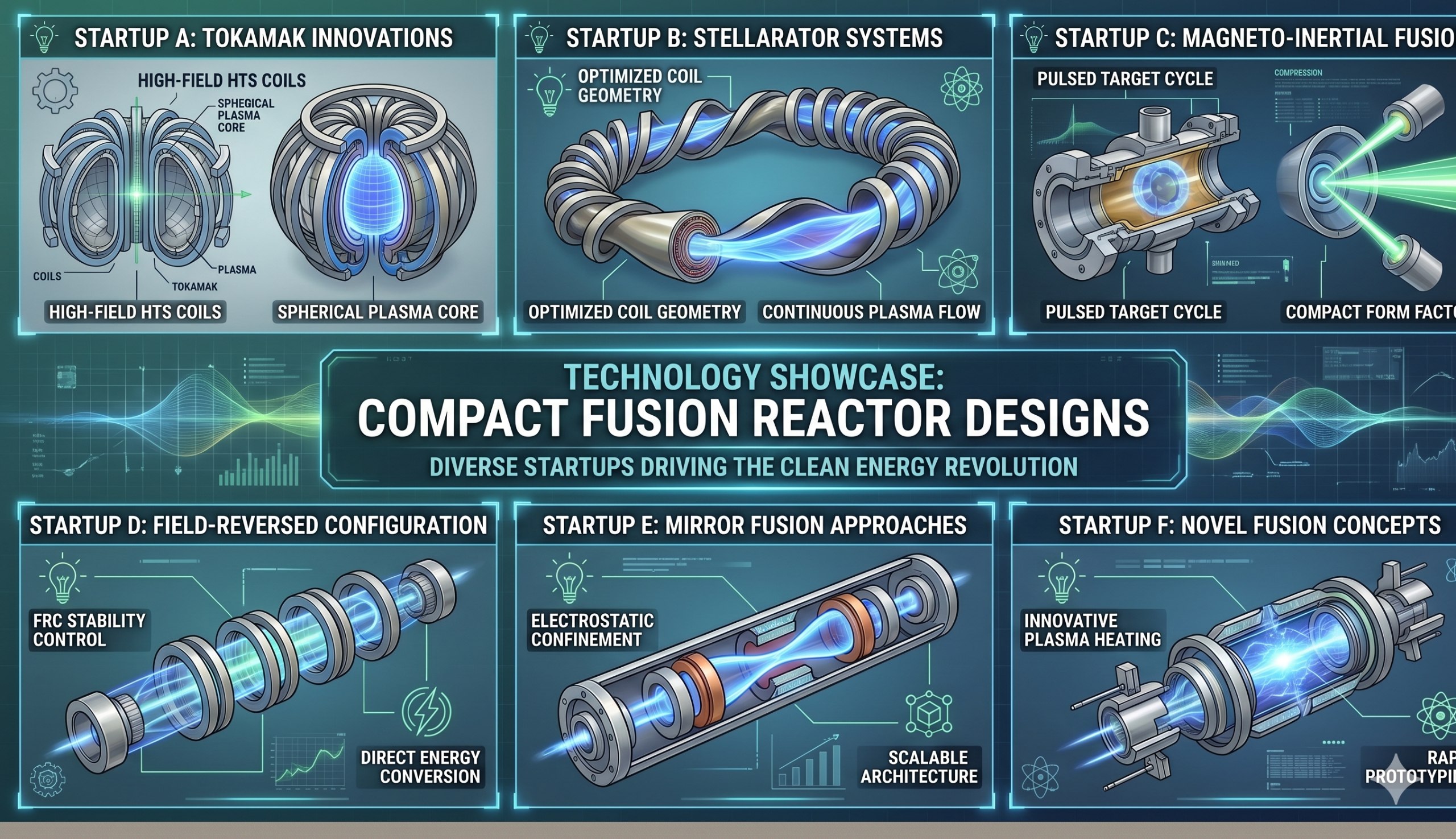
Current fusion startups can be broadly divided into four major technology camps:
Magnetic Confinement Route (approximately 45%): Includes tokamak-derived designs and stellarator approaches. Representative companies: Commonwealth Fusion Systems (CFS, US, ~$2 billion funding) based on MIT's SPARC design, using HTS magnets for compact tokamaks; Type One Energy (US) and Renaissance Fusion (France) developing stellarator approaches.
Inertial Confinement Route (approximately 15%): Uses lasers or plasma jets to compress fuel pellets. Representative companies: First Light Fusion (UK) employing a unique "projectile" approach using high-velocity projectiles striking fuel targets; FocusED Energy (US) pursuing the laser inertial fusion route.
Hybrid Route (approximately 10%): Combines advantages of magnetic and inertial confinement. Representative companies: General Fusion (Canada, ~$300 million funding) using liquid metal liner magnetized target approach; Helion Energy (US, ~$1 billion funding) employing field-reversed configuration (FRC) magneto-inertial fusion.
Non-Conventional Routes (approximately 20%): Includes electrostatic confinement, muon-catalyzed fusion, and other non-mainstream approaches. Representative companies: TAE Technologies (US, ~$1.2 billion funding) pursuing an advanced FRC route; Zap Energy (US) developing the Z-pinch approach.
Funding Landscape Analysis
From a capital distribution perspective, a clear concentration effect at the top is evident:
- First Tier (>$1 billion): CFS (~$2 billion), TAE (~$1.2 billion)
- Second Tier ($300 million - $1 billion): Helion (~$1 billion), General Fusion (~$300 million)
- Third Tier ($100-300 million): Zap Energy, First Light Fusion, Marvel Fusion
- Long Tail (<$100 million): The remaining 30+ companies
Notably, 2021-2025 was a boom period for fusion startup funding, with average annual funding surging from under $500 million before 2020 to over $1.5 billion. However, starting in the second half of 2025, as the macro interest rate environment shifted and investors questioned "when fusion will actually generate power," the funding pace has slowed somewhat.
Geographic Distribution
The United States is the undisputed leader, concentrating approximately 70% of global fusion startup funding. Europe (UK, Germany, France) accounts for about 20%, and Asia (Japan, China) approximately 10%. This distribution is highly correlated with VC ecosystem maturity — fusion, as a capital-intensive deep-tech field, naturally gravitates toward regions with dense venture capital.
China's fusion startup landscape merits particular attention. Although public funding data is limited, industry estimates suggest China has at least 5-8 fusion startups, many with implicit support from local governments and state capital. China's "new nationwide system" applied to the fusion sector may create unique competitive advantages — while the US relies on private capital, Chinese companies can access long-term policy-backed funding.
Commercialization Timeline
The publicly stated timelines of individual companies are as follows:
- Helion Energy: 2025-2026 net power generation demonstration (Polaris device)
- TAE Technologies: 2029 net power generation
- Commonwealth Fusion Systems: Early 2030s grid connection
- General Fusion: 2027 demonstration
- Zap Energy: 2028 Q>1 achievement
These timelines are widely regarded by industry observers as overly optimistic. Historical experience suggests that fusion device commissioning and optimization typically take 2-3 times longer than expected. But even if actual progress lags by 5 years, the overall pace of this industry remains far faster than the government-led ITER project.
Observatory Analysis
From the POC.HK observatory perspective, we distill three key insights:
First, talent flow is accelerating. Over the past five years, the number of plasma physicists moving from national laboratories to startups has increased by more than 300%. This migration of talent from public research institutions to the commercial sector marks a cognitive shift in fusion technology from "research project" to "commercial product."
Second, supply chains are forming. Key components for fusion devices — HTS tapes, high-power RF heating systems, advanced diagnostic equipment — have begun to see specialized suppliers offering standardized products. Five years ago, these components still required each startup to develop in-house.
Third, regulatory frameworks are catching up. The US Nuclear Regulatory Commission (NRC) has initiated development of a regulatory framework for fusion devices, and regulators in the UK and Japan are following suit. This is crucial for the industry's long-term development — without a clear regulatory path, neither insurance companies nor electricity purchasers will commit.
Looking Ahead
Key observation points for the next 18-24 months:
- Helion Polaris device results: If net power generation is achieved, it will fundamentally change industry credibility
- CFS SPARC device commissioning: HTS magnet performance in a real plasma environment
- First Light Fusion "gain threshold" validation: Feasibility of its unique projectile approach
- Potential IPO wave: Leading companies may seek public listings, providing more exit pathways for the industry
- Rise of Chinese fusion startups: Whether any Chinese company will enter the global spotlight
The fusion industry is at a critical juncture, transitioning from "research project" to "industry." Within the next two years, at least one leading company's device will produce a physically meaningful net energy output. Once that threshold is crossed, capital attitudes will shift from "wait and see" to "accelerated investment." The convergence of private capital, advanced materials, and engineering innovation is creating conditions that the fusion field has never seen before in its seven-decade history. The fusion landscape of 2026 is more diverse, better funded, and closer to physical demonstration than at any previous point.