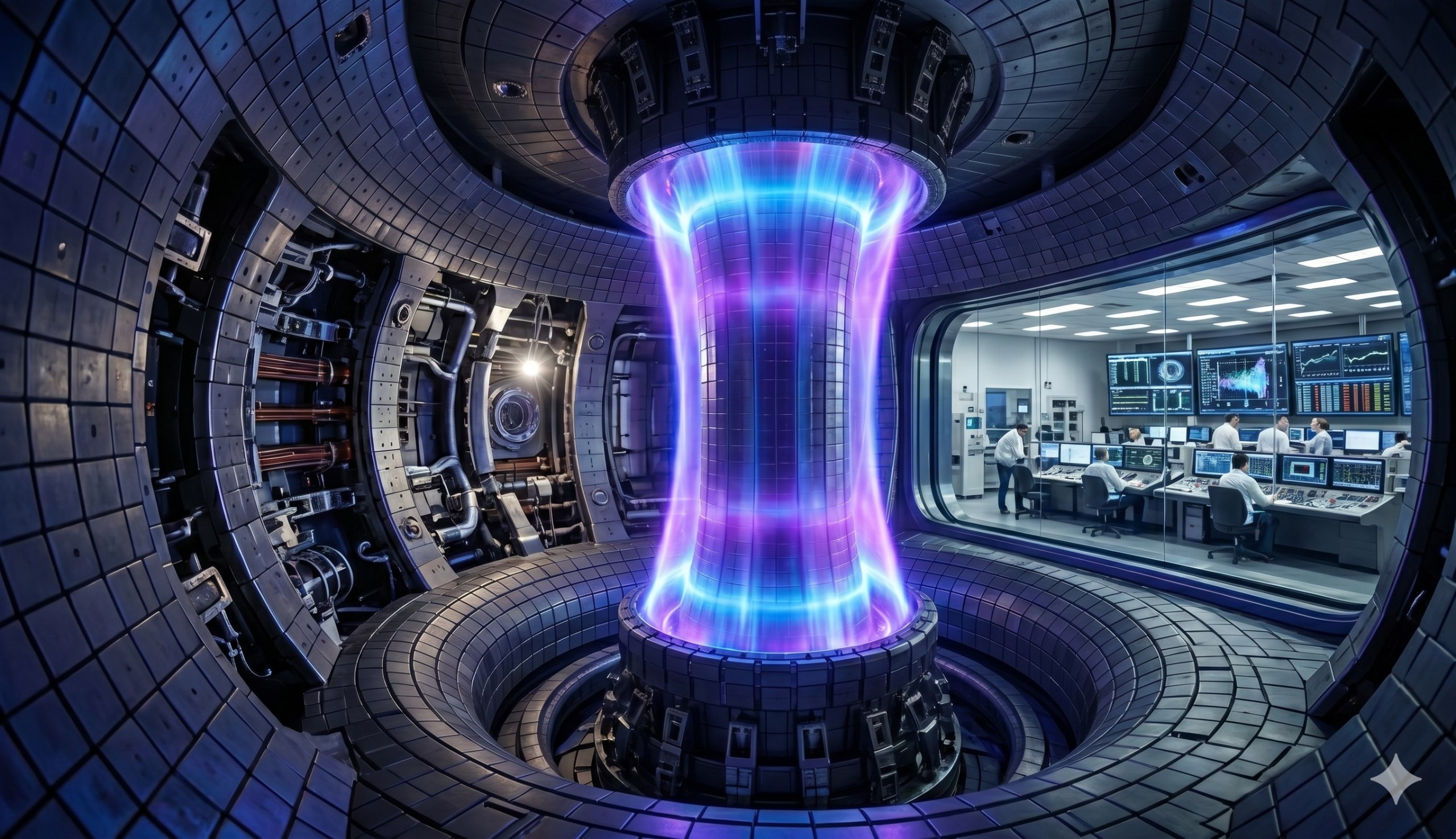
SPARC Fusion Device Milestone
In 2026, the SPARC device jointly developed by MIT and Commonwealth Fusion Systems (CFS) is approaching its most decisive milestone. As the first compact tokamak to fully adopt high-temperature superconducting (HTS) magnet technology, SPARC's success or failure will directly determine whether the golden age of fusion energy commercialization has arrived.
SPARC Fusion Device Milestone
In 2026, the SPARC device jointly developed by MIT and Commonwealth Fusion Systems (CFS) is approaching its most decisive milestone. As the first compact tokamak to fully adopt high-temperature superconducting (HTS) magnet technology, SPARC's success or failure will directly determine whether the golden age of fusion energy commercialization has arrived.
SPARC's Technological Innovation
SPARC's core technological breakthrough lies in high-temperature superconducting magnets. Traditional tokamaks use low-temperature superconducting magnets (such as ITER's Nb₃Sn coils), requiring cooling to 4K (-269°C). SPARC employs yttrium barium copper oxide (YBCO) HTS tape, which operates at approximately 20K (-253°C).
The practical significance of this temperature difference extends far beyond reduced cooling costs:
- Magnetic Field Strength: SPARC's plasma center magnetic field reaches 12.2 tesla, more than double that of ITER. Given that fusion power scales with the fourth power of the magnetic field (P_fusion ∝ B⁴), SPARC can achieve similar fusion power with less than one-twentieth of ITER's volume.
- Device Compactness: SPARC's plasma major radius is only 1.85 meters (compared to ITER's 6.2 meters), with the main structure approximately 1/40 the size of ITER.
- Construction Timeline: Expected to take only 5-7 years from design to completion, whereas ITER has exceeded 30 years and is still unfinished.
Key Milestones Review
SPARC's development journey includes several critical milestones:
September 2021: CFS successfully tested the first full-scale HTS magnet coil, generating over 20 tesla at 20K, setting a historic record. This test validated the core technology's feasibility.
2023: The SPARC project completed final design review, initiating site preparation and procurement of key components. CFS selected the construction site in Devens, Massachusetts, and began building large-scale magnet manufacturing facilities.
2024: Installation began on the vacuum vessel and plasma heating systems. SPARC's ion cyclotron resonance heating (ICRH) system is designed for over 30 MW of power, sufficient to heat plasma to over 150 million °C.
2025: All HTS magnet coils completed manufacturing and passed testing. These are the most critical and expensive components of the entire project.
2026 (planned): Full device assembly completion, beginning vacuum testing and magnetic field mapping. This represents system-level validation before final operation.
Technical Specifications Comparison
| Parameter | SPARC | ITER | Unit |
|---|---|---|---|
| Plasma Major Radius | 1.85 | 6.2 | meters |
| Plasma Minor Radius | 0.57 | 2.0 | meters |
| Magnetic Field Strength | 12.2 | 5.3 | tesla |
| Fusion Power | ~100 | 500 | MW |
| Q value (target) | >2 | >10 | — |
| Main Magnet Technology | YBCO HTS | Nb₃Sn LTS | — |
| Construction Timeline | ~5 years | ~35+ years | — |
Significance for CFS's Commercial Path
SPARC's immediate goal is to achieve Q>2 (fusion power more than double the input heating power), but its true value lies in paving the way for CFS's commercial device, ARC.
ARC is a scaled-up version of SPARC, designed for approximately 400 MW output, and is the first fusion power plant design expected to achieve grid parity. ARC's magnet technology and plasma approach will directly inherit from SPARC's validated results. If SPARC successfully achieves Q>2 in 2026-2027, CFS plans to begin construction of an ARC demonstration plant in 2028, targeting grid connection in the early 2030s.
Observatory Analysis
The significance of the SPARC project extends beyond the technology itself — it demonstrates the viability of the "university + startup" joint R&D model in the fusion field. Traditionally, fusion research was the exclusive domain of national laboratories, requiring multi-billion-dollar budgets and multi-decade timelines that private capital could neither afford nor was willing to participate in. But SPARC, with a total investment of approximately $2 billion, is expected to achieve physical objectives that previously required $20 billion.
From a techno-economic perspective, SPARC's HTS magnet route has a more favorable economy of scale curve than ITER: once magnet manufacturing processes mature, the marginal cost of subsequent devices will decline sharply. This stands in stark contrast to ITER's "bigger is better" design philosophy.
Another observation point is supply chain maturity. The SPARC project has driven global expansion of YBCO HTS tape production capacity. Global YBCO annual output was only about 600 km in 2022, but is expected to have grown to over 3,000 km by 2026. This production base constitutes critical infrastructure for the entire fusion industry.
Looking Ahead
SPARC will face decisive operational results in 2026-2027. Here are the key milestones we need to watch:
- Second half of 2026: First plasma generation. Will verify the integrated performance of vacuum systems, magnet control, and diagnostic equipment
- Early 2027: First heating experiments. Will verify whether the ICRH system can heat plasma to the required temperatures
- Mid-2027: Q>1 breakthrough. If achieved, this will be SPARC's most critical milestone
- End of 2027: Q>2 target achievement. SPARC would become the first tokamak device to achieve net energy gain
If SPARC succeeds, it will be the strongest signal yet for the fusion industry — proving that fusion is not an eternal "30 years away" but a goal achievable within our careers. The dawn of fusion may be closer than we think.
SPARC's significance extends beyond its own technical achievements. It demonstrates that the combination of high-temperature superconductors with compact tokamak design can deliver fusion performance comparable to ITER at a fraction of the cost and timeline. If SPARC achieves Q>2, the fusion industry will have a validated blueprint for commercial power plants — not decades from now, but within this decade. The HTS magnet technology pioneered by SPARC has already begun to transform other areas of applied physics, including particle accelerators and medical imaging systems, creating a ripple effect that extends well beyond fusion energy. As one MIT fusion researcher put it: "SPARC is not just a fusion experiment — it is the proof that private capital and academic physics can move faster than government bureaucracy. That lesson will outlive any single device." The fusion community watches Devens with hope — not only for the plasma it will produce, but for the future it represents.