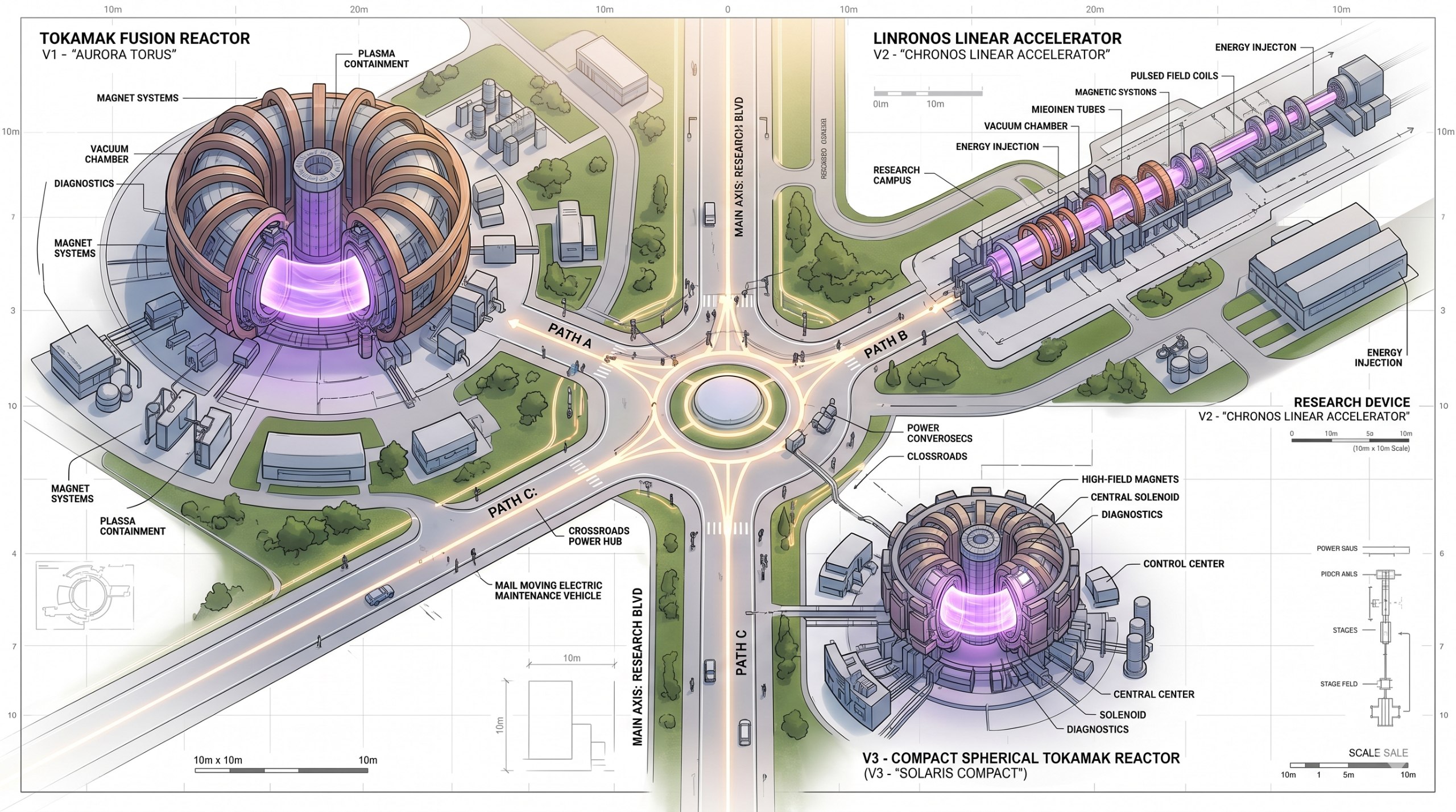
Fusion at a Crossroads: From Device Competition to Ecosystem Rivalry
The global nuclear fusion industry is undergoing a quiet structural transformation. Over the past two years, public attention has been focused on flagship devices such as SPARC, Polaris, and ITER -- but a deeper shift is underway. Fusion is moving from a "device competition" to an "ecosystem rivalry." The success or failure of any single device matters, but the factors determining when this industry truly commercializes extend far beyond that.
Device-Level Divergence Signals
CFS's SPARC device completed installation of all 18 toroidal field magnet coils, representing significant technical progress. HTS magnet production capability at 20 Tesla operating conditions has been validated, meaning that the engineering feasibility of the tokamak approach is being progressively unlocked. However, what deserves Observatory's attention is this: SPARC's success does not equal ARC's (its commercial successor) success. A vast engineering gulf separates a device from a power plant -- thermal management, tritium breeding, continuous operation -- problems that will not surface during SPARC's pulsed operation.
Meanwhile, ITER's management restructuring reveals deeper structural problems in international collaborative projects. Interest coordination among seven member parties, supply chain fragmentation, and governance efficiency are fundamentally at odds with the agile development models of private companies. Observatory believes that the ITER experience is reshaping our understanding of large-scale scientific projects: when the technology itself pushes boundaries, management complexity can become a bottleneck rather than a catalyst.
Lessons from Japan's Strategy
Japan's $33 billion (5000 billion yen) national fusion strategy deserves deep analysis. Unlike the purely private-driven US model and the government-led European approach, Japan has chosen a hybrid path -- continuing to support the JT-60SA tokamak while establishing dedicated funding for private fusion startups. This dual-track "national facility + private incubation" model may prove to be the optimal balance of risk and progress.
The critical point: Japan's strategy explicitly targets the 2040s -- far more cautious than the timelines claimed by Helion and CFS. This difference in time horizons is not about varying degrees of technological optimism but reflects fundamentally different understandings of fusion industrialization. Fusion is not just a science problem -- it is a question of supply chains, standardization, and regulatory architecture, none of which can be resolved in five years.
Talent Market Signals
Fusion engineer salaries rising 25% in 18 months, job vacancies up 40% -- these data points tell us two things: first, private capital injection is creating real demand; second, fusion is transitioning from a "physics problem" to an "engineering problem." When salary growth concentrates among HTS magnet engineers and plasma control software developers rather than theoretical physicists, it means the industry has passed the proof-of-concept stage and entered the engineering realization phase.
Regulatory Pathway Divergence
The US, UK, and China are moving toward different regulatory models: the US is decoupling fusion from fission in regulation, the UK is establishing a regulatory sandbox, and China has published a guidance framework. Observatory believes the US decoupling approach has the most far-reaching implications -- it fundamentally changes fusion's regulatory classification, providing private companies with a predictable approval pathway. The UK's sandbox model, while flexible, is difficult to scale. China's guidance framework reflects its characteristic cautious piloting approach.
This article is an original analysis by POC.HK Future Technology Observatory, provided for informational purposes only and does not constitute investment advice. Fusion technology remains in development, and actual developments may differ from the projections herein.
This Week's Global Fusion Industry Developments
The global fusion industry is undergoing a quiet structural transformation -- from government-led large international collaborative projects (such as ITER) toward private capital-driven multi-route exploration. Several key developments this week.
Commonwealth Fusion Systems' SPARC device -- completed all testing of the toroidal field magnet system this week -- 18 TF magnets achieved 20 T field strength at 20 K -- paving the way for first plasma operations in 2027. SPARC targets Q>2 (fusion power output exceeding heating input power by a factor of 2) -- validating the HTS magnet approach in a compact tokamak. If successful, SPARC would become the first private fusion device to achieve net energy gain -- a decisive validation for the entire private fusion industry.
Major Player Comparison
| Company | Technical Route | Latest Progress | Expected Net Gain |
|---|---|---|---|
| CFS (US) | HTS Tokamak | SPARC magnet testing complete | 2028 |
| Helion (US) | Field-Reversed Configuration | Polaris reaches 180M degrees C | 2027 |
| TAE (US) | Field-Reversed Configuration | Copernicus under construction | 2029 |
| General Fusion (Canada) | Magnetized Target | UK demonstration facility | 2028 |
| Zap Energy (US) | Z-Pinch | FuZE-Q receives more funding | 2030 |
| ENN (China) | Spherical Tokamak | New device under construction | -- |
Capital Markets
Private fusion investment momentum continued strong in 2026 -- cumulative global private fusion company funding exceeded $8 billion by June. Key funding this week includes: Zap Energy's $150 million Series D (for FuZE-Q device upgrades) and ENN's $100 million (for spherical tokamak construction).
Technical Challenges
The core technical challenges of fusion commercialization can be grouped into three levels. First -- plasma confinement: how to heat plasma to hundreds of millions of degrees and confine it long enough to sustain a fusion reaction. Different technical routes (tokamak, FRC, Z-pinch) use different confinement methods -- each with tradeoffs -- and none has yet demonstrated clear commercial feasibility at engineering scale. Second -- materials: fusion reaction-produced high-energy neutrons (unavoidable in the tokamak route) activate reactor structural materials and cause fatigue and embrittlement -- requiring development of neutron-radiation-resistant materials, a long and expensive engineering challenge. Third -- fuel cycle: tritium is the primary fuel for D-T fusion -- but tritium is virtually nonexistent in nature and must be produced inside the reactor through lithium blanket interaction with fusion neutrons -- tritium breeding and extraction technology has not been validated under fusion-relevant conditions.
Private fusion companies making progress in 2026 are predominantly pursuing non-neutron routes (Helion's D-He3 cycle and TAE's p-B11 cycle) -- these routes do not produce neutrons, avoiding most material and activation problems -- but require higher plasma temperatures and have lower fusion cross-sections, imposing stricter plasma confinement requirements. Successful non-neutron routes would dramatically simplify fusion reactor design, reduce costs, and accelerate commercialization.
Academic Research Developments
Important progress was also made in fusion basic science this week. MIT's Plasma Science and Fusion Center published a paper on enhanced D-T fusion cross-section -- by injecting specific frequency microwaves into the plasma -- selectively heating the high-energy ion population without raising overall plasma temperature -- increasing fusion reaction probability by approximately 50%. If experimentally validated, this technique could boost fusion power density by roughly 50% without changing reactor size -- with potentially significant implications for fusion economics.
China's fusion research maintained rapid progress in 2026. The Institute of Plasma Physics, Chinese Academy of Sciences' EAST tokamak achieved a new operational record in 2026 -- maintaining plasma at 120 million degrees Celsius for over 1,000 seconds -- approximately 300 seconds longer than the previous record. EAST provides critical operational data for the design of China's next-generation fusion device (CFETR) -- planned for construction in the 2030s, targeting Q>5, making it one of the world's largest fusion devices. China's fusion research progress benefits from sustained government funding and a stable research roadmap -- in contrast to the policy fluctuations affecting fusion research in Western nations.
Outlook
The fusion industry maintained strong momentum from both private capital and government funding in H1 2026 -- SPARC's magnet testing completion, Helion's temperature milestone, and TAE's funding -- all point in the same direction: fusion is transitioning from "always 30 years away" to "beginning to have clear timelines." But the industry still faces systemic challenges in plasma physics, engineering materials, and fuel cycle -- and these challenges should not be underestimated in difficulty or duration before the first fusion power plant connects to the grid.