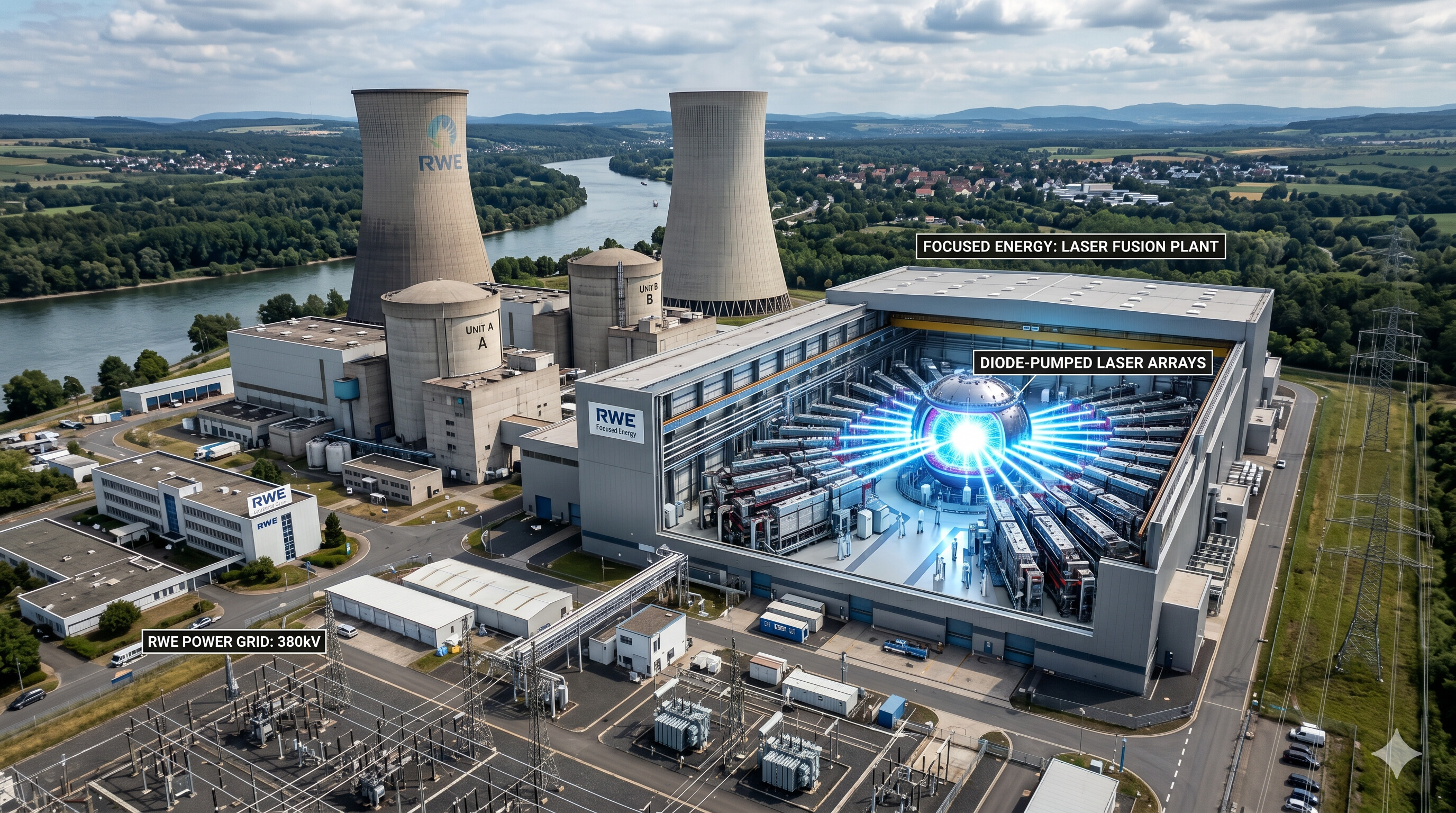
Focused Energy, the German laser fusion company, has secured $240 million in what the company describes as the largest fully secured Series A financing in the global fusion industry. The round, announced on May 27, 2026, makes Focused Energy the most valuable fusion company in Europe and accelerates its plan to build the world's first commercial laser fusion power plant at the Biblis site in Hesse, Germany.
The financing brings together a diverse coalition of investors including RWE, the German Federal Agency for Breakthrough Innovation SPRIND, the European Innovation Council Fund, the Hessian Investment Management Company, Futury Capital, and the previous lead investor Prime Movers Lab. The oversubscribed round attracted not only financially strong institutions from Germany, Europe, Asia, and the Gulf region, but also capital providers willing to fund the entire construction phase through to a fusion power plant.
The Laser Fusion Advantage
Unlike the more widely publicised magnetic confinement approaches pursued by companies like Commonwealth Fusion Systems and Helion Energy, laser fusion — technically termed inertial confinement fusion — compresses and heats a small fuel pellet using high-powered lasers until the hydrogen isotopes fuse and release energy. This is the only fusion approach for which a scientifically verified net energy gain has been demonstrated to date, achieved by the National Ignition Facility at Lawrence Livermore National Laboratory in December 2022.
Focused Energy's approach builds on this demonstration but shifts the architecture from a single-shot research experiment to a commercially viable, repetitively pulsed power plant. The company employs diode-pumped solid-state laser technology, which offers higher electrical efficiency than the flashlamp-pumped lasers used at NIF. Each laser shot compresses a deuterium-tritium fuel pellet, triggering a micro-implosion that releases a burst of fusion energy. The plant operates at a repetition rate of up to 10 Hz — ten fusion pulses per second — each contributing to a steady thermal output that drives conventional steam turbines.
The Biblis Site and German Industrial Strategy
Focused Energy chose the Biblis site in Hesse for its first power plant, a strategic decision that leverages Germany's existing nuclear infrastructure. The site previously hosted a commercial nuclear fission reactor operated by RWE, which is currently being decommissioned. The existing grid connections, cooling infrastructure, and regulatory familiarity with nuclear operations on the same site provide substantial cost and timeline advantages.
Dr. Markus Krebber, CEO of RWE AG, framed the investment as part of a broader German industrial strategy: “Thanks to its excellent research ecosystem and innovative start-ups such as Focused Energy — one of the leading companies in the field of laser fusion — Germany is well-positioned to take a leading global role in nuclear fusion.”
The partnership is significant for another reason: RWE contributes not only capital but regulatory expertise and site access, solving two of the hardest challenges for any fusion startup — finding suitable real estate with appropriate infrastructure and navigating the complex licensing landscape.
From Research to Commercial Reality
Focused Energy's technology roadmap is structured in three phases. The first phase, now substantially underway, involves validating the laser driver system at full scale and demonstrating repeatable, high-gain target implosions. The second phase will construct an integrated engineering prototype that couples the laser system with a target injection and tracking system, proving the end-to-end plant architecture. The third phase is the full-scale commercial plant at Biblis.
The company has also announced a spin-off called SourceLight, announced on June 10, 2026, which will commercialise Focused Energy's Laser Diode Remote Sensing (LDRS) technology for industrial applications. SourceLight targets markets including nuclear waste characterisation, security screening, and industrial quality assurance — a pragmatic near-term revenue stream that supports the longer fusion development timeline while building the company's laser manufacturing capabilities.
Observatory Analysis
The Focused Energy milestone deserves attention less for the absolute funding figure and more for what it represents structurally. The $240 million Series A marks the first time a European fusion company has achieved a valuation comparable to its US counterparts, signalling that the fusion race is no longer an American-dominated contest. Europe possesses deep scientific expertise in laser physics — the Max Planck Institutes and the French Alternative Energies and Atomic Energy Commission (CEA) have decades of accumulated knowledge — but has historically lagged in translating that research into commercial ventures. Focused Energy's financing suggests this gap is closing.
Equally significant is RWE's participation. A major European utility investing directly in fusion development, rather than waiting to purchase power from fusion plants later, represents a fundamental shift in how the energy industry views fusion's commercial timeline. Utilities place bets based on realistic deployment horizons, not speculative hype. RWE's commitment to fund through to a power plant implies an internal assessment that laser fusion is investable on a timeline relevant to utility planning cycles — approximately a decade.
The laser fusion path itself presents a distinct set of trade-offs compared to magnetic confinement. The pulsed nature of inertial fusion means that a single laser system can theoretically serve multiple reaction chambers through optical switching, creating a scaling dynamic more analogous to semiconductor fabs than conventional power plants. However, the engineering challenges of target manufacturing — producing millions of perfectly uniform fuel pellets per year — and the demands on laser damage thresholds at industrial repetition rates remain unproven at scale.
Fusion Funding Landscape and Competitive Positioning
Focused Energy's $240 million Series A brings the total disclosed capital tracked across 24 private fusion companies to $11.4 billion, according to the Fusion Report's latest refresh of June 5, 2026. For context, Commonwealth Fusion Systems has raised over $2 billion cumulatively, Helion Energy approximately $1.2 billion, and TAE Technologies approximately $1.2 billion. Focused Energy's Series A is the largest fully secured round in the sector, but the company will require significantly more capital to bridge from development to a commercial power plant.
The RWE partnership introduces a novel capital efficiency model for fusion development. Most fusion startups must independently bear the high upfront costs of site acquisition, grid connection, and regulatory permitting. Focused Energy, by leveraging RWE's existing nuclear infrastructure at Biblis, substantially reduces non-technical capital expenditure. If this utility-startup collaboration model succeeds, it could become a template for European fusion commercialisation.
The SourceLight spin-off strategy also merits attention. By separating short-term industrial laser applications from long-term fusion development, Focused Energy creates a visible near-term revenue stream for investors while simultaneously building its laser manufacturing capabilities — a dual-track approach increasingly common in deep-tech startups navigating long development timelines.
Disclaimer: The information contained in this article is for reference purposes only and does not constitute investment advice or any form of commercial decision-making basis. Data and time-sensitive information are accurate as of the date of publication and may change with subsequent developments. The author and POC.HK assume no responsibility for any losses arising from the use of the information herein.