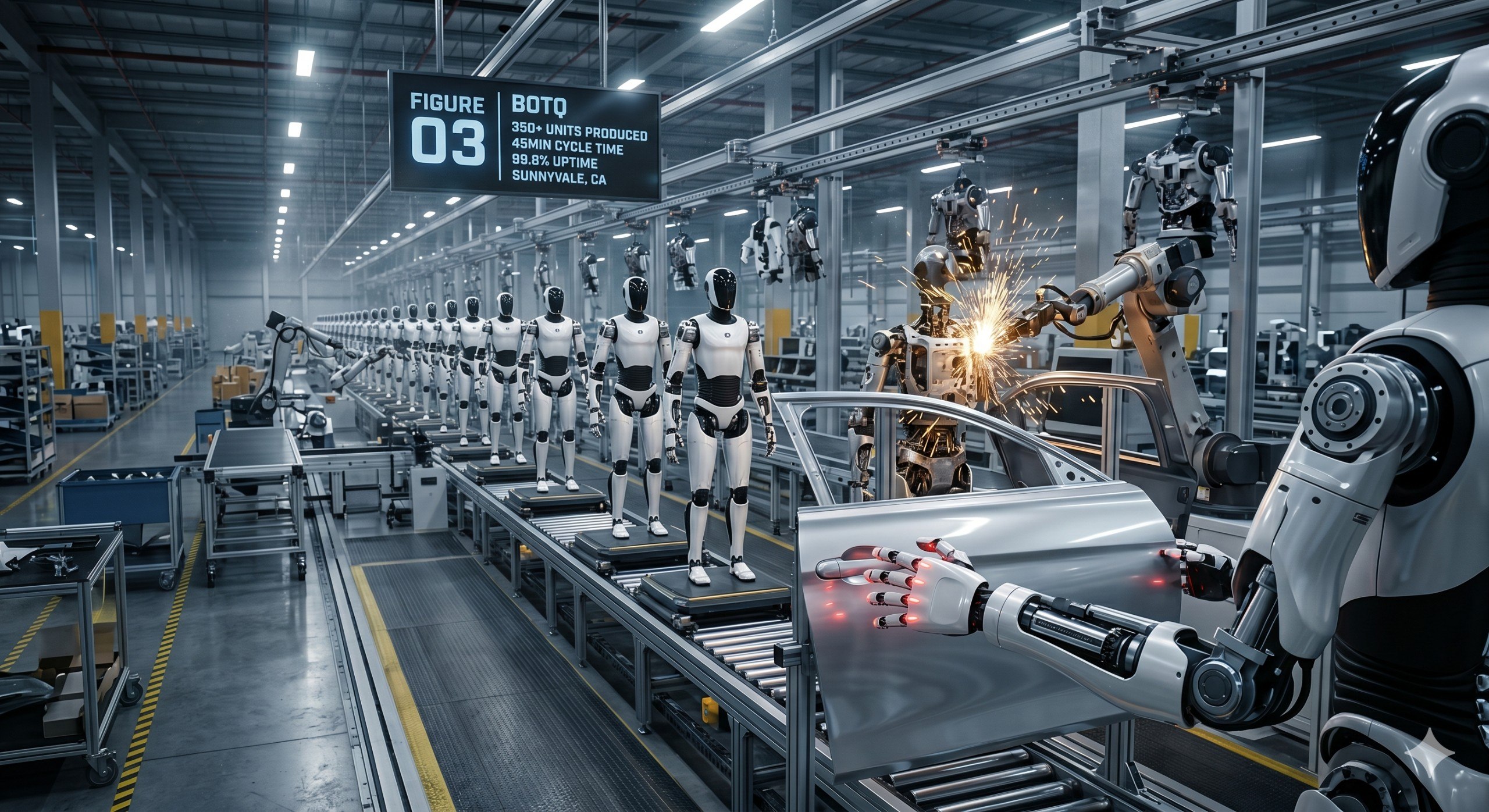
In June 2026, the humanoid robotics industry reached a critical production inflection point. Figure AI's BotQ mass production facility in Sunnyvale, California has achieved a production rate of one Figure 03 humanoid robot per hour, with cumulative output exceeding 350 units. At the BMW Spartanburg factory pilot, these robots completed over 90,000 sheet metal part handling operations and contributed to the production of more than 30,000 BMW X3 sport utility vehicles. These numbers represent not merely a single company's progress, but a structural leap for humanoid robots from laboratory prototypes to scaled manufacturing.
From Prototype to Mass Production: The BotQ Manufacturing Revolution
The Figure 03, the company's third-generation product, represents a qualitative leap over its predecessor the Figure 02 across multiple critical dimensions. The Figure 02, unveiled in August 2024, remained in a "semi-prototype" phase with limited testing at the BMW factory. The Figure 03, by contrast, is entirely designed for mass production.
The BotQ factory draws inspiration from Tesla's philosophy of "the machine that builds the machine." The facility deploys multiple automated assembly lines capable of completing full robot assembly in 45-60 minutes. Industry sources indicate BotQ's design capacity target is 50 units per day by end of 2026, expanding to 100 units per hour by 2027 — equivalent to approximately one million units annually.
If achieved, this production capacity would fundamentally alter the economic model of the labor market. At an estimated early pricing of $50,000-80,000 per Figure 03, the equivalent hourly labor cost of approximately $10 falls far below the average manufacturing wage in developed economies.
Key Production Metrics
| Metric | Data | Timeline |
|---|---|---|
| Unit production time | 45-60 minutes | June 2026 |
| Weekly output | 55+ units | June 2026 |
| Cumulative production | 350+ units | June 2026 |
| BMW sheet metal parts handled | 90,000+ | June 2026 |
| BMW X3 vehicles contributed to | 30,000+ | June 2026 |
| Positioning accuracy | 5mm | BMW line verified |
| Target daily capacity | 50 units/day | End of 2026 |
| Long-term capacity target | 100 units/hour | 2027 |
Figure 03's Technological Advances
The Figure 03's hardware design underwent substantial restructuring to prioritize reliability in manufacturing environments. Key improvements over its predecessor include:
Actuator and Joint Design: The Figure 03 adopts an entirely new linear actuator design, replacing the rotary actuator combination used in the Figure 02. These new actuators integrate motor, gearbox, and encoder into a single module, reducing the joint count from 38 to 28 while maintaining 42 total degrees of freedom. This modular design reduces assembly complexity and improves serviceability — a faulty actuator can be replaced in 15 minutes without disassembling the entire arm.
Battery and Endurance: A built-in 2.25 kWh battery pack supports eight continuous hours of industrial-grade operation. A hot-swap battery design enables 3-minute battery changes for 24/7 uninterrupted operation. By comparison, the Tesla Optimus Gen 2 carries approximately 2 kWh with 6-7 hours of operation.
Computing and Perception: The Figure 03 is equipped with dual NVIDIA Orin SoCs delivering 550 TOPS of AI compute power. The head houses six stereo vision cameras, while four wide-angle cameras on the torso provide 360-degree perception coverage. A vision-language model developed in partnership with OpenAI enables the Figure 03 to understand natural language commands, recognize environmental changes, and adjust actions in real time.
Hand Dexterity: The latest-generation hand features 12 independently controlled finger joints, each fingertip embedding three tactile sensors capable of sensing 0.1 Newtons of contact force — enough to safely pick up an egg while simultaneously handling 25 kg automotive parts.
The BMW Production Validation: Real-World Stress Testing
The Figure 03 deployment at BMW's Spartanburg factory represents the largest commercial validation of humanoid robots in automotive manufacturing to date. Since the Figure 02 first entered the factory for pilot testing in January 2025, and after 18 months of iteration, the Figure 03 has demonstrated sustained industrial-grade capability across three key production stages:
Sheet Metal Handling: The initial task assigned to the robots. Automotive door panels, hoods, and roof panels range from 5 kg to 25 kg with complex geometries requiring precise grip angles and movement trajectories. The Figure 03 achieves pick-and-place operations within 5mm accuracy through its vision positioning system, outperforming the typical 10-15mm error range of manual operation.
Parts Sorting and Assembly Preparation: Robots deployed in logistics zones transfer different specification parts from shelves to designated positions along the assembly line. This task requires identifying part types, matching production orders, and sequencing by timing — monotonous and error-prone for human workers but ideal for the Figure 03's AI vision system.
Visual Quality Inspection: Using its six stereo vision cameras and high-resolution imaging capabilities, the Figure 03 performs real-time detection of surface defects and assembly tolerances during the assembly process, feeding inspection results directly into the quality control system.
BMW operational data shows that introducing humanoid robots improved production efficiency at relevant workstations by approximately 15% and reduced defect rates by approximately 8%. More importantly, worker satisfaction improved — as repetitive, physically demanding tasks were delegated to robots, human workers transitioned to higher-value skilled roles such as programming, quality engineering, and process optimization.
Competitive Landscape: The Three-Way Production Race
Figure AI's production breakthrough arrives as the global humanoid robot manufacturing race enters an intense phase. Here is how the major competitors compare on production progress:
| Company | Cumulative Output | Production Rate | Commercial Deployment | Pricing |
|---|---|---|---|---|
| Figure AI | 350+ | 1 unit/hour | BMW (30,000+ vehicles) | $50-80K |
| Tesla Optimus Gen 3 | Few prototypes | Low-volume target (Summer 2026) | Own factory planned | $20-30K |
| Unitree G1 | 5,500+ (2025 full year) | EOL production | Education/light industrial | $16,000 |
| Boston Dynamics Atlas | First deliveries | Limited production | Hyundai RMAC, DeepMind | Undisclosed |
| Agility Digit | 7+ active deployments | RaaS model | Toyota Canada | RaaS lease |
| Neura Robotics | Prototype stage | 2027 target | — | Undisclosed |
Observatory Analysis: Structural Signals of Humanoid Robot Scaling
Figure AI's achievement of one robot per hour is not an isolated technical milestone, but a landmark signal that the humanoid robotics industry has transitioned from "Can it work?" to "How much does it cost?"
From Point Validation to Ecosystem Deployment: The BMW Spartanburg case demonstrates that the value of humanoid robots lies not in replacing individual human workers — one Figure 03 costs approximately 1.5-2 times the annual salary of a US manufacturing worker. The real economic value comes from: (1) 24/7 operation eliminating three-shift labor bottlenecks; (2) zero-defect precision reducing quality losses; and (3) flexibility enabling seamless switching between production lines — something fixed automation cannot match.
The Double-Edged Sword of Pricing Pressure: Tesla's target price of $20,000-30,000 will have profound implications for the industry's pricing strategy. If Optimus Gen 3 truly achieves this price point, competitors will be forced to cut prices rapidly. But seen differently, lower prices will accelerate market adoption — when an industrial humanoid robot costs less than an entry-level car, the procurement threshold for manufacturers is fundamentally broken.
The True Scaling Bottleneck is Deployment, Not Production: There is a vast gap between producing a thousand robots and effectively deploying a thousand robots. Every factory's layout, processes, safety standards, and material flows are different. Humanoid robot companies need to develop not faster production lines, but more efficient deployment pipelines — including automated workflows for on-site training, task configuration, and safety certification.
Disclaimer: The information in this article is for reference purposes only and does not constitute investment advice or commercial decision-making basis. Data and time-sensitive information are current as of the publication date and may change with subsequent developments. Neither the author nor POC.HK assumes any liability for losses arising from the use of this information.