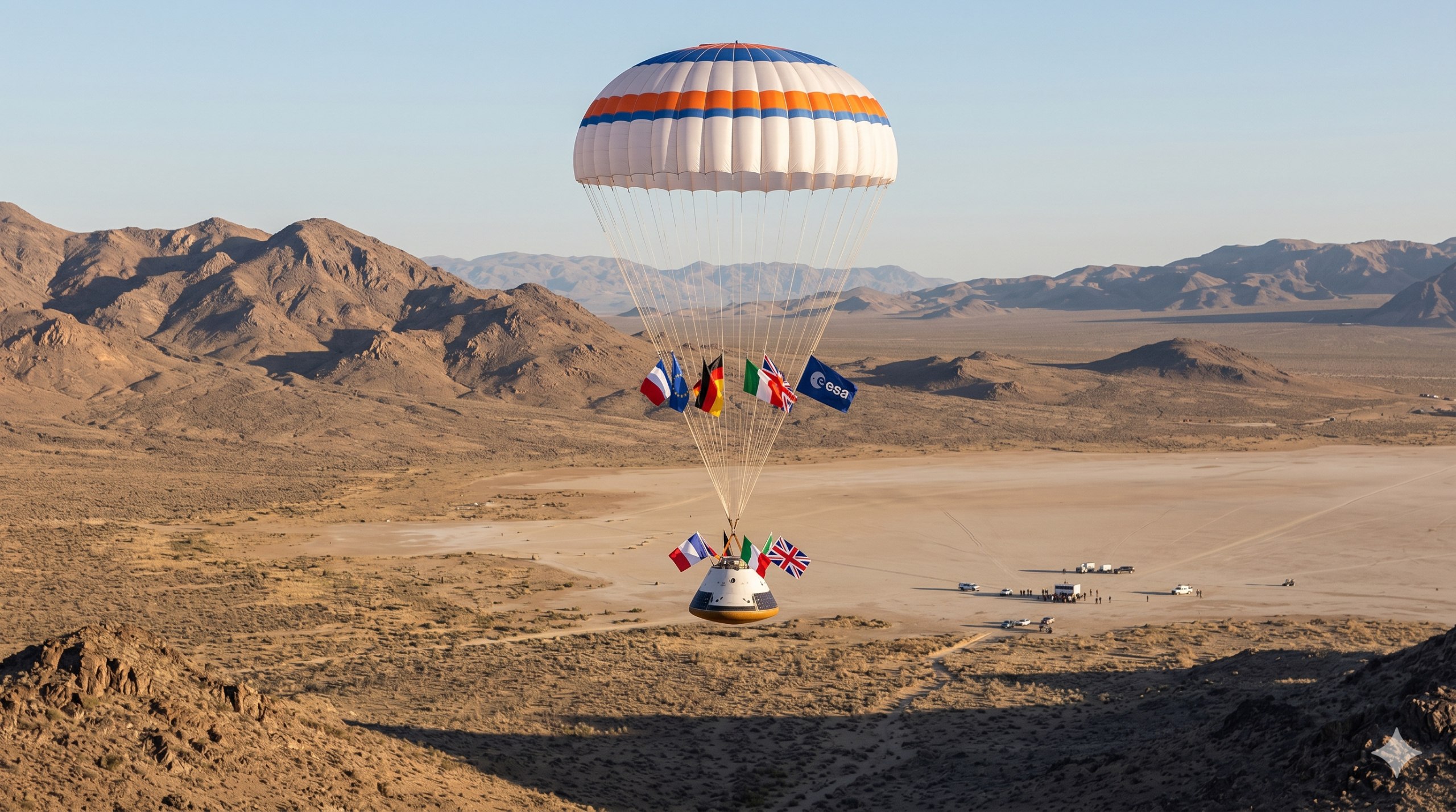
European Nyx Capsule Completes Drop Test: Europe's Commercial Cargo Path
On June 5, 2026, European space company The Exploration Company (TEC) announced the completion of a drop test of the parachute system for its reusable Nyx capsule. Conducted over California's Mojave Desert, this test may appear to be a routine engineering verification, but it marks a critical step forward in Europe's space cargo capability — a field long dominated by SpaceX and Northrop Grumman, now facing a new competitor.
I. Who is The Exploration Company?
TEC is a pan-European space company headquartered in Munich, Germany, with offices in Bordeaux and Oberpfaffenhofen, France, founded in July 2021 by former Airbus and ArianeGroup engineer Hélène Huby (CEO). Core team members (Artur Koop, Sebastien Reichstadt, Pierre Vinet, Jon Reijneveld) previously worked together on flagship European space programs including the Automated Transfer Vehicle (ATV) and the Orion-ESM European Service Module.
The company currently has offices in Italy, France, Houston (USA), and the Middle East and North Africa region, with over 300 full-time employees. TEC's positioning is clear: building a "complete space transportation platform" — from reusable capsules to high-thrust rocket engines, covering the full spectrum of transportation needs from Low Earth Orbit (LEO) to lunar orbit.
Its flagship product, Nyx (named after the Greek goddess of night), is designed as a modular, reusable spacecraft with on-orbit refueling capability. Nyx's initial mission is to deliver cargo to LEO space stations, with the ability to safely return cargo to Earth. The company also announced plans for a crewed version in June 2025, though it explicitly stated this is a long-term project.
II. What Did the Drop Test Validate?
On May 19, 2026, a helicopter lifted Nyx's Drop Test Vehicle (DTV) to an altitude of 2,800 meters above California's Mojave Desert and released it. The capsule mock-up first deployed two drogue parachutes to stabilize its attitude, then released four main parachutes, ultimately landing softly on the desert floor.
In a statement on June 4, TEC said: "Preliminary analysis confirms that all necessary conditions and event timelines were achieved, including nominal separation and handover from drogue to main parachutes. The vehicle's dynamic behavior during initial release and handover was consistent with expectations for this DTV configuration."
It is worth noting that Nyx's final design calls for a splashdown at sea rather than a land landing, but this test was conducted on land to simplify logistics. This means the mechanical validation of the parachute system was the core objective, while the landing medium (water vs. land) can be specifically validated in subsequent phases.
This test is part of a broader certification campaign for Nyx's parachute system. Prior to this, TEC conducted water impact tests in January 2026 at a test facility in Italy, using scale models to validate mathematical models for splashdown conditions.
These tests fill critical gaps left by the Mission Possible mission. About a year ago, TEC launched a test capsule to orbit on a SpaceX rideshare mission. The capsule successfully survived the heat of re-entry but lost contact after splashdown, and the capsule was ultimately not recovered. TEC has not publicly disclosed what went wrong with Mission Possible — a company official said at a conference in October 2025 that the investigation was ongoing; a company spokesperson clarified that the recent drop test was unrelated to the Mission Possible anomaly.
III. ESA's Commercial Cargo Program: Europe's COTS
The strategic significance of Nyx must be understood within the broader context of the European Space Agency (ESA) roadmap.
In 2024, ESA launched a European cargo spacecraft development program modeled after NASA's Commercial Orbital Transportation Services (COTS), selecting TEC and Thales Alenia Space for Phase 1. The program's goal is straightforward: to establish cargo transportation capability independent of the United States and Russia, ensuring that supply to European space stations — whether the ISS or future commercial stations — is insulated from external political factors.
This decision was driven by Europe's structural weakness in crewed/cargo spaceflight. Europe once had the Automated Transfer Vehicle (ATV), a cargo spacecraft built by Airbus and launched on Ariane 5 rockets, which successfully completed five ISS resupply missions between 2008 and 2015. However, ATV was terminated after its fifth mission, and Europe lost its independent cargo capability. Since then, Europe has relied on Russia's Soyuz and America's Dragon/Cygnus for crew and cargo transportation — a dependency that became unreliable after the 2022 Russia-Ukraine war.
ESA's Commercial Cargo Program is designed to fill this gap. Similar to NASA's COTS model, ESA does not directly fund spacecraft manufacturing but purchases transportation services from commercial companies through service contracts — leaving risk and innovation impetus to the private sector.
IV. Nyx vs. Existing Cargo Spacecraft
To understand Nyx's market potential, the best approach is to position it on the competitive landscape map.
SpaceX Dragon 2 (crewed/cargo dual-use, operational since 2019): Dragon is currently the most mature commercial cargo solution, capable of carrying 6,000 kg of pressurized cargo or 3,307 kg of unpressurized cargo, with autonomous docking and sea splashdown recovery. Its core competitive moat lies in deep integration with SpaceX's launch ecosystem — using Falcon 9 rockets, operating from its own launch pads and mission control centers. Dragon's cost advantage is significant, but for European customers, it carries geopolitical risk.
Northrop Grumman Cygnus (expendable, operational since 2013): Cygnus features a large pressurized cargo volume (27+ cubic meters, larger in Enhanced and XL variants), and its pressurized module is built by Thales Alenia Space (Italy) — making it the existing cargo spacecraft with the highest European content. However, Cygnus is expendable and cannot return cargo, limiting applications such as laboratory sample recovery.
Sierra Space Dream Chaser (reusable lifting body, in development): Dream Chaser features a unique runway horizontal landing design with low re-entry G-loads (1.5G), making it very friendly to returned cargo. However, the program has faced multiple delays and, as of mid-2026, has yet to perform its first ISS mission.
Nyx's differentiated positioning: TEC's Nyx positions itself between Dragon and Dream Chaser. Like Dragon, it is reusable (cost-reducing) with cargo return capability; like Dream Chaser, it is gentle on returned cargo loads (but uses a more mature parachute-splashdown approach rather than runway landing). Key differentiators include:
- Launch vehicle agnosticism: Nyx is designed to launch on any heavy rocket — Ariane 6, Falcon 9, Vulcan Centaur, or future European commercial rockets. This provides tremendous operational flexibility.
- On-orbit refueling: Nyx has on-orbit refueling capability, meaning as a cargo spacecraft, it can perform more complex orbital transfer missions beyond just the ISS orbit.
- Modular expandability: Nyx is designed as a "family," with future variants capable of serving lunar orbit and even lunar surface missions.
V. 2028 Test Flight and Commercial Roadmap
TEC plans to conduct Nyx's first orbital flight test in 2028, which will include autonomous docking with the International Space Station. This will be the key milestone validating Nyx's full mission profile — launch, orbital maneuvers, docking, undocking, re-entry, and splashdown.
Prior to this, TEC still needs to complete a series of engineering verifications:
- Final certification testing of the parachute system (based on data from this drop test)
- Comprehensive testing of the thermal protection system (partially validated in Mission Possible)
- Orbital-level testing of the propulsion system
- Compatibility certification of the docking mechanism with the ISS
- Overall system design reviews (PDR/CDR)
On funding, Hélène Huby revealed during a visit to the United Arab Emirates in May 2026 that the company is raising a new $200 million funding round to support development of its rocket engine program. Prior to this, TEC has completed several funding rounds with investors including the European Innovation Council and French Tech Souveraineté.
Notably, TEC's business scope extends far beyond Nyx. The company is developing the Huracan engine (3,370 lbf thrust, liquid oxygen/methane, for lunar landers and cislunar vehicles) and the Storm engine (reusable, up to 400,000 lbf thrust, for driving globally competitive launch vehicles). TEC's website briefly mentioned a rocket called Yrene, but has since categorized it under "future vehicles."
VI. The Symbolism of European Space Autonomy
The significance of the Nyx program extends far beyond commercial market competition. On a broader level, it represents Europe's attempt to re-establish strategic autonomy in space.
After the Cold War, Europe's space strategy was long built on "cooperation" rather than "autonomy" — cooperating with Russia to build Soyuz launch facilities at Kourou, cooperating with the US to build the Orion Service Module, participating in the ISS through ATV and the Columbus module. This model was shattered after 2022: Russia withdrew from European launch cooperation, Soyuz was pulled from Kourou; Ariane 6 arrived late due to technical delays; Europe suddenly found itself with neither independent crewed space capability nor reliable cargo access.
ESA's strategic response encompasses three levels: short-term reliance on American commercial spacecraft to maintain ISS participation; medium-term development of indigenous European cargo capability through the Commercial Cargo Program (Nyx and Thales Alenia proposals); long-term goal of achieving European crewed spaceflight.
Within this framework, Nyx is not just TEC's product — it is a key pillar of ESA's strategy. It is currently Europe's only commercial spacecraft concept that simultaneously offers cargo delivery, return, and on-orbit refueling capabilities. If the 2028 test flight succeeds, Nyx will become Europe's first domestically produced orbital cargo spacecraft since ATV — and a commercial one at that.
From an economic perspective, Europe's commercial space market is growing. A McKinsey report projects Europe's space economy will reach €100 billion by 2030, with transportation and logistics accounting for approximately 15–20%. If TEC can achieve stable commercial cargo services between 2028 and 2030, it will enjoy first-mover advantage in the European domestic market — especially under ESA's policy favoring "European preference procurement."
VII. Conclusion: From Parachutes to Independence
A drop test over the Mojave Desert in May 2026 may seem like routine engineering verification. But for a continent lacking independent cargo capability, every test is building an invisible umbilical cord — connecting Europe to its future of space autonomy.
The road ahead for Nyx is still long. From the parachute test to the 2028 orbital flight, countless engineering challenges and funding needs lie ahead. But the direction is clear: Europe no longer wants to rely on other nations' spacecraft to deliver its own supplies.
As TEC's website succinctly declares: "We build space vehicles for humanity." And the first stop for that "humanity" is Europe itself.