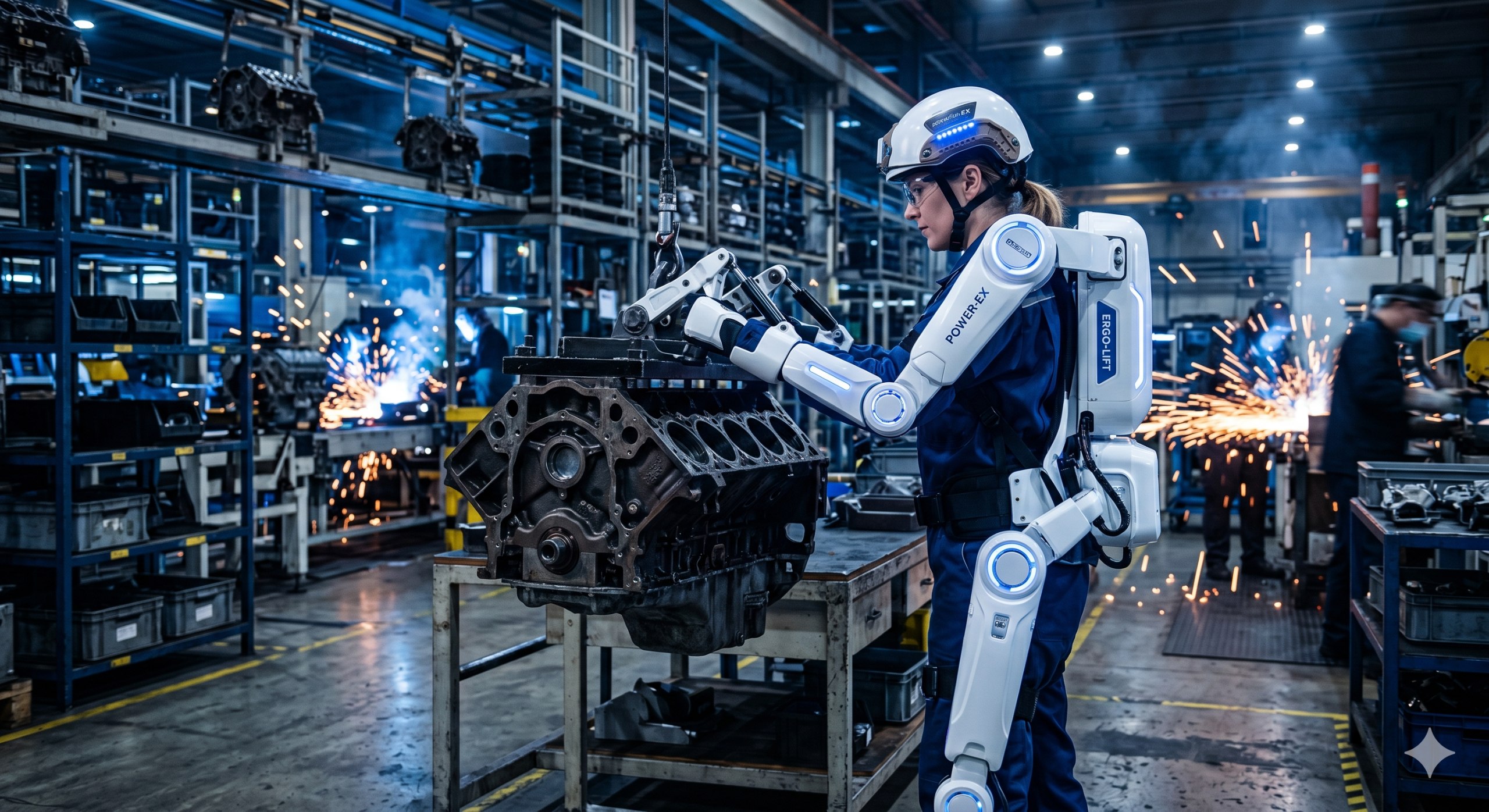
The New Workwear
The factory floor of 2026 looks different than it did just a few years ago. Alongside the conveyor belts, robotic arms, and automated guided vehicles, a new piece of equipment has become increasingly common: exoskeletons. These wearable robotic suits, once confined to university labs and military research programs, have crossed the threshold into commercial viability and are now deployed in thousands of workplaces around the world.
An exoskeleton is a mechanical device worn on the body that augments, supports, or replaces human physical capability. Some exoskeletons are passive — they use springs, dampers, or elastic materials to store and release energy, supporting the wearer without any motors or batteries. Others are active — they incorporate electric motors, sensors, and control systems that detect the wearer's movements and provide powered assistance at joints like the shoulders, back, hips, and knees.
The technology has been in development for decades, but several factors have converged in the mid-2020s to drive widespread adoption. Battery technology has improved dramatically, allowing active exoskeletons to operate for full shifts without recharging. Sensors and control algorithms have become more sophisticated, making the suits more intuitive and less intrusive. And most importantly, the economics have shifted: employers are realizing that the cost of an exoskeleton — typically between $5,000 and $50,000 per unit — is far less than the cost of workplace injuries, lost productivity, and worker turnover.
The result is a quiet revolution in how manual labor is performed.
Passive vs. Active: Two Approaches
The exoskeleton market has split into two broad categories, each suited to different applications.
Passive exoskeletons are simpler, lighter, and cheaper. They use no motors or batteries. Instead, they employ springs, cables, and mechanical linkages to store energy during one phase of a movement and release it during another. A common example is the back-support exoskeleton: a wearable frame that transfers the load of bending and lifting from the lower back to the hips and legs. When a worker bends forward to lift a box, the exoskeleton stores energy in its springs; when they straighten up, the springs release that energy, reducing the strain on the lumbar spine by 30 to 60 percent.
Passive exoskeletons are particularly effective for repetitive tasks with predictable motion patterns. Automotive assembly workers who spend hours performing overhead work — installing components on vehicles passing by on the assembly line — use shoulder-support exoskeletons that offload the weight of their arms. Warehouse workers who do continuous bending, lifting, and twisting use back-support and leg-support models. The devices are lightweight (typically 2 to 5 kg), unobtrusive, and require no charging or electronics maintenance.
Active exoskeletons are more complex and more capable. They use electric motors, encoders, gyroscopes, and force sensors to detect the wearer's intended movement and provide powered assistance. An active back exoskeleton can provide up to 80 percent load reduction during lifting, while an active full-body suit can assist with walking, lifting, carrying, and climbing — all with coordinated motor support at multiple joints.
The challenge with active exoskeletons is the control system. The device must distinguish between intentional movements and external perturbations (bumps, uneven terrain, unexpected loads). It must match the wearer's speed and force requirements in real time, without lag or overshoot. And it must never oppose the wearer's motion — an exoskeleton that resists when you try to lift a box is worse than no exoskeleton at all.
Modern active exoskeletons use a combination of electromyography (EMG) sensors that detect muscle activation, inertial measurement units that track limb position, and force sensors in the joint actuators. Machine learning algorithms trained on thousands of hours of human motion data predict the intended movement and apply assistance at precisely the right moment and magnitude.
Where Exoskeletons Are Used Today
Automotive manufacturing was the earliest adopter and remains the largest market. Workers on assembly lines perform thousands of repetitions per shift of the same motions: reaching overhead, bending into engine compartments, carrying heavy components. Ergonomic injuries — particularly to the shoulders, back, and knees — have historically been endemic. Major automakers including Toyota, Ford, BMW, and Volkswagen have deployed exoskeletons across multiple assembly plants, with thousands of workers using them daily. BMW reported a 40 percent reduction in ergonomic stress claims at plants where exoskeletons were deployed.
Warehouse logistics is the fastest-growing segment. The explosive growth of e-commerce has created enormous demand for picking, packing, and palletizing workers — and an equally enormous injury problem. Amazon, Walmart, and other major logistics operators have deployed exoskeletons in fulfillment centers, particularly for tasks involving repetitive bending and lifting. The injury reduction numbers are compelling: logistics operators report 30 to 50 percent reductions in musculoskeletal injury rates among exoskeleton users.
Construction is a newer but promising market. Construction work involves highly variable tasks, uneven terrain, and environments where bulky equipment is impractical. However, specific tasks — drywall installation, concrete finishing, rebar tying, and material handling — are well suited to exoskeleton assistance. Several large construction firms have begun pilot programs, and early reports indicate reduced fatigue and improved productivity in these targeted applications.
Healthcare is an emerging frontier. Nursing assistants, orderlies, and healthcare workers who lift, transfer, and reposition patients suffer disproportionately high rates of back injuries. Passive back-support exoskeletons have been trialed in hospital settings, with positive early results. Active exoskeletons that provide powered lifting assistance for patient handling are in development.
The Ergonomics Case
The primary business case for exoskeletons is injury prevention, and the numbers are stark. Work-related musculoskeletal disorders account for roughly 30 percent of all workplace injuries in the United States, costing employers an estimated $20 billion annually in direct workers' compensation costs and far more in indirect costs: lost productivity, retraining, overtime for replacement workers.
Lower back injuries alone account for a significant portion of these costs. The average workers' compensation claim for a lower back injury is $40,000 to $80,000, and severe cases can exceed $150,000. An exoskeleton that prevents even a fraction of these injuries pays for itself many times over.
Beyond injury reduction, exoskeletons offer productivity and quality benefits. Workers wearing exoskeletons report lower perceived exertion at the end of a shift, suggesting that the devices reduce cumulative fatigue. Less fatigued workers make fewer errors, maintain better quality, and are less likely to leave the job. In high-turnover industries like warehousing, where annual turnover rates can exceed 100 percent, anything that improves the work experience has a direct impact on the bottom line.
Barriers to Adoption
Despite the clear benefits, exoskeleton adoption faces several barriers.
Cost remains the primary obstacle. Active exoskeletons cost between $20,000 and $50,000 per unit, and a typical deployment requires multiple units per facility. While the return on investment is compelling over a multi-year horizon, the upfront capital expenditure can be difficult to justify in budget cycles.
Comfort and compliance are ongoing challenges. An exoskeleton that is uncomfortable to wear will not be worn, regardless of its potential benefits. Early passive exoskeletons were criticized for being bulky, hot, and restrictive. Newer models have improved dramatically — lighter materials, better ventilation, more ergonomic fit — but the problem has not been fully solved.
Task variability limits the addressable market. Exoskeletons are most effective for repetitive, predictable tasks. They are less useful for highly variable work that requires climbing, crawling, or moving through confined spaces. For these tasks, the exoskeleton can become an impediment rather than an aid.
Workflow integration requires planning. Introducing exoskeletons involves training workers, modifying workstations, and developing maintenance procedures. Workers need to learn how to put on, adjust, and remove the devices efficiently. Employers need to decide whether exoskeletons are assigned to individual workers or shared across shifts. None of these challenges is insurmountable, but they require investment in implementation that goes beyond the cost of the hardware.
The Regulatory Landscape
Exoskeletons operate in a regulatory gray area. The U.S. Occupational Safety and Health Administration (OSHA) has not issued specific standards for exoskeleton use, though it has issued guidance encouraging the use of ergonomic interventions — including exoskeletons — where they reduce injury risk. Employers using exoskeletons are expected to conduct hazard assessments, provide training, and ensure that the devices do not create new hazards.
The European Union is further along in developing regulatory frameworks. The European Agency for Safety and Health at Work (EU-OSHA) has published guidance on exoskeleton use, and several European standards organizations are developing technical specifications for exoskeleton design and testing. The ISO 13482:2014 standard for personal care robots provides some relevant guidance, but a comprehensive exoskeleton-specific standard is still in development.
What Comes Next
The exoskeleton market is projected to grow from approximately $2 billion in 2025 to over $10 billion by 2030, driven by declining hardware costs, expanding applications, and growing awareness of the technology's benefits. Several trends will shape this growth.
Soft exoskeletons — lighter, more flexible devices made from textiles and cables rather than rigid frames — are an active area of development. These devices are less powerful than rigid exoskeletons but much more comfortable and easier to wear for extended periods. They may ultimately address a larger addressable market precisely because they are less intrusive.
AI-powered assistance will make exoskeletons smarter. Future devices will learn the wearer's movement patterns over time, anticipating needs before they arise and providing assistance that is tailored to the individual's body, job, and fatigue level. Cloud-connected exoskeletons will allow employers to monitor usage, assess ergonomic risk across the workforce, and optimize deployment.
Lower cost driven by economies of scale and competition will bring exoskeletons within reach of smaller employers. As production volumes increase, per-unit costs are expected to decline significantly, following the pattern seen in other electronics-based industries.
For the millions of workers who perform physically demanding jobs, exoskeletons offer a compelling vision: not a replacement of human workers by robots, but an augmentation of human capability by robotic technology. The exoskeleton does not eliminate the worker — it makes the worker stronger, safer, and more capable. In a world where manual labor remains essential but increasingly hard to find, that combination of human skill and robotic power may be exactly what the workplace needs.
|> Disclaimer: This article is for informational purposes and reflects publicly available information about exoskeleton technology and deployment as of May 2026.