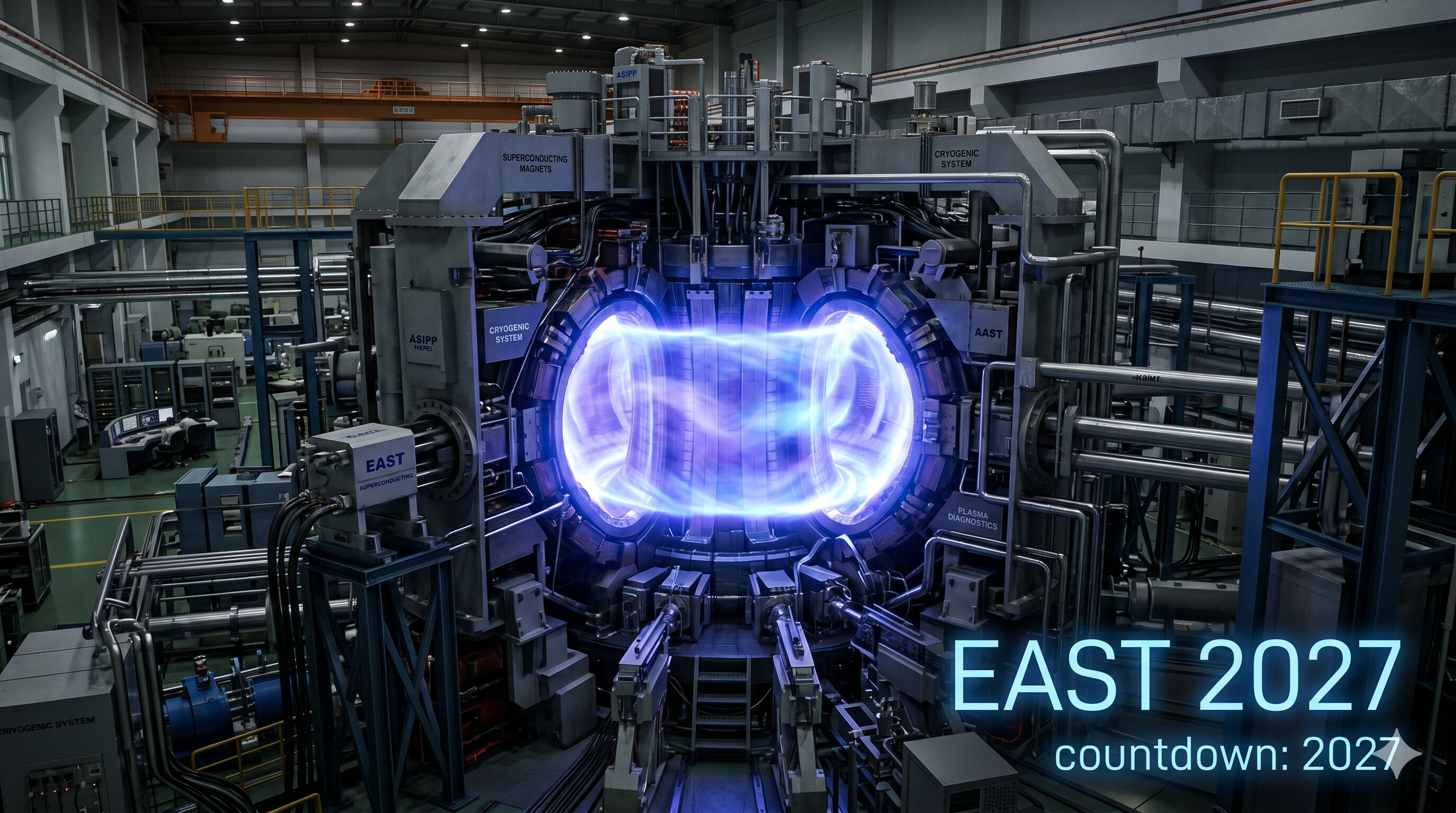
In June 2026, China's Experimental Advanced Superconducting Tokamak (EAST) in Hefei formally set 2027 as its target year for achieving fusion ignition. If successful, this would mark only the second time humanity has achieved a self-heating burning plasma in a laboratory setting — after Lawrence Livermore's NIF in 2022 — and the first time in a magnetic confinement device.
This announcement was not an isolated event. The same week (June 16-19, 2026) saw multiple milestone developments across the global fusion landscape: Helion Energy secured the world's first fusion power plant operating licenses from Washington State; Tennessee became the first U.S. state to pass fusion-specific regulations; and the U.S. Department of Energy released its finalized Fusion Science and Technology Roadmap. Collectively, these events point to a critical transition: fusion is moving from a "will it ever work?" physics question to a "who gets there first, how to regulate it, and how to finance it" industrial challenge.
Why Magnetic Confinement Ignition Matters
EAST is a fully superconducting tokamak operated by the Institute of Plasma Physics, Chinese Academy of Sciences (ASIPP) in Hefei. Since beginning operations in 2006, EAST has achieved multiple world records: a 101.2-second long-pulse H-mode plasma in 2017, sustaining plasma at 120 million degrees Celsius for 101 seconds in 2021, and breaking the plasma density limit in 2023.
The 2027 ignition target centers on achieving self-heating combustion — where alpha particles produced by the fusion reaction generate enough heat to sustain the reaction without continuous external energy input. This is fundamentally different from NIF's inertial confinement approach, which uses 192 laser beams to compress a deuterium-tritium pellet in nanoseconds. EAST's magnetic confinement ignition, if achieved, would prove the feasibility of sustained self-heating in steady-state operation — precisely the mode required for commercial fusion power plants.
EAST's roadmap includes several critical phases: first achieving the Lawson criterion (the breakeven condition where plasma temperature multiplied by confinement time reaches the threshold), then gradually increasing the deuterium-tritium fuel ratio, and finally entering the ignition window by 2027.
The Multi-Path Fusion Race
EAST's 2027 target exists within a broader global fusion landscape with multiple parallel technical approaches at different stages of development.
Commonwealth Fusion Systems' SPARC uses high-temperature superconducting (HTS) magnets in a compact tokamak design, targeting Q>1 on a similar timeline. SPARC's advantage lies in leveraging MIT's years of HTS magnet research, achieving magnetic field strengths above 20 Tesla that enable much smaller device dimensions than traditional tokamaks. CFS has raised over $2 billion cumulative.
Helion Energy takes a fundamentally different approach — Field-Reversed Configuration (FRC) — which uses the plasma's own current-generated magnetic field rather than a tokamak's toroidal field. Helion's key differentiator is direct electricity generation (bypassing the thermal cycle), theoretically offering higher energy conversion efficiency. In June 2026, Helion secured Radioactive Materials and Air Emissions Licenses from Washington State for its Orion fusion plant in Malaga — the first operating licenses ever granted for a fusion power plant, marking fusion's transition from laboratory to regulatory approval.
XCimer Energy and Inertia represent the commercial laser inertial confinement path. Xcimer received DOE approval for its Athena fusion power plant preconceptual design in June 2026. Inertia completed a $450 million Series A and assembled a Science & Technology Advisory Board including former NNSA leadership.
TAE Technologies pursues an FRC combined with neutral beam injection heating, using hydrogen-boron (p-B11) fuel for aneutronic fusion — physically more challenging but avoiding neutron irradiation material problems.
Regulatory Breakthrough: How Fusion Gets Defined
On June 9, 2026, Tennessee passed the first U.S. state-level fusion regulation, creating a legal framework for licensing and operating fusion devices. Type One Energy's Infinity Two stellarator plant (400 MWe) is expected to be the first licensee, with construction targeted for 2028.
This legislative milestone transcends Tennessee. For years, fusion devices in the U.S. faced regulatory ambiguity — should they be classified as nuclear fission reactors (stringent regulation) or particle accelerators (relatively light touch)? Tennessee's law explicitly defines fusion as distinct from fission, providing a template for other states.
Meanwhile, Helion's Washington State licensing process itself became a precedent. The Washington Department of Ecology spent two years evaluating the Orion plant's environmental impact, ultimately concluding that fusion plants pose far lower radioactive risk than fission reactors. This assessment experience will directly influence future fusion project approval timelines and cost projections.
The DOE's finalized Fusion Science and Technology Roadmap, also released June 9, targets commercial fusion by the mid-2030s. The roadmap establishes a public-private framework: national laboratories handle foundational plasma science and materials testing facilities (such as General Atomics' first full-scale Fusion Blanket Component Test Facility), while private companies manage engineering design and commercialization.
The Capital Super-Cycle
Fusion is experiencing unprecedented capital inflows. Helion has raised $1.5 billion cumulative at a $15.5 billion valuation. CFS is the best-funded private fusion company. Inertia's $450 million Series A makes it the highest-funded laser fusion path. General Fusion is pursuing a SPAC merger for $1 billion in equity.
However, fusion faces a unique financing challenge: these companies need to sustain funding for 5-10 years before generating commercial electricity. Unlike solar or wind, fusion has essentially zero revenue before commercialization. Investors are betting on a long-duration technical thesis — and history shows fusion's physics bottlenecks always prove harder than expected.
China's funding model is entirely different. EAST is fully state-funded through the National Natural Science Foundation and the Chinese Academy of Sciences, insulated from market cycles. This institutional advantage enables long-horizon, high-risk research programs, but also means technology transfer and commercialization pathways are less flexible than private companies.
Observatory Analysis: The Fusion Trilemma
The fusion industry is undergoing its critical transition from a physics problem to an industrial challenge — what POC.HK calls the "Fusion Trilemma": physics, regulation, and capital must all be solved within the same time window.
Physics dimension: The race between EAST (2027 ignition), SPARC (Q>1), and Helion (Orion under construction) will determine over the next 12-24 months which technical path offers the most credible route to net energy gain. The tokamak vs. alternative configuration debate is being settled by execution — not which design is more elegant, but which team crosses the engineering threshold first.
Regulatory dimension: Tennessee and Washington State have established a critical proof-of-concept — fusion can be regulated, and at much lower cost than fission. But interstate regulatory variation, the absence of a federal unified framework, and international coordination challenges (particularly within the ITER framework) remain unresolved. American federalism's regulatory flexibility may also become a coordination liability.
Capital dimension: Fusion is the most capital-intensive clean technology ever. If investment hits a wall before commercial power is delivered — whether due to macroeconomic downturn or wavering confidence in fusion — the entire industry faces a funding cliff. Japan's state-directed investment model (via the J-Fusion fund) may offer a risk-mitigation alternative.
From a geopolitical perspective, the race between China's EAST and U.S. private fusion companies creates an asymmetric competition: America's advantages are private capital and regulatory innovation; China's is centralized, long-horizon state funding. If EAST achieves magnetic confinement ignition in 2027, it would be a landmark achievement for Chinese clean energy technology and could reshape global fusion R&D resource allocation.
Disclaimer: The information contained in this article is for informational and educational purposes only and does not constitute any investment advice or business decision basis. Data and time-sensitive information are accurate as of the publication date and may change with subsequent developments. Neither the author nor POC.HK assumes any responsibility for any losses arising from the use of this information.