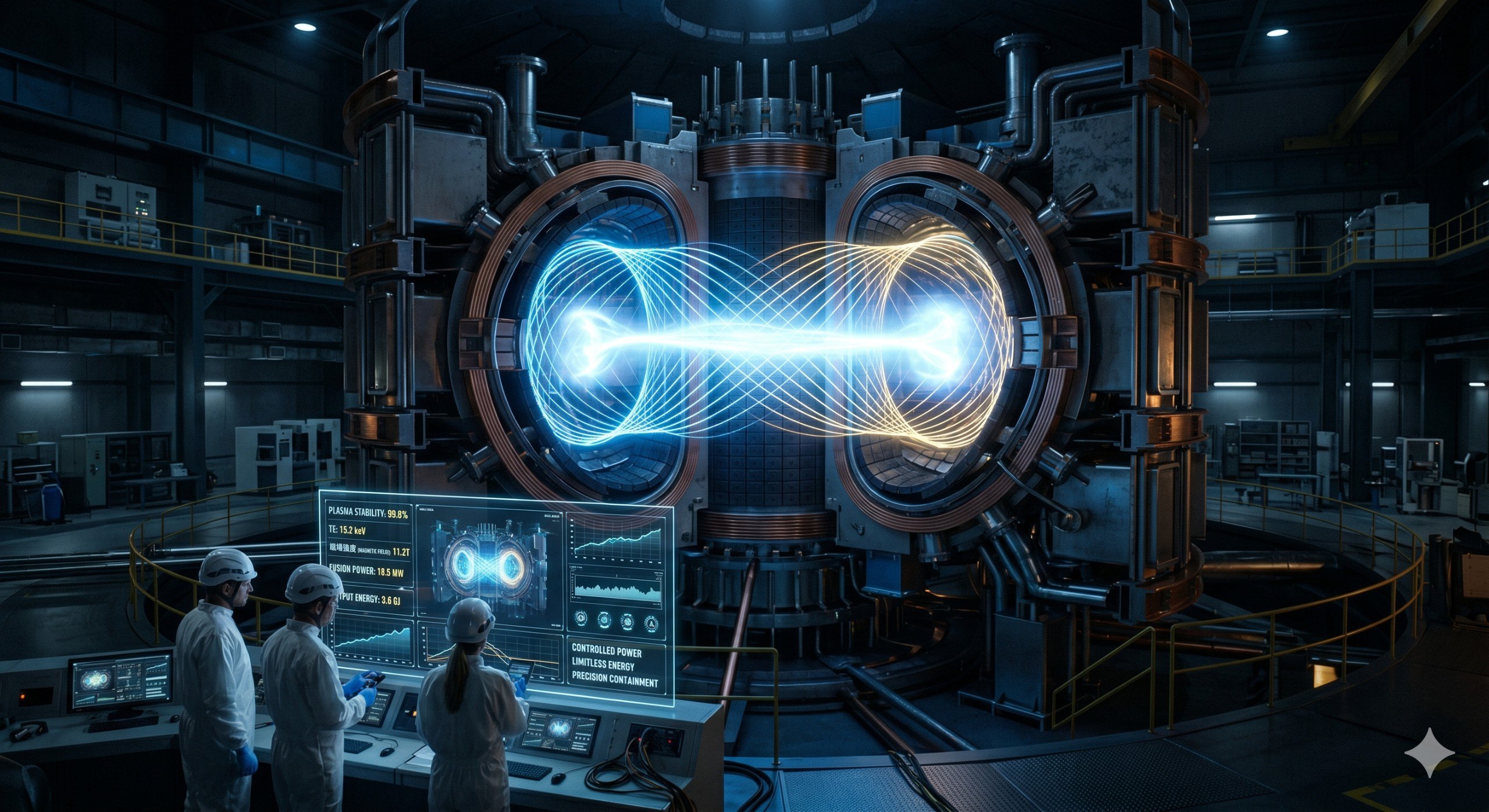
On June 9, 2026, the U.S. Department of Energy officially released the finalized Fusion Science and Technology (FS&T) Roadmap — a 52-page national strategy document that integrates fusion science, technology development, infrastructure, workforce training, and commercialization priorities into a unified framework. The roadmap targets the deployment of a Fusion Pilot Plant (FPP) and the delivery of commercial fusion power to the grid by the mid-2030s.
This event marks a structural shift in U.S. fusion policy from research-oriented to commercialization-oriented. Compared to the initial draft released in October 2025, the final version incorporates broader stakeholder input — over 800 scientists and engineers contributed — and explicitly aligns with the Trump administration's Genesis Mission framework.
The roadmap's core strategic framework is named Build-Innovate-Grow, organized around three priority drivers.
Build: Developing critical infrastructure to close fusion materials and technology gaps. The roadmap identifies six core science and technology domains — structural materials, plasma-facing components, confinement systems, fuel cycle, blanket technology, and plant engineering and integration — each with specific milestone timelines.
Innovate: Accelerating breakthroughs through advanced research, high-performance computing, and artificial intelligence. DOE places particular emphasis on AI-fusion convergence — machine learning is expanding from plasma control to materials discovery, systems optimization, and operational prediction.
Grow: Expanding the fusion ecosystem through public-private partnerships, regional manufacturing hubs, and workforce development. With over $9 billion in private investment already advancing burning-plasma demonstrations and prototype reactor designs, the roadmap recognizes that fusion commercialization requires systemic solutions spanning supply chains, talent pipelines, and regulatory frameworks.
The finalized roadmap carries multiple strategic implications.
First, it resolves a long-standing directional uncertainty in the fusion sector. Dozens of fusion startups have pursued different technical approaches — tokamak, stellarator, field-reversed configuration, inertial confinement, magnetized target fusion, plasma jet — but lacked a unified government framework for evaluation. By defining key performance indicators for a Fusion Pilot Plant, the roadmap provides a comparable assessment framework.
Second, the roadmap sends a critical signal to the private sector. Companies such as Commonwealth Fusion Systems (approaching Q>1 breakeven with SPARC), TAE Technologies (building sixth-generation device), Helion Energy (near net energy gain), and XCimer Energy (recent DOE approval for inertial confinement plant design) now operate within a known commercialization window — the mid-2030s — with a defined public-sector support pathway.
Third, the roadmap clarifies the role of international collaboration. DOE's Genesis Mission, a national initiative to accelerate scientific discovery through AI, has its first international partner in Japan, with 11 joint research teams spanning quantum science, fusion, biotechnology, and autonomous laboratories. The roadmap integrates these international partnerships into the national fusion strategy.
However, the roadmap's success depends on three critical execution variables.
Funding is the primary variable. The roadmap carries no new appropriation commitments — DOE's fusion budget for fiscal 2025 was approximately $800 million, compared to ITER's ~$2 billion annual expenditure. Meeting mid-2030s commercialization targets will require significant increases in combined public and private investment.
The second variable is actual device performance. If SPARC achieves Q>1 burning plasma in 2026-2027, it provides critical physics validation for the roadmap. If Helion achieves net energy gain by 2027, it validates non-tokamak approaches. These real-world data points will determine whether the roadmap's timeline needs adjustment.
The third variable is workforce and supply chain. Fusion requires engineers with specialized skills — plasma physicists, HTS material experts, tritium handling engineers — currently in critically short supply. The roadmap's Grow pillar aims to address this, but results require time.
The roadmap also highlights high-temperature superconducting (HTS) materials as a priority. CFS's SPARC and ARC designs use REBCO HTS tape, with implications beyond fusion — the same materials serve MRI, fault current limiters, and quantum computing sensors.
Regulatory modernization is another focus. The existing nuclear regulatory framework was designed for fission reactors, with fundamental mismatches for fusion. The roadmap recommends a risk-based rather than technology-based approval pathway to accelerate FPP licensing.
Tritium fuel sustainability — often overlooked but critical — receives dedicated attention. Commercial fusion plants require kilograms of tritium annually, currently produced only in CANDU fission reactors with global inventory of ~25 kg. The roadmap lists tritium self-sufficiency as a core technology domain.
Disclaimer: This article is for informational purposes only and does not constitute investment advice. Data and time-sensitive information are current as of the publication date and subject to change. Neither the author nor POC.HK assumes responsibility for any losses resulting from the use of this information.