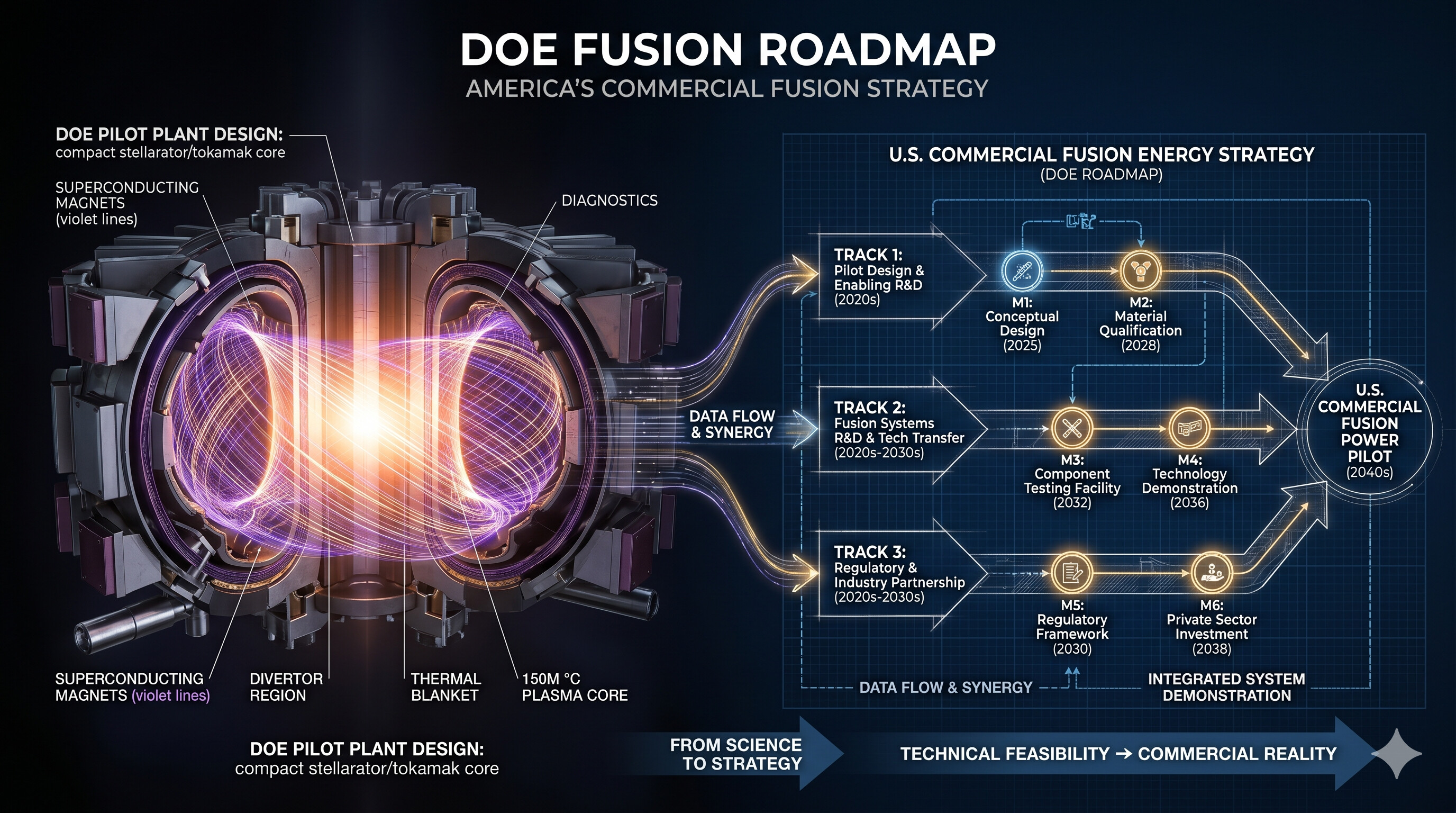
On June 9, 2026, the U.S. Department of Energy (DOE) released its finalized Fusion Science & Technology Roadmap — the first comprehensive national roadmap for commercial fusion energy development in the United States. This landmark document signals a major policy shift from "basic research" toward "deployment-oriented" fusion energy development, providing clear technical pathways and funding frameworks for the next decade of fusion commercialization.
The roadmap arrives in the wake of historic fusion breakthroughs from 2025-2026. In December 2025, Commonwealth Fusion Systems' SPARC achieved plasma temperatures of 150 million degrees Celsius — ten times hotter than the Sun's core — and became the first privately funded reactor to produce more fusion energy than the energy required to heat and confine the plasma. In January 2026, China's EAST tokamak surpassed the Greenwald density limit, published in Science Advances, demonstrating plasma stability at previously inaccessible densities. In February 2026, Helion Energy became the first private fusion company to demonstrate measurable deuterium-tritium (D-T) fusion reactions with net energy gain on its Polaris device. In April 2025, NIF standardized its ignition capability, achieving a fusion energy gain factor (Q) of approximately 4.13, producing 8.6 megajoules from 2.08 megajoules of laser input.
Roadmap Core Content
The DOE roadmap establishes three parallel technology development tracks:
Track 1: Magnetic Confinement Fusion Tokamaks and stellarators as core pathways, supporting:
- High-temperature superconducting (HTS) magnet scaled production — the key enabling technology for compact tokamak designs like SPARC
- Advanced plasma control and diagnostics, including deep reinforcement learning-based real-time plasma stabilization — a collaboration between Google DeepMind and CFS
- Plasma-material interactions and plasma-facing component lifetime validation
- Tritium breeding blanket engineering design and testing — critical for fusion fuel self-sufficiency
- Validation experiments at existing U.S. facilities (DIII-D, NSTX-U)
Track 2: Inertial Confinement Fusion Building on recent NIF achievements, supporting:
- High-repetition-rate laser system development — transitioning from NIF's single-shot mode to the several shots per second needed for commercial plants
- Target fabrication scaling and cost reduction (currently thousands of dollars per target, needs to reach single dollars)
- Inertial fusion energy concept design and economic analysis
Track 3: Alternative Concepts Supporting diverse technical approaches including:
- Field-reversed configurations (Helion Energy) — first commercial fusion power purchase agreement with Microsoft
- Magnetized target fusion (General Fusion, Focused Energy)
- Z-pinch and pulsed power approaches
- Emerging concepts (Levitated Dipole, D-³He fusion, open magnetic field configurations)
These three tracks are complementary rather than competitive — the roadmap explicitly states that success in any single track would significantly accelerate overall fusion commercialization.
NRC Regulatory Framework Reform
In parallel with the roadmap, the U.S. Nuclear Regulatory Commission (NRC) proposed a dedicated fusion regulatory framework in February 2026 — classifying fusion devices as "byproduct material" rather than fission reactors. This means fusion devices would face regulatory requirements similar to medical isotope production facilities rather than nuclear power plant-level scrutiny.
This framework's significance:
- Licensing speed: 3-5 years versus 10-15 for fission reactors — potentially accelerating first commercial operation by a decade
- Cost reduction: Compliance costs estimated 80% lower — representing hundreds of millions in savings for capital-intensive fusion projects
- Site flexibility: Industrial parks rather than dedicated nuclear sites
- Public acceptance: Inherent safety against meltdown significantly reduces opposition
- Insurance costs: Clear regulatory classification substantially lowers project insurance premiums
NRC final framework expected by 2027, paving the way for first commercial fusion plant licensing in the early 2030s.
Global Fusion Competition Landscape
The DOE roadmap arrives amid unprecedented global fusion competition:
United States: Private fusion companies have raised over $8 billion cumulatively, with 45+ active companies across 12 countries. CFS's SPARC targets net energy gain (Q>1) by 2026-2027. Helion Energy signed the first commercial fusion PPA with Microsoft. Pacific Fusion closed $900 million Series A.
China: EAST's Greenwald density limit breakthrough in January 2026 was the most impactful fusion science result of the year. The Chinese government invested $2.1 billion to establish China Fusion Energy Co. Ltd (CFEC), targeting its own compact fusion demonstration reactor. CFETR (China Fusion Engineering Test Reactor) design work is accelerating.
Europe: ITER continues facing delays and cost overruns, but Europe is diversifying fusion investments. Wendelstein 7-X stellarator achieved 1.3 GJ energy conversion record in 2023. UK committed £2.5 billion over five years for fusion research with its own regulatory framework. Germany, France, and Switzerland all have active fusion startups.
South Korea: KSTAR maintained plasma at 100 million degrees Celsius for 102 seconds in February 2026 — more than double its previous 48-second record, confirmed by the IAEA.
Commercial Timeline Reassessment
Based on 2026 milestones, fusion commercialization timelines are being reassessed:
| Milestone | Previous Forecast | 2026 Forecast | Key Variable |
|---|---|---|---|
| First private Q>1 | 2030+ | 2026-2027 (SPARC) | HTS magnet performance, plasma stability |
| First engineering Q>1 (full system) | 2035+ | 2028-2030 | Tritium breeding, heat extraction |
| First pilot fusion plant | 2040+ | 2032-2035 | NRC licensing, supply chain maturity |
| Commercial scale deployment | 2050+ | 2038-2045 | Economics, manufacturing scale |
| Significant grid contribution | 2060+ | 2045-2055 | Cumulative capacity, fuel supply chain |
Economics remains the largest uncertainty. Private companies project LCOE of $50-100/MWh, but this rests on optimistic assumptions including high capacity factors (>90%), long component lifetimes (>10 years), and low fuel costs. For comparison, 2026 solar and wind LCOE has fallen to $20-40/MWh — meaning fusion must deliver additional value through baseload stability and carbon-free attributes.
Observatory Analysis
The release of the DOE Fusion Roadmap carries significance comparable to the completion of the Human Genome Project in the early 2000s — it provides the first systematic commercialization pathway for a field long dismissed as "always 30 years away." Yet the roadmap itself cannot solve the fundamental engineering challenges.
The primary bottleneck is no longer physics — the multiple breakthroughs of 2026 have amply demonstrated fusion's scientific feasibility — but engineering and materials science. Specifically: reactor materials capable of withstanding 14.1 MeV neutron bombardment, tritium breeding blankets producible at scale, and plasma control systems maintaining stability in continuous operation — these are the true variables determining the commercialization timeline.
From an investor perspective, the fusion sector is transitioning from "science bet" to "engineering bet." Risk profiles are shifting: scientific risk has declined substantially, but engineering, regulatory, and market risks remain formidable. For early investors, SPARC achieving Q>1 by 2027 will be the critical catalyst triggering the next wave of large-scale valuation reassessment.
Disclaimer: The information contained in this article is for reference only and does not constitute investment advice or business decision-making basis. Data and time-sensitive information are accurate as of the publication date and may change with subsequent developments. Neither the author nor POC.HK assumes any responsibility for losses resulting from the use of this information.