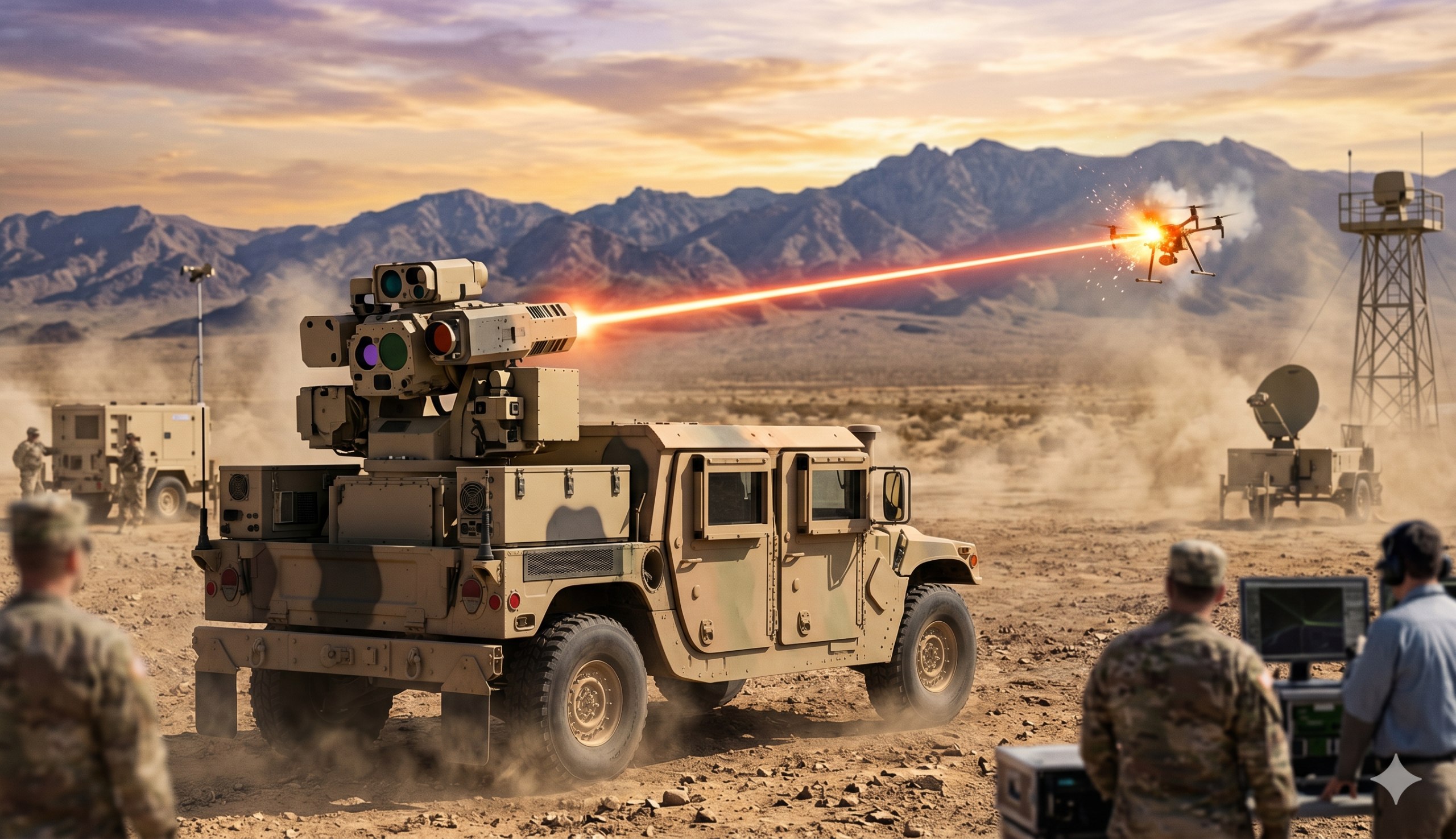
Directed Energy Weapons: The Tipping Point for Laser Combat Deployment
In 2026, high-energy laser (HEL) weapons are transitioning from "laboratory curiosities" to "battlefield practical tools." At least 7 countries' militaries have now deployed or are nearing combat-ready operational testing of laser interception systems. The United States, Israel, United Kingdom, Germany, China, Russia, and India all have active development programs in this field.
Leap in Technology Maturity
Currently deployed laser weapons are primarily concentrated in the 50kW to 150kW power range. 50kW-class systems (such as Raytheon's High Energy Laser Weapon System, HELWS) can reliably intercept first-person-view (FPV) drones and small quadcopters. 100kW to 150kW-class systems (such as Lockheed Martin's ATHENA system and Israel's Iron Beam) can handle rockets, mortar shells, and medium-sized drones.
In 2025, the U.S. Army completed a 12-month combat test under the Indirect Fire Protection Capability-High Energy Laser (IFPC-HEL) program, deployed at Fort Sill, Oklahoma. The system intercepted over 200 targets in testing with an approximately 87% success rate. Notably, the tests included anti-rapid maneuver scenarios — targets executing irregular maneuvers at speeds exceeding Mach 2, with the system still achieving interception rates of approximately 70%.
Core technological breakthroughs in directed energy weapons are concentrated in two areas. First is adaptive optics compensation for beam directors — using deformable mirrors to correct laser beam distortion caused by atmospheric turbulence in real time, with compensation frequency increased from approximately 1 kHz in 2020 to approximately 20 kHz in 2026, extending effective combat range from approximately 1 km to approximately 5 km. Second is thermal management — solid-state laser electro-optical conversion efficiency improved from approximately 35% in 2020 to approximately 48%, reducing waste heat generation; meanwhile, microchannel liquid cooling technology advances enable the laser head to fire continuously for over 30 seconds without overheating.
Revolution in Cost Economics
Directed energy weapons' greatest advantage is their extremely low per-interception cost. Traditional kinetic interceptors (such as Patriot PAC-3 or Iron Dome Tamir missiles) cost between $40,000 and $3 million per interception. Laser systems' per-shot cost is merely electricity and coolant consumption — 50kW systems cost approximately $1 to $5 per shot, 100kW systems approximately $5 to $20.
However, total cost of ownership (TCO) for a weapon system is far more complex than per-shot cost. A combat-ready 100kW laser system (including generator, cooling unit, and radar guidance system) has a procurement cost of approximately $40 million to $60 million, comparable to one fire unit of a Patriot system. But laser systems' lifecycle maintenance costs are expected to be significantly lower than missile systems, as there are no complex propellant and pyrotechnic systems to maintain.
Limitations and Hybrid Solutions
Directed energy weapons are not a panacea. Their primary limitation is atmospheric attenuation — rain, fog, and smoke can reduce laser effective range by 50% to 80%. Under Persian Gulf summer sandstorm conditions, a 100kW laser system's effective interception range drops from 5 km to less than 1.5 km.
Additionally, as continuous-wave weapons, lasers need to dwell on a target for several seconds to cause structural damage. This may be too slow for high-speed maneuvering targets (such as hypersonic missiles) — the target may have moved out of the beam's focus point during the laser illumination period.
The currently recognized best solution is a hybrid defense system: lasers handle long-range "soft kill" and low-cost target interception (drone swarms, rockets); kinetic interceptors handle close-range final defense lines and high-threat targets (large cruise missiles, ballistic missiles). Israel's "Iron Beam + Iron Dome" combination is the most mature hybrid system example. Raytheon also launched the "Phantom" hybrid system in 2025 — integrating a 150kW laser emitter with 24 small kinetic interceptors.
Future Outlook
In 2027 to 2028, the U.S. Army plans to transition the IFPC-HEL system from testing to initial procurement, with an initial order expected for approximately 20 systems. The U.S. Navy is also accelerating its Laser Weapon System (LaWS) upgrade — installing a 150kW-class laser weapon system on the Arleigh Burke-class destroyer USS Preble in 2026 for anti-drone and anti-small-craft missions.
China's "Silent Hunter" laser weapon system successfully intercepted multiple drones during deployment testing in Saudi Arabia in 2025, with output power believed to be between 30kW and 100kW. Russia's "Peresvet" laser system has been deployed on mobile vehicle platforms, but very little is known externally about its performance parameters.
The era of directed energy weapons has arrived. They will not completely replace traditional kinetic weapons but will become an indispensable layer in air defense systems — providing the capability to counter large numbers of low-end aerial threats at extremely low cost. In today's increasingly normalized drone warfare environment, this capability is transitioning from "nice to have" to "essential equipment."
Disclaimer: This article is written by POC.HK Future Technology Observatory based on publicly available information and independent analysis.