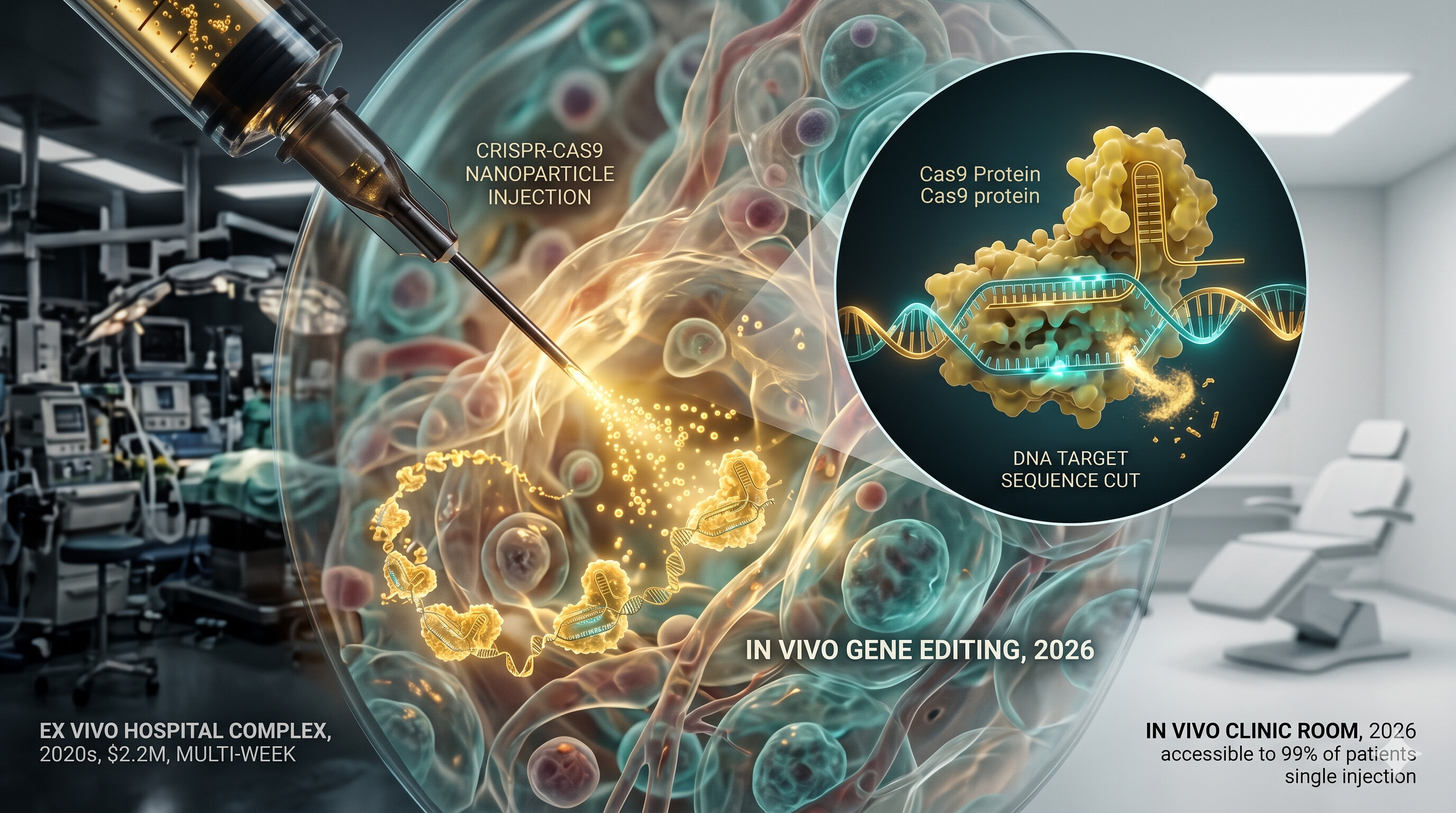
In December 2023, Casgevy (exa-cel) received FDA and UK MHRA approval, becoming the world first approved CRISPR gene-editing therapy. It proved CRISPR could cure sickle cell disease and beta-thalassemia — inherited blood disorders that have plagued humanity for millennia. But Casgevy business model simultaneously exposed the structural dilemma of gene therapy: a .2 million price tag per patient, weeks of inpatient chemotherapy conditioning, and complex procedures limited to specialized tertiary medical centers, leaving 99% of global patients without access.
In 2026, the CRISPR field is undergoing a more fundamental shift: a technical migration from ex vivo editing to direct in vivo delivery. The goal is to transform gene editing from major surgery into a routine injection — if successful, it would fundamentally change the accessibility economics of gene therapy.
Casgevy Achievement and Limitations
Casgevy mechanism represents the pinnacle of ex vivo gene editing: hematopoietic stem cells are extracted from the patient, precisely edited in the laboratory using CRISPR-Cas9 to target the erythroid-specific enhancer of the BCL11A gene, reactivating fetal hemoglobin (HbF) production, then reinfused into the patient.
Clinical results are striking — over 95% of treated patients achieved functional cure with no vaso-occlusive crises. Patient hemoglobin levels returned to near-normal values.
But Casgevy clinical process is equally daunting:
- Stem cell mobilization and collection: 5-7 days of drug stimulation and one or more apheresis sessions
- Chemotherapy conditioning: Patients receive busulfan chemotherapy to clear bone marrow space, requiring 2-3 weeks of hospitalization
- Ex vivo editing and quality control: Gene editing and safety testing takes 2-4 weeks
- Cell reinfusion and hematopoietic reconstitution: 3-6 months of immune monitoring after reinfusion
The entire process from start to completion typically takes 4-6 months. For sickle cell patients living in sub-Saharan Africa — where the disease burden is highest — this is not just a cost problem but an infrastructure problem.
In Vivo Gene Editing: Three Technical Paths
In vivo gene editing R&D in 2026 is concentrated on three parallel technical paths:
Lipid Nanoparticle (LNP) Delivery. This is the most clinically advanced path, leveraging lessons from mRNA vaccine success. CRISPR Therapeutics CTX310 is a representative in vivo editing candidate targeting liver genes. LNPs encapsulate mRNA encoding Cas9 protein and guide RNA, delivered via intravenous injection to the liver, where gene editing occurs in hepatocytes. Because no chemotherapy conditioning or hospitalization is required, the LNP path can compress treatment from weeks of hospitalization to outpatient hours.
Approximately 20 LNP in vivo editing programs have entered clinical trials.
Viral Vector Delivery (AAV). Adeno-associated virus vectors offer higher delivery efficiency but face immunogenicity and payload capacity limitations. Approximately 16 AAV in vivo editing trials are ongoing, targeting liver, eye, muscle, and central nervous system diseases. AAV advantage lies in precise organ targeting, but potential immune responses limit redosing possibilities.
Alternative Delivery Systems. Virus-like particles (VLPs) and extracellular vesicles represent next-generation delivery technology. These systems combine viral vector high delivery efficiency with LNP low immunogenicity. Eli Lilly and Beam Therapeutics are actively developing VLPs for in vivo base editing and prime editing delivery.
The RUBY Trial: First Clinical Validation of CRISPR-Cas12a
One of the most important CRISPR clinical advances in 2026 is the RUBY trial results. Editas Medicine reni-cel uses CRISPR-Cas12a (rather than Cas9) to directly edit HBG1 and HBG2 fetal hemoglobin promoters, reactivating HbF.
Phase 1/2 clinical data: of 28 severe sickle cell disease patients, 27 (96%) experienced zero painful vaso-occlusive crises during up to two years of follow-up after treatment. Average hemoglobin levels returned to near-normal values.
The RUBY trial significance extends beyond efficacy. It uses a different CRISPR enzyme (Cas12a vs Cas9) and a different gene target (HBG promoters vs BCL11A enhancer), demonstrating CRISPR editing platform diversity and portability. If reni-cel ultimately receives FDA approval, it would provide a second option competing with Casgevy, helping to reduce overall treatment costs.
Industry Economics: From Million-Dollar Therapies to the Access Problem
Casgevy .2 million list price — even considering the economic logic of one-time cures — is difficult to scale in the real world. Industry analysts forecast that by 2030, the treatable patient population for gene therapies will exceed 48,000 per year, with U.S. list price spending potentially reaching 0-15 billion annually.
The economic model of in vivo editing differs fundamentally from Casgevy:
- Cost structure: LNP in vivo editing requires no cell collection, laboratory manipulation, or chemotherapy hospitalization, potentially reducing manufacturing costs by 10-100x
- Medical infrastructure: Outpatient injection replaces inpatient transplantation, enabling treatment at far more medical facilities
- Scalability: Standardized LNP production enables large-scale supply, unconstrained by individualized cell manufacturing capacity limits
However, in vivo editing faces new challenges: off-target editing risk monitoring is more difficult because editing events occur inside the patient rather than in a laboratory; dose control requires greater precision; long-term safety data accumulation requires larger patient sample sizes.
CRISPR 2.0: Base Editing and Prime Editing Enter the Clinic
2026 is witnessing CRISPR 2.0 technologies — base editing and prime editing — beginning their transition to clinical application.
Beam Therapeutics BEAM-101 uses base editing to mimic a benign genetic variant (the HbF persistence hereditary trait) and has entered clinical trials. Unlike traditional CRISPR requiring DNA double-strand breaks, base editing can directly convert one DNA base to another without creating double-strand breaks, theoretically offering higher safety.
In FSHD (facioscapulohumeral muscular dystrophy), Epicrispr Biotechnologies EPI-321 uses epigenome editing — rather than changing DNA sequence — to silence the致病 DUX4 gene, with preliminary clinical data now available.
Key Clinical Programs to Watch
Notable in vivo editing clinical programs in 2026 include:
- CTX310 (CRISPR Therapeutics): LNP in vivo editing for alpha-1 antitrypsin deficiency, trial expected to launch in 2026
- CTX340: Angiotensinogen gene editing for refractory hypertension, in IND-enabling studies
- ABO-101 (Arbor Biotechnologies): CRISPR therapy for primary hyperoxaluria type 1, first patient dosed
- CB-010 (Caribou Biosciences): Allogeneic CRISPR-edited CAR-T cells achieving 94% overall response rate in B-cell lymphoma
Forward Outlook
CRISPR gene editing is undergoing a critical transition from proof-of-concept to clinical scale. The 2026 industry structural characteristics are as follows:
Casgevy established ex vivo editing clinical feasibility, but high costs and complex processes limit global impact. The in vivo editing path — particularly LNP delivery — may see first product approvals between 2028-2030, transforming gene therapy from a million-dollar, months-long hospitalization extreme treatment into a tens-of-thousands-dollar, outpatient-completed routine medical option.
However, in vivo editing long-term safety data still needs accumulation, meaning large-scale commercialization will proceed slower than technology optimists predict. The most likely scenario: between 2028-2032, in vivo editing achieves first approvals in liver and hematological diseases, while more complex tissues (central nervous system, heart) will take longer.
For a technology field considered science fiction just five years ago, this is already remarkable progress.
Disclaimer: The information provided in this article is for reference only and does not constitute investment advice or business decision-making basis. Data and time information is current as of the publication date and may change with subsequent developments. Neither the author nor POC.HK assumes any responsibility for losses resulting from the use of this information.