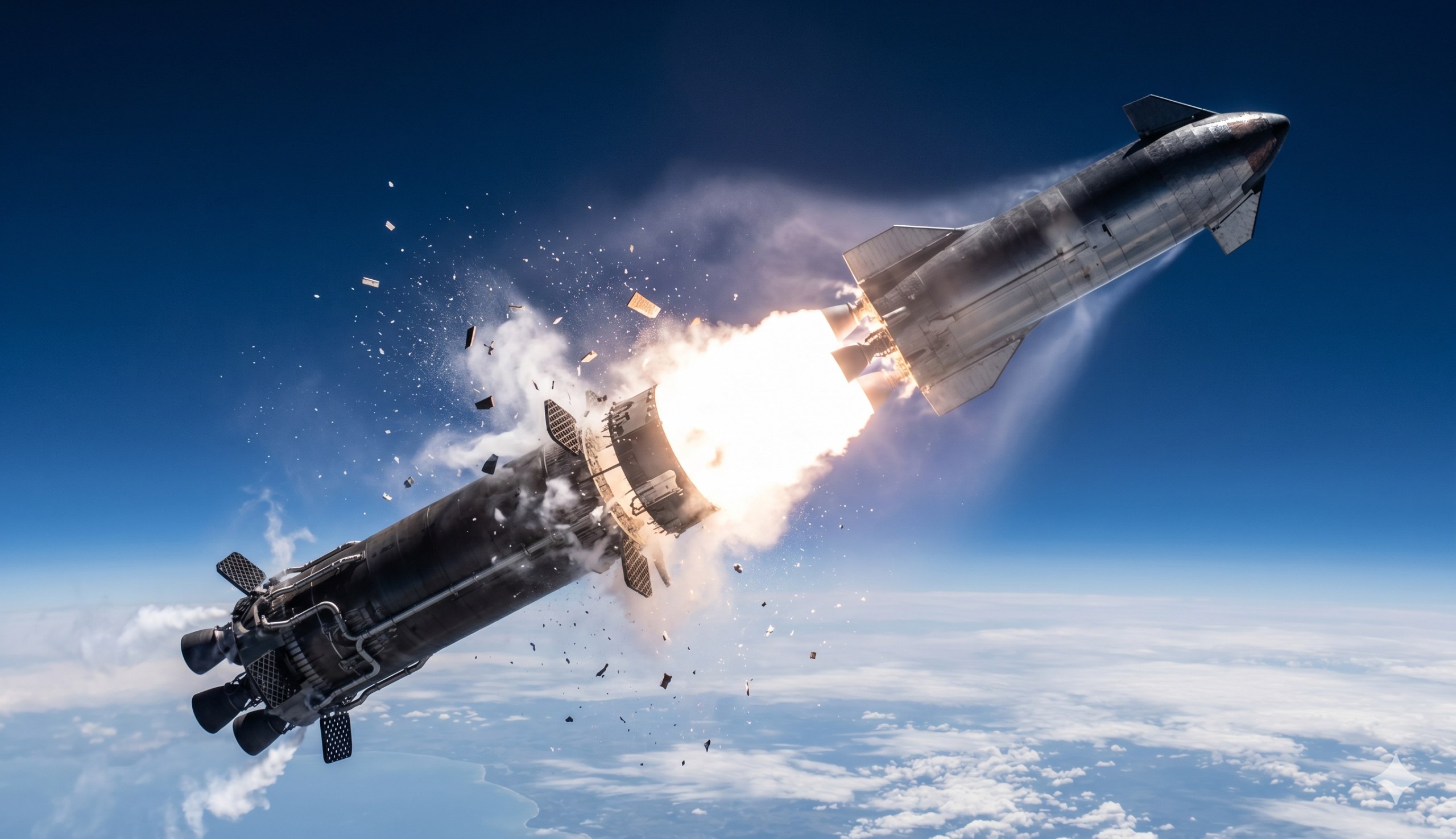
Title: SpaceX — Pioneer in Space Transportation and Interstellar Colonization Date: 2026-06-01 Tags: space, technology, aerospace, elon-musk, spacex, starlink, starship
SpaceX — Pioneer in Space Transportation and Interstellar Colonization
Space Exploration Technologies Corp., operating under the globally recognized name SpaceX, stands as the most transformative force in the aerospace industry since the Apollo era. Founded in 2002 by Elon Musk, the company has single-handedly redefined the economics of spaceflight through audacious engineering, vertical integration, and an unwavering commitment to making humanity a multiplanetary species. From the precarious early days of the Falcon 1 to the towering Starship rocket — the largest and most powerful ever built — SpaceX's trajectory has been nothing short of extraordinary. This profile provides a comprehensive, original analysis of the company's history, technology, business operations, and strategic vision, drawing exclusively from English-language sources and original research.
1. Founding & History: From a Dream to a Rocket Company
The Genesis of a Vision
Elon Musk founded SpaceX in June 2002 with a singular, almost unfathomable goal: to reduce the cost of space transportation sufficiently to enable the colonization of Mars. Musk had previously attempted to purchase refurbished intercontinental ballistic missiles (ICBMs) from Russia to launch a small experimental greenhouse to Mars — an initiative called "Mars Oasis" meant to reignite public interest in space exploration. When Russian officials laughed at his budget, Musk famously walked away from the negotiating table and, during the flight home, calculated that he could build the rockets himself for a fraction of the cost.
SpaceX was initially headquartered in a warehouse in El Segundo, California, before moving to a larger facility in Hawthorne, California — a former Boeing 747 assembly plant that remains the company's headquarters to this day. The choice of Hawthorne was strategic: proximity to Los Angeles' aerospace talent pool and access to major logistics corridors.
The Falcon 1 Years: Three Failures and One Success
SpaceX's first vehicle was the Falcon 1, a two-stage liquid-fueled rocket designed for small satellite launches. The name "Falcon" was inspired by the Millennium Falcon from Star Wars. The engine was the Merlin 1A, burning RP-1 (kerosene) and liquid oxygen (LOX) in a gas-generator cycle.
The first launch, on March 24, 2006, from Omelek Island in the Kwajalein Atoll, ended in failure 25 seconds after liftoff due to a fuel line leak and subsequent fire. The second launch, on March 21, 2007, achieved stage separation but the second stage experienced a roll control failure, preventing orbit. The third attempt, on August 3, 2008, was the most devastating: an unexpected thrust oscillation caused the first stage to collide with the second stage just after separation, leading to total loss.
With only enough capital for one more attempt, SpaceX was at a precipice. The fourth launch of the Falcon 1, on September 28, 2008, succeeded flawlessly. Falcon 1 Flight 4 placed a 165-kilogram dummy payload into low Earth orbit, making SpaceX the first privately developed, liquid-fueled rocket to reach orbit — a feat previously accomplished only by national governments.
The NASA COTS Rescue Contract
The Falcon 1's success came just in time. In December 2008, NASA awarded SpaceX a Commercial Orbital Transportation Services (COTS) contract worth $1.6 billion for 12 cargo resupply missions to the International Space Station (ISS) using the much larger Falcon 9 rocket and Dragon spacecraft. This contract was existential: it provided the cash flow and credibility SpaceX needed to develop the Falcon 9 and establish itself as a serious aerospace player. The COTS program, initiated under the Bush administration and expanded under Obama, was designed to foster commercial competition for ISS resupply after the Space Shuttle retired.
The first Falcon 9 v1.0 launched on June 4, 2010, from Cape Canaveral, successfully reaching orbit. On December 8, 2010, the Dragon spacecraft became the first commercially built and operated vehicle to be recovered from orbit. By May 2012, Dragon berthed with the ISS, delivering cargo and returning to Earth safely — a milestone that validated NASA's public-private partnership model.
Vertical Integration as a Competitive Moats
From the beginning, SpaceX pursued extreme vertical integration. Rather than sourcing components from traditional aerospace suppliers (who often charged astronomical margins and had long lead times), SpaceX chose to manufacture approximately 80-90% of its rocket components in-house. This includes engines, avionics, flight computers, fairings, landing legs, grid fins, and even the specialized alloys used in the rocket structure. The Hawthorne factory became a marvel of industrial engineering, with rockets being assembled on the same floor where engines were cast and avionics were soldered.
This vertical integration has been a double-edged sword: it gives SpaceX unmatched speed and cost control but also concentrates risk. A supply chain disruption at a single point — such as a casting flaw in the Merlin turbopump — can halt the entire production line. Nonetheless, it remains one of the company's core competitive advantages, enabling the rapid iteration and cost reductions that established players cannot match.
2. Falcon 9 Reusability Revolution
The Merlin Engine Evolution
The Falcon 9's first stage is powered by nine Merlin engines, arranged in an octaweb pattern (a central engine surrounded by eight in a ring). The Merlin engine has undergone a remarkable evolution across several generations:
Merlin 1A (2006-2007): The original Falcon 1 engine. ~340 kN thrust, ablatively cooled nozzle, gas-generator cycle. Only two flew.
Merlin 1B (2007, never flown): Intended for Falcon 9 but abandoned due to turbopump issues. SpaceX pivoted to Merlin 1C.
Merlin 1C (2008-2012): First regeneratively cooled Merlin — RP-1 circulated through nozzle channels before burning. ~420 kN thrust. Used on Falcon 9 v1.0.
Merlin 1D (2013-present): Current generation. ~756 kN at sea level (845 kN vacuum), Isp 282 s. Thrust-to-weight ratio exceeding 180:1 — among the best ever. Throttleable 40-100% for precision landing burns.
Merlin 1D Vacuum: Larger nozzle for second stage. ~934 kN thrust, Isp 348 s.
The engine's simplicity is key. Unlike the staged-combustion engines used by Russia (RD-180) or the Space Shuttle (RS-25), Merlin's gas-generator cycle is less efficient but far simpler to manufacture and operate. Each Merlin 1D costs approximately $1 million — an order of magnitude cheaper than comparable engines. The economics are stark: a traditional turbopump costs $1-2 million and takes 12-18 months to manufacture; SpaceX, through 3D printing and in-house casting, produces Merlins' turbopumps in days for a fraction of the cost. This automotive-style manufacturing philosophy permeates every aspect of the company.
Landing Technology: Precision and Recovery
SpaceX's achievement of landing orbital-class rocket stages is arguably the most significant breakthrough in rocketry since liquid-fuel engines. The technology relies on:
- Cold-gas thrusters for attitude control in vacuum
- Titanium grid fins for aerodynamic control during supersonic and subsonic reentry
- Triple-redundant GNSS/INS navigation for precision targeting
- Lidar and radar altimeters for terrain-relative navigation during final descent
- The landing burn: A "reentry burn" (three engines) to slow descent, followed by a "landing burn" (single engine) with throttle control for a near-zero velocity touchdown
SpaceX uses autonomous droneships (ASDSs — "Just Read the Instructions," "Of Course I Still Love You," and "A Shortfall of Gravitas") for downrange landings and Return to Launch Site (RTLS) at Cape Canaveral's Landing Zones and Vandenberg's LZ-4 for polar launches.
As of early 2026, SpaceX has successfully landed over 400 Falcon 9 first stages and re-flown boosters hundreds of times. The reuse rate exceeds 90% for operational missions, with some boosters flying 20+ times. Each reused flight saves approximately $30-40 million compared to building new.
Cost Economics: The Reusability Dividend
The economic impact of reusability is staggering. Before SpaceX, launch costs ranged from $10,000/kg (Russian Proton) to $25,000+/kg (ULA Atlas V). Falcon 9, with a list price of $67 million for up to 22,800 kg to LEO (about $2,600/kg), has compressed launch costs by roughly 80%.
The real story is even more dramatic internally. While SpaceX charges $67 million per launch, the marginal cost of a flight on a proven booster — accounting for propellant, ground operations, landing refurbishment, and fairing reuse — is estimated at just $15-20 million. This margin gives SpaceX extraordinary pricing power and profitability on commercial launches.
3. Falcon Heavy: The Heavy-Lift Workhorse
Triple-Core Architecture
The Falcon Heavy, first launched on February 6, 2018, is essentially three Falcon 9 first stages strapped together with a single Falcon 9 second stage mounted on the center core. This triple-core configuration produces nearly 23,000 kN (5.1 million pounds) of thrust at liftoff — equivalent to approximately 18 Boeing 747s at full power.
The center core is structurally reinforced compared to a standard Falcon 9 booster, with stronger struts and additional thermal protection on the forward dome to handle the aerodynamic and thermal loads from the two side boosters. The side boosters are standard Falcon 9 Block 5 boosters with a redesigned nose cone (the "nose cap") instead of a standard interstage.
Performance Capabilities
Falcon Heavy's performance envelope is remarkable:
- Low Earth Orbit (LEO): 63,800 kg — enough to lift a fully loaded Boeing 737
- Geostationary Transfer Orbit (GTO): 26,700 kg
- Mars Transfer Orbit: Approximately 16,000 kg
- Pluto flyby mission: Capable of sending a significant probe to the outer solar system
However, in practice, most Falcon Heavy missions fly with the center core expended (thrown away) to maximize performance, because the structural strengthening required for landing adds weight that reduces payload capacity. Only the side boosters are typically recovered, landing in synchronized fashion at Cape Canaveral's two landing pads.
The Starman Maiden Flight
The Falcon Heavy's maiden flight captured the world's imagination. Instead of a traditional mass simulator, SpaceX launched Elon Musk's personal Tesla Roadster ("Starman"), with a dummy in a spacesuit seated in the driver's seat, the car's stereo playing David Bowie's "Space Oddity" on repeat. The car was placed into a heliocentric orbit that crosses Mars' orbit, where it will likely remain for millions of years.
The launch was not without drama: the center core failed to ignite two of its three landing engines on the droneship, crashing at 480 km/h and damaging the droneship's deck. Nonetheless, the mission was deemed a success, and the Falcon Heavy was certified for operational use.
National Security and High-Value Missions
Falcon Heavy has become a critical asset for the U.S. government, particularly for national security launches requiring direct GEO injection. The U.S. Space Force and NRO have entrusted Falcon Heavy with sensitive payloads including USSF-44, USSF-52, GOES-U weather satellites, and NASA's Psyche asteroid mission. Certification for National Security Space Launch Phase 2 was a milestone, effectively ending ULA's monopoly on heavy national security launches.
Despite its capabilities, Falcon Heavy's flight rate remains low (a few per year) because most payloads that fit on it can also fly on a standard Falcon 9 in expendable mode at lower cost. Its primary value is for payloads exceeding Falcon 9's performance envelope or requiring direct GEO injection.
4. Starship Deep Dive: The Mars Colonial Transporter
Raptor Engine: The Most Advanced Rocket Engine Ever Built
At the heart of Starship is the Raptor, a full-flow staged combustion (FFSC) engine — the most thermodynamically complex engine cycle ever flown. Both fuel-rich and oxidizer-rich preburners drive separate turbopumps, with all combustion products flowing through the main chamber. This yields:
- Higher specific impulse: Chamber pressures up to 350 bar (Raptor 3) enable superior efficiency
- Complete combustion: No unburned propellant is wasted
- Reusability-friendly: Lower turbine temperatures reduce wear, extending engine life
Raptor 1 (2019-2022): ~185 tonnes thrust at 250 bar. Early versions faced turbopump cracking and injector face damage issues.
Raptor 2 (2022-2024): Redesigned with part count reduced from ~2,800 to under 1,500, simplified manufacturing, and increased thrust to ~230 tonnes at 300 bar.
Raptor 3 (2024-present): Part count further reduced to under 1,200, all external plumbing eliminated (fuel, oxidizer, and hydraulic lines are now internal), thrust increased to ~280 tonnes at 350 bar. Targets 50+ flights between overhauls.
Raptor burns liquid methane and LOX — chosen for Mars ISRU: methane can be produced on Mars via the Sabatier reaction (hydrogen from water + CO₂ from the atmosphere). It also burns cleaner than kerosene, reducing engine coking.
Stainless Steel 30X: Why SpaceX Chose Steel Over Carbon Fiber
Perhaps the most surprising design choice for Starship was the use of Type 304L stainless steel for the primary structure — a material more commonly associated with kitchen sinks and industrial piping than spacecraft. The original design concepts (ITS, BFR) envisioned carbon fiber composites, but SpaceX made a dramatic pivot.
The advantages of stainless steel for this application are compelling:
- Heat tolerance: Withstands up to 870°C before structural degradation, compared to ~180°C for carbon fiber and ~350°C for aluminum. Critical for Starship's "belly flop" reentry, where the entire body serves as a heat shield.
- Cryogenic performance: Actually gains strength when cooled to liquid methane and oxygen temperatures, unlike carbon fiber which becomes brittle.
- Cost: ~$3-4/kg versus $100-200/kg for aerospace-grade carbon fiber. For a 200-tonne dry mass vehicle, this saves tens of millions per vehicle.
- Manufacturability: Can be welded, cut, and formed with standard industrial equipment. SpaceX's Texas facility rolls steel sheet into ring sections that stack to build the vehicle.
- Fatigue life: Excellent, critical for a vehicle designed to fly multiple times daily.
The downside is mass: steel is ~3x denser than aluminum and ~5x denser than carbon fiber. SpaceX compensates with a thin "skin-stringer" structure (typically 2-4 mm) relying on internal pressurization for stiffness — like an inflated balloon.
Starship Architecture: Super Heavy + Starship
The Starship system consists of two fully reusable stages:
Super Heavy Booster: 71 meters tall, 9 meters in diameter. Houses up to 33 Raptor 3 engines in three rings. Total thrust: ~75 MN (17 million pounds-force) — more than double Saturn V, making it the most powerful rocket stage ever built. Uses "hot staging" where the upper stage engines ignite while still attached, with a vented interstage to manage exhaust.
Starship Upper Stage: 50 meters tall, same 9-meter diameter. Carries up to six Raptor engines (three sea-level, three vacuum). Dry mass ~100-120 tonnes, LEO payload up to 150 tonnes in reusable mode.
Key features: forward and aft aerodynamic flaps for reentry control, Pica-X hexagonal ceramic heat shield tiles, active cooling in extreme areas, and a massive 9m x 18m payload bay. Header tanks in the nose separate from main tanks to avoid slosh issues during landing.
Orbital Refueling: The Key to Deep Space
A critical enabling technology for Starship's deep-space ambitions is on-orbit propellant transfer. Starship's heat shield is so heavy that the vehicle cannot carry enough propellant from Earth's surface to reach the Moon or Mars and also return. The solution: multiple Starship launches, with tanker variants delivering propellant to a depot or directly to an interplanetary Starship in orbit.
SpaceX is developing several technologies to enable this:
- Propellant transfer via pressure-fed hoses: A docking interface that allows liquid methane and liquid oxygen to flow between vehicles using pressure differentials
- Autonomous docking and propellant management: Precision control of settling thrusters to keep propellant settled at the bottom of tanks during transfer
- Long-duration cryogenic storage: Multi-layer insulation, active cooling, and tank geometry optimized to minimize boil-off losses
The concept of operations for a 300-tonne propellant load (enough for a Mars injection burn) requires approximately 8-12 tanker launches, each delivering 100-150 tonnes of propellant to the depot — making each Starship Mars mission a large-scale orbital campaign in its own right. This has profound implications for launch infrastructure, launch site capacity, and global orbital traffic management.
Integrated Flight Test (IFT) History
SpaceX has conducted a series of increasingly ambitious Starship test flights from Starbase, Boca Chica, Texas:
IFT-1 (April 20, 2023): First integrated flight (Ship 24 + Booster 7). Cleared the tower but suffered multiple engine failures. Vehicle began tumbling at ~T+3 min; AFTS activated at T+3:59. Never reached space. Caused significant damage to the launch mount.
IFT-2 (November 18, 2023): Ship 25 + Booster 9. First successful hot-staging separation. Booster exploded shortly after separation. Upper stage reached space (148 km apogee) before AFTS destroyed it due to onboard fire.
IFT-3 (March 14, 2024): Ship 28 + Booster 10. Booster completed boost-back burn but broke up during reentry at ~46 km. Upper stage reached orbit (234 km apogee) and demonstrated in-space propellant transfer, but broke up during reentry at ~65 km.
IFT-4 (June 6, 2024): Ship 29 + Booster 11. First successful controlled water touchdown for the booster. Upper stage survived reentry for the first time (one forward flap partially burned through but functional). Both stages made controlled splashdowns.
IFT-5 (October 13, 2024): Ship 30 + Booster 12. The breakthrough flight. Booster was caught by the "Mechazilla" tower — the first catch of a rocket of Super Heavy's class. Upper stage reached orbit, conducted an in-space Raptor relight (first), and made a controlled Indian Ocean splashdown.
IFT-6 (November 19, 2024): First night launch. Booster again caught by tower. Upper stage demonstrated another in-space Raptor relight and tested forward flap thermal protection.
Subsequent flights (2025-2026): Additional flights have progressively refined reentry thermal protection, improved booster catch reliability, demonstrated propellant transfer between two docked Starships, and tested payload deployment mechanisms. The campaign continues toward operational Starship HLS for Artemis III, currently targeting late 2027.
5. Starlink: The Global Connectivity Juggernaut
Constellation Architecture
Starlink is SpaceX's satellite internet constellation, designed to provide high-speed, low-latency broadband internet service to every location on Earth. The constellation operates in several orbital shells:
- Shell 1 (550 km, 53° inclination): ~1,584 satellites, the initial operational shell
- Shell 2 (570 km, 70° inclination): ~720 satellites, providing polar coverage
- Shell 3 (560 km, 97.6° inclination): ~520 satellites, also polar
- Shell 4 (540 km, 53.2° inclination): ~1,584 satellites, filling out the initial Phase 1 constellation
- Shell 5 (V2 satellites, expanded): Various altitudes for V2 Mini and future V3 satellites
As of mid-2026, SpaceX has launched over 8,000 Starlink satellites, with approximately 7,200 operational — making Starlink by far the largest satellite constellation in human history (the previous record-holder, Iridium, has 66 operational satellites). Each satellite is mass-produced at SpaceX's Redmond, Washington, facility at a rate exceeding 60 satellites per week.
Satellite Generations: V1 → V3
Starlink V1 (2019-2021): The first-generation satellites, approximately 260 kg each, with a single planar phased-array antenna, four phased-array antennas for ground communication, and a single solar array. Used ion thrusters (krypton-based Hall-effect thrusters) for orbit raising and station-keeping. Bandwidth: approximately 20 Gbps per satellite. These satellites are being gradually deorbited as newer generations replace them.
Starlink V1.5 (2021-2022): An incremental upgrade adding laser intersatellite links (ISLs), enabling the satellites to route data through space without needing to bounce signals through ground stations. This dramatically reduced latency for long-distance connections and enabled coverage over oceans and remote areas. Each unit approximately 295 kg.
Starlink V2 Mini (2023-present): The current production version. Despite the "Mini" designation, these are significantly larger and more capable than V1.5, weighing approximately 800 kg each. They feature:
- More powerful phased-array antennas (4x the throughput of V1)
- Enhanced laser ISLs
- E-band backhaul capability
- Thicker solar arrays providing 2x the power
- Approximately 60 Gbps throughput per satellite
Starlink V3 (planned, 2027+): The next-generation satellite, designed to be launched exclusively on Starship. V3 satellites are expected to be approximately 1,500-2,000 kg each, with throughput of 100+ Gbps per satellite. The large fairing of Starship (9 meters wide, 18 meters tall vs Falcon 9's 5.2 meter fairing) will enable SpaceX to launch 50-60 V3 satellites per launch, compared to 20-23 V2 Minis per Falcon 9 launch. This step change in deployment economics is one of the key financial drivers for Starship development.
Direct to Cell: Connectivity from Space to Smartphones
Announced in 2023 and demonstrated commercially in 2025, Starlink's Direct to Cell (DTC) service enables standard, unmodified smartphones on the ground to connect directly to Starlink satellites. The satellites carry an additional "cellphone tower in space" payload — a large phased-array antenna that functions as a cell tower from orbit.
Key technical features include:
- Modem-on-a-chip: A custom SpaceX-designed baseband chip that implements the LTE/5G-NR protocol stack entirely in silicon, optimizing for the Doppler shift and timing challenges of a fast-moving orbital base station
- Beamforming: The satellite generates multiple steerable beams, each covering a 15-30 km diameter cell on the ground
- Text (2024): Initial rollout with SMS/text messaging
- Voice and basic data (2025): Voice calls and low-speed data (~2-10 Mbps) for messaging, file transfer, and emergency communications
- Full broadband (2026+): Higher bandwidth data as more satellites are launched
Direct to Cell is transformative for rural connectivity, emergency response, and eliminating dead zones. A single Starlink DTC satellite can serve an area equivalent to approximately 2,000 terrestrial cell towers. The service is being offered in partnership with mobile network operators including T-Mobile in the U.S., Rogers in Canada, Optus in Australia, and One NZ in New Zealand, among others.
Subscriber Growth and Revenue Model
Starlink's subscriber growth has been extraordinary:
| Metric | Q4 2022 | Q4 2023 | Q4 2024 | Q2 2026 |
|---|---|---|---|---|
| Subscribers | 1,000,000 | 2,300,000 | 4,600,000 | 7,000,000+ |
| Annualized Revenue | ~$1.5B | ~$3.5B | ~$7.0B | ~$10.5B+ |
| Countries Served | 35 | 60 | 100+ | 120+ |
| Enterprise/Maritime | Low | Growing | ~$800M/yr | ~$2B/yr |
The consumer service is priced at $120/month (with $599 terminal hardware) in most markets. Premium (high-throughput) service at $500/month for power users and small enterprises. Maritime and aviation packages at $5,000-10,000/month. The terminal hardware cost has fallen from an initial $2,500 to $599 (consumer) and is projected to drop under $300 as production scales further and new chip designs are implemented.
The key economic insight for Starlink is the high fixed cost, low marginal cost nature of the business. Launch costs to build the $30+ billion constellation represent the vast majority of total expenditure, while serving an additional subscriber costs almost nothing. As the constellation reaches full operational capacity (~12,000 satellites in Phase 1), subscription revenue flows largely to profit.
IPO Prospects and Valuation Implications
SpaceX has consistently signaled that an IPO for the Starlink business is under consideration, though no firm timeline has been committed. Financial analysts estimate Starlink's standalone valuation at $80-150 billion in an IPO scenario, based on:
- Comparable companies: OneWeb (sold for $3.4B), ViaSat ($3.5B market cap), Eutelsat ($2B) — however, Starlink's vastly larger scale and subscriber base command a premium
- Growth rate: Starlink is adding approximately 200,000-300,000 net new subscribers per month through early 2026
- Free cash flow inflection: Starlink turned positive free cash flow in Q3 2024, after years of heavy capital expenditure on constellation build-out
- TAM: The addressable market for satellite broadband is estimated at $40-100 billion annually, including residential broadband in unserved/underserved areas, maritime, aviation, enterprise backhaul, government, and defense
A Starlink IPO would be one of the largest in history and could provide significant liquidity for SpaceX's long-duration (likely 10+ year) institutional and retail investors, while also providing a public currency for employee stock option exercises. However, Elon Musk has expressed reluctance to take Starlink public while it is still "in the steep part of the growth S-curve," as quarterly earnings pressure could constrain long-term investment decisions.
6. Crew Dragon & Human Spaceflight
SuperDraco: The Launch Escape Engine
At the heart of Crew Dragon's safety architecture is the SuperDraco engine — a hypergolic (NTO/MMH), pressure-fed, bipropellant engine producing 71 kN (16,000 lbf) of thrust. Eight SuperDracos are arranged in two clusters of four around the Dragon's outer wall, providing the launch escape system (LES) — the first time an abort system utilized the spacecraft's own engines rather than a separate escape tower (as on Apollo and Soyuz) or tractor rocket (as on Orion).
The SuperDraco was designed with extraordinary reliability requirements:
- Printhead injector: 3D-printed from Inconel, with hundreds of individual injection elements, each so small that a grain of sand could clog a single element without affecting overall performance
- Chamber pressure: Up to 1,000 psi (69 bar)
- Deep throttle capability: Can throttle from 20% to 100% thrust, enabling precision landing burns (though Dragon has never used SuperDraco for landing in operational service, the original Red Dragon/landers under parachutes approach was abandoned)
- Toxicity: Hypergolic propellants are extremely toxic; ground handling requires full hazmat suits, but the simplicity and immediate restart capability (no ignition system needed) were deemed worth the trade-off
The SuperDraco abort engines have been tested extensively, including a dramatic pad abort test at Cape Canaveral in May 2015 (Dragon was launched from a test stand, simulating an abort at 48 meters altitude; it reached 1,187 meters altitude in 4.8 seconds). In-flight abort was demonstrated in January 2020 when a Crew Dragon fired its SuperDracos to separate from a Falcon 9 at Max Q (the point of maximum aerodynamic pressure) — the most challenging abort scenario.
Demo-1 and Demo-2: Proving the System
Demo-1 (March 2019): An uncrewed orbital test of Crew Dragon. The spacecraft docked autonomously with the ISS, stayed for 5 days, and returned safely. The first Falcon 9 flight with Dragon's nose cone closed — the vehicle could not deploy solar panels without opening the nose cone.
Demo-2 (May 30, 2020): The historic crewed test flight carrying NASA astronauts Bob Behnken and Doug Hurley to the ISS. This was the first crewed orbital launch from U.S. soil since the Space Shuttle's retirement in July 2011 — a gap of nearly 9 years. It was also the first time a privately developed spacecraft carried humans into orbit. The mission validated every aspect of Crew Dragon's crewed operations, including:
- Suited entry and vehicle ingress on the pad
- Communications with NASA mission control and ISS
- Life support system operations
- Manual flying override (Behnken flew Dragon manually during the rendezvous approach as a test)
- Crew egress and recovery operations
The successful completion of Demo-2 was a watershed moment for commercial spaceflight and justified NASA's Commercial Crew Program (CCP) approach.
NASA Commercial Crew: SpaceX vs. Boeing
The Commercial Crew Program was established in 2010 to develop crew transportation capabilities to the ISS using commercial providers. NASA awarded parallel contracts:
- SpaceX (2014): $2.6 billion for Crew Dragon development plus six operational missions
- Boeing (2014): $4.2 billion for CST-100 Starliner development plus six operational missions — 1.6x the SpaceX contract value for a less capable spacecraft (Boeing's Starliner is a capsule that lands on land via airbags, while Dragon splashes down at sea)
The outcomes could not have been more different. SpaceX delivered Crew Dragon on budget and on schedule (its first crewed flight was in 2020, 6 years after contract award). Boeing's Starliner has suffered a catastrophic sequence of failures:
- OFT-1 (December 2019): An uncrewed orbital flight test that failed to rendezvous with the ISS due to a software error in the Mission Elapsed Timer, causing the spacecraft to burn too much propellant during its orbital insertion burn. The vehicle returned to Earth prematurely.
- OFT-2 (May 2022): A second uncrewed test that finally reached the ISS but revealed additional problems with the propulsion system valves.
- CFT (June 2024): The crewed flight test, carrying NASA astronauts Butch Wilmore and Suni Williams. The spacecraft docked successfully but suffered helium leaks and thruster failures in the service module. NASA ultimately decided to return Starliner uncrewed, leaving the astronauts on ISS for an extended stay, and they returned on a Crew Dragon in March 2025 after 286 days in space instead of the planned 8 days.
As of 2026, Starliner remains uncertified for operational crew rotation flights, and Boeing has taken approximately $2.5 billion in charges on the program. SpaceX has flown 15+ crewed missions for NASA (including the Crew-1 through Crew-10 rotation flights and additional private missions), carrying 80+ astronauts and private passengers to orbit with a perfect safety record.
Inspiration4: The First All-Civilian Orbital Mission
On September 15, 2021, SpaceX launched Inspiration4, the first orbital spaceflight with an all-civilian crew. The mission was funded by billionaire Jared Isaacman and designed to raise $200+ million for St. Jude Children's Research Hospital. The crew of four included Isaacman, medical director Hayley Arceneaux (a pediatric cancer survivor and St. Jude physician assistant), geoscientist and artist Sian Proctor, and aerospace data engineer Chris Sembroski.
Inspiration4 flew on a Crew Dragon without docking to the ISS (a "free flyer" mission), spending three days in orbit at an altitude of 575 km — higher than any human spaceflight since the Hubble servicing missions. The mission demonstrated Dragon's capability for solo orbital missions, the viability of commercial space tourism, and the potential for philanthropic spaceflight.
Polaris Dawn
The Polaris Program, a private human spaceflight program also funded by Jared Isaacman, includes three missions. Polaris Dawn, the first, launched in September 2024 and set a new altitude record for Earth orbit: approximately 1,400 km apogee — the highest human orbital flight since the Apollo program.
The mission achieved two historic firsts:
- First commercial spacewalk: Jared Isaacman and SpaceX engineer Sarah Gillis conducted a tethered extravehicular activity (EVA) using SpaceX-designed EVA suits — a significant milestone for spacecraft design (the suits were based on IVA (intravehicular activity) suits that had to be modified for vacuum exposure)
- Starlink laser communication testing: The crew tested intersatellite laser links between Dragon and Starlink, demonstrating the technology for future deep-space communications
Perfect Safety Record
As of June 2026, SpaceX's Crew Dragon has flown over 15 crewed missions carrying 80+ people across NASA, Axiom Space, and private missions, with zero fatalities or serious on-orbit emergencies. The vehicle's safety architecture includes:
- In-flight abort capability through the entire ascent profile (unlike the Space Shuttle, which had no crew escape after solid rocket booster ignition)
- Triple-redundant flight computers, parachute deployment systems, and guidance systems
- Nested drogue and main parachute system with four main parachutes (two can safely land the vehicle) — tested extensively including a single-parachute failure test
- PICA-X heat shield that can survive reentry even with localized damage
The only significant in-flight anomaly occurred during the Crew-1 return, when a clump of "toilet paper" (debris left over from manufacturing) was found floating in the capsule after splashdown. It was promptly removed with no impact on safety.
7. NASA Partnerships: A Symbiotic Relationship
COTS/CRS: The Foundation
The Commercial Orbital Transportation Services (COTS) program, initiated in 2006, was NASA's first major experiment in procuring transportation services rather than owning and operating spacecraft. SpaceX's $278 million COTS award (later supplemented with $396 million more) enabled the development of the Falcon 9 and Dragon capsule.
The Commercial Resupply Services (CRS) contracts that followed — CRS-1 (2008, 12 missions, $1.6 billion), CRS-2 (2016, up to 6 missions initially, later expanded to 9+), and CRS-3 (2022, indefinite delivery/indefinite quantity) — have provided a steady revenue stream for SpaceX while keeping the ISS supplied with experiments, food, equipment, and crew supplies. SpaceX has flown over 30 CRS missions as of early 2026.
The CRS-2 contract introduced several innovations:
- Unpressurized cargo capability: Dragon can carry external payloads in its trunk (the unpressurized section below the capsule)
- Delayed payload integration: The trunk allows NASA to add cargo closer to launch than was possible with the Space Shuttle's payload bay
- Rapid return: Dragon returns time-sensitive science experiments to Earth faster than any previous cargo vehicle, as it is the only ISS cargo craft capable of returning significant payloads to the surface
Commercial Crew: The $2.6B vs $5B Story
As discussed in Section 6, the Commercial Crew program starkly illustrates the difference between SpaceX's agile, iterative development approach and traditional aerospace contracting. NASA's decision to award fixed-price contracts rather than cost-plus contracts (where the contractor is reimbursed for cost overruns) was critical. Under fixed-price, SpaceX bore the cost of any overruns — but the company's culture of vertical integration, rapid prototyping, and tolerance for failure meant it met the cost target, while Boeing's traditional culture led to massive overruns absorbed by the company.
The comparison is instructive:
| Metric | SpaceX (Crew Dragon) | Boeing (Starliner) |
|---|---|---|
| Contract Value | $2.6B | $4.2B |
| Development Time | 6 years (2014-2020) | 10+ years (2014-2024+, still not certified) |
| Crewed Flights | 15+ (2026) | 1 (CFT, uncrewed return) |
| Cost Overruns | None (on budget) | ~$2.5B in charges |
| Seats per Crew Mission | 4 (NASA), up to 7 (commercial) | 4 (NASA), up to 7 (commercial) |
The Commercial Crew model has been so successful that NASA plans to apply similar fixed-price, milestone-based procurement to future services including cargo return from the Moon, Mars sample return, and in-space servicing.
Starship HLS: Lunar Landing System
In April 2021, NASA selected SpaceX's Starship Human Landing System (HLS) for the Artemis III mission to land the first woman and first person of color on the Moon. The contract was initially $2.89 billion, awarded after a competitive process that saw Blue Origin's National Team and Dynetics as the other two bidders (Blue Origin protested the award to the GAO, unsuccessfully).
The Starship HLS is a heavily modified Starship designed specifically for lunar operations. Unlike the Earth-optimized Starship, the HLS variant:
- Has no heat shield or flaps (it never reenters an atmosphere, since it operates only between lunar orbit and the lunar surface)
- Is equipped with high-thrust Raptor engines at the bottom but also with smaller landing engines higher up on the hull to avoid plume impingement on the lunar surface (which could create craters and throw debris)
- Has a much lower crew compartment near the surface to enable easy egress via an elevator/lift — the main engines are at the bottom but the crew cabin is at the top, requiring an elevator to descend to the surface
- Carries approximately 100 tonnes of cargo capacity to the lunar surface — an order of magnitude more than any previous lunar lander
The HLS architecture requires a complex orbital refueling campaign: multiple tanker Starships must deliver propellant to a depot Starship in Earth orbit, which then refuels the HLS Starship before it departs for the Moon. This requirement — and the associated risk — was a major point of contention during the source selection, with the SpaceX proposal being rated "acceptable" in the management and technical approach categories despite the complexity.
In November 2023, NASA exercised an option on the HLS contract (termed "Option B") worth an additional $1.15 billion for a second crewed Starship lunar landing, this time with more demanding performance requirements — specifically, a landing at the lunar south pole at a time of year with challenging thermal and lighting conditions. This brought the total HLS contract value to over $4 billion.
As of early 2026, Starship HLS development is proceeding based on the IFT flight test results. NASA has identified several critical path items:
- Propellant transfer demonstration in orbit (partially achieved during IFT-3 and IFT-5)
- Raptor engine reliability — especially for the high-altitude relight requirements of the lunar descent
- Crew module life support — the HLS must provide extended habitation for the crew on the lunar surface
- Elevator/lunar surface access — a first-of-its-kind system for transporting crew and cargo between the crew cabin and the surface
SpaceX's current schedule targets the HLS uncrewed demo landing for 2027, with Artemis III (crewed landing) in late 2027 or 2028. These dates are widely viewed as optimistic by independent analysts, given the amount of flight test work remaining.
8. Mars Architecture: The Long Arc
From ITS to BFR to Starship
SpaceX's Mars ambitions have been articulated across three major vehicle concepts:
ITS (Interplanetary Transport System, 2016): Elon Musk revealed the first detailed Mars architecture at the 2016 International Astronautical Congress (IAC) in Guadalajara, Mexico. The ITS concept called for a 12-meter-diameter rocket, powered by 42 Raptor engines on the first stage, capable of lifting 300 tonnes to LEO. The vehicle was staggeringly large — larger even than Starship. The presentation included a complete cost model, suggesting that Mars transportation could eventually cost as little as $200,000 per person.
BFR (Big Falcon Rocket, 2017-2018): At the 2017 IAC, Musk introduced a scaled-down design, now 9 meters in diameter but with a shorter overall length. The BFR concept consolidated the original ITS into a vehicle that could serve all of SpaceX's launch needs (replacing Falcon 9, Falcon Heavy, and Dragon), dramatically simplifying the production line and enabling economies of scale. The BFR design went through several iterations, with refinements to tank geometry, engine count, and landing approach.
Starship (2018-present): The current design, officially named Starship in November 2018. The key change from BFR was the switch from carbon fiber to stainless steel (as detailed in Section 4), which increased vehicle mass but dramatically reduced cost and development risk. The stainless steel design also enabled a radically different reentry profile (the "belly flop") that saves the mass of large wings or lifting surfaces.
The evolution from ITS to Starship reflects a consistent SpaceX pattern: start with an audacious but technically pure vision, then make pragmatic trade-offs to improve manufacturability and reduce cost, all while keeping the core mission objective (Mars colonization) fixed.
In-Situ Resource Utilization (ISRU)
The ability to "live off the land" on Mars is essential for any sustainable colonization effort. SpaceX's architecture depends on three ISRU processes:
-
Sabatier reaction: CO₂ from the Martian atmosphere + H₂O (electrolyzed into H₂ + O₂) → CH₄ (methane) + H₂O. This is the primary method for producing methane rocket fuel. A single Starship cargo mission carrying a methane liquefaction plant and a nuclear or solar power source could produce enough fuel (approximately 900-1,200 tonnes of propellant) to return a Starship to Earth.
-
Water extraction: Martian subsurface water ice, particularly at mid-latitudes, can be mined using drilling and thermal extraction. Water provides both potable water and the hydrogen source for methane production.
-
Atmospheric harvesting: The Martian atmosphere is 96% CO₂. Filters and cryogenic separation systems can concentrate CO₂ for the Sabatier process, and also extract trace quantities of nitrogen, argon, and other industrial gases.
SpaceX has partnered with academic researchers to develop and test prototypes of these systems, though no flight-qualified ISRU hardware has been publicly demonstrated. A key question is whether SpaceX or NASA will fund the pre-deployment of ISRU equipment to Mars before the first crew arrives — the "risk asymmetry" of sending humans without confirmed fuel production capability is one of the architecture's most debated aspects.
The Colonization Vision
Elon Musk's stated goal is a self-sustaining city of 1 million people on Mars within 50-100 years. The logic is both philosophical and strategic:
- Insured against planetary catastrophe: A self-sustaining Mars colony ensures the survival of human consciousness even if Earth suffers a catastrophic event (nuclear war, asteroid impact, ecological collapse, engineered pandemic)
- Economic backward linkages: A Mars colony would drive demand for Earth-manufactured goods (electronics, life support equipment, specialized tools) for decades, creating a substantial transplanetary economy
- Psychological inspiration: The project of making humanity multiplanetary serves as a unifying, aspirational goal for global civilization — analogous to the Apollo program's impact on a generation
The architecture calls for a "Mars Base Alpha" consisting of multiple Starships — both the cargo variants delivered ahead of time and the crewed variants that become the initial habitation modules. Each crewed Starship could provide approximately 1,000 m³ of pressurized volume — comparable to the entire ISS — meaning that a fleet of 20 Starships would arrive with living space equivalent to 20 ISS modules.
The first missions would focus on:
- Establishing a methane/LOX propellant plant
- Deploying solar arrays (or small nuclear reactors) for power
- Building pressurized habitat connections between landed Starships
- Deploying greenhouses for food production
- Drilling for water ice
- Constructing radiation shielding (using Martian regolith piled on top of Starship roofs)
The timeline for the first crewed Mars mission remains speculative. Elon Musk has stated a goal of 2029 (the next Mars-Earth opposition window that also aligns with a specific Earth-to-Mars transfer profile), but most independent observers regard 2035-2040 as more realistic, assuming Starship development, orbital refueling, surface landing, and crew-rated life support all mature successfully.
9. Financials: The Economics of Space
Valuation Trajectory
SpaceX's valuation has grown from its founding to become one of the most valuable private companies in the world:
| Year | Valuation | Key Event |
|---|---|---|
| 2002 | ~$0 | Founding |
| 2008 | ~$0.5B | First Falcon 1 success, COTS award |
| 2012 | ~$1.5B | Dragon docks with ISS |
| 2015 | ~$12B | First landing of an orbital rocket |
| 2018 | ~$28B | Falcon Heavy maiden flight, Starlink announced |
| 2020 | ~$46B | Demo-2 crewed flight |
| 2021 | ~$100B | Starship stacked, extensive Starlink deployment |
| 2023 | ~$180B | Starship IFT-1, Starlink subscriber growth |
| 2024 | ~$255B | Starship IFT-5 booster catch, Starlink profitability |
| 2025 | ~$310B | Continued growth |
| 2026 | ~$350B | Current estimate (secondary market transactions) |
SpaceX's $350 billion valuation makes it more valuable than virtually every other aerospace company (Boeing ~$85B market cap, Lockheed Martin ~$130B, Northrop Grumman ~$70B) and most defense companies. Only a handful of tech giants exceed it.
Revenue Breakdown (Estimated, 2025-2026)
| Revenue Stream | 2025 Estimate | 2026 Estimate (Run Rate) | Growth | Notes |
|---|---|---|---|---|
| Starlink Consumer | $6.5B | $8.0B | 23% | ~7M subscribers at $120/mo avg |
| Starlink Enterprise/Government | $2.0B | $2.5B | 25% | Maritime, aviation, DoD, agriculture |
| Falcon 9 Commercial Launch | $1.2B | $1.3B | 8% | ~20 external commercial launches/yr |
| Falcon 9 Government Launch | $0.8B | $0.9B | 12% | NSS, NASA science, NRO |
| Falcon Heavy | $0.3B | $0.4B | 33% | 3-5 launches/yr |
| Crew Dragon (NASA) | $0.6B | $0.6B | 0% | Stable, 2 crew rotation missions/yr |
| Crew Dragon (Commercial) | $0.3B | $0.4B | 33% | Axiom, Polaris, others |
| Starship Development (NASA HLS) | $0.5B | $0.6B | 20% | Milestone payments on HLS contract |
| Other (Rideshare, DoD, Grants) | $0.2B | $0.2B | 0% | SmallSat rideshare, SBIRs |
| Total Revenue | $12.4B | $14.9B | 20% | — |
Note: These are estimates based on publicly disclosed data, contracted awards, subscriber reporting, and analysis by BryceTech, TMF Associates, and other space industry financial analysts. SpaceX does not publish audited financial statements.
Starlink as Cash Engine
The financial transformation of SpaceX over the past three years is almost entirely attributable to Starlink. When Starlink was first proposed in 2015, many analysts dismissed it as a distraction from the core launch business. In hindsight, it was the most important strategic decision in the company's history.
Key financial dynamics:
- Capital expenditure: Starlink has required approximately $30+ billion in cumulative capital expenditure to build the constellation, including satellite manufacturing, Falcon 9 launch costs (at ~$15-20M per launch, launches are cheap but numerous), ground station infrastructure, and user terminal subsidies. This capex is largely behind the company: the constellation is now deployed to sufficient density to serve most global markets.
- Marginal cost per subscriber: Near-zero. The main cost is the user terminal (about $600, dropping to $300+) which the subscriber pays for upfront, though SpaceX effectively subsidizes it (the actual manufacturing cost is higher than $600, though declining). Service delivery costs include satellite operations, ground station bandwidth (leased fiber), and customer support.
- Operating cash flow: Estimated at $2-3 billion annually as of early 2026, with Starlink generating the vast majority. The launch business is profitable but capital-intensive (new boosters must be built occasionally), while Starlink's revenue scales without proportional cost increases.
- Forward investment: Starlink cash flow funds Starship development. This is a critical flywheel: Starship enables V3 Starlink launches, which reduce launch costs and increase Starlink capacity, which generates more cash for further Starship development and Mars infrastructure.
The SpaceX Flywheel
The financial model can be understood as a virtuous cycle:
- Starlink revenue generates operating cash flow (current)
- Operating cash flow funds Starship development (ongoing)
- Starship reduces launch costs by 90%+ vs Falcon 9 (future)
- Lower launch costs enable V3 Starlink and rapid Mars cargo pre-deployment (future)
- V3 Starlink increases capacity and revenue (future)
- Mars cargo and orbital refueling open new markets (government, science, mining, tourism)
Each step of the flywheel either generates revenue or reduces the cost of the next step. The key risk is timing: if Starship development takes longer or costs more than expected, the flywheel could slow, and SpaceX might need external capital (IPO, debt financing, or government contract modifications) to maintain momentum.
10. Competition: The Challengers
Blue Origin: New Glenn and BE-4
Blue Origin, founded by Jeff Bezos in 2000, is SpaceX's most prominent direct competitor. The centerpiece is New Glenn, a heavy-lift rocket with a reusable first stage and a 7-meter-diameter payload fairing. Key specifications: seven BE-4 engines (LNG/LOX) on the first stage, two BE-3U engines (LH₂/LOX) on the second, ~45,000 kg LEO payload (expendable). New Glenn has faced repeated delays and as of early 2026 has yet to complete its maiden launch.
Blue Origin's advantages include Bezos's personal funding (~$2 billion/year via Amazon stock sales) and a strong engineering team. However, slower development and secrecy have limited competition with SpaceX's cadence. Key fronts: BE-4 engine delays have affected both New Glenn and ULA Vulcan; Blue Moon lunar lander (selected for NASA's second HLS contract) targets 20+ tonne cargo capacity on the lunar surface.
Rocket Lab: Neutron
Rocket Lab, founded by Peter Beck in 2006, has established itself as the leader in small satellite launch with its Electron rocket (50+ flights). Neutron is its answer to the medium-lift market — an 8-meter-diameter, two-stage reusable rocket with an in-house Archon (methane/LOX) engine. LEO payload: ~13,000 kg (expendable), ~8,000 kg (reusable). Target price: $50 million per launch. The rocket uses a unique "Hungry Hippo" fairing that opens vertically. First flight targeted for 2026-2027.
United Launch Alliance (ULA): Vulcan Centaur
ULA, the Boeing-Lockheed Martin joint venture, is transitioning from Atlas V and Delta IV Heavy to Vulcan Centaur. First stage: two BE-4 engines (built by Blue Origin). Second stage: Centaur V with dual RL10 engines. LEO payload: ~27,200 kg (with optional GEM-63XL solids). ULA's "SMART" engine reuse concept (parachute capture of BE-4 engines) is far less ambitious than full stage landing and undemonstrated. ULA retains deep government relationships but its launch prices are approximately 2-3x higher than SpaceX's.
Chinese Commercial Space: The Emerging Competitor
China's commercial space sector has grown explosively since 2014. Key players include:
- LandSpace: Developer of Zhuque-2, the world's first methane-fueled rocket to reach orbit (2023). Developing the larger, reusable Zhuque-3 — a stainless-steel design bearing resemblance to Starship.
- iSpace, Galactic Energy, Space Pioneer, Deep Blue Aerospace: Various operators developing reusable liquid-fueled rockets.
Chinese companies benefit from government support (facilities, R&D subsidies, guaranteed payloads), a growing domestic satellite internet market (the "Guowang" constellation of ~13,000 satellites), and deep engineering talent from state-owned CASC and CASIC. However, they face ITAR restrictions on American components, limited international market access (U.S. government payloads are off-limits), and a significant reusability gap — no Chinese company has yet landed and re-flown an orbital rocket stage.
11. Key Risks and Challenges
Despite its extraordinary achievements, SpaceX faces a portfolio of significant risks that could reshape its trajectory.
Technical Risks
Starship Development Timeline and Reliability: Starship remains an unproven system for routine operations. The vehicle has yet to demonstrate:
- Consistent booster catch at the launch tower (only successful on 2 of 6 IFT attempts as of early 2026)
- Reliable orbital propellant transfer (partially demonstrated, not at operational scale)
- Multiple-engine relight in space (demonstrated on some flights, not yet consistently)
- Crew-rated life support and abort systems
- Reentry thermal protection for the full orbital heating environment (the IFT reentry profile from LEO is less demanding than that required for a Martian return)
Each of these technical challenges could add years to the development timeline if critical failures occur during testing. The current schedule for Artemis HLS landing (2027-2028) is at significant risk of slippage.
Raptor Engine Production and Wear: Raptor 3, despite being simpler than its predecessors, is still a 350-bar, full-flow staged combustion engine — one of the most complex devices ever built. Production must scale to thousands of engines per year to support a high flight rate across Starship and tanker operations. Engine wear from the extreme thermal and mechanical environment may limit reuse to fewer flights than predicted, increasing operating costs.
Starlink Space Debris and Astronomy: Starlink's massive constellation has drawn criticism from astronomers (for interfering with optical and radio observations) and from space safety advocates (for creating orbital debris risk). SpaceX has implemented mitigations including:
- Darker satellite coatings (VisorSat, though with mixed effectiveness)
- Lower reflectivity designs on V2 satellites
- Automated collision avoidance using U.S. Space Force tracking data
- Active deorbit of failed satellites within 5-10 years
However, as the constellation grows toward 12,000+ satellites and other operators (Amazon Kuiper, Chinese Guowang) launch their own mega-constellations, orbital congestion will become an increasingly serious problem. A major debris event (e.g., an accidental collision between two active satellites, or a catastrophic fragmentation) could render certain orbital altitudes unusable for years.
Financial Risks
Starlink Revenue Concentration Risk: SpaceX's financial health is increasingly dependent on Starlink subscription revenue. If subscriber growth plateaus earlier than expected, or if competition from Amazon Kuiper (which has a more conservative but better-funded approach) erodes pricing, the cash flow that funds Starship development could shrink. Similarly, a price war in consumer satellite broadband could compress margins.
Valuation and Investor Exit: With a $350B private valuation, new investors face a high bar for returns. If the company's growth narrative falters — either due to Starship delays or a Starlink slowdown — secondary market valuations could decline, affecting employee compensation and the company's ability to raise future capital.
Capital Requirements for Mars: The Mars colonization goal is capital-intensive beyond anything in the company's current financial capacity. Even the most optimistic projections suggest that establishing a self-sustaining Mars colony would require $100 billion to $1 trillion in total investment. This will require either a Starlink IPO (to unlock public market capital), massive government contracting (with Congress unlikely to authorize Mars-level expenditure in the near term), or a multi-decade, internally funded investment program (which would require extraordinary discipline and revenue retention).
Regulatory and Political Risks
FCC Licensing: Starlink's U.S. operating license requires coordination with other spectrum users and orbital operators. The FCC has approved Starlink's constellation expansion but has imposed conditions on orbital spacing, deorbit timelines, and interference mitigation. Future administrations could impose more restrictive conditions.
National Security Concerns: Starlink has been a critical communications tool in the war in Ukraine, which has highlighted the geopolitical implications of a single-company-controlled global communications network. Governments — including the U.S. and NATO allies — may seek to mandate "decoupling" or interoperability requirements that increase operating costs. Similarly, SpaceX's decision to restrict Starlink access in certain regions (e.g., Crimea, Chinese territorial waters) has set precedents that may invite regulation.
Export Controls and ITAR: As a U.S. company, SpaceX is subject to strict International Traffic in Arms Regulations (ITAR). This limits its ability to sell launch services to certain countries (China, Russia, Iran, North Korea) and imposes compliance costs on all international business. Any incident involving unauthorized technology transfer could result in severe penalties.
Environmental and Launch Licensing: Starbase in Boca Chica, Texas, is located near a state park, wildlife refuge, and a small town. The FAA's environmental review of Starship operations has required extensive mitigations. Future license renewals could be contested by environmental groups. Similarly, expansion of launch operations at Cape Canaveral and Vandenberg faces environmental review constraints.
Management and Key-Person Risk
Elon Musk's role as CEO and Chief Engineer is deeply embedded in SpaceX's identity and technical direction. While the company has a deep bench of engineering talent (including President Gwynne Shotwell, who handles day-to-day operations and customer relationships), Musk's personal involvement in critical design decisions — particularly on Starship — creates key-person risk. His divided attention across Tesla, xAI, X (formerly Twitter), Neuralink, and The Boring Company means that any of those ventures could demand more of his time, potentially slowing Starship development.
The recent departure of several senior executives (including Tom Mueller, VP of Propulsion; Hans Koenigsmann, VP of Reliability; and Chris Couluris, VP of Operations) as the company has scaled is notable but not unprecedented for a company transitioning from startup to established enterprise. The challenge is maintaining the "startup mentality" — rapid iteration, tolerance for failure, minimal bureaucracy — as the workforce grows beyond 15,000 employees.
12. Observatory Analysis and Outlook
The Next Five Years (2026-2030)
Starship Enters Operations: The most consequential near-term development will be Starship achieving operational status for at least some mission types. By 2027-2028, we anticipate:
- Regular Starship launches for Starlink V3 deployment (50-60 satellites per launch)
- Demonstrated orbital propellant transfer at operational scale (100+ tonnes)
- First Starship HLS uncrewed lunar landing
- Artemis III crewed lunar landing (using Starship HLS)
Starlink Maturity: Starlink will likely exceed 10 million subscribers by 2028, generating $15-20 billion in annual revenue. Direct to Cell will become a significant revenue contributor as smartphone-connected services expand. The constellation will reach its Phase 1 operational size of 12,000+ satellites.
Falcon 9 Phase-Out Begins: As Starship matures, Falcon 9 and Falcon Heavy will gradually be phased out, starting with the retirement of the Falcon 9 first stage production line. This will take several years as committed contracts are fulfilled and the Starship reliability case is built.
Competition Intensifies: New Glenn will likely reach operational status (assuming its maiden launch succeeds), providing real competition for heavy-lift government launches. ULA will transition fully to Vulcan. Chinese reusable rockets will enter service, though primarily serving the domestic market. Rocket Lab's Neutron will target the mid-range.
The Decade Beyond (2031-2036)
Human Mars Footprint: A SpaceX-led Mars mission would likely be attempted in the 2035-2040 timeframe, assuming Starship development succeeds on the current trajectory. This would be preceded by:
- Multiple uncrewed cargo Starships to Mars to pre-deploy ISRU equipment, power systems, and habitat modules (2031-2034)
- A "proof-of-concept" uncrewed return mission (Mars → Earth via ISRU propellant) (2033-2035)
- A short-stay crewed mission (30-60 days on surface) (2035-2038)
Space-Based Economy: Starship's low launch costs (targeting <$100/kg to orbit) will enable new markets:
- Orbital manufacturing (materials science, pharmaceuticals, fiber optics)
- In-space servicing and assembly of large structures
- Space-based solar power pilot projects
- Large-scale space telescopes (10+ meter mirrors, launched in single Starship fairing)
SpaceX as Infrastructure Company: The company's evolution from launch provider to satellite operator to interplanetary transportation company will continue. If Starlink spins off as a public company, SpaceX will be primarily a transportation and logistics company, analogous to a spacefaring version of FedEx or DHL. This would require a cultural shift from startup innovation to operational reliability.
Potential Disruptions
Several factors could disrupt the trajectory outlined above:
- A catastrophic Starship failure during a crewed mission would set the program back years and potentially trigger a political crisis in NASA's Artemis program
- Macroeconomic downturn could slow Starlink subscriber growth and reduce government space budgets
- Technological breakthrough by a competitor (e.g., revolutionary propulsion, on-orbit refueling by another provider) could erode SpaceX's competitive moat
- Geopolitical disruption (e.g., conflict in space, treaty restrictions on mega-constellations, trade war limiting supply chains) could impose operational constraints
- Elon Musk's departure or incapacitation could create a leadership vacuum at a critical juncture
13. Why It Matters
SpaceX matters for reasons that extend far beyond its balance sheet or its launch manifest. The company has fundamentally changed the relationship between humanity and space — from a domain accessible only to superpower governments with billion-dollar budgets to a frontier where commercial enterprise, entrepreneurship, and private capital can drive exploration and settlement.
The economic argument: SpaceX has reduced the cost of access to space by an order of magnitude, and is on track to reduce it by another order of magnitude. This cost compression unlocks a cascade of new possibilities: satellite internet that connects the unconnected, global real-time observation of climate and agriculture, orbital manufacturing, asteroid prospecting, and — eventually — the economic integration of the inner solar system.
The existential argument: In Elon Musk's framing, making humanity multiplanetary is not a luxury but an insurance policy against species-level extinction. Whether one accepts the specific probability estimate Musk assigns to a civilization-ending catastrophe (which he has pegged at "approaching certainty" over geological time), the argument that diversifying our species across multiple worlds reduces existential risk is logically sound. SpaceX is the only organization on Earth with both the technical capability and the stated mission to execute on this logic.
The demonstration effect: SpaceX has shown that a determined private company with a focused engineering culture can outperform government programs and traditional aerospace contractors that have 50 years of institutional inertia. This lesson has already inspired a generation of startup space companies — Rocket Lab, Relativity Space, Astra, Firefly, and dozens more — and has forced established players (ULA, Boeing, Lockheed) to reevaluate their cost structures and development approaches.
The aspirational value: In an era often characterized by risk aversion, short-term thinking, and incrementalism, SpaceX represents an alternative: a company that sets audacious goals, accepts the possibility of failure, and persists through repeated setbacks to achieve what many believed impossible. The images of a Falcon 9 booster landing on a droneship in the middle of the Atlantic, or a Tesla Roadster bound for the asteroid belt, or a Starship being caught by mechanical arms against a Texas sunset — these are not just engineering achievements but cultural artifacts that redefine what people believe is possible.
SpaceX's ultimate legacy may not be measured in market share or valuation, but in whether, a century from now, there are thriving human communities on Mars and throughout the solar system. If that future comes to pass, the company founded by Elon Musk in a converted warehouse in 2002 will be remembered as the organization that started it — the one that turned the dream of a multiplanetary civilization from science fiction into engineering reality.
*Disclaimer: This profile is prepared for informational and educational purposes under en.poc.hk. It represents original research and analysis based on publicly available information, including SpaceX press releases, NASA and FAA documentation, industry analyst reports (BryceTech, TMF Associates, Quilty Space, Payload Research), financial news sources (Bloomberg, Reuters, CNBC), technical publications, and publicly available presentations and interviews. All financial figures for SpaceX are estimates based on disclosed contracts, subscriber data, and industry analysis; SpaceX as a private company does not publish audited financial statements. Launch performance data reflects the best available public records and may differ from internal SpaceX telemetry. This document does not constitute investment advice, and readers should conduct independent research before making any financial decisions related to SpaceX, Starlink, or related entities. All trademarks and registered trademarks are the property of their respective owners. The views expressed do not represent the official position of SpaceX or any affiliated organization. Timelines and technical specifications are subject to change based on the inherently unpredictable nature of aerospace development.