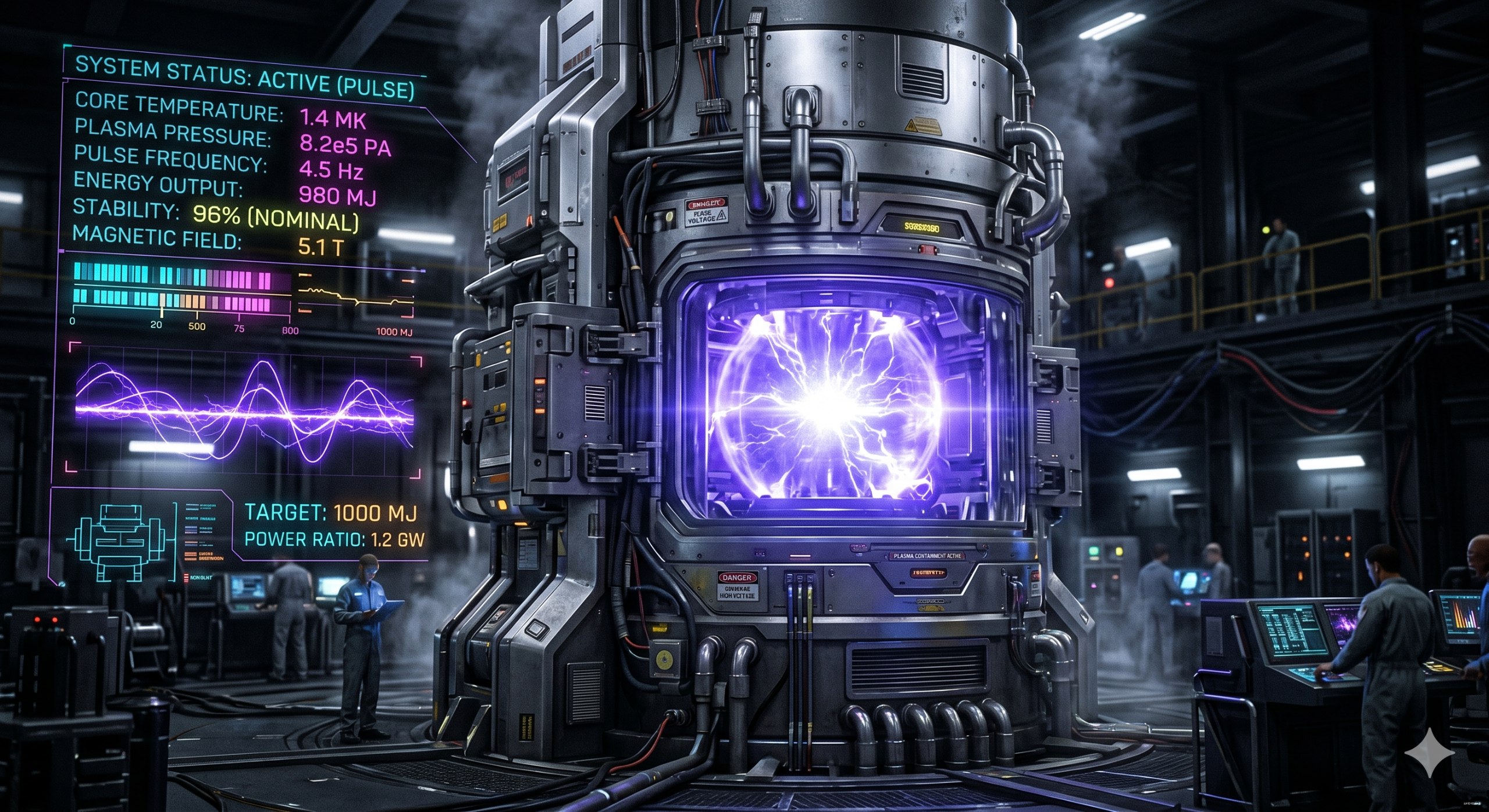
Aiming to be the first to deliver net electricity from fusion, Helion's Polaris device represents the most aggressive timeline in the industry
Helion's Unique Approach
Helion Energy stands apart in the fusion startup landscape with its distinctly unconventional technical path. Founded in 2013 and headquartered in Everett, Washington, Helion has raised approximately $1 billion in funding, with notable investors including Sam Altman (who served as chairman), Peter Thiel, and Dustin Moskovitz.
Unlike the tokamak-based approaches pursued by most government projects and CFS, Helion employs a Field-Reversed Configuration (FRC) combined with magneto-inertial fusion — a hybrid approach that blurs the line between magnetic and inertial confinement.
How It Works
Helion's sixth-generation device, Polaris, operates through a multi-step process:
- Plasma Formation: Two FRC plasmoids (compact, self-organized plasma rings) are formed at opposite ends of a linear chamber
- Acceleration and Collision: The plasmoids are accelerated toward each other using electromagnetic fields, colliding at high velocity in the center
- Adiabatic Compression: Magnetic fields further compress the merged plasma to extreme temperatures and densities, triggering fusion reactions
- Direct Energy Recovery: Helion's key innovation — fusion products are captured through magnetic induction, converting kinetic energy directly into electricity without needing a conventional steam turbine cycle
This direct energy recovery is what sets Helion apart. Traditional fusion designs (tokamaks, stellarators) produce high-energy neutrons that must heat water to drive turbines. Helion's approach, using deuterium-helium-3 (D-³He) fuel, produces charged particles that can be directly converted to electricity at potentially higher efficiencies.
The Polaris Device: A Bet-The-Company Moment
Polaris is Helion's make-or-break device. The company has stated that Polaris is designed to demonstrate net electricity generation — meaning it will actually put power onto the grid, not just achieve plasma energy gain (Q>1).
Key specifications of Polaris:
- Target: First net electricity from fusion, aiming for approximately 50 MW of electrical output
- Timeline: Originally targeted for 2025, now expected in 2025-2026
- Fuel: Deuterium-helium-3 (D-³He), which produces primarily charged particles rather than neutrons
- Size: Significantly more compact than tokamak equivalents, fitting in a facility roughly the size of a warehouse
The D-³He fuel choice is strategic. While deuterium is abundant, helium-3 is extremely rare on Earth. Helion plans to produce its own helium-3 through a secondary deuterium-deuterium (D-D) fusion reaction within the same device, potentially creating a self-sustaining fuel cycle.
Key Challenges
Despite the compelling vision, Helion faces significant hurdles:
Scientific Validation: No FRC device has ever demonstrated net energy gain. While Helion's previous devices (Trenta, Venti) have achieved impressive plasma temperatures exceeding 100 million °C, they have not yet reached the breakeven point. Polaris must prove that FRC can scale to commercial performance.
Fuel Supply: The reliance on helium-3 is a double-edged sword. If the self-sustaining fuel cycle cannot be realized, external helium-3 is astronomically expensive (current lunar and terrestrial supplies are minimal).
Industry Skepticism: Many mainstream fusion physicists remain skeptical of Helion's claimed efficiency and timeline, noting that the physics of FRC stability and energy recovery introduces additional unknowns compared to better-understood tokamak approaches.
Observatory Analysis
Helion represents the high-risk, high-reward end of the fusion investment spectrum. If Polaris succeeds in generating net electricity, the impact on the fusion industry would be seismic — proving that a compact, non-tokamak design can achieve what was thought to require multi-billion-dollar government projects. The direct energy recovery concept alone could be transformative, potentially offering significantly lower capital costs per megawatt than steam-based systems.
However, the risks are equally significant. The history of fusion is littered with devices that worked in simulation but failed in practice. Helion's unconventional approach means it cannot rely on the extensive physics database that supports tokamak designs.
Looking Ahead
The next 12-18 months are critical for Helion. If Polaris achieves its goals:
- The fusion industry's credibility with investors and the public would skyrocket
- The FRC route would be validated as a viable path to commercial fusion
- Helion would leapfrog many competitors in the race to grid-connected fusion
If Polaris falls short, Helion's timeline would likely slip by years, and the company's ability to raise additional capital could be severely tested. Either way, the outcome will send powerful signals throughout the fusion ecosystem.
Disclaimer: This article is for reference only and does not constitute investment advice. Fusion technology remains under development; actual results may differ materially from those described herein.