Figure AI — Pioneer in General-Purpose Humanoid Robotics
Founding & History
Figure AI was founded in 2022 by serial entrepreneur Brett Adcock in Sunnyvale, California — the beating heart of Silicon Valley and the global hub for cutting-edge robotics innovation. The company's founding mission was audacious: to build the world's first commercially viable, general-purpose humanoid robot capable of working alongside humans in unstructured environments — factories, warehouses, retail spaces, and ultimately homes.
The idea crystallized during the pandemic years when labor shortages across manufacturing, logistics, and service industries reached crisis levels. Adcock recognized that the robotics industry had made remarkable progress in narrow, task-specific automation — robot arms welding car bodies, autonomous forklifts moving pallets in warehouses — but no company had yet cracked the code on a single, versatile humanoid platform that could adapt to thousands of different tasks without extensive reprogramming or environmental modification.
Figure AI began operations in a modest Sunnyvale office with a small team of engineers drawn from Boston Dynamics, Tesla, Apple, Google X, and leading robotics labs at MIT, Stanford, and CMU. The early focus was on fundamental hardware architecture: designing a robot that was strong enough to perform real physical labor, nimble enough to navigate human spaces, and cost-effective enough to achieve economic viability at scale. Within 18 months, the team had developed its first full-body prototype — Figure 01 — which demonstrated bipedal locomotion, object manipulation, and basic autonomous task execution.
The public unveiling of Figure 01 in early 2023 generated enormous media excitement and positioned Figure AI as a leading contender in the emerging humanoid robotics space. Unlike many robotics startups that spent years in research labs before attempting commercialization, Figure AI adopted an aggressive go-to-market strategy from the outset, targeting real industrial deployments within its first two years of operation.
By mid-2024, the company had progressed to its second-generation platform — Figure 02 — incorporating lessons from early testing and feedback from potential enterprise customers. The transition from 01 to 02 represented a significant hardware and software refresh, with improvements in dexterity, battery life, computational power, and overall reliability.
Today, Figure AI is widely recognized as one of the largest privately held humanoid robotics companies in the world by both funding and valuation, and it remains at the forefront of the race to commercialize general-purpose humanoid robots. The company employs approximately 400 people across its Sunnyvale headquarters and a new manufacturing facility in the Bay Area, with plans for significant headcount expansion as it scales toward volume production.
Founder Background: Brett Adcock
Brett Adcock is a distinctive figure in the technology and robotics world — a serial entrepreneur with a track record of founding companies in vastly different industries and scaling them to significant valuations. Born in 1986 in central Illinois, Adcock grew up on a farm, an upbringing that instilled in him a deep appreciation for physical labor and the kinds of repetitive, strenuous tasks that robots could one day automate.
Adcock's formal education is in computer science and business from the University of Florida, but like many successful entrepreneurs, he describes his most formative education as happening outside the classroom — building software products, studying market opportunities, and learning the hard lessons of startup execution through repeated cycles of building, shipping, and iterating.
His first major venture was Vettery, an online recruitment marketplace he co-founded in 2012. Vettery aimed to modernize the hiring process by using data-driven matching algorithms to connect job seekers with employers more efficiently than traditional recruiting firms. The platform gained significant traction, particularly in the New York City tech and finance hiring markets, and was acquired by Adecco Group in 2018 for a reported $110 million. The experience gave Adcock deep insight into labor markets — an understanding that would later inform his thesis that humanoid robots were not merely interesting technology but an economic necessity driven by structural labor shortages.
Adcock's next venture was Archer Aviation, founded in 2018. Archer aimed to build electric vertical takeoff and landing (eVTOL) aircraft — essentially, flying taxis for urban air mobility. The company went public via a SPAC merger in 2021 at a multi-billion-dollar valuation and has since progressed through several generations of aircraft prototypes, secured partnerships with United Airlines and the US Department of Defense, and continues working toward FAA certification and commercial service. Archer taught Adcock how to navigate the intersection of hardware engineering, regulatory approval, manufacturing scale-up, and capital markets — all skills directly transferable to the humanoid robotics challenge.
Adcock's leap from eVTOL aircraft to humanoid robots might seem unusual, but he describes it as a natural progression: both Archer and Figure are tackling fundamental bottlenecks in physical labor and transportation using advanced hardware-software systems. In interviews, Adcock emphasizes that the core engineering challenge — building a complex electromechanical system that must be safe, reliable, and affordable at scale — is common to both verticals.
Adcock is known for an intense, hands-on leadership style. He frequently participates in engineering reviews, visits factory floors where Figure robots are being tested, and maintains an aggressive public timeline for product development and deployment milestones. His willingness to make bold predictions (and his track record of meeting many of them) has earned him both admirers and skeptics in the robotics community.
Beyond Figure, Adcock is an active angel investor in early-stage deep tech and robotics startups. He has also been vocal about his broader philosophical views on automation and labor, arguing that humanoid robots represent not a threat to human employment but rather a necessary response to demographic decline and the growing unwillingness of younger generations to perform dangerous, repetitive, or physically demanding work.
Figure 02: Technical Specifications and Capabilities
The Figure 02 represents the company's second-generation humanoid platform and is the product currently being deployed in commercial pilot programs. It is a remarkable piece of engineering that pushes the boundaries of what is possible in a bipedal humanoid form factor.
Physical Dimensions and Structure
Figure 02 stands 170 centimeters (approximately 5 feet 7 inches) tall and weighs 60 kilograms (about 132 pounds). These dimensions were chosen deliberately: tall enough to reach standard work surfaces and shelves designed for humans, but compact and light enough to operate safely in human-occupied spaces without requiring reinforced flooring or oversized doorways. The robot's silhouette is broadly human-proportioned, though with a slightly wider stance at the base for stability during dynamic movements.
The structural frame is built from a combination of high-strength aluminum alloys and carbon fiber composites, chosen to balance weight, strength, and cost. The exoskeletal design — where the outer shell bears structural loads — allows for a slim profile while maintaining the rigidity needed for precise manipulation tasks. The robot's outer surfaces are covered in a soft-touch plastic material designed to minimize damage in collisions and to make the robot feel less intimidating to human coworkers.
Degrees of Freedom and Actuation
Figure 02 boasts 44 degrees of freedom (DOF) across its entire body, enabling an extraordinary range of movement. The most notable feature is the 16-DOF arms — each arm has far more articulation than typical industrial robot arms, approaching or exceeding human-level dexterity. The hands are especially sophisticated, with articulated fingers capable of a wide variety of grip types: power grips for heavy objects, precision pinches for small components, and tool-specific grasps for screwdrivers, wrenches, and other common implements.
The actuation system uses a combination of electric motors and harmonic drives, chosen for their high torque density, precision, and backdrivability — meaning the joints can be moved manually when the robot is powered off, a critical safety feature. Each joint includes torque sensors and encoders that feed back real-time position and force data, enabling fine force control for tasks like inserting a connector or turning a knob without crushing or breaking it.
The lower body includes 6 DOF per leg (hip, knee, ankle in multiple axes) plus the pelvis joint, enabling walking, running, squatting, stair climbing, and the ability to recover from pushes or stumbles. The walking gait is dynamically stable, using model predictive control to continuously adjust foot placement based on the robot's estimated state and the terrain ahead.
Battery and Power System
Power is provided by a custom-designed lithium-ion battery pack rated for approximately 5 hours of continuous operation under moderate load conditions. The battery is swappable — a critical design choice for industrial use cases where robots must operate across multiple shifts. Empty batteries can be removed and replaced with fully charged units in under two minutes, enabling near-continuous operation in factory environments where downtime costs are measured in thousands of dollars per minute.
The power management system includes intelligent thermal regulation, with liquid cooling for the battery and high-power electronics, and passive cooling for lower-power components. The robot can operate in ambient temperatures ranging from freezing to over 40 degrees Celsius, appropriate for warehouses and factories that are not always climate-controlled.
Compute and Sensing
On-board computation is provided by an NVIDIA Jetson-based system, specifically the NVIDIA Jetson AGX Orin platform (or its successors depending on the production revision), delivering multiple hundreds of trillions of operations per second (TOPS) of AI computing performance. This on-board compute handles all real-time control, perception, and decision-making — Figure 02 is fully autonomous and does not rely on cloud connectivity for its moment-to-moment operations (though it can upload telemetry and receive fleet-level updates when connected).
The sensor suite includes:
- Six RGB cameras providing stereo vision and 360-degree situational awareness
- Two depth cameras (one on the head, one on the torso) for high-resolution 3D mapping of the workspace
- LiDAR for long-range obstacle detection and localization
- Microphone array for voice command recognition and sound source localization
- IMU (inertial measurement unit) for balance and orientation tracking
- Force-torque sensors in the wrists and feet for haptic feedback during manipulation and walking
All sensor data is fused in real-time to create a continuously updated digital twin of the robot's environment, enabling precise navigation and manipulation even in dynamic, cluttered spaces.
AI Architecture: Brains Behind the Machine
What truly distinguishes Figure AI from many robotics companies is its conviction that the key to general-purpose humanoid robotics is not better hardware — though hardware matters enormously — but a fundamentally different approach to robot intelligence. Figure has placed a massive bet on end-to-end neural network architectures trained through imitation learning, a departure from the traditional robotics paradigm of manually engineered perception, planning, and control stacks.
End-to-End Neural Network Control
Traditional industrial robots are programmed through explicit motion planning: engineers write code that specifies exact joint angles, trajectories, and force profiles for each task. This approach works brilliantly for repetitive, structured operations — the same welding path on a car chassis, endlessly repeated — but breaks down when the environment changes, when objects are in slightly different positions, or when the task requires adaptation to novel situations.
Figure AI's approach is radically different. Instead of programming specific behaviors, the company trains large neural networks that map directly from sensor inputs (images, depth maps, force readings, proprioception) to motor commands (target joint torques and positions). The network learns the entire control pipeline — perception, planning, and execution — as a single, differentiable model. This means that Figure 02 does not have separate modules for "object detection," "grasp planning," and "motion execution"; it has one unified model that takes camera pixels and produces motor currents.
The advantages of this approach are profound:
- Generalization: A network trained on thousands of variations of a task can handle new variations it has never seen, adapting to different object shapes, lighting conditions, or obstacle configurations.
- Graceful degradation: Because the network is continuous rather than composed of discrete modules, failures tend to be partial rather than catastrophic — the robot might fumble a grip slightly rather than completely failing to initiate a grasp sequence.
- Continuous improvement: As more training data is collected, the network can be fine-tuned and improved without rewriting any code, enabling a virtuous cycle of data-driven performance enhancement.
Imitation Learning
The primary method for teaching Figure 02 new skills is imitation learning, specifically behavior cloning combined with more advanced techniques. In practice, this works as follows:
A human operator wears a teleoperation rig that captures their full-body movements — hand positions, finger articulations, torso orientation, foot placement — in real-time. The operator then performs the target task (e.g., picking a part from a bin and placing it into an assembly fixture) while the Figure 02 robot mirrors the movements. After multiple demonstrations of the same task, the recorded sensor-motor trajectories become training data for the neural network.
Over time, the network learns the underlying structure of the task — not just the specific motions demonstrated, but the general strategy for achieving the goal. A network trained on hundreds of hours of bin-picking demonstrations, for example, can generalize to pick objects it has never seen before, from bins it has never encountered, under lighting conditions that differ from the training data.
Figure AI has developed sophisticated data augmentation and domain randomization techniques to maximize the generalization capability of its trained models. The company also uses simulation (powered by NVIDIA Isaac Sim and other platforms) to generate synthetic training data for scenarios that are dangerous, time-consuming, or impractical to demonstrate with teleoperation.
Vision-Language Models
A critical component of Figure 02's intelligence is its integration of Vision-Language Models (VLMs). These models — similar in architecture to large multimodal models — enable the robot to understand natural language instructions and to reason about its environment at a semantic level.
When a human supervisor tells Figure 02 "Pick up the blue widget from the third shelf and place it in the outgoing bin on the left," the VLM processes this instruction, identifies the relevant objects in the robot's visual field (the blue widget on shelf three, the outgoing bin on the left), and generates a high-level action plan that the lower-level control network then executes. This high-level reasoning includes understanding object properties (fragile, heavy, slippery), spatial relationships (in front of, behind, on top of), and temporal ordering (first X, then Y, then Z).
The VLM also enables Figure 02 to handle ambiguous or incomplete instructions by asking clarifying questions. If told "Put this over there," the robot can reply "There are two tables and a shelf visible. Which surface should I place the object on?" This kind of interactive clarification is critical for real-world deployment, where human instructions are rarely as precise as formal programming commands.
Current AI Strategy and the OpenAI Partnership
Figure AI's relationship with AI and foundation model companies has been a defining narrative for the startup. In early 2024, Figure announced a landmark partnership with OpenAI, the world's leading AI research company. Under this partnership, OpenAI's advanced multimodal models — including GPT-4V and successors — were integrated into Figure 02's control architecture, enabling the robot to leverage OpenAI's cutting-edge language understanding, visual reasoning, and conversational capabilities.
The partnership was widely seen as a strategic masterstroke: Figure gained access to the world's best AI models without having to build them from scratch, while OpenAI gained a physical embodiment for its intelligence — a robot that could interact with the world rather than just generating text and images. Videos released during the partnership showed Figure 02 robots engaging in remarkably natural conversations with humans, describing what they were seeing, explaining their planned actions, and even showing rudimentary common-sense reasoning.
However, in late 2024, the partnership was terminated. Public reports attributed the split to internal strategic realignment at OpenAI, which was simultaneously exploring its own robotics ambitions and may have viewed Figure as a potential future competitor rather than a partner. The end of the partnership was a significant setback for Figure in terms of public perception, but the company moved quickly to develop its own in-house AI capabilities.
Figure's current AI strategy is built on internal foundation models trained on the massive corpus of teleoperation data the company has collected from its robots. By late 2025, Figure claimed that its proprietary models matched or exceeded the performance of the former OpenAI-integrated system on all key robotics benchmarks. The company has also established partnerships with several smaller AI research labs and continues to recruit top AI talent from OpenAI, Google DeepMind, and other leading organizations.
The key insight driving Figure's current approach is that for embodied AI — AI that must interact with the physical world — generic foundation models trained primarily on internet text and images are not sufficient. What matters most is data from physical interaction: millions of hours of robot movement data, force-torque feedback from real manipulation, failure data from objects dropped or collisions with obstacles, and long-horizon task sequences that test reasoning and memory over minutes rather than seconds. Figure believes that its growing dataset of physical interaction, combined with its proprietary neural network architectures, gives it an irreplaceable advantage that no pure AI company can replicate without comparable hardware.
BMW Factory Deployment: The First Commercial Milestone
The most concrete validation of Figure AI's technology to date came in 2024, when the company announced a landmark commercial agreement with BMW Group. Under this agreement, Figure deployed 10 Figure 02 robots at BMW's manufacturing facility in Spartanburg, South Carolina — one of BMW's largest production plants globally, employing over 11,000 people and producing more than 1,500 vehicles per day including the BMW X3, X4, X5, X6, and X7 models.
Deployment Context and Objectives
BMW's Spartanburg plant operates on a just-in-time manufacturing model where parts arrive at precisely the right moment to be installed on the assembly line. Any disruption to parts flow can cascade into significant production delays. The plant faces persistent shortages of workers willing to perform physically demanding roles — lifting heavy components, working in awkward positions inside vehicle bodies, standing for entire shifts on concrete floors — and these shortages have only intensified as the American manufacturing workforce ages and younger workers prefer service-sector and remote jobs.
The 10 Figure 02 robots were assigned to a specific production cell focused on body-in-white operations — the stage where stamped sheet metal panels are welded and assembled into the vehicle's structural body shell. Specifically, the robots were tasked with:
- Transporting stamped metal panels from incoming racks to weld fixtures
- Manipulating panels into precise alignment for robotic welding stations
- Inspecting weld quality using integrated vision systems
- Moving completed body subassemblies to the next production stage
- Handling raw logistics — moving empty racks, retrieving tools, and organizing workcell consumables
Robotics as a Service (RaaS) Model
Critically, the deployment was structured under a Robotics as a Service (RaaS) model rather than a traditional capital equipment sale. Under this model, BMW pays a recurring monthly fee per robot that covers hardware, software, maintenance, and support. The fee is structured to be competitive with the fully loaded cost of a human worker (including wages, benefits, training, and overhead) in the target roles, meaning BMW achieves cost parity or savings from day one with no upfront capital expenditure.
The RaaS model is strategically important for Figure for several reasons:
- Lower adoption barriers: Industrial customers are often reluctant to make multi-million-dollar capital commitments for unproven technology. RaaS shifts the risk to Figure and allows customers to scale usage up or down flexibly.
- Continuous revenue: RaaS provides recurring revenue streams that are more predictable and valuable than one-time hardware sales, improving the company's financial profile for investors.
- Data flywheel: RaaS customers typically agree to data sharing arrangements that give Figure access to operational telemetry, enabling continuous model improvement across the entire deployed fleet.
Results and Lessons
BMW has not publicly disclosed detailed performance metrics, but available information suggests the deployment has been broadly successful. The robots have achieved reliability rates exceeding 90% uptime in production, with most downtime attributable to routine maintenance and software updates rather than hardware failures. Task completion accuracy has been reported at over 95% for standard operations, though performance degrades for edge cases and highly variable tasks.
The deployment has also surfaced important lessons for Figure. One key finding is that humanoid robots do not need to match human speed to be economically viable — they need to match human reliability. A robot that works at 70% human speed but never takes sick days, never requests overtime pay, never files workers' compensation claims, and never requires re-training for different shifts is often more valuable than a faster human worker who is unpredictable in their availability and consistency.
Another lesson is the importance of workspace design. While Figure 02 is designed to operate in unmodified human environments, BMW made modest changes to the deployment cell to facilitate robot operations — improved lighting for the vision system, reorganized rack positions for optimal reach, and clear floor markings to support the robot's navigation system. These modifications were minimal compared to the wholesale factory redesign that traditional industrial automation would require, supporting Figure's thesis that humanoids can be integrated into existing facilities with relatively low friction.
The BMW deployment has served as a powerful reference case for Figure's sales efforts with other potential customers. Several other automotive OEMs, as well as major logistics and manufacturing companies, are reportedly in advanced discussions for similar deployments.
Manufacturing Strategy and Cost Targets
For Figure AI, the single most important metric is not robot capability but robot cost. Brett Adcock has stated repeatedly that the company's ultimate goal is to build a humanoid robot that is economically competitive with human labor, and that this requires a unit price in the range of $20,000 to $50,000 at volume production — roughly the price of a mid-range to luxury automobile.
Current Cost Structure
Production costs for Figure 02 are currently well above the target range, as is typical for early-stage hardware products being built at prototype or small-batch volumes. Industry analysts estimate the current cost per unit (including direct materials, assembly labor, and allocated overhead) to be in the range of $100,000 to $150,000, though Figure has not confirmed these figures. The most expensive components are likely the actuators (custom electric motors and harmonic drives), the compute module (NVIDIA Jetson-class system), the sensor suite (multiple cameras, LiDAR, force sensors), and the custom battery pack.
Cost Reduction Roadmap
Figure's cost reduction strategy rests on several pillars:
-
Design for Manufacturing (DFM): The Figure 02 platform was designed with manufacturing efficiency as a primary constraint, but future generations will be increasingly optimized for automated assembly. The company aims to reduce the number of unique parts, simplify wiring harnesses, and design snap-together rather than screw-together assemblies.
-
Volume Scaling: The most powerful lever for cost reduction in hardware is volume. Figure's target of 1,000 units in 2026, ramping to tens of thousands per year thereafter, would enable dramatic reductions in component costs through supplier negotiation, long-term purchase agreements, and amortization of tooling and fixture costs.
-
Vertical Integration: Figure is developing in-house capabilities for the highest-value and most differentiating components. The company has built an internal actuator design team and is exploring custom silicon for robot-specific AI workloads. Vertical integration reduces reliance on suppliers, improves margins, and allows tighter hardware-software co-optimization.
-
Supply Chain Development: Figure is actively cultivating a specialized supply chain for humanoid robotics components, working with suppliers to develop lower-cost versions of critical parts. The company's procurement team has been frank about their strategy: use the promise of large future volumes to negotiate favorable pricing today, similar to how Tesla's Gigafactory strategy reshaped the lithium-ion battery supply chain.
Production Targets
Figure's public production roadmap calls for:
- 2025: Approximately 100 units, primarily for pilot deployments with enterprise customers and internal testing
- 2026: 1,000 units, targeted at commercial deployments with confirmed customers
- 2027: 10,000+ units, assuming successful scaling of manufacturing and continued customer demand
The 2026 target of 1,000 units is particularly important as it represents the threshold at which unit economics become testable at meaningful scale. At 1,000 units per year, Figure would be approaching the production volumes of luxury automakers like Ferrari or Lamborghini — still niche, but sufficient to build a real business and refine the manufacturing process for higher volumes.
Manufacturing Facility
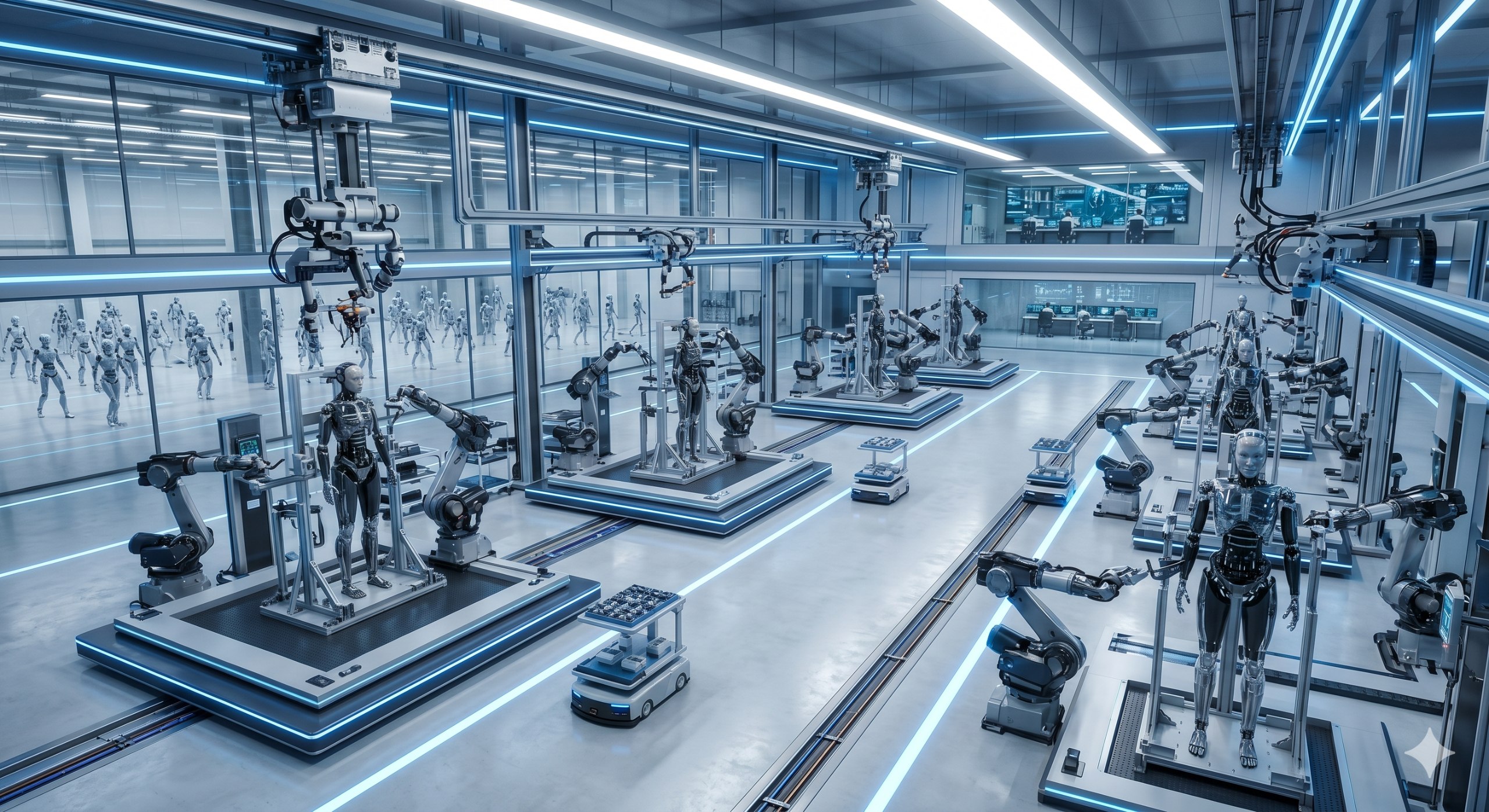
To support these production targets, Figure is establishing its own manufacturing facility in the San Francisco Bay Area. The facility is designed to be a "factory within a factory" — a highly automated assembly line where robots (including Figure robots themselves, in a recursive manufacturing loop) assist human workers in building the next generation of humanoid robots.
The manufacturing process is organized into several stages:
- Sub-assembly lines: Dedicated work cells for actuators, hands, sensor modules, compute modules, and battery packs
- Chassis assembly: Integration of the main structural frame with actuation systems
- Cable routing and harness assembly: One of the most labor-intensive steps in current humanoid manufacturing
- Final assembly: Mating of arms, legs, and head to the torso; installation of exterior panels
- Testing and validation: Full functional testing of each robot, including movement calibration, sensor verification, and AI model validation
- Burn-in: Extended operation period to identify early failures before customer delivery
The $20,000-50,000 Target and Its Implications
The target price range of $20,000 to $50,000 is not arbitrary; it is derived from the economics of replacing a human worker. In the United States, the fully loaded annual cost of a manufacturing worker (wages, benefits, payroll taxes, training, supervision) is typically $50,000 to $80,000. A humanoid robot priced at $30,000 with a five-year depreciation schedule would cost approximately $6,000 per year in capital cost, plus perhaps $5,000 per year in maintenance, electricity, and software subscriptions — for a total annual cost of roughly $11,000, less than one-fifth the cost of a human worker.
Even accounting for the robot's likely lower productivity in the early years of deployment (lower speed, narrower task range, need for supervision), the economic case is compelling at the target price. The challenge for Figure is to reach that price point while maintaining the reliability and capability that customers demand. If the company succeeds, the addressable market is effectively every job that involves physical manipulation in structured environments — millions of roles across manufacturing, logistics, retail, food service, hospitality, healthcare, and construction.
Funding and Valuation
Figure AI has been one of the most heavily funded startups in the robotics sector, reflecting both the capital-intensive nature of building a humanoid robotics company and the enormous enthusiasm among technology investors for the humanoid robot thesis.
Funding History
The company's major funding rounds include:
-
Seed Round (2022): An undisclosed seed round led by Brett Adcock's personal capital and contributions from angel investors, funding the company's first 18 months of operation and the development of the Figure 01 prototype.
-
Series A (2023): Approximately $70 million raised from a group of technology investors including leading venture capital firms. This round funded the transition from Figure 01 to Figure 02 and the initial build-out of the engineering team.
-
Series B (Early 2024): $675 million raised in one of the largest single funding rounds for a robotics company. The round was led by high-profile strategic investors and included:
- Microsoft: The tech giant invested as part of its broader bet on AI and robotics platforms, viewing Figure as a potential channel for Azure AI services and enterprise AI deployment.
- NVIDIA: NVIDIA's investment is both financial and strategic — Figure 02 uses NVIDIA compute and simulation platforms, and NVIDIA clearly sees humanoid robots as a future growth driver for its robotics-related hardware and software products.
- Amazon Industrial Innovation Fund: Amazon's dedicated fund for supply chain, logistics, and manufacturing technology made a significant investment, reflecting Amazon's intense interest in warehouse automation and its ongoing search for solutions to labor shortages in its fulfillment centers.
- Bezos Expeditions: Jeff Bezos's personal investment vehicle participated, marking one of the most high-profile individual endorsements of the humanoid robotics thesis. Bezos has long been fascinated by robotics and automation — Amazon's acquisition of Kiva Systems (now Amazon Robotics) was one of the defining moves in warehouse automation.
- Other investors: The round also included participation from Parkway Venture Capital, ARK Invest, Align Ventures, and a consortium of other technology-focused funds.
-
Additional Funding (2024-2025): Figure raised additional capital through a combination of venture debt and smaller equity rounds, bringing cumulative funding to over $750 million.
Valuation
As of early 2026, Figure AI is valued at approximately $2.6 billion on a fully diluted basis, making it a "centaur" (a startup valued over $100 million) approaching "decacorn" status ($10 billion+). The valuation has grown roughly 10x from the Series A to the Series B, reflecting the rapid progress in technology development and commercial deployment.
For context, Figure's $2.6 billion valuation places it among the most valuable private robotics companies globally, alongside or ahead of established players like Boston Dynamics (reportedly valued around $3 billion after various ownership changes) and well ahead of most other humanoid robotics startups.
Capital Allocation
Figure has been relatively transparent about how it is using its capital:
- Engineering talent: The largest expense category, with a team of approximately 400 engineers, researchers, and technicians commanding competitive Silicon Valley compensation packages
- Hardware development: Tooling, prototyping, and testing costs for multiple generations of robot hardware
- Manufacturing: Capital equipment for the production facility and initial inventory of components and raw materials
- AI training compute: Significant expenditure on GPU clusters for training the company's neural network models
- Field operations: Deployment teams, customer support, and maintenance capabilities for deployed robots
- Working capital: The cash conversion cycle for hardware manufacturing (pay suppliers before receiving customer payments) requires substantial working capital reserves
Investor Perspective
From an investor's perspective, Figure AI represents a high-risk, high-reward bet on a technology that could either transform the global economy or remain a niche curiosity for decades. The bull case centers on the enormous addressable market (millions of replacement workers in developed economies with aging populations) and the possibility that Figure establishes a first-mover advantage that proves difficult to overcome. The bear case centers on the immense technical challenges still to be solved, the possibility of a safety incident that could trigger regulation and public backlash, and the threat of competition from well-funded incumbents like Tesla and emerging Chinese manufacturers with lower cost structures.
The presence of Microsoft, NVIDIA, Amazon, and Bezos as investors lends credibility to Figure and provides strategic support beyond mere capital — these are companies with deep expertise in AI computing, cloud infrastructure, logistics, and large-scale hardware manufacturing that can help Figure navigate the challenges ahead.
Competitive Landscape
Figure AI operates in a rapidly intensifying competitive environment. The race to build commercially viable humanoid robots has attracted some of the world's most capable engineering organizations, and the competitive dynamics are evolving quickly.
Tesla Optimus
Tesla's Optimus program (also referred to as Tesla Bot) is widely seen as Figure's most formidable competitor. Unveiled in 2021 at Tesla's AI Day, Optimus has progressed through multiple prototype generations and is now being tested in Tesla's own factories. Tesla's advantages are substantial: the company has world-class expertise in mass manufacturing, supply chain management, battery technology, and AI (including the Dojo supercomputer project for AI training). Elon Musk has claimed that Optimus could eventually be sold for $20,000 or less, undercutting even Figure's ambitious targets. However, Tesla has been criticized for overpromising and underdeliving on robotics timelines, and the degree of Optimus's actual functional capability remains somewhat unclear to outside observers.
Boston Dynamics
Boston Dynamics, now owned by Hyundai Motor Group and widely recognized as the birthplace of modern dynamic legged locomotion, is the established technology leader in advanced robotics. Their Atlas platform (recently converted from hydraulic to all-electric actuation) demonstrates extraordinary athletic capabilities: backflips, parkour, dancing, and acrobatic maneuvers that no other humanoid robot can match. However, Boston Dynamics has historically struggled to commercialize its technology — Spot, their four-legged robot, has found niche applications in inspection and surveying but has not achieved broad commercial adoption. Hyundai's ownership brings significant manufacturing resources and a clear use case (automotive manufacturing), which could accelerate Boston Dynamics' commercialization trajectory.
Unitree Robotics
Unitree, based in Hangzhou, China, has emerged as a highly competitive player in the humanoid robotics space. Their H1 and subsequent G1 humanoid robots have generated enormous attention for their combination of impressive capability and dramatically low pricing — the G1 is priced at approximately $16,000, well below Figure's target price range. Unitree benefits from China's advanced supply chain for motors, batteries, sensors, and electronics, as well as lower labor costs for assembly. The concern for Western competitors is that Unitree (and other Chinese robotics companies) could replicate the playbook that Chinese companies used to dominate solar panels, lithium batteries, and increasingly electric vehicles: aggressive price competition enabled by supply chain advantages and state support, eventually marginalizing higher-cost Western producers.
1X Technologies
1X (formerly Halodi Robotics), based in Norway, takes a distinct approach to the humanoid form factor. Their EVE robot (wheeled base, humanoid upper body) and newer NEO (bipedal) platform emphasize safety and affordability, with a focus on applications in service, healthcare, and home environments. 1X has a strategic partnership with OpenAI (also an investor in the company), giving it access to advanced AI capabilities. The company's more conservative design philosophy — prioritizing safety and simplicity over raw capability — could prove advantageous in applications where human interaction is frequent and the risk of injury must be minimized.
Agility Robotics
Agility Robotics, based in Oregon, builds Digit, a humanoid robot focused specifically on logistics and warehouse tasks. Digit has a distinctive leg design (inverted knees that fold backward) optimized for stability and efficiency in structured environments. Agility was the first company to achieve a significant commercial deployment of humanoid robots, partnering with Amazon and logistics providers for pilot programs. The company was acquired by Psyche Robotics in 2024, signaling continued consolidation in the sector. Digit's narrower focus on logistics could be either an advantage (deeper optimization for a specific use case) or a limitation (narrower total addressable market) compared to Figure's general-purpose approach.
Comparative Analysis
The competitive landscape can be understood across several dimensions:
-
Technical capability: Boston Dynamics leads in dynamic locomotion and athletic performance; Figure and 1X are strong in AI and autonomous operation; Tesla benefits from deep pockets and robotics expertise but has shown less concrete progress in public demonstrations.
-
Cost competitiveness: Unitree is the clear leader on unit price, followed by Figure's targeted pricing; Tesla claims aggressive pricing but has not published specific numbers for a production product.
-
Commercial traction: Agility and Figure have the most advanced commercial deployments; Boston Dynamics has modest commercial traction through the Spot platform; Unitree sells primarily to research labs and developers; 1X is pre-commercial; Tesla Optimus has not been sold externally.
-
Manufacturing capability: Tesla and, increasingly, Unitree have demonstrated ability to manufacture at scale; Figure and Boston Dynamics are building manufacturing capabilities; Agility and 1X face more significant manufacturing scaling challenges.
-
Funding: Figure and Tesla (with its massive corporate resources) are best capitalized; Boston Dynamics benefits from Hyundai's resources; Unitree has raised substantial venture capital though less than Figure; 1X and Agility operate with smaller war chests.
The competitive picture suggests that the humanoid robot market is unlikely to be a winner-take-all market, at least in the near term. Different form factors, price points, and specialization foci will likely coexist across different applications and geographies. However, the company that can achieve the best combination of capability, reliability, and cost at scale will be well-positioned to capture the largest share of the most economically valuable applications.
Market Opportunity: The Labor Shortage Thesis
The economic case for humanoid robots rests on a single, powerful observation: developed economies around the world face a structural and worsening shortage of workers willing and able to perform physical labor, and this shortage will only intensify in the coming decades due to demographic trends, cultural shifts, and economic development.
The Demographic Imperative
The world is undergoing an unprecedented demographic transformation. The United Nations projects that the global share of the population aged 65 and over will rise from approximately 10% in 2022 to 16% in 2050, with even steeper increases in developed economies. Japan, Italy, Germany, South Korea, and increasingly the United States and China are experiencing or approaching population decline as birth rates fall below replacement levels.
For labor markets, this means a shrinking pool of working-age adults to fill available jobs. In the United States, the labor force participation rate for prime-age workers (25-54) has been trending downward for decades, exacerbated by the retirement of the Baby Boomer generation. The Congressional Budget Office projects that labor force growth will average just 0.1% per year over the next decade, compared to 1.3% per year between 1990 and 2010.
The Unfilled Jobs Crisis
As of early 2026, the United States has approximately 10 million unfilled jobs across all sectors, according to Bureau of Labor Statistics data. While this number fluctuates with economic cycles, the structural component — jobs that remain unfilled even during economic slowdowns — has been steadily rising. The most severe shortages are in:
- Manufacturing: Approximately 600,000 unfilled manufacturing jobs in the US, with the National Association of Manufacturers projecting that 2.1 million jobs could go unfilled by 2030 due to the skills gap and demographic trends.
- Logistics and warehousing: The explosive growth of e-commerce has created enormous demand for warehouse workers, with turnover rates exceeding 100% annually at some major operators. The warehousing and storage sector has roughly 200,000 unfilled positions.
- Construction: With 400,000+ unfilled positions, construction faces severe labor shortages that contribute to housing affordability crises across major metropolitan areas.
- Food service and hospitality: The post-pandemic recovery in these sectors has been hampered by persistent difficulty attracting workers, with millions of positions remaining unfilled even as wages rise substantially.
- Healthcare support: As the population ages, demand for nursing assistants, home health aides, and other healthcare support roles far outstrips supply.
The "Dirty, Dangerous, and Dull" Factor
Beyond aggregate demographics, there is a cultural dimension to the labor shortage. Younger generations — particularly in developed economies — are increasingly unwilling to perform jobs that are physically demanding, repetitive, dangerous, or socially stigmatized. This is not primarily a wage issue; wages in many blue-collar roles have risen substantially in recent years without attracting sufficient workers. It is a question of job quality, dignity, and the expectation that technology should eliminate rather than create drudgery.
This creates a natural use case for robots that can perform the most undesirable tasks — lifting heavy objects, working in extreme temperatures, performing the same motion thousands of times per shift, handling hazardous materials — while freeing human workers for more engaging, varied, and higher-value roles.
The Addressable Market for Humanoid Robots
Estimating the total addressable market (TAM) for humanoid robots is inherently speculative, but analysts have offered a range of projections:
- Goldman Sachs (2024): Projected a $6 billion market by 2030 and up to $154 billion by 2035 in a "blue sky" scenario, with the base case around $38 billion.
- Mordor Intelligence: Estimated the humanoid robot market at $3.3 billion in 2024, growing at 45% CAGR to $66 billion by 2030.
- Internal industry estimates: Many companies in the sector project markets exceeding $1 trillion in the long term, effectively equating to the replacement of a significant fraction of the global manual labor force.
The most realistic near-term addressable market (2025-2030) is probably in the tens of billions of dollars, concentrated in manufacturing and logistics where the value proposition is clearest and the operating environment is most structured. Over a 10-20 year horizon, as technology improves and costs decline, the market could expand dramatically into construction, retail, food service, hospitality, healthcare, and ultimately domestic service.
Economic Impact
The potential economic impact of successful humanoid robotics extends beyond the direct revenues of robot manufacturers. If humanoid robots can effectively address labor shortages, they could:
- Slow wage inflation in labor-constrained sectors, reducing cost pressures on consumers
- Enable onshoring of manufacturing that had moved overseas in search of cheaper labor
- Increase GDP growth by expanding the effective labor force
- Improve workplace safety by eliminating many of the most dangerous jobs
- Enable new forms of care for the elderly and disabled that are currently unaffordable due to labor costs
- Support economic growth in regions (particularly East Asia) experiencing the most severe demographic decline
Key Technical Challenges
For all the excitement surrounding humanoid robots, the technology remains at an early stage, and significant technical challenges must be overcome before widespread deployment is feasible.
Manipulation Dexterity and Reliability
Human hands are extraordinarily capable manipulators, with 27 degrees of freedom, thousands of mechanoreceptors per square centimeter, and a brain that has been optimized for fine manipulation over millions of years of evolution. Reproducing even a fraction of this capability in a robot is enormously challenging.
Current humanoid robot hands can perform basic power grasps and simple pinch grips, but they struggle with tasks requiring delicate force control (inserting a key into a lock, handling a raw egg without crushing it), in-hand manipulation (reorienting an object without dropping it), or adapting to objects of widely varying shape and compliance. Reliability is a particular concern: a hand that works 99% of the time would drop an object every 100 grasps, which is unacceptable in a factory environment where hourly throughput targets are measured in hundreds of units.
Balance and Locomotion in Unstructured Environments
While Figure 02 and other humanoid robots can walk reliably on flat, clean surfaces, real-world environments present endless challenges: slippery floors, loose gravel, uneven pavement, stairs of varying height and depth, door thresholds, cables on the floor, wet surfaces, and unexpected obstacles. Recovering from a trip or stumble — something humans do reflexively — requires sophisticated sensing, rapid computation, and precisely coordinated joint torques that push the limits of current technology.
Bipedal locomotion also imposes significant energy costs. Humans are remarkably efficient walkers, using about 0.4-0.6 metabolic equivalent (MET) for level walking. Current humanoid robots consume several times more energy per unit of distance traveled, limiting battery life and increasing operating costs.
Perception and Scene Understanding
Figure 02's vision system can detect and classify objects, but true scene understanding — knowing what objects are, what they are for, how they relate to each other, and what actions are possible with them — remains a hard AI problem. A human who walks into an unfamiliar kitchen can immediately identify the refrigerator, understand that it opens, know that food is stored inside, and plan a sequence of actions to retrieve an ingredient. Achieving this kind of robust, generalized scene understanding in real-time on an embedded computing platform is a profound technical challenge.
Long-Horizon Task Planning and Execution
Most real-world tasks involve sequences of actions that extend over minutes or hours: "Relocate 500 boxes from location A to location B, but if any box is labeled 'fragile,' place it on the top layer; if any box is leaking, stop and flag it for inspection; if the path to location B is blocked, find an alternative route." Handling such multi-condition, long-horizon tasks reliably requires planning, memory, common-sense reasoning, and the ability to recover from failures at any intermediate step.
Current AI systems, including the large language model-based architectures Figure uses, are notoriously fragile in long-horizon tasks. They can lose track of their position in a sequence, forget earlier conditions or constraints, or fail to recognize when a subtask has been completed incorrectly and needs to be re-done. Improvements in reasoning, memory, and robust plan execution are essential for real-world deployment.
Safety and Reliability
A 60-kilogram robot moving at human walking speed with articulated arms that can generate substantial forces represents a significant safety concern. If the robot falls, or if its arm strikes a human worker, serious injury could result. Current safety approaches include force limiting (joints cannot exert more than a certain torque), speed limiting in human proximity, and software-based collision detection and avoidance. However, achieving safety levels comparable to human workers — or better — across all operating conditions remains an open challenge.
The reliability requirement is equally stringent. Industrial customers expect equipment uptime of 99% or higher over multiple years of operation. For a complex electromechanical system with dozens of moving joints, hundreds of sensors, and a neural network control stack, achieving this level of reliability at the target price point is an enormous engineering challenge.
Cost Reduction
As discussed in the manufacturing strategy section, reducing cost from approximately $100,000+ per unit today to $20,000-50,000 at scale requires breakthroughs in actuator design, battery technology, sensor cost, manufacturing process, and supply chain development. While the cost trajectory is plausible — similar to the cost declines seen in electric vehicle batteries and consumer electronics — it is not guaranteed, and Figure's entire economic thesis depends on reaching the target price point.
Software Reliability and AI Robustness
Neural network-based control systems have well-known failure modes: they can be fooled by adversarial inputs, perform unpredictably in out-of-distribution situations, and lack the interpretability that would allow engineers to understand and fix specific failure cases. For a factory robot whose failures could cause production downtime, equipment damage, or human injury, achieving sufficient AI robustness is a prerequisite for scaled deployment. The industry is actively researching approaches including formal verification, uncertainty quantification, and failover to classical control systems, but no fully satisfactory solution exists today.
Power and Thermal Management
Operating a full-body humanoid robot with high-torque actuators, powerful compute, and multiple sensors generates substantial heat that must be dissipated without active cooling systems that would add weight, cost, and points of failure. Current robot designs struggle with thermal management during sustained high-intensity operation, and battery technology limits operating time to a few hours per charge.
Observatory Analysis and Outlook
From the perspective of POC.HK Future Technology Observatory, Figure AI represents one of the most important and interesting companies to emerge in the robotics space in the past decade. Its combination of aggressive timelines, substantial funding, rapidly improving technology, and early commercial traction makes it a company that demands serious attention from anyone tracking the future of labor, manufacturing, and automation.
Strengths and Advantages
Figure's primary strengths are:
- Clear thesis and focus: Unlike some robotics companies that meander between applications, Figure has maintained a consistent focus on the general-purpose humanoid form factor for industrial applications.
- Technical approach: The commitment to end-to-end neural network control, trained through imitation learning at scale, represents a genuine technical bet that could prove decisive if it pays off. This approach aligns with the broader trend in AI toward learned rather than engineered solutions.
- Early commercial validation: The BMW deployment, while small, is a genuine commercial engagement that provides real-world data, customer feedback, and operational experience that pure R&D efforts cannot match.
- Funding and relationships: The quality of Figure's investor base — Microsoft, NVIDIA, Amazon, Bezos — provides not just capital but strategic support, commercial introductions, and credibility with enterprise customers.
- Founder execution: Brett Adcock's track record with Vettery and Archer Aviation, while not in robotics, demonstrates ability to raise capital, build teams, execute on ambitious timelines, and navigate complex hardware development cycles.
Risks and Vulnerabilities
Figure's primary risks are:
- Capital intensity: Building a humanoid robotics company is enormously expensive, and Figure will likely need to raise substantial additional capital before reaching profitability. Market conditions for technology fundraising could deteriorate, and existing investors may not continue to support the company indefinitely without demonstrated progress toward profitability.
- Competition: The competitive landscape is intensifying rapidly, with well-funded and capable competitors from multiple angles. Tesla's manufacturing expertise and brand, Unitree's cost advantages, and Boston Dynamics' technical leadership each pose different but serious threats.
- Technical risk: The end-to-end neural network approach, while intellectually appealing, has not been proven at the scale and reliability required for commercial deployment. It is possible that this approach proves inadequate for the most demanding real-world applications, requiring Figure to pivot to more conventional control architectures.
- Regulatory risk: The deployment of humanoid robots in workplaces raises unresolved regulatory questions around safety certification, liability for robot-caused injuries, and the potential for job displacement to trigger political backlash and restrictive regulation.
- Manufacturing execution: Scaling from dozens to thousands to tens of thousands of units per year is extraordinarily difficult for any hardware product, and humanoid robots are among the most complex electromechanical systems ever attempted at volume production.
- Safety incident: A single serious safety incident — a robot injuring a human worker — could set the entire industry back years, triggering increased regulation, public fear, and customer hesitation.
Outlook Assessment
Figure AI has a reasonable probability of becoming a significant commercial success, but that probability is well below 50%. The company faces genuine technical, commercial, and manufacturing challenges that no company has yet solved at scale. The most likely outcome over the next 3-5 years is probably not outright failure or dominant success, but rather a continuation of Figure's current trajectory: gradual improvement in technology, expansion of commercial deployments, multiple rounds of additional funding, and eventual acquisition by a larger industrial or technology company that sees humanoid robotics as strategically important.
An acquisition by Microsoft, NVIDIA, Amazon, or an automotive OEM would be a natural outcome that provides Figure's investors with a return while giving the acquiring company a leading position in what could become a transformative technology category. The precedents are well established: Google acquired Boston Dynamics (later selling to Hyundai), Amazon acquired Kiva Systems, and numerous other robotics companies have been acquired by larger strategic buyers.
The Time to Take It Seriously
Regardless of Figure's ultimate fate as a company, the broader category of humanoid robots deserves serious attention from business leaders, policymakers, and investors. Even if Figure AI itself does not succeed, the technical progress the company has made — along with progress by Tesla, Unitree, Boston Dynamics, and others — suggests that commercially viable humanoid robots will arrive within this decade, not in some distant future. Business leaders should begin planning for a world in which humanoid robots are available at prices and capability levels that make them economically viable for a growing range of applications.
Policymakers should consider the implications for labor markets, training and education, workplace safety regulation, and social safety nets. The transition to a workforce that includes significant numbers of humanoid robots could be enormously beneficial — increasing productivity, filling labor gaps, and eliminating dangerous jobs — but it will also require thoughtful management to ensure that the benefits are broadly shared.
Why It Matters
Humanoid robotics stands at a rare inflection point where multiple technology trends — advances in AI, declining cost of sensors and compute, improved battery technology, breakthroughs in actuation and materials science, and growing manufacturing capability — are converging to make possible something that science fiction has promised for nearly a century: a general-purpose machine that can work alongside humans, performing physical tasks with flexibility and intelligence.
Figure AI is one of the leading companies attempting to turn this vision into commercial reality. Whether the company succeeds or fails will matter enormously — not just for its employees and investors, but for our collective understanding of what is possible in robotics and AI. A successful Figure AI would demonstrate that general-purpose physical labor can be automated, opening the door to a transformation of the global economy as profound as the Industrial Revolution or the digital revolution. A failure would set back the entire field by years and would particularly discredit the end-to-end AI approach to robot control, potentially sending the industry back toward more incremental, task-specific automation.
The implications of successful humanoid robotics extend far beyond factory floors. If robots can perform physical work with human-level adaptability at sub-human cost, the effects ripple through every sector of the economy: manufacturing becomes cheaper and more resilient to supply chain disruptions; logistics becomes faster and more reliable; construction becomes more productive and safer; elder care becomes more affordable and accessible; retail and hospitality can staff locations fully even in tight labor markets; and dangerous jobs in mining, firefighting, disaster response, and hazardous materials handling can be delegated to machines that will never be injured.
The labor question — whether humanoid robots will destroy jobs or create them — is the most emotionally charged and politically consequential issue surrounding the technology. The evidence from previous waves of automation (industrial robots, computers, the internet) suggests that the actual effects are complex and depend heavily on policy choices, education systems, and social safety nets. In the most optimistic scenario, humanoid robots fill the roles that no one wants to do anyway — dirty, dangerous, and dull — while humans shift toward more creative, interpersonal, and intellectually engaging work, with higher wages and better working conditions for those who remain in physical roles. In the pessimistic scenario, automation displaces workers faster than new jobs can be created, exacerbating inequality and social unrest.
The outcome is not predetermined. It will be shaped by the technical choices made by companies like Figure AI, the policy decisions made by governments, the investment priorities of capital markets, and the collective choices of society about what kind of future we want to build. What matters most, for now, is that we pay attention. The humanoid robot revolution may still be in its early days, but it is no longer a distant speculation. It is happening. Figure AI, whatever its fate, is helping to write the first chapter of that story.
Disclaimer: This article is compiled by POC.HK Future Technology Observatory based on publicly available information, company disclosures, industry reports, and analyst assessments. It is provided for informational and educational purposes only and does not constitute investment advice, solicitation, or endorsement of any kind. The analysis and opinions expressed reflect the understanding of the Observatory as of the date of publication and may change as new information becomes available. Readers are encouraged to conduct their own due diligence and consult qualified financial advisors before making any investment decisions. POC.HK makes no representations or warranties as to the accuracy or completeness of the information contained herein.