On May 28, 2026, Anthropic completed the largest financing round in AI history — raising $65 billion in Series H funding at a $965 billion valuation, surpassing OpenAI to become the world's most valuable private AI company. This milestone not only reflects investor confidence in the Claude model family's technical trajectory, but also marks the maturation of the "AI safety first" philosophy from a fringe position into a mainstream industry paradigm. From its founding in 2021 by former OpenAI researchers Dario Amodei and Daniela Amodei, Anthropic has traversed in five years a journey that would take traditional technology companies twenty.
Founding Story: An Alternative AI Path Born from Safety Concerns
Anthropic's genesis traces back to a schism over AI safety philosophy. In late 2020, OpenAI's safety research team — led by Dario Amodei — grew deeply concerned about OpenAI's increasingly commercialization-driven direction following the release of GPT-3. The core disagreement centered on whether AI safety should be a company's internal policy or an independent research domain requiring external governance.
In early 2021, seven core OpenAI researchers — including Dario Amodei, Daniela Amodei, Tom Brown, Jared Kaplan, and Sam McCandlish — collectively resigned to form Anthropic. The company name, derived from the "anthropic principle," signals its core conviction that AI systems must be fundamentally designed with human interests as the starting point.
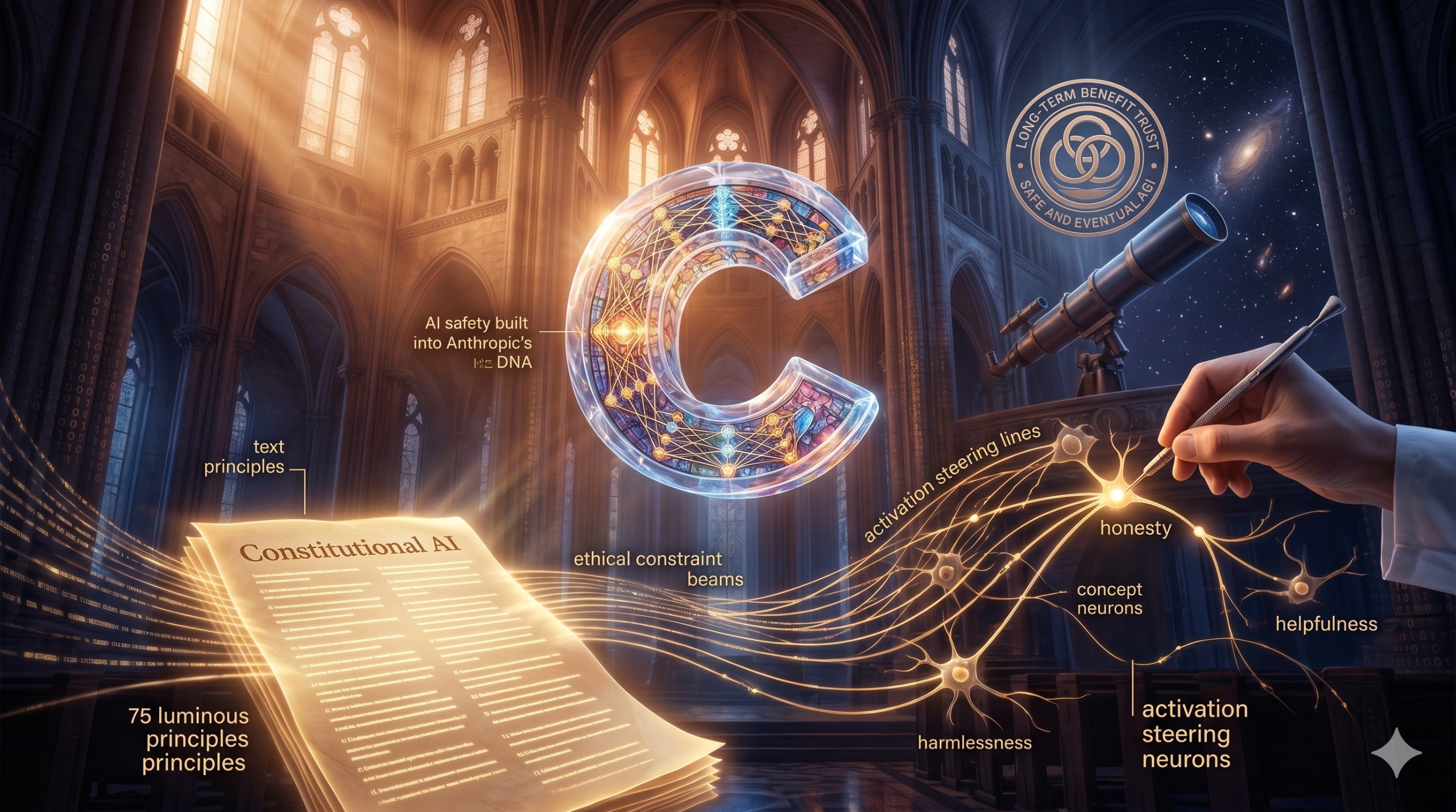
This founding DNA has guided Anthropic's technical decisions throughout its five-year history: from Claude's Constitutional AI training methodology to the Long-Term Benefit Trust in its governance structure, Anthropic has adopted the most cautious safety-oriented approach among all major AI companies.
Funding Trajectory: From Ethical Mission to Trillion-Dollar Commercial Equation
| Round | Date | Amount | Valuation | Lead Investors |
|---|---|---|---|---|
| Seed | May 2021 | $124M | Undisclosed | Sandberg, Angels |
| Series A | Apr 2022 | $580M | Undisclosed | FTX (later bankruptcy) |
| Series B | Feb 2023 | $300M | ~$4B | Undisclosed |
| Series C | May 2023 | $450M | ~$5B | Spark Capital, Google |
| Series D | Aug 2023 | $200M | ~$9B | Google, Salesforce |
| Series E | Dec 2023 | $700M | ~$18B | Menlo Ventures, Google |
| Series F | Feb 2024 | $1B | ~$30B | Menlo, Google, Spark |
| Series G | Mar 2025 | $3.5B | ~$61.5B | Lightspeed, Coatue, Google |
| Series H | May 2026 | $6.5B | $965B | Lightspeed, Coatue, Sequoia, Google, Saudi Arabia PIF, SoftBank |
Anthropic's capital path reveals two striking features: first, an extremely steep valuation growth curve — from $4 billion in early 2023 to $965 billion in mid-2026, a 240x increase in three years; second, Google's position as the most committed strategic investor, participating in every round from Series C through H.
Of the $65 billion Series H, approximately $30 billion is allocated to compute infrastructure — including the Colossus 1 contract with SpaceX valued at $1.25 billion per month through 2029, providing over 300 megawatts of compute power. The remaining capital will fund Claude team expansion (from 1,200 to 3,000 people), next-generation model training, and product internationalization.
The Claude Model Family: Technical Architecture and Iteration
Claude 3 (March 2024)
Anthropic's first multimodal model family, with three tiers: Haiku, Sonnet, and Opus. Opus matched GPT-4 on benchmarks including MMLU and GSM8K. Claude 3 introduced key improvements to Constitutional AI — guiding model behavior through a predefined set of conduct principles rather than human feedback, fundamentally solving the "reward hacking" problem inherent in RLHF.
Claude 3.5 Sonnet (June 2024)
Anthropic made a bold product decision — releasing only the Sonnet tier, skipping an Opus refresh. This positioned Claude 3.5 Sonnet to deliver near-flagship performance at roughly one-tenth the inference cost of Opus, making it the developer community's preferred API model.
Claude 4 (June 2025)
A major architectural shift — Claude 4 integrated Agentic AI capabilities into the core model for the first time, enabling users to define multi-step workflows through natural language, with the model autonomously deciding when to use tools, how to gather information, and when to request user confirmation. Claude 4 also supported a 200K token context window, establishing new industry standards in long-document comprehension and code generation.
Claude Opus 4.8 (May 2026)
The latest flagship model, achieving qualitative leaps in reasoning, coding, and tool use. Opus 4.8's most compelling capability demonstration came from a startling experiment: Anthropic's research team instructed Opus 4.8 to autonomously orchestrate a multi-agent system to migrate the Bun runtime from Zig to Rust — 750,000 lines of code migrated in just 11 days with a 99.8% test pass rate. This experiment demonstrated that agentic AI is no longer just an assistive tool, but a structural presence capable of undertaking large-scale software engineering.
Core Technical Innovations: From Constitutional AI to Interpretability Research
Anthropic has invested substantially more than competitors in three technical directions:
Constitutional AI: Unlike OpenAI's RLHF approach, Anthropic's models train themselves using a predefined set of behavioral principles. This method has two key advantages: (1) reducing dependence on expensive human-labeled data; and (2) making model values more stable and predictable — because the behavioral principles are public rather than hidden in individual annotators' judgment. Claude's behavioral constitution currently includes approximately 75 principles covering dimensions of honesty, helpfulness, and harmlessness.
Interpretability Research: Anthropic has invested heavily in understanding the internal mechanisms of neural networks. Its research team developed techniques such as Feature Visualization and Activation Steering, enabling researchers to locate and manipulate neural representations of specific concepts within models — for instance, finding neurons associated with "deception" and dampening their activation. While still in early stages, this research provides the most fundamental technical guarantee for AI safety.
Long-Term Benefit Trust: Anthropic's unique governance structure. The trust is managed by trustees independent of company operations, with the authority to intervene when Claude models could cause serious harm — including requesting suspension of model deployment, modifying conduct principles, or in extreme cases, dissolving the company. This structure makes Anthropic the only AI company theoretically capable of making decisions contrary to commercial interests but beneficial to safety.
Market Positioning and Competitive Landscape
| Dimension | Anthropic | OpenAI | Google DeepMind |
|---|---|---|---|
| Flagship model | Claude Opus 4.8 | GPT-5.5 Instant | Gemini 3.5 Flash |
| Safety approach | Constitutional AI + Trust | Internal oversight board | Google AI Principles |
| Core customers | Enterprise developers, finance | Consumer + Enterprise | Search + Workspace |
| API pricing | Premium (safety premium) | Mid-range | Lower (subsidized) |
| Valuation | $965B | ~$800B | Under Alphabet |
| Compute partnership | SpaceX Colossus 1 | Microsoft Azure | Google TPU |
Anthropic's market positioning can be summarized as "the Apple of AI safety" — attracting customers with the highest demands for safety and reliability at premium pricing, rather than pursuing market-share-maximization strategies. This positioning is particularly effective in the enterprise market, where financial institutions, healthcare providers, and defense contractors find "explainability" and "controllability" decisive factors in selecting AI vendors.
Observatory Analysis: The Structural Significance of Anthropic
Anthropic's rise is not merely a single company's success story — it represents a structural divergence in the development path of the AI industry.
Market Validation of the Safety Premium: Anthropic has proven at a $965 billion valuation that "trustworthy AI" is a genuine market category — enterprises and institutions are willing to pay a premium for explainability, controllability, and safety. This creates a parallel industrial track alongside the pure performance-maximization approach. In a world gripped by fear of "AI gone wrong," the trust Anthropic provides is itself a scarce resource.
Viability of the Independent Path: Anthropic's growth has demonstrated the commercial viability of an independent AI company model — one not dependent on a major cloud platform. Unlike OpenAI's reliance on Microsoft or Gemini's on Google, Anthropic has maintained full operational independence. Despite accepting Google investment, its governance trust mechanism ensures decision-making independence. This could become the organizational template for a new generation of AI companies.
Transition from Model Competition to Ecosystem Competition: As the Claude family matures, Anthropic is transitioning from a model provider to an ecosystem orchestrator. Claude Computer Use, Vulnhunter, and the forthcoming Claude developer platform are building a service ecosystem around model capabilities — mirroring OpenAI's platformization path from GPT-3 to ChatGPT Plus.
Disclaimer: The information in this article is for reference purposes only and does not constitute investment advice or commercial decision-making basis. Data and time-sensitive information are current as of the publication date and may change with subsequent developments. Neither the author nor POC.HK assumes any liability for losses arising from the use of this information.