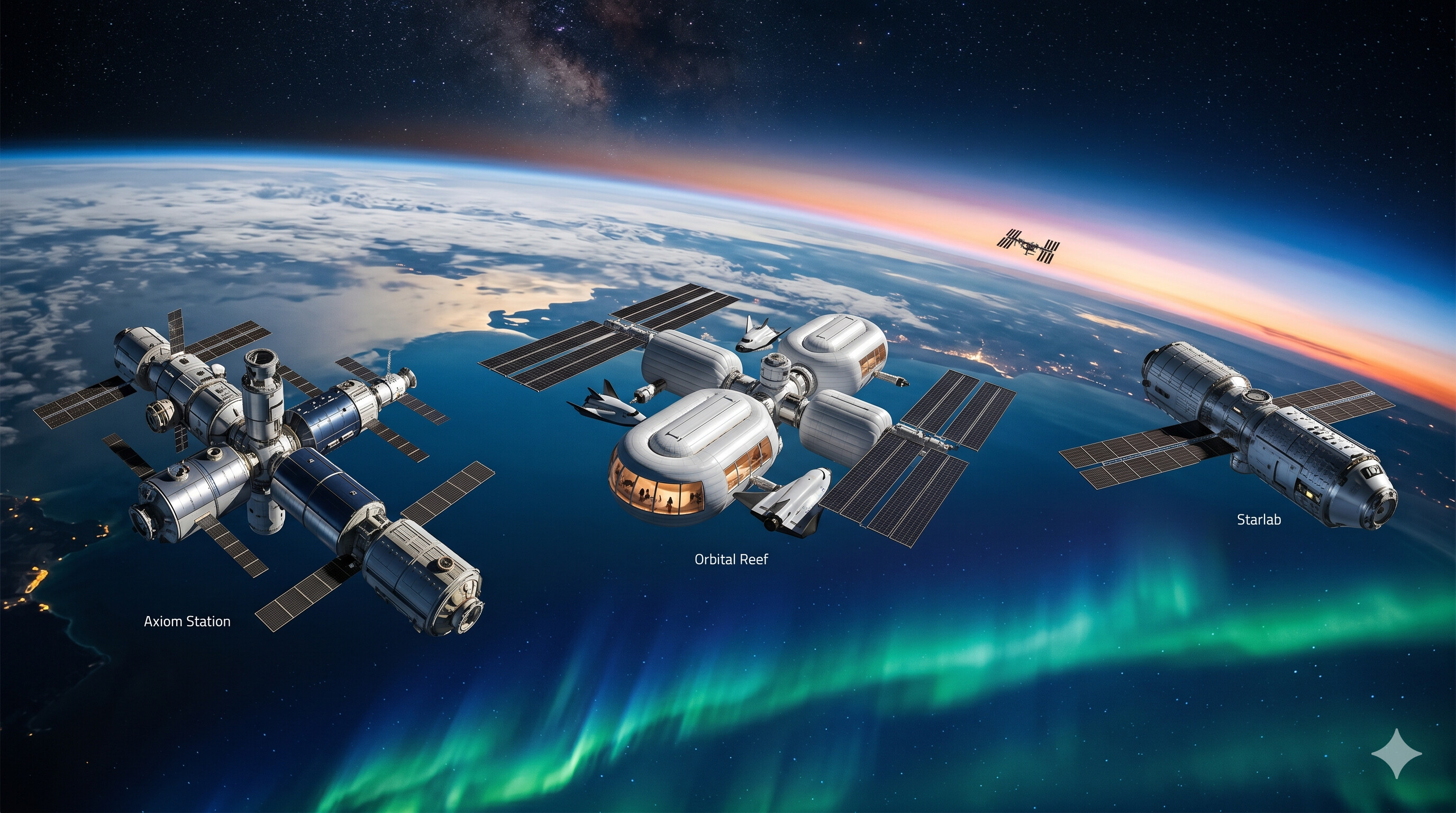
The International Space Station has been humanity's permanent home in orbit since the year 2000. But by 2026, a quarter-century chapter is approaching its close: NASA has scheduled the ISS for deorbit around 2030. Between the ISS retirement and the deployment of commercial replacements, there exists a potential multi-year gap in orbital capability — ending over 30 years of continuous human presence in low Earth orbit. This is not merely an engineering problem but an economic and strategic one: who will build the post-ISS infrastructure for low Earth orbit?
The answer is rapidly emerging. As of mid-2026, at least four well-funded commercial space station programs are racing forward: Axiom Space, Vast, Starlab (led by Voyager Technologies), and Orbital Reef (led by Blue Origin and Sierra Space). Each represents different technological pathways, business models, and strategic positioning. This is an infrastructure race unfolding thousands of kilometers above Earth, with stakes extending beyond billions of dollars in market value to the very future of sustained human presence in low Earth orbit.
THE STRATEGIC CONTEXT OF ISS RETIREMENT
Understanding the commercial space station race requires first understanding the strategic implications of ISS retirement. The ISS is not merely a research platform — it is a diplomatic and scientific ecosystem built by 15 nations including the United States, Russia, Europe, Japan, and Canada, at a cost exceeding $150 billion. Its retirement will leave several critical gaps.
First, research continuity. Microgravity research aboard the ISS has produced thousands of results ranging from protein crystal growth to materials science. If commercial alternatives fail to deploy in time, these research programs face multi-year interruptions, potentially leading to the dissolution of scientific teams and loss of expertise.
Second, crewed spaceflight capability. The ISS is the sole destination for American, European, and Japanese astronauts. Without the ISS, NASA's Commercial Crew Program (SpaceX Crew Dragon) loses its primary customer — but commercial space stations will become the new destination. This accelerates the transition of crewed spaceflight from government program to commercial service.
Third, geopolitical implications. The ISS is a symbol of post-Cold War US-Russian space cooperation. Its retirement will end this unique era of partnership, and the alternatives — whether commercial or China's Tiangong space station — will reshape the geopolitical landscape in orbit.
VAST: THE EXECUTION LEADER
Founded in 2021 by cryptocurrency entrepreneur Jed McCaleb, Vast has moved faster than any competitor. The company has over 1,000 employees at its Long Beach, California headquarters and has raised over $1 billion in total funding, including a landmark $500 million round in March 2026. Vast's Haven Demo — an approximately 500-kilogram satellite testbed — flew successfully in late 2024 and was deorbited in February 2025, making Vast the only commercial station company with flight heritage on its own hardware.
Haven-1, a single-module pathfinder station, is in integration and targeted for a Q1 2027 launch on SpaceX Falcon 9. Haven-2, the multi-module ISS successor, begins module launches in 2028 with full operations by 2032. Vast also secured NASA's 6th private astronaut mission to the ISS.
Vast's strategy is "get to orbit first, iterate later." By prioritizing a smaller pathfinder module, the company aims to establish orbital presence, generate revenue, and accumulate operational experience before expanding to a full station. This approach mirrors SpaceX's rapid iteration philosophy — reducing initial complexity to accelerate first launch.
AXIOM SPACE: THE ISS TRANSITION PLAY
Axiom Space, based in Houston, takes a unique approach: its first modules will attach directly to the ISS, leveraging existing infrastructure while building out its station. Once the ISS retires, the Axiom modules detach to form a free-flying station. This strategy reduces early-stage risk but creates dependency on ISS availability and retirement timelines.
Axiom raised $350 million in February 2026 and has completed multiple private astronaut missions to the ISS, generating real revenue and operational experience. The company has signed research agreements with multiple commercial clients, including pharmaceutical companies interested in microgravity protein crystal growth experiments.
Axiom's competitive advantage lies in operational experience and customer relationships. Through existing NASA contracts and private missions, Axiom has established operational momentum that competitors have not yet matched. However, its ISS-linked strategy carries risk: if the ISS experiences problems before Axiom's modules are capable of independent operation, the entire timeline is affected.
ORBITAL REEF AND STARLAB: THE CONSORTIUM APPROACH
Orbital Reef is a joint venture between Blue Origin and Sierra Space, backed by Jeff Bezos' space company and Sierra's Dream Chaser spaceplane. Partners include Boeing, Redwire, AWS, and Amazon Supply Chain, forming a consortium with deep industrial base. Orbital Reef's design is comparable in scale to the ISS, targeting operational capability by 2030. Its modular architecture allows gradual expansion, while Dream Chaser provides unique cargo transport and return capability.
Starlab, led by Voyager Technologies — which acquired Lockheed Martin's space station assets in 2025 — takes a single-module, large-volume approach targeting a 2028 launch. Unlike other proposals, Starlab requires only a single launch (on SpaceX Starship or New Glenn) to deploy the complete station, avoiding the complexity and risk of multi-module docking. Voyager has also established partnerships with the European Space Agency, securing international partner relationships.
Orbital Reef and Starlab represent capital-intensive approaches — both backed by major aerospace companies with substantial funding but slower decision cycles. Their advantages lie in industrial-scale engineering capability and existing customer relationships.
THE BUSINESS MODEL: FROM GOVERNMENT CONTRACT TO COMMERCIAL SERVICE
The fundamental economic model for commercial space stations is transitioning from NASA's cost-plus contracts to a service procurement model. NASA's Commercial LEO Destination (CLD) program has allocated over $415 million in Phase 1 and plans $1-1.5 billion for Phase 2 (2026-2031). But these funds represent service procurement — NASA purchases seats on stations rather than funding construction.
This means commercial stations require diversified revenue sources. Primary potential customer categories include pharmaceutical and biotechnology companies interested in microgravity protein crystal growth and cell culture. Microgravity can produce higher-quality protein crystals enabling improved drug design. Merck's Keytruda — one of the world's best-selling drugs — benefited from microgravity research in its manufacturing process. This market's potential annual value is estimated at $5-10 billion.
Advanced materials manufacturing in microgravity can produce structures impossible under Earth's gravity. ZBLAN optical fiber, advanced alloys, and electronic materials have commercial potential. Redwire has demonstrated multiple manufacturing demonstrations on the ISS and plans to scale up on commercial stations.
Space tourism and media represent a third revenue stream. Axiom has sold multiple private astronaut missions at $55 million per seat. As costs decline, demand may grow — but this market's size remains highly uncertain.
OBSERVATORY ANALYSIS: A STRUCTURAL SHIFT IN ORBITAL INFRASTRUCTURE
POC.HK Observatory assesses that the commercial space station race represents a deeper structural shift in human space activity — from government-led exploration to commercially driven orbital economy. The ISS retirement is not an ending but a transition point.
Historically, space station economic returns have been indirect — through technology spillover effects and research discoveries rather than direct commercial revenue. Commercial space stations have the first real opportunity to generate sustainable direct revenue. If successful, this would unlock a new economic domain: low Earth orbit as not merely a laboratory and observation platform, but a venue for manufacturing, services, and innovation.
However, risks are substantial. The capital requirements for commercial space stations are enormous — estimated at $3-10 billion to build and operate a crewed station. Market demand is unverified — pharmaceutical companies may ultimately determine microgravity research is not essential, and space tourism may remain a luxury for the few. If a crewed spaceflight capability gap emerges after ISS retirement, re-establishing orbital presence will be more expensive and difficult than maintaining existing presence.
The competitive landscape may also shift. China's Tiangong space station is expanding, Russia plans its own orbital station, and India has announced station plans. The post-ISS LEO environment will not feature a single Western station but a network of multiple orbital outposts — each operated by different nations or entities, serving different customer bases, creating a more fragmented but also more diverse orbital ecosystem.
In the long term, commercial space station success will determine whether humanity can establish truly sustainable presence in low Earth orbit — a question that concerns not only scientific research but the foundational infrastructure for human civilization's expansion into space.
免責聲明:本文所載資料僅供參考,不構成任何投資建議或商業決策依據。數據及時間資訊以發布當日為準,可能隨後續發展而有所變動。作者及POC.HK不對因使用本文資訊而導致的任何損失承擔責任。