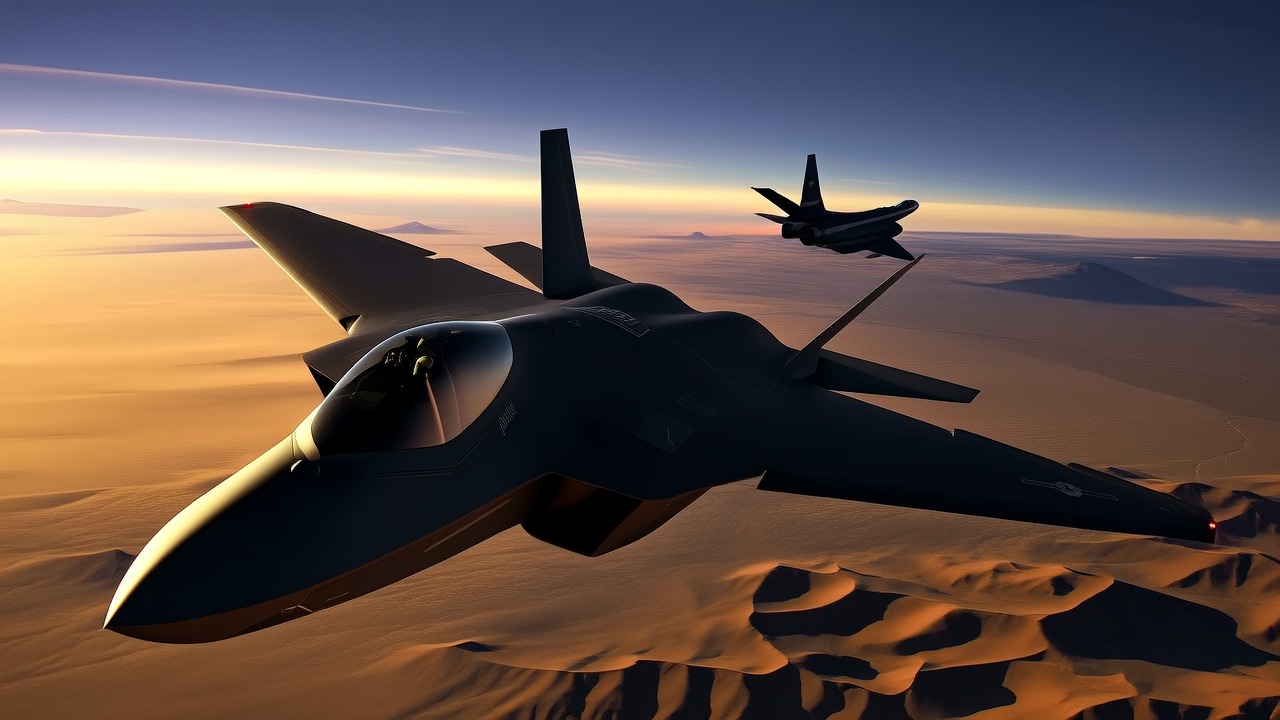
In March 2025, the United States Air Force made a historic decision. When prototype unmanned combat aircraft from two top defense contractors — General Atomics Aeronautical Systems (GA-ASI) and Anduril Industries — were formally assigned fighter designations YFQ-42A and YFQ-44A, this was far more than a naming ceremony. It marked the first time in US Air Force history that the "F" (fighter) prefix had been assigned to an unmanned aircraft.
"This may only be symbolic," said Air Force Chief of Staff General David Allvin at the announcement, "but we are telling the world we are leaning into a new chapter of aerial warfare." The core concept driving this new chapter is the Collaborative Combat Aircraft (CCA), better known by its popular moniker — the "Loyal Wingman."
From Concept to Fighter Designation
The CCA concept was straightforward on paper: an unmanned combat aircraft far cheaper than the F-35 ($80-100 million per unit), AI-driven, capable of flying in formation with manned fighters on strike, reconnaissance, and electronic warfare missions, operating autonomously under the broad direction of a human pilot. But the path from concept to prototype to production contract has taken nearly a decade.
In April 2024, the Air Force selected GA-ASI and Anduril from an initial field of five companies (including Lockheed Martin, Northrop Grumman, and Boeing) to proceed into prototype development. Throughout 2025, both companies completed ground testing and entered flight testing. Late in 2025, the Air Force re-competed the contract — inviting all five original bidders — but ultimately stayed with the same two companies for production awards.
"The Air Force eventually wants a fleet of approximately 1,000 CCAs," acquisition executive Timothy Helfrich said in announcing the production contracts. "When paired with our manned fighters, we can extend reach, increase survivability, and generate the mass that is necessary in combat in a highly contested environment." The first increment of CCAs requires a combat radius of at least 700 nautical miles.
The Technology Core: AI-Driven Autonomous Operations
The fundamental distinction between CCAs and traditional drones (like the MQ-9 Reaper) lies in autonomy. The MQ-9 is essentially a human-piloted aircraft via satellite link — requiring constant operator attention, stable communications, and becoming virtually inoperable during communication interruptions or delays. CCAs are different: they carry onboard AI systems capable of independent mission execution in communications-degraded environments.
CCA AI is designed for "human-on-the-loop" rather than "human-in-the-loop" operation. The human pilot assigns mission objectives ("patrol this airspace, call for confirmation before engaging threats"), and the CCA's AI autonomously plans routes, manages sensors, adjusts formation position, and requests weapons authorization when necessary. When communications are lost, the CCA operates independently according to pre-set engagement rules.
Key enabling technologies include:
Edge AI computing: CCAs must process data from multiple sensors (radar, infrared, electronic support) in real-time and make millisecond-level combat decisions. NVIDIA's Jetson AGX Orin and dedicated defense-grade AI chips are being integrated into CCA prototype platforms.
Autonomous formation and tactical coordination: Multiple CCAs must maintain formation and execute coordinated tactical maneuvers without GPS or human direction. This requires distributed multi-agent reinforcement learning — each CCA is an autonomous agent making local decisions while maintaining team-level coordination through shared situational awareness.
Human-machine interface: How does a single pilot effectively command 2 to 5 CCAs? Traditional single-vehicle remote control is infeasible in combat. The solution is abstraction — pilots issue "tactical intent"-level commands via touchscreen or voice ("search sector 3 for SAM launchers"), and CCA AI decomposes these into specific flight paths and sensor instructions.
Global Competition: Not Just America
CCA has become a core agenda for air force modernization worldwide.
The Royal Australian Air Force (RAAF) and Boeing Australia's MQ-28 Ghost Bat is the world's first CCA to enter operational testing. In June 2025, two MQ-28s, controlled by an E-7A Wedgetail and operating alongside a third digitally-simulated MQ-28, completed a combat mission against an airborne target — the world's first multi-vehicle CCA coordinated combat exercise. By March 2025, the MQ-28 had completed its 100th flight, and in June it deployed operationally to an air force base for the first time.
China is rapidly following. Its loyal wingman program (the successor to the GJ-11 or "Dark Sword") conducted multiple flight tests in 2024-2025. The UK's Mosquito project and Turkey's Kızılelma are also advancing CCA programs. Japan's fighter modernization roadmap includes CCA as a core capability module.
In Europe, the Franco-German-Spanish FCAS (Future Combat Air System) program integrates CCAs as core system components, with initial operational capability targeted around 2040. European CCA programs, however, face the typical European defense collaboration challenges of complex program management and diverging national requirements.
Controversies and Challenges
The CCA path is not without controversy.
First is cost. While CCAs are positioned as cheaper alternatives to F-35s, advanced CCA variants (with full strike capability and high survivability) may cost $20-40 million per unit. At 1,000 units, total program cost could exceed $30 billion — not including continuous AI software upgrades and sustainment costs. Some analysts question whether this scale truly resolves the Air Force's structural problem of "expensive platforms that cannot be risked."
Second is AI reliability. In asymmetric contested environments, AI decision unpredictability is both a tactical advantage and a safety risk. AI systems may encounter out-of-distribution scenarios — making unexpected decisions under combat conditions never seen in training data. For armed unmanned combat aircraft, this uncertainty carries extreme risk.
Third is operational ethics. CCA autonomous engagement capabilities blur the "human authorization" boundary. When 5 CCAs engage simultaneously in a communications-denied environment, can a human commander effectively supervise every lethal decision? This is not just a technical question but a legal and treaty issue.
POC.HK Observatory Analysis
CCA development represents a structural shift from platform-centric to network-centric air power. In the platform-centric era, the unit of air power was the individual fighter aircraft. In the CCA era, the unit shifts to the "formation system" — one manned aircraft plus 2 to 5 CCAs forming a single combat entity, with the human pilot transitioning from "operator" to "tactical commander."
The structural consequences of this shift are not yet fully appreciated. If one F-35 commanding 3 CCAs can control airspace that previously required 4 F-35s, then the Air Force's procurement structure, training system, and operational doctrine all require fundamental reconstruction. Pilot training focus will shift from "dogfighting" to "multi-agent mission management and AI behavior understanding." This skill transition cycle may span a generation, posing short-term operational capability risks.
From an industrial perspective, CCA's rise may reshape the global fighter market. The F-35's global monopoly is essentially built on platform economics — higher performance, more nations, longer production runs to amortize development costs. CCA's modularity and software-driven nature may shift the fighter market from "platform competition" to "intelligence competition" — hardware costs decrease while software (AI, autonomy) becomes the value core.
A signal worth tracking: whether the Air Force introduces a third supplier beyond GA-ASI and Anduril in Increment 2. If Boeing or Northrop Grumman enters the second round, it would suggest the CCA market is less open than anticipated — with a few companies (mastering both AI autonomy and manufacturing capability) potentially monopolizing this market.
Finally, the relationship between CCAs and fifth/sixth-generation manned fighters may invert over time. If CCA AI autonomy reaches the point in the 2030s where it surpasses human pilots in most combat scenarios, the "manned commanding unmanned" model may yield to "a few humans supervising large unmanned formations from safe zones," or even "pure unmanned fighter formations" — where the "Q" (unmanned) prefix in FQ-42 and FQ-44 ceases to be a distinguishing category and becomes the norm.
Disclaimer: The information contained in this article is for reference purposes only and does not constitute investment advice or business decision-making basis. Data and time-sensitive information are current as of the publication date and may change with subsequent developments. Neither the author nor POC.HK assumes any responsibility for losses resulting from the use of this information.