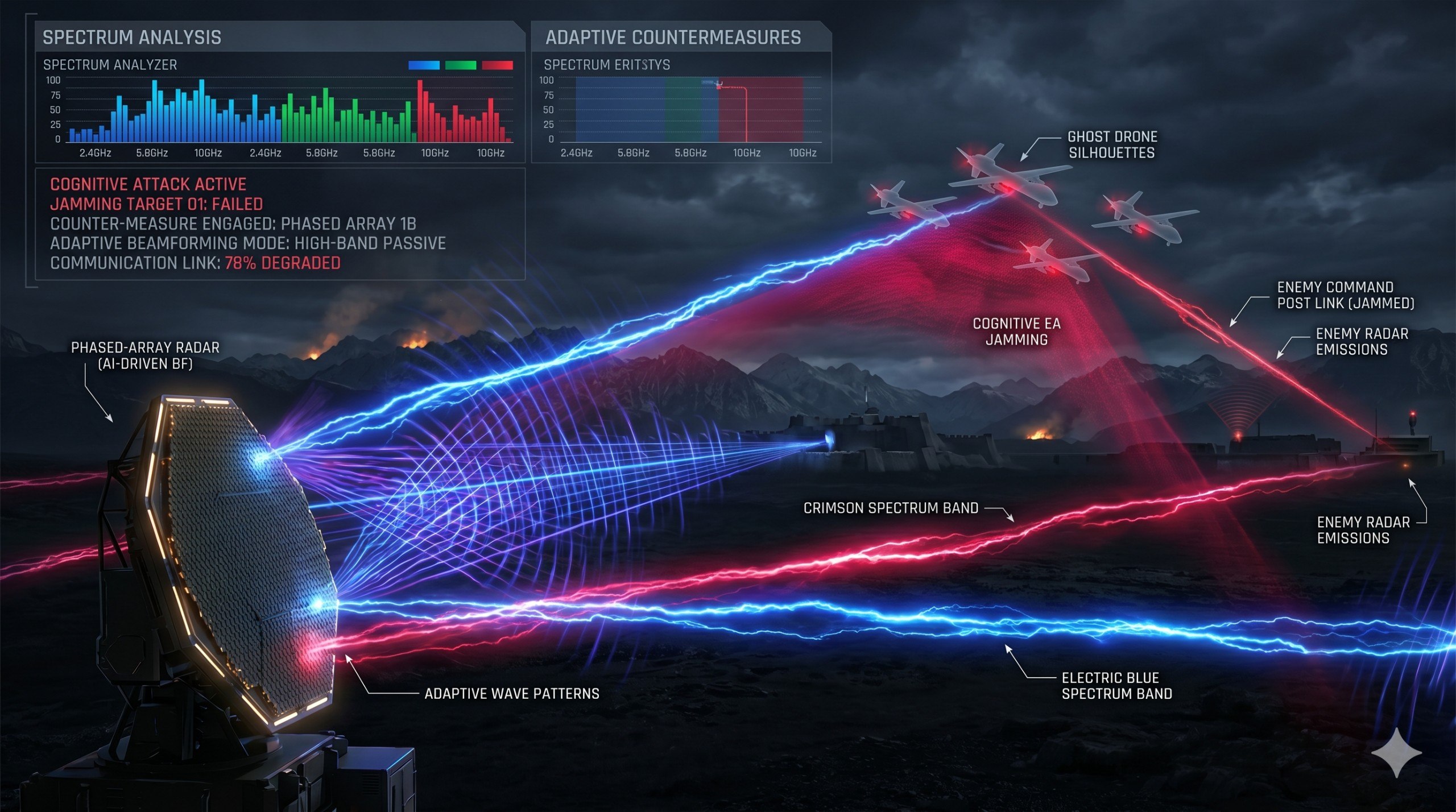
Traditional electronic warfare has been a cat-and-mouse game across the electromagnetic spectrum — one side emits radar beams, the other detects and jams them. But by 2026, artificial intelligence is transforming this game into an entirely new dimension. Cognitive electronic warfare no longer just detects and jams signals faster; it makes the electromagnetic spectrum itself an intelligent battlefield that learns, adapts, and predicts. This shift represents the most fundamental paradigm change in military spectrum operations since the invention of radar.
The history of electronic warfare can be divided into three eras. The first era, during World War II, consisted of simple radar jamming where chaff was the primary countermeasure. The second era, from the 1960s through the 2010s, was characterized by digital radar warning receivers and programmable jammers — systems that could detect threats and trigger pre-set responses. The third era — the one we are now entering — is the cognitive electronic warfare era, where machine learning algorithms analyze the entire electromagnetic spectrum in real time, autonomously identify emerging threat patterns, and dynamically generate optimal counter-strategies without human pre-programming.
FROM REACTIVE TO PREDICTIVE: THE NATURE OF COGNITIVE SPECTRUM OPERATIONS
Traditional electronic warfare is inherently reactive. A fighter jet's radar warning receiver detects an enemy fire-control radar lock, looks up a pre-loaded threat library, and triggers a pre-recorded jamming pattern. The effectiveness of this process depends entirely on the completeness and update frequency of the threat library. Against an unknown radar system or novel waveform, traditional systems are essentially helpless.
Cognitive electronic warfare fundamentally changes this paradigm. By running deep reinforcement learning models on embedded edge hardware, cognitive electronic support systems can analyze intercepted signals in real time, identifying their waveform characteristics, pulse sequence patterns, and modulation schemes — even if that signal has never been entered into any threat library. Instead of matching pre-set patterns, the system learns the intrinsic structure of the signal.
DARPA's Behavioral Learning for Adaptive Electronic Warfare (BLADE) and Radio Frequency Machine Learning Systems (RFMLS) programs pioneered this transformation. BLADE developed algorithms capable of learning new threats in an operational environment and dynamically generating countermeasures. RFMLS applied machine learning to RF signal classification, enabling systems to distinguish between friendly, enemy, and neutral signals even in highly dense and contested signal environments. These programs have transitioned from laboratory to operational testing, with multiple outputs integrated into the US Air Force and Army's next-generation electronic warfare systems.
DEEP REINFORCEMENT LEARNING AND DYNAMIC JAMMING STRATEGIES
The core technical engine of cognitive electronic warfare is deep reinforcement learning. Unlike supervised learning — where models train on labeled datasets to predict fixed output categories — reinforcement learning learns optimal policies through continuous interaction with the environment. In the electronic warfare context, an agent (the jammer) takes actions (selecting jamming parameters) in the electromagnetic environment, receives reward signals (successfully disrupting enemy communications or radar locks), and updates its policy to maximize cumulative reward.
This approach achieved breakthrough results in 2025-2026. Researchers demonstrated that deep reinforcement learning-driven jamming systems could converge to near-optimal jamming strategies in complex electromagnetic environments within minutes, rather than hours or days. The jamming strategies these systems autonomously discovered were often non-intuitive — exploiting subtle vulnerabilities in the target system's signal processing chain that no human analyst had identified.
The Army Research Laboratory's FREEDOM program — Fundamental Research for Electronic Warfare in Multi-Domain Operations — is funding the foundational science to solve this at the hardware and algorithm level: RF sensing architectures, AI models optimized for embedded inference, and closed-loop EW techniques capable of sustained autonomous operation across contested spectrum. The program plans a Brigade Combat Team-level assessment of AI-enabled EW capabilities in June 2026, with full deployment targeted by 2028.
ADVERSARIAL AI AND THE EW ARMS RACE
The rise of cognitive electronic warfare also raises a profound question: what happens when AI systems fight each other? If cognitive jamming systems can learn to adapt to enemy radars, the same techniques can be used to deceive the cognitive jamming systems themselves.
Russian military researchers have published work in open literature on "adversarial waveform generation" — techniques for crafting electromagnetic emissions that deliberately mislead AI-based signal classifiers. In a practical application, a radar or communication system could, by subtly modulating its emissions in a specific pattern, cause an adversary's AI EW system to misidentify it as a non-threat or to apply an ineffective jamming response. This is the same principle as the adversarial examples that fool image classifiers into misidentifying stop signs as speed limit signs.
The implication is a layered AI arms race within electronic warfare: cognitive EW systems that learn to jam must also be hardened against adversarial inputs, requiring AI-based anomaly detection in the sensing layer, robust training against adversarial examples, and human-in-the-loop verification for high-stakes jamming decisions.
CHINA AND RUSSIA: THE COMPETITIVE LANDSCAPE
The United States is not alone in developing cognitive EW capabilities. China's PLA Strategic Support Force, responsible for EW, has published extensively on cognitive EW research, and multiple Chinese universities maintain active programs in AI-based signal processing and electronic countermeasures. The technical approaches mirror DARPA's work: reinforcement learning for jamming strategy optimization, deep learning for signal classification, and GAN-based waveform generation.
Russia's cognitive EW development has followed a different path — driven more by operational necessity in Ukraine than by pre-war research investment. The Krasukha-4 broadband multifunctional jamming station and its successors have been upgraded with AI-assisted signal processing modules. Russian ELINT assets have reportedly incorporated machine learning to accelerate characterization of Ukrainian and NATO communication systems.
Notably, Chinese and Russian approaches differ from the US in key ways. US cognitive EW development is primarily driven by DARPA programs and private defense technology startups. China's approach is more centralized — led by national laboratories and military academies, coordinated by the Strategic Support Force. Russia's progress is more incremental, grounded in battlefield experience, but with slower hardware refresh cycles.
SOFTWARE-DEFINED RADIO: THE HARDWARE FOUNDATION
Cognitive electronic warfare is not just about algorithms — it depends on hardware transformation. Software-defined radio (SDR) platforms form the foundational layer of cognitive EW, allowing radio frequency, waveform, and protocol parameters to be changed through software updates rather than hardware replacement.
By 2026, SDR technology has reached an inflection point. The latest generation of SDR platforms carries sufficient processing headroom to run onboard machine learning inference, at unit costs that support high-volume tactical deployment. This means cognitive algorithms can run on everything from man-portable jammers to brigade-level tactical EW systems. The gap is no longer hardware — it is the AI models trained specifically for the defense EW problem space, the integration frameworks allowing those models to operate within modular open-systems architecture (MOSA) frameworks, and the evaluation infrastructure required to validate autonomous EW behavior before operational deployment.
OPERATIONAL IMPLICATIONS AND STRATEGIC IMPACT
The operational implications of cognitive electronic warfare extend far beyond technical performance metrics. Fundamentally, it changes the strategic calculus of electronic warfare.
First, spectrum superiority shifts from resource-intensive to knowledge-intensive. In traditional EW, advantage came from having more jammers, higher transmit power, and more comprehensive threat libraries. In cognitive EW, advantage comes from having better algorithms, higher quality training data, and faster learning cycles. This reduces the importance of hardware scale and elevates the value of software and data capabilities.
Second, cognitive EW dramatically compresses the sensor-to-shooter cycle. In traditional EW, identifying a new threat and deploying countermeasures could take days to weeks — analyzing intercepted signals, reverse-engineering, developing jamming programs, loading operational systems. Cognitive systems can complete this cycle in seconds to minutes. This is critical for countering mobile, ephemeral threats such as enemy radar systems that turn on for only seconds before shutting down.
Third, cognitive EW blurs the traditional boundaries between electronic attack, electronic protection, and electronic support. Since the same AI system simultaneously manages sensing, analysis, and response functions, these traditionally separate operational domains become inseparable at the software level. This creates new demands for command-and-control structures and doctrine development.
OBSERVATORY ANALYSIS: THE TRAJECTORY OF COGNITIVE EW
Looking ahead over the next five years, several key trends will shape the trajectory of cognitive electronic warfare.
In the near term (2026-2027), the first operational cognitive EW systems will enter limited deployment. The US Army's FREEDOM program assessment and the Air Force's next-generation EW systems will provide the first large-scale test cases for cognitive EW tactical utility. This period will also see increased research into adversarial waveform attacks and defensive techniques against them.
In the medium term (2028-2030), cognitive EW will expand from single-platform capability to networked collaborative systems. Multiple cognitive EW assets will share spectrum sensing data, coordinate jamming strategies for maximum coverage across all frequency bands, and dynamically allocate tasks to avoid mutual interference. This requires low-latency, jamming-resistant data links between EW assets — itself a cognitive EW application problem.
In the long term, cognitive electronic warfare will form the foundation of future electromagnetic spectrum operations — converging EW, communications, and radar functions into a unified, AI-driven spectrum management framework. This will make the spectrum a dynamically allocated operational resource, as precisely and flexibly targeted as kinetic fires are today. Cognitive electronic warfare is not merely an improvement on existing capabilities — it is a fundamental redefinition of military spectrum superiority.
免責聲明:本文所載資料僅供參考,不構成任何投資建議或商業決策依據。數據及時間資訊以發布當日為準,可能隨後續發展而有所變動。作者及POC.HK不對因使用本文資訊而導致的任何損失承擔責任。