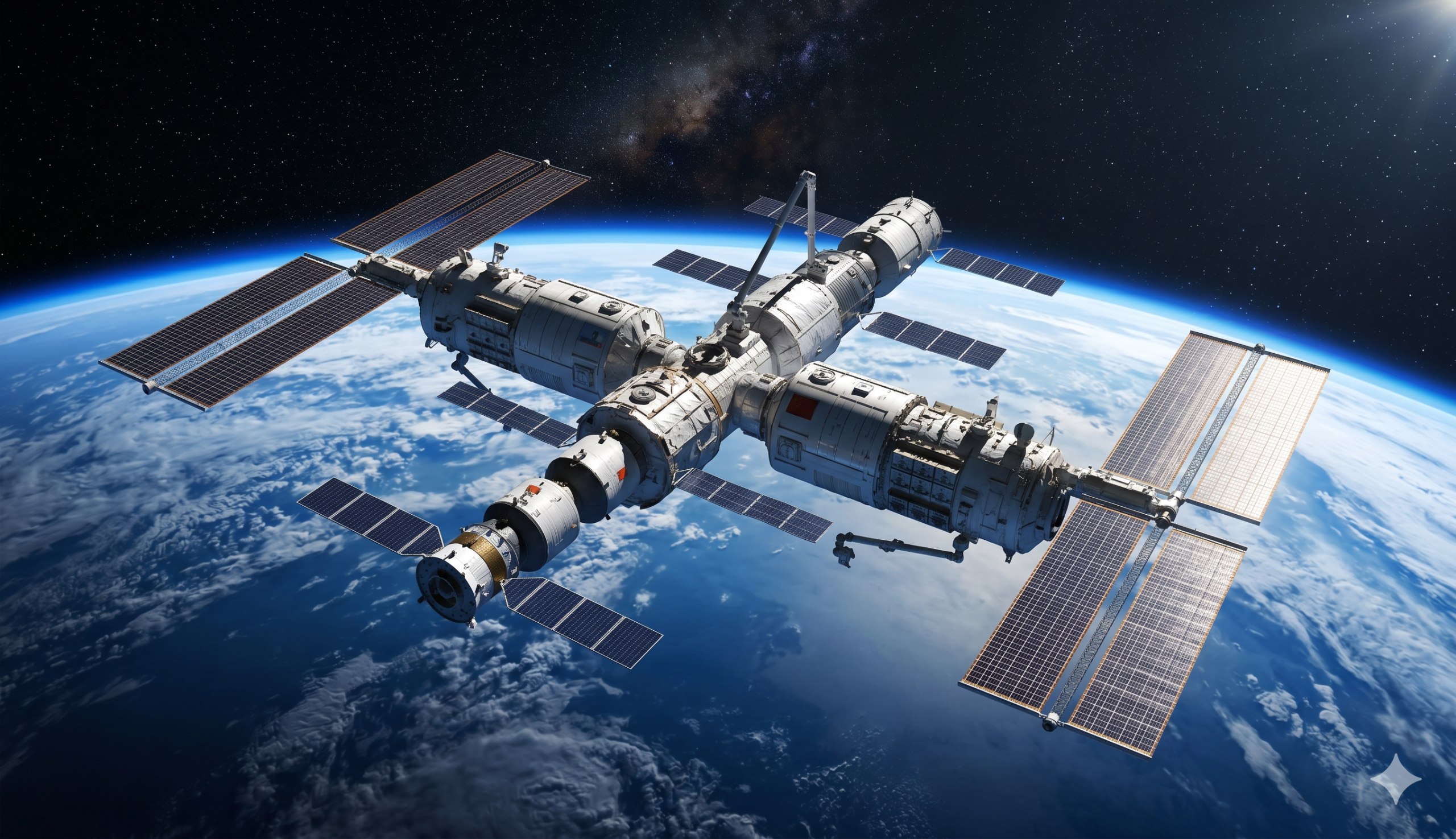
Tiangong Space Station: China's Space Program Strategic Hub and New Paradigm for International Cooperation
In October 2025, China's Tiangong space station completed its third major expansion since initial assembly in 2022. The newly added "Hexie-2" (Harmony-2) experiment module, jointly developed by the European Space Agency (ESA) and the China Manned Space Agency (CMSA), is equipped with a state-of-the-art microgravity materials science furnace, ultra-cold atomic physics experiment apparatus, and a 2.5-meter-diameter space telescope. After expansion, Tiangong's total mass exceeds 180 tons, capable of accommodating 6 astronauts for long-term habitation — making it the second-largest space station currently in orbit, second only to the International Space Station (ISS) at approximately 420 tons.
From Follower to Core Player
Tiangong's development trajectory reflects China's space program's transformation from technological follower to independent innovator. When the Tianhe core module launched in 2021, its technical level was roughly equivalent to ISS technology benchmarks from the late 1990s. But by 2025, the Hexie-2 experiment module's thermal control, life support, and energy management systems had surpassed ISS counterpart systems in efficiency metrics.
Specifically, Tiangong's solar power generation efficiency reaches 34% (using triple-junction gallium arsenide solar cells), compared to the ISS's 28% to 30%. Its integrated power system stability achieved 99.97% on-orbit availability in 2024. Water recycling system efficiency improved from 80% in 2022 to 95% in 2025, approaching the ISS's 98% water recovery rate. These figures indicate that China's space engineering capabilities have progressed from catch-up to parallel competition.
A New Model of International Cooperation
Tiangong's most striking feature is the new paradigm of international cooperation it is constructing, distinct from the ISS model. The ISS cooperation framework was formed in the post-Cold War era, led by the United States with Russian and European participation, constituting a "club-style" closed system. Tiangong adopts a more flexible, mission-oriented cooperation model.
As of May 2026, Tiangong has signed experimental cooperation agreements with research institutions from 17 countries. Initial cooperative projects include: Italian space life science experiments, a French gamma-ray burst monitoring device, Saudi Arabian lunar dust and solar wind research, and a Pakistani CubeSat deployment mission. Notably, these cooperations are not products of intergovernmental agreements but results selected by CMSA through the United Nations Office for Outer Space Affairs (UNOOSA) "Space Station Experiment Application" mechanism — any UN member state's research institution can apply.
This model lowers political barriers but also raises discussions about scientific standards and data sharing transparency. Some Western scientists note that the proportion of Tiangong experiment results published in open-access journals is lower than ISS counterparts, and data sharing periods are longer (typically 18 to 24 months of exclusive access before public release).
Scientific Output Assessment
From a scientific output perspective, Tiangong has supported over 300 experiments across three years of operation, with approximately 120 papers published in peer-reviewed journals between 2024 and 2025. Key achievements include: successfully growing protein crystals with ordered structures under microgravity, achieving 1.6 Å resolution — a quality difficult to attain in ground laboratories; and completing a 12-month space materials aging study using external exposure facilities, providing direct data for material selection for China's next-generation deep space probes.
Tiangong's orbital telescope — the Xuntian optical module (planned for launch and docking in late 2026) will be a true game-changer. The telescope has a 2-meter aperture, comparable to the Hubble Space Telescope, but with 300 times the field of view — a single image can cover approximately 175 full-moon areas. Over Xuntian's 10-year design lifespan, it will complete high-resolution survey observations of approximately 40% of the entire sky, expected to discover millions of new galaxies, asteroids, and variable stars.
Geopolitical Dimensions
Tiangong's existence inevitably carries geopolitical implications. It demonstrates that an international space cooperation network not led by the United States is taking shape. This has profound implications for the future structure of space governance — on issues including space debris mitigation rules, spectrum allocation, and lunar resource development, China is transitioning from rule-taker to rule-maker.
In 2025, China and Russia jointly released an updated roadmap for the International Lunar Research Station (ILRS), planning to establish a crewed lunar south pole base in the early 2030s. ILRS is widely viewed as a competitor to the U.S.-led Artemis program. While CMSA states that ILRS is open to all nations, current partners are primarily concentrated among emerging economies and developing countries.
Observatory Analysis
From an independent technical analysis perspective, Tiangong's program efficiency is commendable. China's space station went from initial assembly to full operation in approximately 3 years, while the ISS took 2 years from its first module Zarya's launch in 1998 to first crewed occupation in 2000, but 13 years for full assembly completion. Tiangong's degree of modularity and ground pre-integration strategy shortened the on-orbit assembly cycle.
However, Tiangong faces challenges that cannot be ignored. First is operational lifespan limitations — Tianhe core module's design life is 10 years (until 2031), while ISS core modules have operated for over 25 years. If China wishes to maintain continuous crewed space presence after 2030, it needs to begin R&D on a new generation of space station modules before 2028. Second, Tiangong's extravehicular activity (EVA) capability remains below the ISS — Chinese astronauts have performed only 17 EVAs from Tiangong as of 2026, far fewer than ISScomparable periodlevels.
Looking Ahead
Looking forward five years, Tiangong will transition from "construction phase" to "results phase." After the Xuntian optical module docks in 2026, Tiangong's scientific observation capabilities will achieve a qualitative leap. In 2027, China plans to complete its first crewed lunar landing mission (Chang'e-9), which will require Tiangong as an intermediate test platform to validate multiple key technologies — including deep space life support and long-duration closed environment management.
On the commercialization front, CMSA has indicated it is studying commercial access mechanisms for Tiangong. In 2025, Chinese private space tourism company CAS Space signed a letter of intent with CMSA, planning to use Tiangong for short-term commercial astronaut visit programs around 2028. If realized, this would provide additional funding sources for Tiangong's long-term operations and accumulate experience for China's next-generation 220-ton multi-module space station planned after 2030.
Tiangong's story is not merely a national space program's success narrative — it is reshaping the cooperative architecture of human space activity, providing a non-negligible alternative for post-ISS space governance.
Disclaimer: This article is written by POC.HK Future Technology Observatory based on publicly available information and independent analysis. The technical parameters, cooperative projects, and timelines mentioned are from CMSA and related institutions' public disclosures; actual progress may be adjusted due to technical, policy, and funding factors.