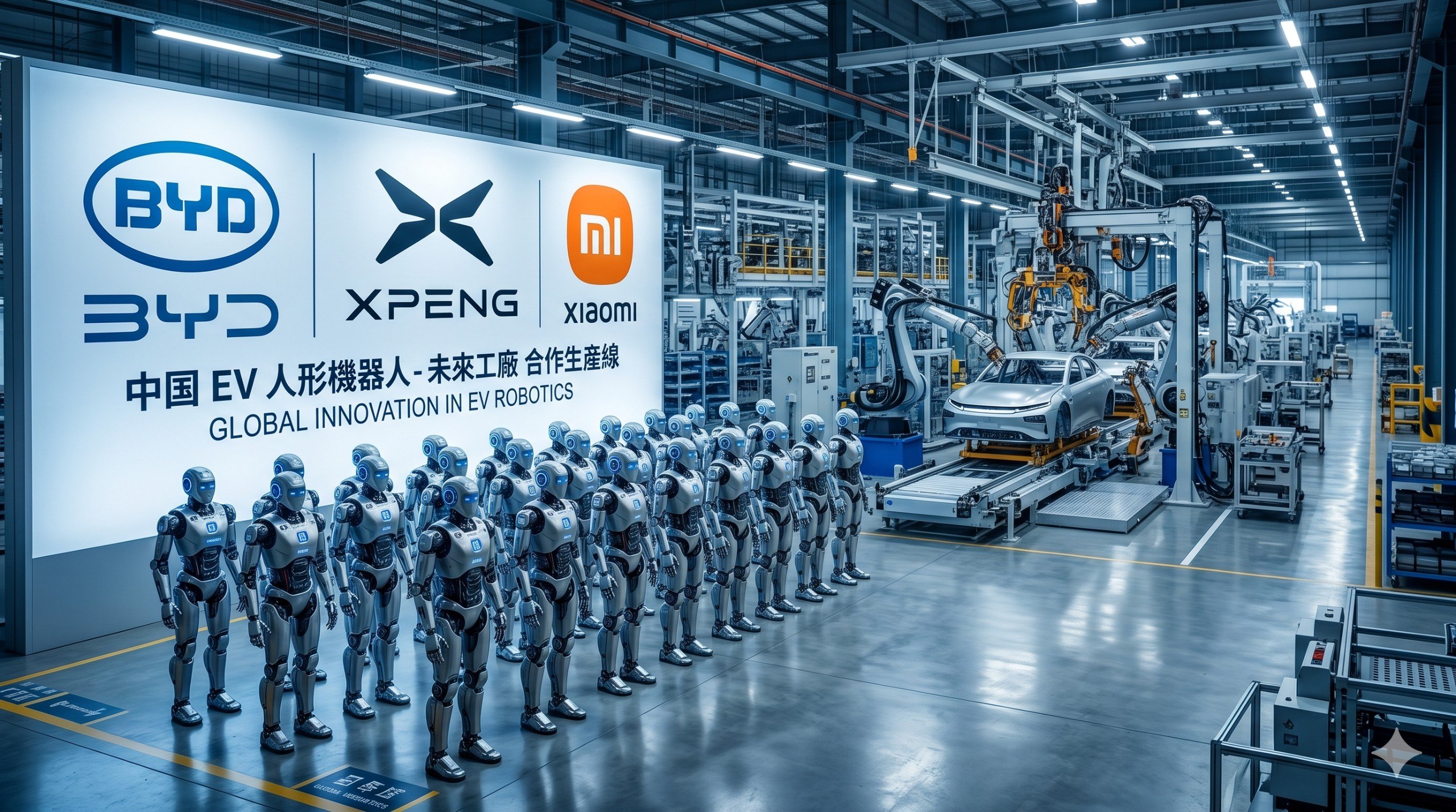
China's electric vehicle manufacturers are opening a new front in their battle with Tesla: humanoid robots. BYD, XPeng, and Xiaomi are accelerating their plans to mass-produce humanoid robots, systematically transferring their accumulated supply chain advantages, cost control capabilities, and manufacturing expertise from the EV sector to robotics. This is not a cross-industry experiment but a structural export of manufacturing capability — and Observatory believes it could fundamentally reshape the global humanoid robotics competitive landscape.
From EVs to Humanoids: The Logic of Manufacturing Capability Transfer
The technological overlap between EVs and humanoid robots runs far deeper than surface appearances suggest. Both share several core technology modules: batteries and power management systems, electric motors and actuators, sensor fusion and environmental perception, and real-time operating systems with embedded control. BYD, with over 15% of the global EV battery market, has developed blade battery technology to mature levels of energy density and safety — capabilities that can transfer directly to humanoid robot power systems. XPeng has accumulated over 20 million kilometers of autonomous driving road test data, and its perception algorithms and path planning technology can migrate almost seamlessly to robot autonomous navigation.
The deeper advantage lies in manufacturing processes. Over the past decade, China's EV industry has built the world's most cost-effective supply chain — from rare earth permanent magnet motors to precision reducers, from automotive-grade chips to high-voltage wiring harnesses. When humanoid robots enter mass production, the marginal cost of these supply chain capabilities will produce a significant competitive advantage. According to Observatory analysis, if Tesla's target cost for Optimus production in the US is $20,000 per unit, Chinese manufacturers, leveraging supply chain advantages, could push costs down to $12,000-$15,000 — a gap sufficient to reshape the market.
XPeng: CEO Personally Steering Robotics Strategy
XPeng is among the most aggressive participants in this race. In June 2026, founder and CEO He Xiaopeng personally took over the robotics division following the departure of a key executive. This move sends a clear signal: humanoid robots have been upgraded from an "exploration project" to a "core strategy" at XPeng. He announced internally that XPeng would achieve mass production and initial delivery of its "Iron" humanoid robot in Q4 2026.
XPeng's technological approach deserves attention. Unlike Tesla Optimus's "software-first" strategy (AI model at the core, hardware designed around software), XPeng follows a "hardware-first-to-system" path — prioritizing actuator, joint module, and energy system production reliability before progressively layering higher autonomous task capabilities. This approach is closer to China's traditional manufacturing strengths, but it also means its AI software competitiveness will take time to build.
The XPeng Iron specifications: 1.7m height, approximately 80kg weight, 42 degrees of freedom, 3kg single-hand load capacity. Compared to Optimus Gen 2 (52 DoF), Iron has slightly less joint flexibility but may offer advantages in battery endurance — thanks to XPeng's accumulated experience in EV battery management systems.
BYD: The Quiet But More Disruptive Player
BYD's positioning in humanoid robotics is more low-key, but its potential impact may exceed XPeng's. As the world's largest NEV manufacturer, BYD possesses extreme cost-control capabilities through scale effects — its vertical integration model (from ore to battery to finished vehicle) has demonstrated 30-40% cost reductions in the EV sector. Applied to humanoid robot manufacturing, this model could produce similar price disruption.
BYD's robotics strategy appears focused on industrial scenarios — particularly warehouse logistics and manufacturing assembly — rather than home services. This aligns with BYD's business logic in electric commercial vehicles and industrial energy storage: serve enterprise clients first, then gradually penetrate consumer markets. BYD has already deployed self-developed logistics robot prototypes at its Shenzhen battery factory for parts handling and sorting operations — providing valuable real-world data for optimizing humanoid robot adaptability in industrial environments.
Notably, BYD's semiconductor subsidiary, BYD Semiconductor, has achieved internationally leading levels in automotive-grade IGBT and SiC power modules — the same power chips are core components for humanoid robot joint drives. Having in-house chip supply means BYD has one less layer of external dependency in its robotics supply chain compared to competitors.
Xiaomi: The Consumer-Grade Price Anchor
Xiaomi, after showcasing its CyberOne humanoid robot in 2022, was once viewed as producing a "showpiece" rather than a serious product. But news in 2026 indicates that Xiaomi has upgraded its robotics project from "concept validation" to "product readiness." Xiaomi's strategy follows the same playbook it has used in smartphones and IoT: enter the market at extreme value pricing, relying on its ecosystem to lock in users.
The upgraded version of Xiaomi's CyberOne, expected in late 2026, could target a price below RMB 100,000 (approximately $14,000) — well below Tesla Optimus's $20,000 target. If Xiaomi achieves this price point, it would become the price anchor for the humanoid robot market, forcing all competitors to follow with price reductions. Xiaomi operates the world's largest consumer AIoT ecosystem, connecting over 650 million devices — a humanoid robot as the highest-level terminal in this ecosystem can interface with all Xiaomi smart home devices, creating an experience advantage competitors would find difficult to replicate.
Supply Chain Analysis: Who Really Wins
The humanoid robot supply chain can be divided into three levels: upstream key components (joint motors, reducers, sensors, batteries, chips), midstream body manufacturing and system integration, and downstream application scenarios and services. The entry of China's EV giants is accelerating upstream component standardization and scaling.
Chinese harmonic reducer manufacturers (Greenharmonic, Laifu Harmonic) and joint motor producers (Inovance Technology) have begun receiving large orders from robotics clients. Inovance's Q1 2026 servo motor shipments grew 85% year-over-year, with approximately 15% from non-industrial robot clients — a signal of early humanoid robot demand that investors should watch.
More importantly, humanoid robot mass production will drive a new growth curve for the battery industry. Each humanoid robot requires 1-3 kWh of battery capacity — far less than an EV's 50-100 kWh — but considering potential annual production in the millions, cumulative demand will reach GWh scale. EVE Energy and CATL have begun developing battery modules optimized specifically for humanoid robots — emphasizing high-rate discharge capability (robot joints require instantaneous high power) over driving range.
Observatory Analysis
The deep logic behind China's EV giants racing into humanoid robotics is a structural export of manufacturing capability, not simple business diversification. Observatory believes this trend will produce three far-reaching impacts:
First, the humanoid robot cost curve will be compressed dramatically. The supply chain scale effects and cost control experience Chinese manufacturers accumulated in EVs will apply directly to robot manufacturing. If Tesla's Optimus target price is $20,000, Chinese competitors could push prices below $15,000 within 12-18 months — 2-3 years faster than most industry analysts expect.
Second, industrial scenarios will see large-scale deployment first. Unlike many Western robotics companies targeting home services and companion scenarios, Chinese manufacturers are focusing primarily on industrial applications — warehousing, assembly, quality inspection — where clear ROI logic exists and enterprise clients are less price-sensitive than consumers. Chinese manufacturing's strong demand for automation provides a natural testing ground for humanoid robots.
Third, supply chain structure will undergo reorganization. Humanoid robot mass production depends on high-precision reducers, torque sensors, lightweight materials, and efficient batteries — suppliers of these components will see a new growth curve. Chinese domestic suppliers, with advantages in cost, response speed, and capacity expansion, may dominate the global humanoid robot supply chain.
But risks exist equally. The "embodied intelligence" of humanoid robots — their ability to autonomously complete complex tasks in the real world — still lags far behind hardware manufacturing maturity. No matter how cheap the hardware, if it cannot actually do useful work, market demand will not materialize. The gap in Chinese manufacturers' AI software capabilities (especially compared to Tesla and Google DeepMind) may constrain their competitiveness in high-end application scenarios. The capability transfer from EVs to humanoid robots is bidirectional — manufacturing capability can be exported, but software capability must be built from scratch.
Forward Outlook
Milestones worth watching in H2 2026 include: XPeng Iron's mass production delivery in Q4 (if on schedule, it would become one of the world's first mass-produced humanoid robots), Xiaomi's next-generation CyberOne price announcement (whether below RMB 100,000 would become the industry price anchor), and whether BYD will formally announce its humanoid robot product line (BYD's characteristically low-key product strategy suggests it will only publicly unveil after internal validation is complete).
Over a longer horizon, the true significance of China's EV giants entering humanoid robotics may lie in redefining the boundaries of "manufacturing." If humanoid robots can achieve mass production at smartphone and EV scale within the next decade, what it represents is not the birth of a new industry, but a paradigm shift in manufacturing itself — from "automated production lines" to "autonomous workers."
Disclaimer: The information in this article is provided for reference only and does not constitute investment advice or business decision guidance. Data and time-sensitive information are current as of the publication date and may change with subsequent developments. Neither the author nor POC.HK assumes any liability for losses resulting from the use of this information.