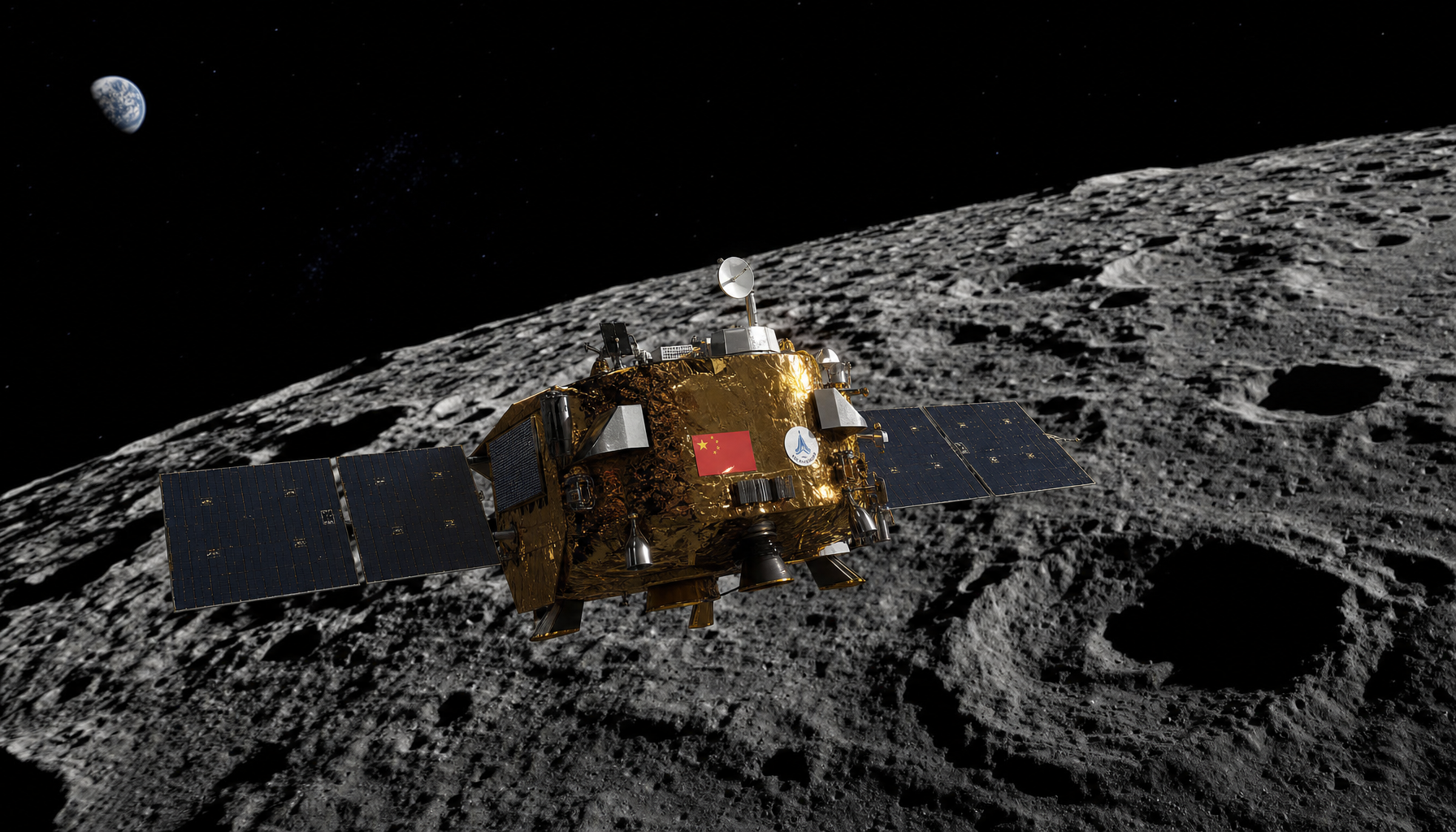
Chang'e-7: Precision Survey of Lunar South Pole Water Ice Resources
In March 2026, the China National Space Administration (CNSA) announced that the Chang'e-7 mission had completed the highest-resolution comprehensive survey of the lunar south pole region to date. The mission, comprising an orbiter, lander, and rover, landed in the permanently sunlit area at the edge of Shackleton Crater in mid-2025, subsequently conducting approximately 9 months of surface exploration.
The high-resolution ground-penetrating radar onboard Chang'e-7surpassed the resolution limits of previous LRO data, identifying water ice deposits buried at depths of only 0.5 to 1.5 meters within Shackleton Crater's permanently shadowed region (PSR), with thicknesses of approximately 3 to 8 meters. The engineering significance of this discovery is critical: shallow water ice means significantly reduced extraction costs, with usable water resources accessible without deep drilling. Spectral analysis simultaneously shows these water ice deposits have a purity of approximately 75% to 85%, suitable for direct use in electrolysis for hydrogen and oxygen production or drinking after simple filtration.
Chang'e-7 also validated several key technologies, including autonomous navigation and landing under extremely low-light conditions, battery thermal preservation systems for -180°C environments (using radioisotope heating units to maintain critical component operating temperatures), and ultra-low-temperature mechanical drilling and sampling devices. These technologies pave the way for the subsequent Chang'e-8 resource extraction demonstration mission.
From a strategic perspective, Chang'e-7's precision survey results provide critical site selection data for the China-Russia joint International Lunar Research Station (ILRS) program. The ILRS plans to establish a crewed south pole base in the early 2030s, and the water ice resource distribution confirmed by Chang'e-7 will directly influence base location and extraction scheme design.
At the international cooperation level, Chang'e-7 carried scientific instruments from Russia, Europe, and Saudi Arabia, reflecting the open cooperation posture of China's lunar exploration program. This creates a de facto competition with the U.S.-led Artemis program — two parallel lunar south pole base plans that will shape humanity's presence on the Moon in the coming decade.
Disclaimer: This article is written by POC.HK Future Technology Observatory based on CNSA public data and independent analysis.