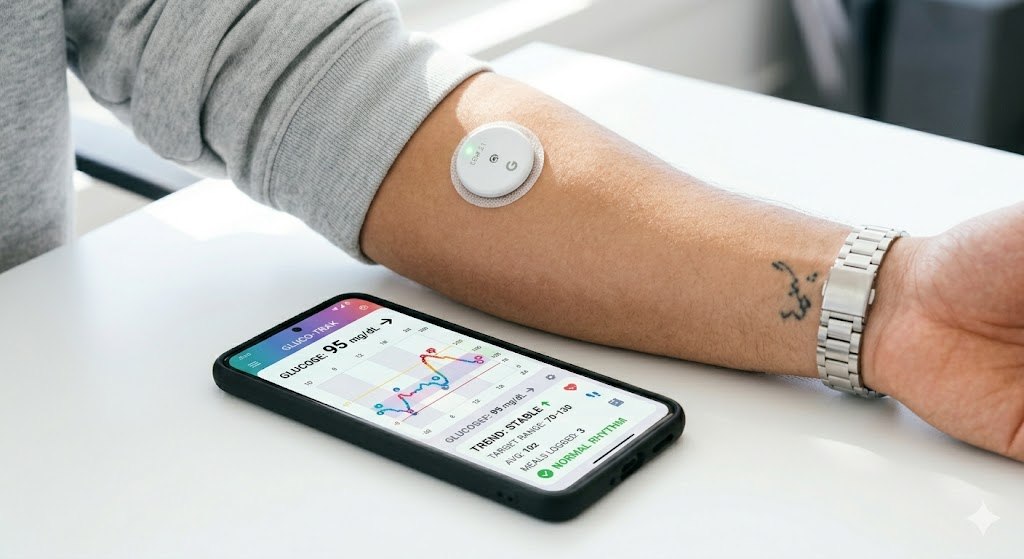
From Diabetes Tool to Consumer Wearable
For decades, blood glucose monitoring meant finger pricks — a painful, inconvenient, and intermittent ritual that diabetics endured multiple times daily. Then came continuous glucose monitors (CGMs): small sensors worn on the arm or abdomen that measure glucose levels in the interstitial fluid every few minutes, transmitting the data wirelessly to a smartphone or receiver. For people with diabetes, CGMs have been transformative, reducing the need for finger sticks, providing real-time alerts for dangerous highs and lows, and enabling tighter glycemic control.
But something unexpected has happened in the last two years. CGMs have crossed over from the diabetes market into the mainstream consumer health market. People without diabetes — healthy individuals, athletes, biohackers, and the simply curious — are wearing CGMs to track how their bodies respond to food, exercise, sleep, and stress. The market has exploded, and 2026 is the year CGMs went truly mainstream.
The Sensor Revolution
A modern CGM consists of a tiny, flexible filament inserted just under the skin, held in place by an adhesive patch about the size of a quarter. The filament measures glucose levels in the interstitial fluid — the fluid that bathes the cells — using a glucose oxidase enzyme electrode that generates an electrical current proportional to glucose concentration. A small transmitter on top of the patch sends this data via Bluetooth to a smartphone app.
The sensors last 10 to 14 days before needing replacement. The insertion process, once a painful procedure requiring a spring-loaded applicator, has been refined to near-painlessness. Current-generation sensors are about the thickness of two stacked quarters, waterproof, and unobtrusive enough to be worn during sleep, exercise, and showering.
The accuracy of modern CGMs is remarkable. The latest models from Abbott (FreeStyle Libre 3), Dexcom (G7), and Medtronic (Guardian 4) have mean absolute relative differences (MARD) of 8 to 10 percent — meaning the sensor reading is typically within 10 percent of the actual blood glucose value. This is more than adequate for most consumer applications, though slightly less accurate than traditional finger-stick blood glucose meters (which have MARD of 5 to 6 percent).
The Metabolic Health Movement
The driver of the CGM consumer boom is the growing awareness of metabolic health. The term refers to how efficiently the body processes and uses energy — specifically, how well the body regulates blood sugar, insulin, and energy storage. Poor metabolic health is linked to a wide range of conditions: type 2 diabetes, obesity, cardiovascular disease, non-alcoholic fatty liver disease, polycystic ovary syndrome, and even cognitive decline.
The key insight driving CGM adoption is this: metabolic dysfunction does not begin at the diagnostic threshold for diabetes. It develops gradually over years, and the earliest signs are visible in post-meal glucose excursions — spikes and dips that occur in response to food. A person with normal fasting glucose and normal HbA1c can still have significant glucose spikes after meals, driven by insulin resistance that has not yet progressed to prediabetes.
CGMs make these hidden patterns visible. A healthy person wearing a CGM quickly learns which foods cause glucose spikes (white rice, sugary drinks, refined carbohydrates), which foods produce flat glucose curves (protein, vegetables, healthy fats), and how factors like exercise, sleep quality, and stress affect their glucose regulation.
The Evidence for CGM in Non-Diabetics
Is there scientific evidence that wearing a CGM improves health outcomes in people without diabetes? The answer is nuanced.
Several studies have shown that real-time glucose feedback leads to dietary behavior change. A 2024 study published in Nature Medicine found that participants who wore CGMs and received personalized dietary recommendations based on their glucose responses reduced their time in hyperglycemia (glucose above 140 mg/dL) by 60 percent over 12 weeks, compared to a control group that received standard dietary advice. Importantly, these participants did not have diabetes — they were metabolically healthy individuals recruited from the general population.
Another study by researchers at Stanford University found that CGM feedback helped individuals reduce their glycemic variability — the swings between high and low glucose — and improved their post-meal glucose profiles. Participants reported making specific dietary changes: swapping white rice for quinoa, adding vegetables to meals, and avoiding liquid sugars.
However, the evidence for long-term health improvements — reduced diabetes incidence, better cardiovascular outcomes, weight loss maintenance — is not yet established. The CGM-as-consumer-product phenomenon has run ahead of the clinical evidence. Critics argue that the market is driven more by anxiety and gadget-lust than by proven health benefits.
The Players and the Market
The CGM market has traditionally been dominated by three companies: Abbott Laboratories (FreeStyle Libre), Dexcom (G7), and Medtronic (Guardian). Together, they control roughly 95 percent of the global CGM market for diabetes, which was valued at approximately $12 billion in 2025 and is projected to reach $25 billion by 2030.
The consumer market is where the growth is happening. Abbott launched Libre Sense, a CGM product specifically marketed to athletes and health-conscious consumers, in 2024. Dexcom partnered with Apple to integrate CGM data directly into the Apple Health app and has been developing consumer-focused features. A host of startups have entered the space: Levels, Nutrisense, Signos, Veri, and January AI all offer CGM-based metabolic health programs that pair sensors with app-based coaching and dietary tracking.
The pricing model for consumer CGMs is typically subscription-based. A month supply of sensors (two to three sensors depending on the brand) costs $150 to $300 per month in the United States, with coaching and app access included in the subscription. This is significantly more expensive than the diabetes CGM market, where insurance covers most or all of the cost, but it remains affordable enough to attract a growing customer base.
Regulatory Pathways
The regulatory landscape for consumer CGMs is evolving. In the United States, CGMs are classified as Class II medical devices by the FDA, requiring 510(k) clearance. Most consumer CGMs are cleared by the FDA for over-the-counter use — meaning no prescription is required — but the labeling and marketing must not make disease-management claims.
The key regulatory distinction is between medical and wellness use. A CGM marketed for diabetes management must meet clinical accuracy standards, undergo rigorous clinical trials, and comply with FDA requirements for prescription devices. A CGM marketed for general wellness — helping people understand how diet and exercise affect their glucose — faces a lighter regulatory touch, as long as it does not claim to diagnose, treat, or prevent disease.
This distinction has created a gray area. Some companies market their CGMs as wellness tools while providing features — trend analysis, personalized recommendations, predictive alerts — that blur the line into clinical utility. The FDA has not yet issued clear guidance specific to consumer CGMs, and the lack of regulatory clarity is a source of uncertainty for the industry.
The Athlete Angle
One of the fastest-growing segments of the consumer CGM market is athletic performance. Endurance athletes — runners, cyclists, triathletes — have discovered that glucose monitoring offers insights into fueling strategies, glycogen depletion, and performance optimization.
During prolonged exercise, blood glucose levels can drop as muscles consume glucose faster than the liver can produce it. An athlete wearing a CGM can see this happening in real time and adjust their carbohydrate intake accordingly, preventing the bonk or hitting the wall that occurs when glucose falls below critical levels.
Professional cycling teams were among the first to adopt CGM technology for performance optimization. Team Sky (now Ineos Grenadiers) used CGMs during training camps as early as 2016. Since then, CGM use has spread across professional sports. The NBA, NFL, and English Premier League all have teams using CGMs to monitor players during training and competition.
A 2025 study of elite marathon runners found that those who used CGM-guided fueling strategies during training and racing maintained more stable glucose levels and reported lower perceived exertion than runners who used traditional scheduled fueling. The performance gains were modest but meaningful — approximately 1 to 2 percent improvement in race time.
The Controversies
The consumer CGM boom has not been without controversy. Critics raise several concerns.
First is the potential for overdiagnosis and unnecessary anxiety. A healthy person wearing a CGM will inevitably see glucose spikes after meals — even healthy meals — that may be entirely normal physiological responses. A spike to 140 mg/dL after a carbohydrate-rich meal is not a sign of dysfunction; it is a normal postprandial response. But to an anxious consumer without medical training, any deviation from a flat line can appear alarming.
Second is the lack of standardized reference ranges for the non-diabetic population. What constitutes a normal 24-hour glucose profile for a healthy person? The answer depends on age, fitness level, diet, time of day, and many other factors. The consensus is emerging that time-in-range (70 to 140 mg/dL) should exceed 90 percent for healthy individuals, and that glucose should return to baseline within two hours of a meal. But these are guidelines, not hard rules, and individual variation is wide.
Third is the cost. At $150 to $300 per month, CGMs are not accessible to everyone. Critics worry that CGM-based health optimization will become another tool of health inequality, available only to those who can afford it. The irony is that the populations most at risk for metabolic disease — lower-income communities, communities of color, food-insecure households — are the least likely to have access to this technology.
The Future: From CGM to Multi-Marker Wearables
The CGM of 2026 is likely just the beginning. The next generation of metabolic wearables will measure not just glucose but also ketones, lactate, cortisol, and other biomarkers, providing a more complete picture of metabolic state.
Abbott has already developed a prototype sensor that measures glucose and ketones simultaneously. Dexcom is working on a multi-analyte platform. Several startups are developing wearable sensors that measure cortisol (the stress hormone) and lactate (a marker of anaerobic metabolism), which could be combined with CGM data for a comprehensive metabolic profile.
The convergence of CGM data with other health data — from smartwatches (heart rate, activity, sleep), smart scales (weight, body composition), and food logging apps — will create increasingly sophisticated models of individual metabolic health. Machine learning algorithms trained on large datasets will predict glucose responses to specific foods, recommend optimal meal timing and composition, and provide personalized exercise prescriptions.
For now, the CGM has established itself as the most important new consumer health wearable since the smartwatch. What began as a medical device for diabetes management has become a tool for anyone curious about how their body works — and that curiosity, in the end, may be the most powerful driver of better metabolic health.
|> Disclaimer: This article is for informational purposes only and does not constitute medical advice. Individuals considering CGM use should consult with a healthcare provider.