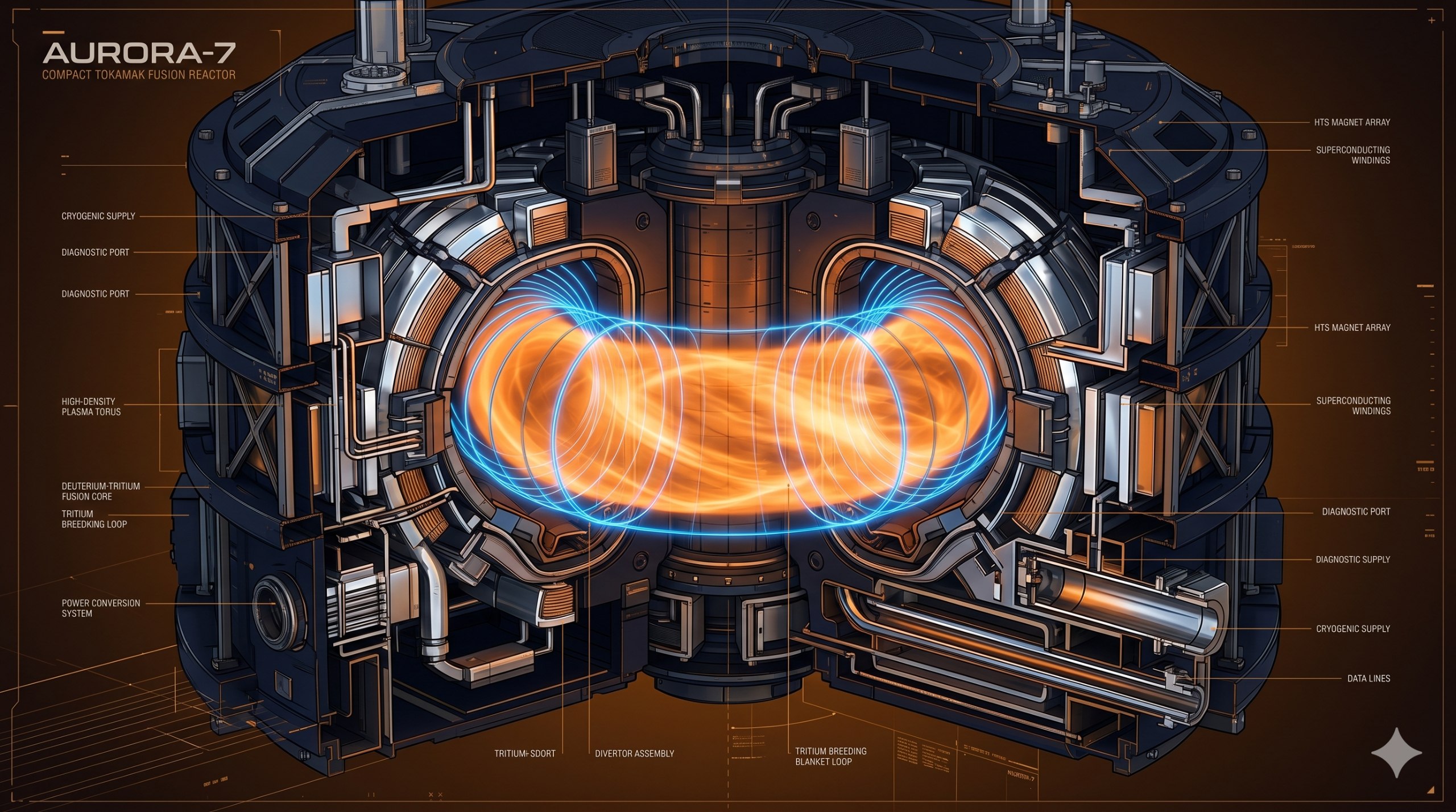
In June 2026, Commonwealth Fusion Systems (CFS), together with MIT and other partners, simultaneously published five peer-reviewed papers in academic journals, comprehensively validating the core plasma physics assumptions of its ARC fusion reactor. The series of papers covers key areas including plasma confinement, heating efficiency, stability boundaries, and divertor design, providing a solid theoretical foundation for ARC to achieve 400 MW of net electricity generation in the early 2030s.
ARC's Technical Positioning: From SPARC to Commercial Power Plant
To understand the significance of ARC, it is first necessary to clarify CFS's roadmap. CFS's technology pathway is divided into two phases: SPARC is the experimental tokamak currently under construction, targeting the demonstration of net energy gain (Q>1) — that is, producing more fusion energy than the energy required to heat the plasma. ARC is the commercial-grade fusion power plant designed based on the technology validated by SPARC, aiming to deliver 400 MW of net electricity continuously to the grid.
SPARC construction is ongoing, with several milestones already achieved — including the successful testing of the TFMC (toroidal field coil) and the commissioning of the cryogenic system. SPARC is expected to achieve first plasma in 2027-2028. If it successfully demonstrates Q>2 (expected range Q=2-11), it will clear the greatest technical uncertainty for ARC's commercialisation.
ARC (Affordable, Robust, Compact) has exceptionally ambitious design targets: total fusion power of approximately 1.13 GW, of which around 500 MW is converted to thermal extraction, yielding a net output of 400 MW after deducting system self-consumption. The reactor size is only about one-third that of a conventional tokamak, thanks to the breakthrough in high-temperature superconducting (HTS) magnets — CFS's TFMC tested in 2024 achieved a magnetic field strength exceeding 20 T, more than double that of conventional low-temperature superconducting magnets.
Focus of the Five Papers' Physics Validation
These five papers, co-authored by CFS, the MIT Plasma Science and Fusion Center (PSFC), and dozens of plasma physicists worldwide, focus on:
Paper 1: Core Plasma Confinement — Uses validated integrated modelling frameworks (including ION, TRANSP, and other codes) to simulate ARC's plasma behaviour under nominal operating conditions. The paper confirms that under the strong magnetic field provided by HTS magnets (approximately 9.2 T at the plasma centre), the plasma energy confinement time is sufficient to sustain a self-heated burn, even when conservative engineering safety factors are applied.
Paper 2: Heating and Current Drive — Provides a detailed analysis of ARC's auxiliary heating system design. ARC plans to use a combination of neutral beam injection (NBI) and ion cyclotron resonance heating (ICRH), delivering approximately 50 MW of heating power during the plasma startup phase. The paper validates the coupling efficiency of this heating scheme within ARC's compact geometry.
Paper 3: Plasma Stability and Edge Localised Mode (ELM) Control — Stability is the central engineering challenge for commercial fusion reactors. The paper analyses the operational stability boundary of ARC's plasma at a normalised beta (beta_N) of approximately 3.5, and proposes strategies for ELM suppression using resonant magnetic perturbations (RMP).
Paper 4: Divertor Design and Heat Exhaust — The divertor is one of the most demanding components in a tokamak, needing to withstand steady-state heat fluxes of up to 10 MW/m^2. The paper proposes a 'snowflake divertor' design, which distributes the heat load across more strike points through magnetic topology modification, reducing peak heat flux to a manageable 2-3 MW/m^2.
Paper 5: Alpha Particle Heating and Fusion Burn — Analyses the energy transfer process of the 5.6 MeV alpha particles produced by D-T fusion reactions within the plasma. Alpha particle heating is the key mechanism for sustained fusion burn — the alpha particles produced must effectively transfer their energy to the background plasma to maintain the plasma temperature above the fusion ignition threshold. The paper confirms that ARC's plasma size is sufficient to confine alpha particle energy within the plasma.
HTS Magnet Manufacturing: The Core Supply Chain Challenge
The success of the ARC plan depends heavily on the manufacturing capability for HTS magnets. The REBCO (rare-earth barium copper oxide) high-temperature superconducting tape used by CFS is currently the only practical superconducting material capable of generating a 20 T magnetic field at 20 K. CFS has signed long-term supply agreements with Shanghai Superconductor and SuperOx, among other suppliers, and has established its own magnet manufacturing facility in Massachusetts.
However, current annual production capacity of REBCO tape is only a few hundred kilometres, while the total tape length required by CFS for the SPARC and ARC projects could reach several thousand kilometres. At the current rate of capacity expansion, industry forecasts suggest global annual HTS tape production capacity will increase from approximately 1,000 km/year to over 5,000 km/year by 2028. This means CFS must compete with other demand sources (including particle accelerators, MRI systems, and fusion startups) for limited supply.
CFS has taken proactive steps in this area: in 2024, the company announced an exclusive supply agreement with Shanghai Superconductor. In 2025, CFS further invested in building its own magnet production line to reduce reliance on external suppliers. This investment is substantial in both time and money — a complete HTS magnet production line takes 2-3 years to become operational, with investment potentially exceeding $500 million.
Tritium Self-Sufficiency: A Necessity for Commercial Fusion
Another key element in ARC's design is the tritium breeding blanket. D-T fusion consumes large quantities of tritium each year (approximately 55.6 kg per GW-year), yet tritium is virtually non-existent in nature (half-life 12.3 years). The ability of a commercial fusion reactor to achieve tritium self-sufficiency directly determines the sustainability of its fuel supply.
CFS's ARC design places lithium-containing breeding blankets around the plasma chamber, using fusion neutrons to react with lithium to produce new tritium. One of the five papers specifically discusses the calculated tritium breeding ratio — under reasonable engineering assumptions, ARC's breeding blanket can achieve a tritium breeding ratio (TBR) of 1.05-1.15, meaning that for each tritium atom consumed, 1.05-1.15 new tritium atoms are produced, enabling fuel self-sufficiency.
However, this is an extremely challenging engineering target. The breeding blanket must maintain structural integrity under the high-energy bombardment of fusion neutrons while efficiently transferring heat to the power generation system. Currently, no complete breeding blanket prototype has been tested in a neutron environment for extended periods. ITER plans to test multiple blanket concepts, but these tests will not be completed until the mid-2030s, well after ARC's construction timeline.
A Critical Turning Point for the Fusion Industry
The timing of CFS's paper release is noteworthy. Just a few months earlier, the ITER project announced yet another delay, pushing its first D-T operation beyond 2035, with costs having ballooned to over $25 billion. By contrast, CFS's roadmap is far more aggressive — the target timeline from project initiation to demonstration power plant operation is approximately 15 years (2018-2033), with total investment estimated at around $3-5 billion.
This 'smaller, faster, more agile' approach to commercial fusion is attracting increasing funding and talent. Beyond CFS, private companies such as TAE Technologies, Helion Energy, and General Fusion are making progress on their respective technology routes. However, CFS is currently the only company with a complete 'experimental reactor to commercial demonstration reactor' roadmap in which the physics basis for both phases has passed peer review.
On the fusion credit policy front, the US Department of Energy (DOE) launched a milestone-based fusion development programme (MIFP) in 2025, and CFS was selected as one of the programme's first participants, qualifying for up to $500 million in federal funding. This reflects a shift in US government policy towards commercial fusion from verbal support to tangible financial backing.
Observatory Analysis
The significance of these five papers extends beyond technical validation — they establish the scientific credibility of commercial fusion power plant design. Plasma physics is an extraordinarily complex discipline, with substantial uncertainties between numerical simulations and physical theory. By publishing these assumptions in peer-reviewed journals and making them openly available, the entire scientific community can scrutinise, reproduce, and challenge CFS's conclusions. This in itself represents a responsible approach to the plasma physics community.
From an engineering progress standpoint, the key bottleneck for ARC has shifted from 'is the plasma physics feasible?' to 'can engineering materials and manufacturing processes deliver on the promises of the physics design?' In particular, the scaled production of HTS magnets, neutron irradiation damage to first-wall materials, and the extraction efficiency of the tritium breeding blanket — these engineering challenges will determine whether ARC can meet its early-2030s target.
The commercialisation timeline for fusion energy has long been a point of debate in the industry. Whether CFS's optimistic timeline (ARC operational in 2033) is realistic depends on SPARC's first plasma results in 2027-2028. If SPARC achieves Q>2, then ARC's engineering construction can proceed apace; if SPARC results fall short of expectations, a redesign will be necessary, and the timeline will slip towards 2035-2040.
In any case, through these five papers, CFS has sent a clear signal to investors and partners: ARC's physics design is ready to stand up to academic scrutiny, not merely as internal corporate speculation. This is an important step for commercial fusion, moving from 'concept stock' to 'engineering project'.
Disclaimer: This article is for informational purposes only and does not constitute investment advice. Data and timestamps are accurate as of the publication date and may change with subsequent developments. Neither the author nor POC.HK assumes any liability for losses arising from the use of this information.