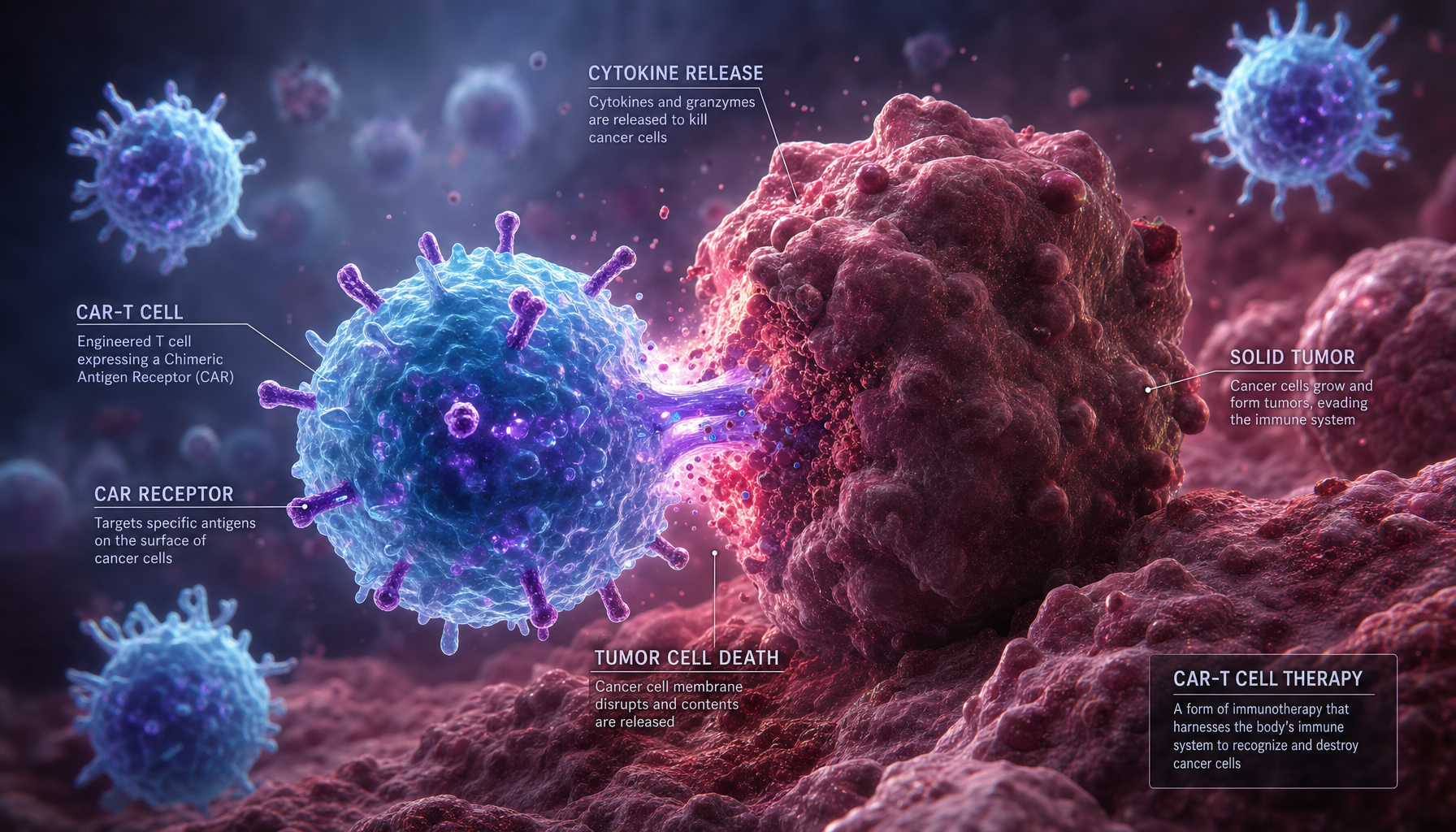
CAR-T Cell Therapy Conquers Solid Tumors: Novel Targeting Strategies Achieve Breakthroughs
Claudin18.2 CAR-T achieves 45% objective response rate in gastric cancer, while logic-gated and universal CAR-T usher in a new era of solid tumor immunotherapy
I. From Blood Cancer to Solid Tumors: The Great Wall CAR-T Must Cross
Chimeric antigen receptor T cell (CAR-T) therapy has achieved unprecedented success in B-cell hematologic malignancies — Kymriah, Yescarta, Tecartus, and other products have brought complete remission to tens of thousands of patients with relapsed/refractory leukemia and lymphoma. However, when CAR-T faces solid tumors — which account for over 90% of all cancers — it has been nearly universally unsuccessful.
The barriers are not singular: the immunosuppressive factors of the tumor microenvironment (TME) (TGF-β, IL-10, adenosine), physical barriers (dense stroma, abnormal vasculature), antigen heterogeneity (different cells within the same tumor express different targets), and CAR-T cell exhaustion from sustained activation in the tumor, together form a "wall of despair" for CAR-T in solid tumors.
However, between 2025 and 2026, multiple technological breakthroughs are overturning this pessimistic outlook.
II. Key Clinical Progress and Target Analysis
2.1 Claudin18.2 CAR-T — The Biggest Breakthrough in Solid Tumors
Claudin18.2 (CLDN18.2) is a tight junction protein with extremely low expression in normal gastric mucosa but high expression in 60-80% of gastric cancers, 50% of pancreatic cancers, and 30% of esophageal cancers — making it a nearly ideal CAR-T target.
CT041 (satri-cel) — CARsgen Therapeutics
CT041 is the most clinically mature CAR-T product in solid tumors to date. As of end of 2025:
- Gastric/gastroesophageal junction cancer: In CLDN18.2-positive chemotherapy-failed patients, overall objective response rate (ORR) was 48.6%, disease control rate (DCR) reached 73.0%
- Pancreatic cancer: ORR of 33.3%, median overall survival (OS) of 8.2 months (historical control approximately 3-4 months)
- Safety: Cytokine release syndrome (CRS) incidence was 95%, but most were Grade 1-2; no treatment-related deaths
CARsgen submitted a New Drug Application (NDA) in China in 2025 for CT041 in CLDN18.2-positive gastric cancer failing at least second-line therapy, with approval expected in the first half of 2027. The global Phase 3 trial NCT06342726 has been initiated simultaneously in the US, Europe, and Asia.
Other CLDN18.2 CAR-T Products:
- Legend Biotech (LB2102): Uses bispecific CAR design (simultaneously recognizing CLDN18.2 and CLDN18.1) to reduce gastric mucosal toxicity; Phase 1 data shows ORR of 40%
- CARsgen and Innobio are engaged in direct competition, with the latter's CLDN18.2 CAR-T among its peers in China receiving priority review designation
2.2 GPC3 CAR-T — New Hope for Hepatocellular Carcinoma
Glypican-3 (GPC3) is highly expressed in 70-80% of hepatocellular carcinoma (HCC) while barely expressed in normal liver tissue.
CARsgen's CT011 (GPC3 CAR-T) reported latest Phase 2 results at the 2025 American Society of Clinical Oncology (ASCO) annual meeting:
- 24 GPC3-positive advanced HCC patients, overall ORR of 37.5% (9/24), DCR of 70.8%
- In the subgroup receiving combined transarterial chemoembolization (TACE), ORR improved to 57.1%
- Median progression-free survival (PFS) was 4.8 months; combined TACE group was 7.3 months
Eureka Therapeutics employs its proprietary ARTEMIS platform (non-ITAM CAR), which can reduce CRS occurrence while maintaining anti-tumor activity. Its ET190L1 (GPC3-ARTEMIS) has initiated Phase 1/2 trials, with early data showing significantly lower CRS incidence than conventional CAR-T.
2.3 Mesothelin CAR-T — The Broadcast Solid Tumor Target
Mesothelin is highly expressed in multiple solid tumors including mesothelioma, ovarian cancer, pancreatic cancer, and non-small cell lung cancer. The challenge is that mesothelin also has some expression in normal pleura, peritoneum, and pericardium, limiting dosing.
T Munity Therapeutics' mRNA transient expression mesothelin CAR-T (non-viral vector, CAR expressed for only a few days) showed encouraging safety in Phase 1 trials: zero Grade ≥3 CRS events, and since mRNA requires no genomic integration, theoretically no oncogenic risk. However, the brief CAR expression period limits efficacy, with ORR of approximately 17%.
University of Pennsylvania / Novartis is developing a "piezoelectric-responsive CAR-T" concept: using focused ultrasound to trigger CAR expression at the tumor site, achieving spatiotemporal precision control. The technology remains preclinical but has attracted widespread attention.
III. Technology Revolution: Helping CAR-T Survive in Solid Tumors
3.1 Logic-Gated CAR
One of the biggest problems with single-antigen CAR-T in solid tumors is "on-target, off-tumor toxicity." Logic-gated CARs use AND / OR / NOT gates to allow T cells to activate only when encountering two or more tumor antigens simultaneously:
- AND gate: T cells must bind both Antigen A and Antigen B to activate (e.g., CLDN18.2 + EpCAM)
- NOT gate (iCAR): Inhibits CAR activity if a normal tissue antigen (such as TROP2 on alveolar epithelium) is encountered
- synNotch system: First recognizes one antigen to induce expression of a second CAR, achieving "sequential gating"
Senti Biosciences' logic-gated CAR-T (SENTI-301) in preclinical models targeting GPC3+ EGFR+ dual-positive HCC showed tumor killing comparable to conventional CAR-T, but with 80% reduced toxicity to normal tissues.
3.2 Universal / Allogeneic CAR-T
The biggest commercialization bottleneck for solid tumor CAR-T is the production cost of autologous CAR-T ($370,000-470,000 per dose). Universal CAR-T (from healthy donors) can significantly reduce costs and enable advance production.
- Cellectis' UCART (TALEN gene-edited to knock out TCR and MHC-I) has completed Phase 1 in solid tumors. Preliminary data shows that despite weak persistence (median 14 days), combining with IL-2 or lymphodepleting chemotherapy can extend it to 28 days
- Caribou Biosciences' CB-011 (B2M knockout with HLA-C retention strategy to avoid NK cell attack) shows better persistence in preclinical solid tumor models
- Fate Therapeutics' iPSC-derived CAR-NK cells (FT536) targeting ROR1 for triple-negative breast cancer have entered Phase 1
3.3 Armored CAR
To overcome TME immunosuppression, researchers are engineering CAR-T cells to secrete immune-stimulatory molecules:
- 4-1BBL / IL-12 secreting CAR-T: Releases co-stimulatory signals locally in the tumor, activating surrounding non-specific immune cells (bystander activation)
- TGF-β dominant negative receptor CAR-T: Replaces the TGF-β receptor intracellular domain with an immune activation signal domain
- PD-1 dominant negative or CD226 overexpression: Prevents CAR-T from becoming dysfunctional due to PD-L1 in the TME
Poseida Therapeutics' success with P-BCMA-101 (for multiple myeloma) is being transferred to solid tumor pipelines; its piggyBac transposon platform can accommodate larger gene fragments, suitable for simultaneously inserting CAR and multiple armor genes.
IV. Market Landscape and Commercial Prospects
Global Clinical Trial Distribution
As of March 2026, there are 1,800+ active CAR-T clinical trials worldwide, with solid tumor-related trials accounting for approximately 580 (32%), a significant increase from 18% in 2022. China accounts for 55% of solid tumor CAR-T trials, the US 28%, and Europe 12%.
Key Players and Funding
| Company | Key Technology | Cumulative Funding / Valuation | Latest Progress |
|---|---|---|---|
| CARsgen Therapeutics | CLDN18.2 CAR-T | HKEX listed, market cap ~HK$4.5B | NDA under review |
| Legend Biotech | Multi-target CAR-T | NASDAQ listed, market cap ~$8.5B | Phase 2 |
| Senti Biosciences | Logic-gated CAR | NASDAQ SPAC listed | Phase 1 |
| Caribou Bio | CRISPR-edited CAR-T | NASDAQ, market cap $1.2B | Phase 1 |
| Cellectis | TALEN universal | Dual-listed US/EU | Phase 1 |
Market Size Forecast
According to EvaluatePharma's 2026 report, the solid tumor CAR-T therapy market is projected to reach $12 billion by 2030, accounting for 35% of the total CAR-T market (the remaining 65% still in hematologic malignancies). CLDN18.2 target peak sales estimated at $4.5 billion, GPC3 at $2.8 billion, and mesothelin at $2.2 billion.
V. Future Outlook and Key Challenges
Near-Term Milestones (2027-2028)
- CT041 (satri-cel) is expected to become the first approved solid tumor CAR-T product; if successful, it will inject tremendous confidence into the entire field
- Logic-gated CAR-T will advance from Phase 1 to Phase 2, validating the clinical feasibility of "precision off-target control"
- FDA may issue guidance on "solid tumor CAR-T clinical trial design," clarifying conditions for biomarker surrogate endpoint use
Medium-Term Challenges (2028-2030)
- Antigen escape: Expansion of CLDN18.2-negative subclones under selective pressure — solution is dual-target or triple-target CAR-T
- Delivery physiological barriers: CAR-T struggles to penetrate dense stroma in pancreatic cancer — combination with matrix-degrading enzymes (such as hyaluronidase)
- Production costs: If autologous CAR-T cannot be reduced below $100,000, it will be difficult to largely replace standard therapy in solid tumors
Long-Term Vision (2030+)
"In-Situ Manufacturing" CAR-T: Using mRNA-LNP to generate CAR-T cells directly within the patient's body, eliminating the cumbersome ex vivo production process. Multiple laboratories have demonstrated in preclinical models that intravenous injection of CD3-targeted mRNA-LNP can convert T cells into CAR-T cells in vivo. If successful, it will completely eliminate the production bottleneck of CAR-T therapy.
Conclusion
CAR-T therapy's journey in solid tumors resembles a difficult siege battle — each line of defense (TME, antigen heterogeneity, off-target toxicity, cell exhaustion) requires entirely new tactical breakthroughs. But the clinical data from 2025-2026 gives us reason for cautious optimism: the success of CLDN18.2 CAR-T has proven that solid tumor CAR-T is not a theoretical phantom but a tangible possibility. With the maturation of logic-gated, allogeneic universal, and armored CAR-T technologies, the era of immune cell therapy in solid tumors may arrive sooner than we think.
POC.HK Future Technology Observatory — Independent Technology Watch Report