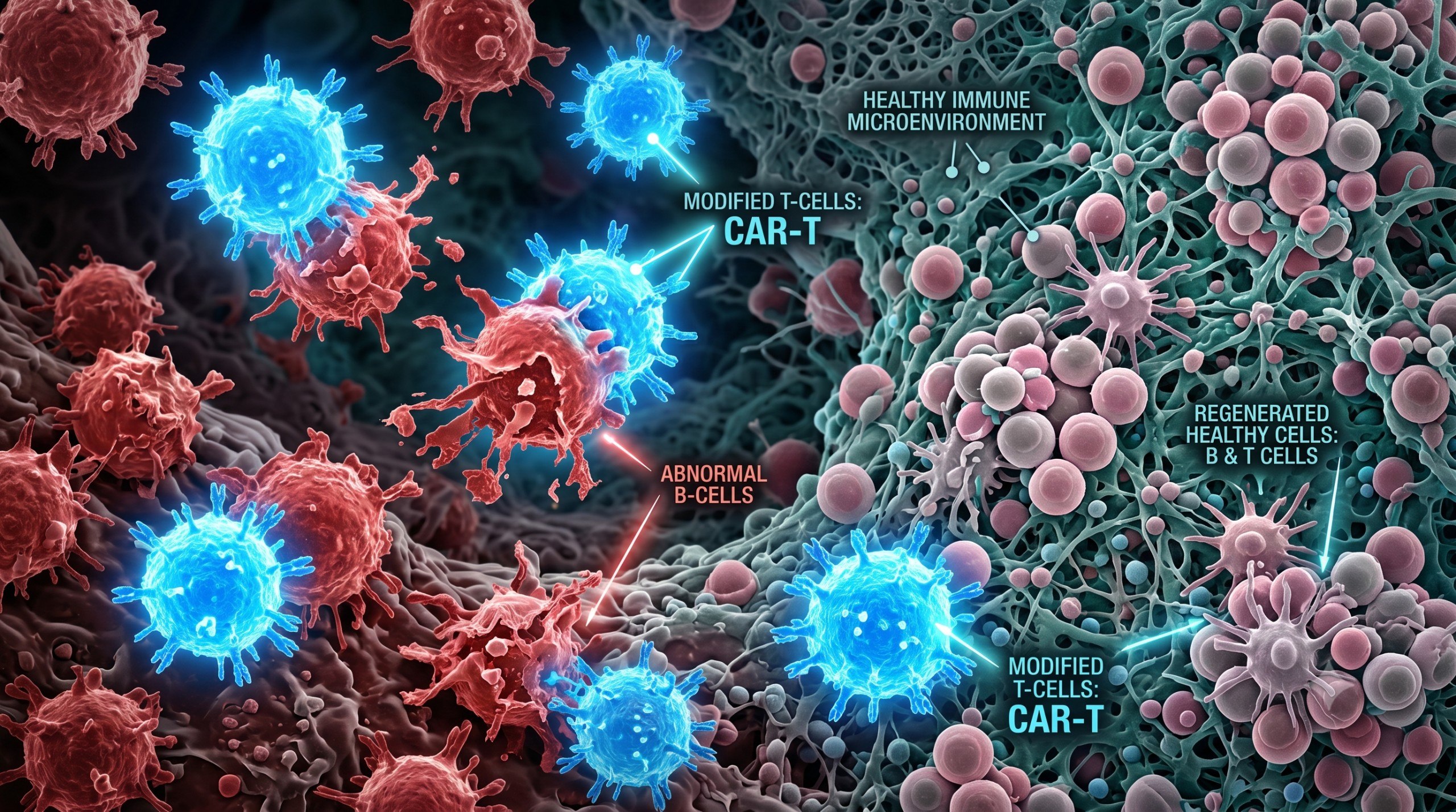
CAR-T cell therapy — a treatment that has achieved revolutionary success in oncology — is expanding its front from cancer to autoimmune diseases. In June 2026, the US FDA approved Imviva Biotech's CTA313 for a Phase 1 basket trial in progressive multiple sclerosis (MS) and other B-cell-mediated autoimmune diseases. Earlier in 2026, published clinical data showed that CD19-targeted CAR-T therapy achieved 100% remission in systemic lupus erythematosus (SLE) patients (all 8 patients achieved clinical remission). Observatory believes these results represent more than a CAR-T indication expansion — they embody a fundamental reconstruction of the autoimmune disease treatment paradigm.
From B-Cell Depletion to Immune Reset: The Scientific Logic of CAR-T for Autoimmune Disease
Understanding why CAR-T can expand from cancer to autoimmune disease requires understanding the core pathological mechanism of autoimmune diseases. In many autoimmune conditions — SLE, MS, rheumatoid arthritis, myasthenia gravis — B cells play a common key pathogenic role.
Specifically, autoreactive B cells produce autoantibodies against self-tissues, attacking joints (RA), myelin sheaths (MS), DNA and nuclear components (SLE), or neuromuscular junctions (myasthenia gravis). Existing treatments — such as rituximab — can also deplete B cells, but the depletion is incomplete and requires regular repeated dosing.
CAR-T's unique advantage lies in: genetically modified T cells can not only more thoroughly deplete B cells, but more importantly, can persist in the body and monitor B cell reappearance. After all B cells are depleted, the immune system must regenerate the B cell population from hematopoietic stem cells — a process called "immune reset." If newly generated B cells derive from hematopoietic stem cell pools uncontaminated by autoreactive precursors, they will no longer produce autoantibodies — theoretically achieving a "cure" rather than "control."
Several key clinical data published in 2026 support this theory. In Mackensen's team study at Friedrich-Alexander-University Erlangen-Nuremberg, all 5 refractory SLE patients receiving CD19-targeted CAR-T therapy achieved clinical remission and discontinued all immunosuppressive drugs — with a mean follow-up exceeding 18 months, some patients maintaining remission beyond 2 years.
CTA313: A Key Advance in Off-the-Shelf CAR-T
Imviva Biotech's CTA313 represents another important direction for CAR-T in autoimmune disease — allogeneic (off-the-shelf) CAR-T. Unlike autologous CAR-T (using the patient's own T cells), allogeneic CAR-T uses T cells from healthy donors, gene-edited to reduce immune rejection risk, and can be stored as a standardized product for immediate use.
CTA313's FDA approval for an MS Phase 1 trial marks an important milestone for several reasons:
First, MS affects approximately 2.8 million people globally, and progressive MS currently lacks effective treatments. Existing disease-modifying therapies primarily target relapsing-remitting MS (RRMS), with limited efficacy in progressive MS. CAR-T's mechanism — depleting autoantibody-producing B cells and B cells that may play pathogenic roles in the CNS — is theoretically attractive for progressive MS.
Second, the "off-the-shelf" nature of allogeneic CAR-T is particularly important for autoimmune disease. Unlike oncology, where patients can typically wait 2-4 weeks for autologous CAR-T preparation during diagnosis, autoimmune disease patients have usually undergone years of conventional treatment referrals. Allogeneic CAR-T's immediate availability can significantly streamline the treatment pathway.
Third, the basket trial design allows CTA313 to simultaneously evaluate safety and preliminary efficacy in progressive MS and other B-cell-mediated autoimmune diseases (such as lupus nephritis, IgG4-related disease) — an efficient trial design still innovative in the autoimmune field.
Unique Challenges of CAR-T Expansion to Autoimmune Disease
Despite encouraging early clinical results, CAR-T faces unique challenges moving from oncology to autoimmune disease:
Different safety curve. Oncology patients can tolerate significant treatment-related toxicity — cytokine release syndrome (CRS) and immune effector cell-associated neurotoxicity syndrome (ICANS) — because the alternative is end-stage cancer. In autoimmune disease, patients have longer life expectancies and typically lower disease burden than end-stage cancer, placing far higher safety requirements. While reported CRS rates for CAR-T in autoimmune disease are lower (approximately 20-30% vs 40-80% in oncology), even fully manageable CRS requires very careful risk-benefit assessment for a lupus patient who could live with the disease for many years.
Difficulty in efficacy evaluation. Efficacy evaluation in oncology is relatively straightforward — tumor shrinkage or disappearance. In autoimmune disease, efficacy evaluation relies on composite scores (SLEDAI for SLE, EDSS for MS) that are subjective, and the disease's inherent fluctuation adds complexity. More importantly, after CAR-T treatment and discontinuation of immunosuppressive drugs, the duration of "remission" requires years of follow-up to determine — short-term "remission" could be a superposition of natural disease fluctuation and drug washout effects.
Uncertainty of the business model. Autologous CAR-T therapy pricing in oncology has reached $370,000-470,000 per treatment — justified by breakthrough efficacy for end-stage cancer. In autoimmune disease, with the same manufacturing cost but facing non-fatal, chronic disease indications, payer acceptance will face significant scrutiny. If allogeneic CAR-T products like CTA313 can reduce manufacturing costs by 80-90% (through scaled production and standardized processes), the business model becomes more viable — but allogeneic CAR-T persistence (in vivo duration) is typically shorter than autologous CAR-T, potentially requiring repeated dosing, increasing long-term costs.
Global Competitive Landscape
CAR-T for autoimmune disease has become one of the most watched new frontiers in the pharmaceutical industry:
| Company | Candidate | Target | Indications | Current Stage |
|---|---|---|---|---|
| Imviva Biotech | CTA313 | CD19 | Progressive MS, SLE, IgG4-RD | FDA Phase 1 approved Jun 2026 |
| Kyverna Therapeutics | KYV-101 | CD19 | SLE, scleroderma, myasthenia gravis | Phase 2 |
| Cabaletta Bio | DSG3-CAART | DSG3 | Mucosal pemphigus vulgaris | Phase 2 |
| BMS / Juno | Breyanzi | CD19 | SLE, lupus nephritis | Phase 1/2 |
| CRISPR Therapeutics | CTX130 | CD19 | SLE | Phase 1 |
| Univ. Erlangen | Autologous CD19 CAR-T | CD19 | SLE, myositis, systemic sclerosis | Investigator-initiated Phase 1 |
Notable: large pharma companies (BMS, Novartis) have not yet fully committed to autoimmune CAR-T — reflecting their caution about market uncertainty. This provides a first-mover window for biotech startups (Imviva, Kyverna), but these companies will face commercialization and payer negotiation challenges after completing clinical development.
mRNA CAR-T: The Next Technology Wave
Beyond traditional viral vector CAR-T, another direction worth watching in 2026 is mRNA CAR-T. The mRNA technology platform — validated at massive clinical scale through COVID-19 vaccines — can be used to transiently express CARs in vivo. This offers several key advantages:
First, mRNA CAR-T does not integrate into the genome, eliminating insertional mutagenesis risk — more controllable safety.
Second, mRNA CAR expression is temporary (lasting days to weeks), which may be an advantage in autoimmune disease rather than a drawback: therapeutic effect is transient B-cell depletion rather than permanent genetic reprogramming — allowing physicians to adjust treatment based on patient response.
Third, mRNA manufacturing is far faster than viral vectors — from sequence design to clinical batch may take only weeks, compared to months for viral vector production.
The University of North Carolina team is developing an mRNA CAR-T platform targeting myasthenia gravis, with plans to expand indications to lupus and rheumatoid arthritis. If mRNA CAR-T can demonstrate clinically comparable efficacy to traditional CAR-T, it may become the preferred option in autoimmune disease — better safety profile, faster manufacturing, greater treatment flexibility.
Observatory Analysis
CAR-T's expansion from oncology to autoimmune disease carries significance beyond indication broadening — it is blurring the boundary between "cure" and "control." CAR-T in oncology is considered a "one-time treatment" — while some patients may relapse, the treatment design aims at eradication. In autoimmune disease, CAR-T's immune reset effect suggests a deeper possibility: by retraining the immune system, patients not only experience symptom disappearance but fundamentally change the disease's immunological foundation.
Observatory believes the field must answer three key questions in the next 3-5 years:
First, CAR-T remission duration in autoimmune disease. Current data extend to approximately 2 years — if remission lasts beyond 5 years, CAR-T could be considered a "functional cure"; if remission lasts 1-2 years requiring repeated dosing, its cost advantage over existing biologics will be questioned.
Second, safety data accumulation. Among approximately 50+ reported autoimmune disease patients receiving CAR-T, severe CRS (grade ≥3) incidence is approximately 5-8% — lower than oncology but not zero risk. As patient numbers expand to hundreds and thousands, the true incidence of rare but serious adverse events (ICANS, prolonged cytopenia) will become clearer.
Third, regulatory definition of "immune reset." Will the FDA require CAR-T products to demonstrate "remission lasting X years or more" in autoimmune disease for full approval? Or can accelerated approval be based on short-term efficacy and biomarker changes? This directly affects product launch timelines and commercial prospects.
Forward Outlook
Events worth watching from H2 2026 to H1 2027 include: Kyverna KYV-101's SLE Phase 2 data readout, CTA313's preliminary safety and biomarker data in progressive MS, and the first clinical dosing of mRNA CAR-T platform in myasthenia gravis.
Over a longer horizon, CAR-T's success or failure in autoimmune disease will directly influence the development trajectory of broader cell therapies (Treg cell therapy, CAR-NK) in non-oncology fields. If CAR-T can safely and effectively treat autoimmune disease, it opens a door to an "precision immune modulation" era — where doctors no longer use broad-spectrum immunosuppressants to blindly suppress the immune system, but precisely target and correct malfunctioning immune circuits. This would be the most direct clinical translation of 50 years of immunology research.
Disclaimer: The information in this article is provided for reference only and does not constitute investment advice or business decision guidance. Data and time-sensitive information are current as of the publication date and may change with subsequent developments. Neither the author nor POC.HK assumes any liability for losses resulting from the use of this information.