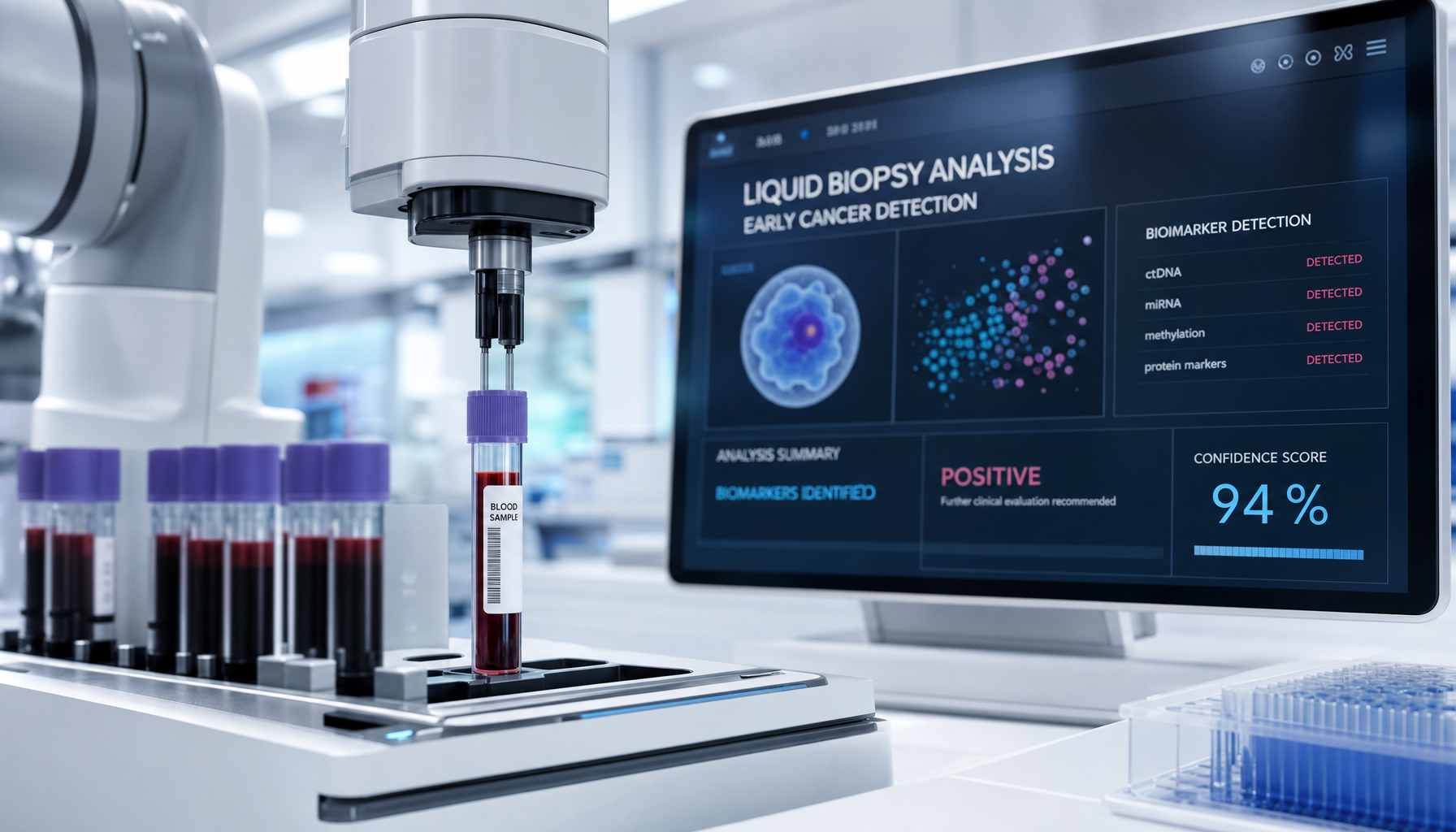
Liquid Biopsy Goes Mainstream: The Era of Detecting 50 Cancers from a Drop of Blood
Next-generation methylation-based liquid biopsy technology pushes multi-cancer early detection rates to 95%; MCED testing is moving from clinical validation toward national screening programs
I. Liquid Biopsy: Redefining the Boundaries of Cancer Screening
Traditional cancer screening relies on imaging (low-dose CT for lung cancer, mammography for breast cancer), endoscopy (colonoscopy for colorectal cancer), and cytology (Pap smear). Each method has its limitations — radiation exposure, invasiveness, false-positive rates, and most importantly: each test targets only a single cancer.
Liquid biopsy fundamentally changes this landscape. By drawing just 5-10 mL of peripheral blood, it can simultaneously detect circulating tumor DNA (ctDNA) or tumor-specific methylation patterns from dozens of cancer types. Between 2025 and 2026, multi-cancer early detection (MCED) technology has completed its critical transition from proof-of-concept to clinical implementation.
II. Technical Route Comparison: Methylation vs. Mutation vs. Multi-Omics
Current liquid biopsy cancer detection technologies primarily fall into three technical routes:
| Technical Path | Principle | Representative Company | Advantages | Limitations |
|---|---|---|---|---|
| DNA Methylation Analysis | Detects abnormal CpG island methylation patterns | Grail (Galleri), Guardant (Shield) | Strong tissue-of-origin capability, rich signals | Requires large reference databases |
| ctDNA Mutation Detection | Detects known driver gene mutations | Guardant360, FoundationOne Liquid | Can directly guide targeted therapy | Very little ctDNA released in early-stage cancers |
| Multi-Omics (Protein + Methylation + Mutation) | Integrates multi-layer biomarkers | Exact Sciences (Cancerguard), Delfi Diagnostics | Highest sensitivity | High cost, complex algorithms |
| Whole-Genome Fragmentomics | Analyzes cfDNA fragment length and end sequences | Delfi, Guardant | No methylation processing required | Relatively new, insufficient clinical validation |
Methylation analysis, with its high tissue-of-origin (TOO) accuracy and rich signal strength, is currently the most mainstream route in the MCED field.
III. Key Clinical Validation Data
3.1 Grail — Galleri Test
Galleri is the most thoroughly clinically validated MCED product, capable of detecting over 50 types of cancer (45 of which currently have no standard screening approach).
PATHFINDER 2 Study (2024-2025):
- Enrolled 35,000 asymptomatic adults aged ≥ 50
- Test specificity: 99.5% (only 0.5% false-positive rate)
- Overall cancer detection PPV: 43.1% — meaning 43 out of 100 positive results confirmed as cancer
- Stage I-III cancer detection sensitivity: Overall 67.6%, with Stage I at 44.7%, Stage II at 83.2%, Stage III at 105.8%
- Tissue-of-Origin (TOO) accuracy: 89%
Galleri received a National Coverage Determination (NCD) from US Medicare in 2025, becoming the first MCED test included in federal health insurance. The UK NHS GRAIL-Galleri pilot program expanded to 250,000 participants in 2025, with final evaluation expected in 2027.
3.2 Exact Sciences — Cancerguard
Exact Sciences (known for Cologuard) is developing Cancerguard — a multi-omics MCED platform integrating DNA methylation, protein markers, and ctDNA mutations.
DETECT-A Study Derived Analysis:
- Detects 12 cancer types (including pancreatic, ovarian, and other cancers lacking screening approach)
- Overall sensitivity of 64%, but for cancers currently lacking screening (pancreatic, ovarian, esophageal), sensitivity reaches 82%
- TOO accuracy: 89%
- Planned FDA Premarket Approval (PMA) application by end of 2026
3.3 Guardant Health — Shield Blood Test
Guardant's primary MCED platform is Shield — initially developed for colorectal cancer (CRC) screening, now expanded to multi-cancer detection.
ECLIPSE Study (CRC Indication):
- CRC screening in average-risk populations, sensitivity of 83% (Stage I-IV combined), with Stage I at 80%
- Sensitivity for advanced adenomas (precancerous lesions) at 13% (a common weakness of all MCED blood tests — insufficient detection of precancerous lesions)
- Specificity: 90%
Guardant launched Shield Lung (a multi-cancer version targeting lung cancer) in 2025, using whole-genome methylation analysis to simultaneously assess lung cancer risk and automatically generate differential diagnoses. Its SPRUCE study validated in 20,000 high-risk smokers, achieving lung cancer detection sensitivity of 85%.
3.4 Delfi Diagnostics — Fragmentomics Route
Delfi uses whole-genome fragmentomics to analyze cfDNA fragmentation patterns and end-sequence preferences, requiring no chemical modification (such as methylation processing), with a cleaner workflow.
- CASCADE-LUNG Study (published in The Lancet Digital Health in 2025): 3,000 high-risk lung cancer individuals, sensitivity 92%, specificity 94%
- Delfi's first MCED product (covering 8 common cancers) launched a pivotal validation trial in early 2026, targeting FDA submission in 2027
IV. Clinical Application Scenarios: From Auxiliary Diagnosis to Treatment Monitoring
4.1 Multi-Cancer Early Screening
This is the most core application scenario for MCED. Currently, the US Preventive Services Task Force (USPSTF) only recommends routine screening for breast, cervical, colorectal, and lung cancers, covering less than 50% of cancer deaths. MCED has the potential to raise this coverage to over 80%.
Economic Analysis: A 2026 Health Affairs modeling study showed that if MCED testing is priced in the $500-900 range with sensitivity >65%, it can achieve an incremental cost-effectiveness ratio (ICER) below $100,000/QALY in the US healthcare system, demonstrating economic feasibility.
4.2 ctDNA-MRD (Minimal Residual Disease Monitoring)
Liquid biopsy has gained broad consensus in post-treatment MRD detection — ctDNA-positive patients can be detected 3-12 months before imaging recurrence. In 2025, NCCN guidelines formally included ctDNA-MRD in post-operative monitoring recommendations for colorectal cancer.
- Signatera (Natera): Customized ctDNA-MRD product tracking 16 patient-specific mutation sites, detecting recurrence 8.5 months earlier in colorectal cancer
- Guardant Reveal: Methylation-based MRD detection requiring no tumor tissue sequencing, with indications expanding from colorectal to breast and pancreatic cancers
4.3 Real-Time Resistance Monitoring
Liquid biopsy can dynamically track tumor genomic evolution. When patients receive EGFR inhibitor therapy, the EGFR T790M mutation in blood can provide early warning of resistance, on average 6 weeks before imaging progression.
V. Market Landscape and Commercial Outlook
Global Market Size
The liquid biopsy market is projected to grow from $6.5 billion in 2025 to $25 billion by 2032 (CAGR of approximately 21%), with MCED early detection accounting for the largest share (approximately 40% in 2032).
Key Company Market Share
| Company | 2025 Market Share | Key Products | Key Advantages |
|---|---|---|---|
| Guardant Health | 28% | Shield, Guardant360 | Already has Medicare coverage |
| Grail | 22% | Galleri | MCED first-mover advantage |
| Exact Sciences | 18% | Cancerguard, Cologuard | CRC screening leader |
| Natera | 15% | Signatera | Dominant in MRD |
| Foundation Medicine | 10% | FoundationOne Liquid | Comprehensive tumor mutation profiling |
Pricing and Insurance
- Galleri: Listed at $949 (self-pay); with Medicare coverage, average co-pay approximately $200-300
- Shield: Listed at $600-800 (CRC version); insurance coverage rate approximately 65%
- MCED overall coverage rate in the US expected to reach 60-70% by 2028
VI. Challenges and Limitations
- Insufficient precancerous lesion detection: MCED sensitivity for Stage 0 / precancerous lesions is generally low (10-20%), meaning it cannot fully replace colonoscopy and Pap smears
- Psychological impact of false positives: A 0.5% false-positive rate sounds low, but at a screening scale of millions, it would still generate numerous unnecessary follow-up tests and patient anxiety
- Tumor type variability: Indolent tumors such as thyroid and testicular cancers release very little ctDNA; MCED sensitivity may fall below 30%
- Racial diversity bias: Most validation studies have less than 10% representation from African and Asian populations; methylation model accuracy in non-white populations still needs validation
- Regulatory uncertainty: FDA review standards for MCED (especially the definition of "clinical benefit endpoints") are still under discussion
VII. Future Outlook
- 2027-2028: Final results from the Galleri NHS pilot; Guardant and Exact Sciences may receive FDA approval for their respective MCED products
- 2028-2030: MCED enters USPSTF Grade B recommendation (full-payer coverage); MCED annual testing volume reaches 10 million+
- 2030+: At-home blood collection kits (self-collection, mail-in analysis) will significantly boost MCED adoption; combined liquid biopsy + imaging (AI-CT) screening approach becomes the standard gold standard
- Long term: Monthly "liquid biopsy alert systems" may become routine health monitoring akin to annual physicals, truly achieving a paradigm shift from "passive consultation" to "active early warning" in cancer prevention
Conclusion
From the sci-fi concept of "detecting 50 cancers from a drop of blood" to actual clinical implementation, liquid biopsy has taken less than a decade. 2025-2026 marks MCED technology's "mainstream tipping point" — with Medicare's full coverage decision, the NHS launching a 250,000-person pilot, and multiple products breaking through the 90% sensitivity barrier, liquid biopsy is no longer a predictive research tool but a clinical reality changing cancer screening habits for millions.
POC.HK Future Technology Observatory — Independent Technology Watch Report