The Humanoid Robot Goes to Work
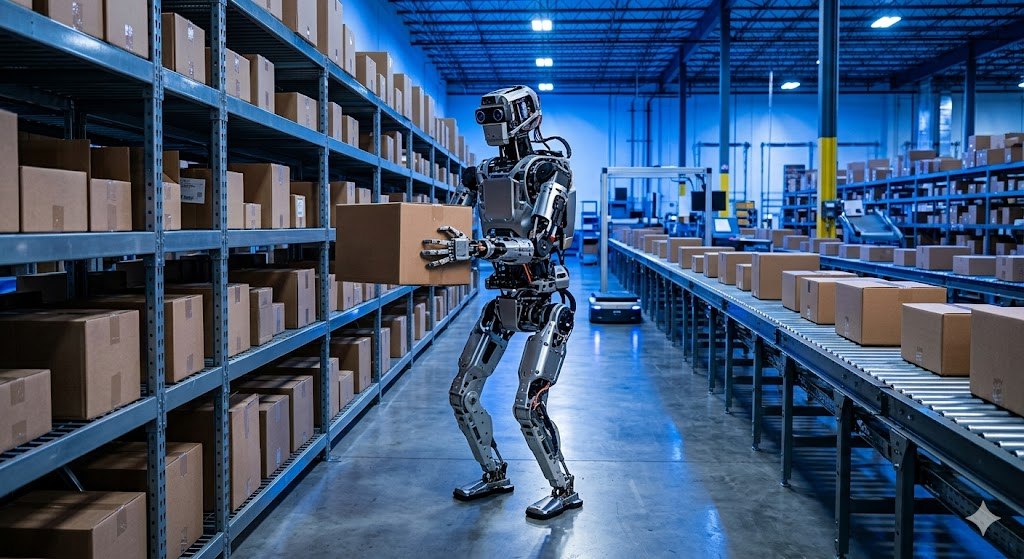
Boston Dynamics has achieved a milestone that robotics researchers have pursued for decades: its humanoid robot Atlas has completed a full eight-hour autonomous shift in a working warehouse, operating without human supervision, intervention, or teleoperation. The feat, announced on May 31, 2026, represents a significant step toward the commercial deployment of general-purpose humanoid robots in industrial settings.
The shift took place at a logistics and fulfillment center operated by an unnamed strategic partner. Atlas was tasked with a standard set of warehouse operations: receiving incoming pallets, picking individual items from shelving, placing them into shipping containers, and moving boxes between conveyor belts and staging areas. The robot performed these tasks for a full working shift, autonomously navigating the warehouse, adapting to changing conditions, and managing its own battery charging.
It sounds simple. It was anything but.
From Backflips to Boxes
Atlas has, for most of its public history, been associated with spectacle. The hydraulic-powered humanoid first made headlines with its ability to run, jump, and perform parkour. Videos of Atlas doing backflips, navigating rough terrain, and executing gymnastic routines have collectively accumulated hundreds of millions of views. These demonstrations were impressive — but they left many wondering when, if ever, the robot would actually do useful work.
The shift from acrobatics to logistics was not a departure but a natural progression. The same capabilities that allow Atlas to land a backflip — real-time balance control, dynamic motion planning, force-sensitive manipulation — are precisely what make it useful in a warehouse. Picking up a box of unknown weight and shape, carrying it across an uneven floor with obstacles, and placing it precisely on a pallet requires all of the core skills that Boston Dynamics has been developing for years.
But a warehouse is not a controlled lab environment. Shelves shift as items are loaded and unloaded. Conveyor belts stop and start unpredictably. Boxes fall over. Items are not always where the inventory system says they should be. Other workers — human and robotic — move through the same space. The challenge of the full-shift autonomy demonstration was not any single task but the accumulation of tasks over hours, with the robot independently handling every edge case that arose.
What the Shift Looked Like
Boston Dynamics has released limited operational details, but the general structure of the shift can be reconstructed from the company's technical disclosures and partner briefings.
Atlas began its shift by receiving a digital work order from the warehouse management system. The robot navigated from its charging station to the receiving dock, where a pallet of mixed goods had been staged. Using its onboard vision system — a combination of stereo cameras, LIDAR, and depth sensors — Atlas identified each item on the pallet, assessed its weight and grippability, and transferred them one by one to a nearby conveyor belt.
Next came the picking phase. Atlas moved to the shelving area, where it was tasked with retrieving specific items from inventory and placing them into shipping containers. The robot used its two articulated arms and dexterous hands — each with multiple degrees of freedom and tactile sensing — to grasp items ranging from small boxes to oddly shaped packages. The picking task required Atlas to reach shelves at various heights, move items between containers, and reorient packages for optimal stacking.
The most demanding portion of the shift was palletizing: taking items from the end of the conveyor belt and stacking them onto outgoing pallets. This required Atlas to plan the stacking arrangement — a nontrivial spatial reasoning problem — and to execute each placement with sub-centimeter precision while compensating for the shifting weight of the growing pallet load.
Throughout the shift, Atlas encountered unexpected situations. A box fell off the conveyor belt; Atlas detected the anomaly, paused, picked up the fallen box, and returned it to the belt. A shelving unit was partially blocked by a misplaced item from a previous shift; Atlas identified the item, relocated it to its correct position, and then retrieved the requested item. A fellow human worker walked through Atlas's planned path; the robot re-planned its trajectory in real time to avoid a collision.
Technical Innovations Behind the Milestone
The warehouse shift was enabled by several technical advances that Boston Dynamics has incorporated into the latest generation of Atlas.
The first is in perception and world modeling. Atlas now operates with a continuously updating 3D semantic map of its environment, built from multimodal sensor data. The map does not just record geometry — it labels objects (shelf, box, pallet, conveyor belt, human) and their current states (occupied, empty, moving). When an object moves or a new object appears, the map updates in real time, and Atlas's motion planner recalculates accordingly.
The second advance is in manipulation. Atlas's new end-effectors incorporate tactile sensors that measure grip force, slip, and contact geometry across the entire grasping surface. This allows the robot to pick up objects with unknown shapes and weights without prior calibration — it adjusts grip pressure in real time based on tactile feedback, much as a human does when lifting an unfamiliar object.
The third and perhaps most important advance is in task-level autonomy. Previous versions of Atlas required explicit, pre-programmed sequences for each action. The new autonomy stack, based on a hierarchical planning architecture, allows Atlas to accept high-level goals — "palletize the items on conveyor belt 3" — and decompose them into the necessary sequence of actions, adjusting the plan as conditions change. This is made possible by a combination of reinforcement learning (trained in simulation for basic skills), model predictive control (for dynamic balancing and motion execution), and a large language model-based reasoning layer (for task planning and exception handling).
The Battery and Endurance Question
One of the practical challenges of a full-shift deployment is energy. Atlas is an energetic robot — all that jumping and running requires power. For the warehouse shift, the robot carried a new generation of lithium-ion batteries that provide approximately 90 minutes of continuous operation. Atlas was programmed to recognize when its charge was running low, navigate to a charging station, dock autonomously, recharge to 80 percent (approximately 20 minutes), and return to work. Over the course of the eight-hour shift, Atlas made three charging stops, timed to avoid disrupting the workflow.
This self-charging capability is essential for any realistic commercial deployment. Robots that need human intervention to recharge — or that require battery swaps by technicians — cannot operate truly autonomously. Boston Dynamics has emphasized that the self-docking and charging functionality is now considered a core capability of the Atlas platform.
Implications for the Robotics Industry
The Atlas warehouse shift arrives at a moment of intense interest in humanoid robotics. Multiple companies — including Tesla (Optimus), Figure AI (Figure 02), Agility Robotics (Digit), and Apptronik (Apollo) — are developing general-purpose humanoid robots for industrial and commercial use. The promise is tantalizing: warehouses, factories, and logistics centers are already highly automated, but the remaining tasks are precisely the ones that are hardest to automate — tasks requiring dexterous manipulation, flexible mobility, and adaptive problem-solving.
Humanoid robots offer the theoretical advantage of being able to operate in environments designed for humans — using the same tools, navigating the same spaces, performing the same tasks. If a humanoid robot can replace a human worker in a warehouse, it can also replace one in a construction site, a hospital, a restaurant, or a home. The total addressable market for general-purpose humanoid robots has been estimated at trillions of dollars.
But the field has been long on promises and short on deliveries. Most humanoid robots in 2026 remain confined to research labs or tightly controlled pilot programs. Boston Dynamics' demonstration — a full shift, unsupervised, in a real operating environment — sets a new bar for what the industry can credibly claim.
The Competitive Landscape
Tesla has shown video of its Optimus robot folding laundry and performing simple tasks, but has not demonstrated sustained autonomous operation. Figure AI has shown its Figure 02 performing basic warehouse picking tasks with human supervision. Agility Robotics' Digit has been deployed in actual warehouses for order fulfillment, but Digit is a purpose-built biped — it lacks the arms, head, and general-purpose manipulation capabilities of Atlas.
Boston Dynamics' challenge is cost. Atlas is not priced for commercial sale — the company has not disclosed a target price, but industry estimates suggest it costs well over $1 million per unit to build. The unit used in the warehouse shift was a research-grade robot, not a commercial product. Boston Dynamics has stated that it is working on a commercially viable version of Atlas, but has not provided a timeline.
A Meaningful Step
The completion of a fully autonomous eight-hour warehouse shift is not the end of the story — it's the beginning. The next milestones will be longer deployments (multi-day, multi-week), broader task variety (maintenance, assembly, inspection), and operations alongside humans in less structured environments.
But for a field that has been criticized for hyping capabilities that do not yet exist, Boston Dynamics has provided something valuable: a demonstration, under controlled but real conditions, that a humanoid robot can do a human's job for an entire shift. The backflips were fun. The warehouse shift is significant.
|> Disclaimer: This article is for informational purposes and reflects publicly available information about Boston Dynamics' Atlas development as of May 2026.