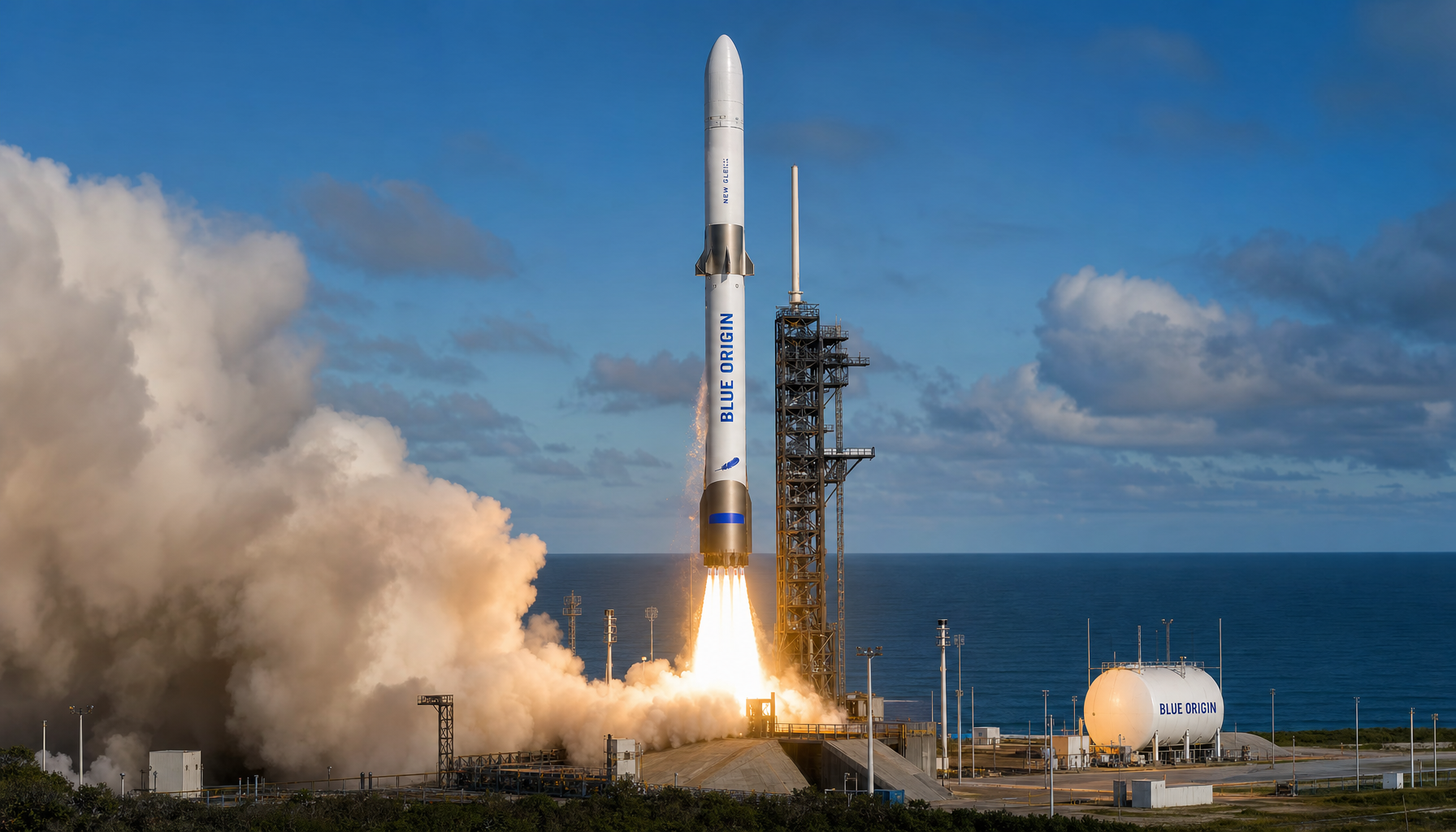
New Glenn: Blue Origin's Orbital Breakthrough and the New Landscape of the Commercial Launch Market
After a decade of development and multiple delays, Blue Origin's New Glenn rocket finally completed its highly anticipated first orbital flight mission (NG-1) on January 15, 2026. The 98-meter-tall heavy-lift launch vehicle, equipped with seven BE-4 liquid oxygen/methane engines, lifted off from LC-36 at Cape Canaveral Space Force Station in Florida at 3:28 AM, successfully delivering a set of test payloads — including a 3-ton simulated satellite and two university-developed CubeSats — into geosynchronous transfer orbit (GTO). Although the first-stage landing recovery was unsuccessful (due to a pressure drop in one engine during the landing burn phase), this launch nonetheless marked Blue Origin's upgrade from a suborbital tourism company to an orbital-class launch service provider.
Technical Architecture and Design Philosophy
New Glenn's technical architecture embodies Blue Origin founder Jeff Bezos' engineering philosophy of "Gradatim Ferociter" (step by step, ferociously). The rocket uses a two-stage design, with the first stage powered by seven BE-4 engines providing total thrust of approximately 1,750 tons — slightly below Falcon Heavy's approximately 2,300 tons, but significantly above Falcon 9's approximately 760 tons. The BE-4 engine is Blue Origin's in-house product manufactured at its Kent, Washington factory, and is one of the few liquid oxygen/methane engines currently in flight operation.
The second stage uses a single BE-3U engine — a vacuum-optimized hydrogen/oxygen engine version with a specific impulse (Isp) of approximately 445 seconds. This design choice reflects New Glenn's mission priority: delivering large payloads directly into high-energy orbits (GTO or lunar transfer orbit). In contrast, SpaceX's approach achieves high-energy missions through Starship's orbital refueling architecture — two technical routes representing different engineering philosophies.
The fairing diameter of 7 meters is the largest among operational launch vehicles — exceeding Falcon 9's 5.2 meters and Ariane 6's 5.4 meters. This makes New Glenn particularly suitable for launching large satellites (such as 6-ton DISH-class communications satellites) or space telescopes requiringvery large payload volume. The fairing uses aluminum honeycomb structure and composite separation systems, with an internal usable volume of approximately 145 cubic meters.
Key Lessons from the First Flight
NG-1's success was not without flaws. Approximately 8 minutes after launch, the first stage completed its propulsive separation and began the return-to-atmosphere landing burn. However, three seconds before landing, one BE-4 engine's oxygen preburner pressure experienced an abnormal drop, resulting in insufficient thrust. Landing velocity exceeded the design range, and the booster ultimately crashed into the water near the landing ship "Jacklyn."
Blue Origin CEO Dave Limp stated at the post-launch press conference that the root cause of the landing failure has been preliminarily identified as a turbo pump seal wear issue, emphasizing that this issue does not affect engine operation during the ascent phase — in fact, all seven BE-4 engines operated normally during ascent, with cumulative burn time exceeding 250 seconds and no performance degradation. The second-stage BE-3U's performance was flawless, precisely executing a 45-minute coast phase between two ignitions. These data indicate that New Glenn's basic design is robust, with the problem concentrated on the boundary conditions for reusable landing.
Order Backlog and Commercial Prospects
As of May 2026, New Glenn has confirmed launch contracts exceeding 50 missions, with total contract value of approximately $6 billion. The largest customer is Amazon's Project Kuiper satellite constellation — a broadband internet constellation of 3,236 satellites directly competing with SpaceX's Starlink. Amazon has signed 38 New Glenn launch contracts with Blue Origin (plus additional optional launches) for Kuiper satellite deployment.
Other significant customers include: the U.S. Space Force's National Security Space Launch (NSSL) Phase 2 contract, awarding 5 New Glenn launch missions worth approximately $1.5 billion; British communications satellite operator OneWeb with 3 launch contracts; and two NASA science mission launches, including the 2028 ESCAPADE Mars exploration mission.
Blue Origin also announced New Glenn's pricing structure in the same press release: standard LEO missions approximately $90 million to $120 million, standard GTO missions approximately $150 million to $200 million. This pricing strategy directly benchmarks Falcon 9's LEO launch price (approximately $67 million) and Falcon Heavy's pricing (approximately $97 million to $150 million). Considering New Glenn's payload advantage on GTO missions (approximately 13 tons versus Falcon 9's approximately 8.3 tons), its per-kilogram launch cost is competitive in the GTO market.
Competitive Landscape with SpaceX
New Glenn's arrival significantly changes the global commercial launch market's competitive dynamics. Since the 2010s, SpaceX's Falcon 9 has held a de facto monopoly in the commercial launch market — according to BryceTech's statistics, Falcon 9 handled approximately 60% of global commercial launch missions in 2024. New Glenn offers another large reusable rocket option, providing customers with an important supply chain diversification choice.
The technical route differences between the two companies are also worth analyzing. SpaceX focuses on achieving extreme economies of scale through Starship — targeting per-launch costs as low as $10 million to $20 million, but requiring very high launch frequency to amortize fixed costs. Blue Origin has adopted a more traditional business model — reducing marginal costs through reusability while maintaining relatively higher per-launch prices and lower annual launch frequency (targeting 12 to 16 launches per year by 2028).
Interestingly, the two companies will also compete directly in the U.S. national security launch market. USSF's NSSL Phase 3 contract (to be tendered in 2027) is viewed as the next major arena, as national security missions typically carry higher profit margins and stable demand.
Observatory Analysis
From an independent observer's perspective, New Glenn's commercial prospects face three key variables. The first variable is the speed of achieving reusability — if Blue Origin requires more than 5 flights to successfully recover the first stage, its cost advantage will be significantly weakened. The second variable is BE-4 engine production output — Blue Origin needs to achieve stable production capacity of approximately 2 to 3 engines per month to support a 12-launch-per-year cadence. The third variable is Kuiper constellation's actual deployment speed — Amazon faces an FCC regulatory deadline requiring deployment of at least 1,618 satellites by July 2026; if Kuiper cannot reach operational scale on time, New Glenn's order backlog may face adjustments.
Another signal worth monitoring is Blue Origin's operational efficiency transformation. Since Dave Limp (former Amazon Devices Senior Vice President) took over as CEO in 2023, Blue Origin's management style has shifted from R&D-driven to operations-driven. Limp introduced Amazon's "six-pager" decision-making framework and lean production principles, reducing New Glenn's production cycle from 18 months to 12 months.
Looking Ahead
The next two years will determine whether New Glenn can transition from "technical success" to "commercial success." In the second half of 2026, Blue Origin plans to execute the NG-2 mission — the first mission carrying real Kuiper satellites for deployment, with another attempt at first-stage recovery. If successful, this would mark New Glenn's first revenue-generating flight while achieving reusability.
In 2027, Blue Origin will complete construction of a second dedicated New Glenn launch pad at Cape Canaveral (LC-36's second launch position), increasing total launch capacity to 20 to 24 per year. Meanwhile, an upgraded second-stage variant of New Glenn — featuring a vacuum-optimized BE-3U (further increasing Isp to approximately 455 seconds) — will be used for lunar missions. Blue Origin's Blue Moon MK2 lunar lander will be launched by New Glenn, serving as another key lander option under NASA's Artemis program beyond Starship HLS.
New Glenn is not just Blue Origin's rocket — it is a critical step in the global commercial launch market's transition from single supplier to diversified competition. For the entire space industry, this means reduced dependence on a single launch vehicle, improved supply chain resilience, and further cost reduction through competition. A healthy, competitive launch market is the foundation for sustainable space economy growth.
Disclaimer: This article is written by POC.HK Future Technology Observatory based on publicly available information and independent analysis. The technical parameters, contract amounts, and timelines mentioned are from Blue Origin public disclosures and related NASA and USSF documents; actual progress may differ due to technical and regulatory factors.