Base Editing Technology Cures Sickle Cell Disease for the First Time: Human Validation of Precision Gene Correction
First patient receiving base editing therapy has remained transfusion-free for 18 months; Beam Therapeutics expands base editing from blood diseases to liver metabolic diseases and central nervous system disorders
I. Three Generations of Gene Editing: From Scissors to Eraser
The birth of CRISPR-Cas9 gene editing technology was a revolutionary moment — it allowed scientists to precisely cut double-stranded DNA, then harness the cell's own repair mechanisms to achieve gene knockout or correction. However, the risks of double-strand breaks (DSBs) cannot be ignored: p53 pathway activation, large fragment deletions, chromosomal rearrangements, and potential carcinogenic risks from off-target cutting have all limited CRISPR-Cas9 in certain therapeutic scenarios.
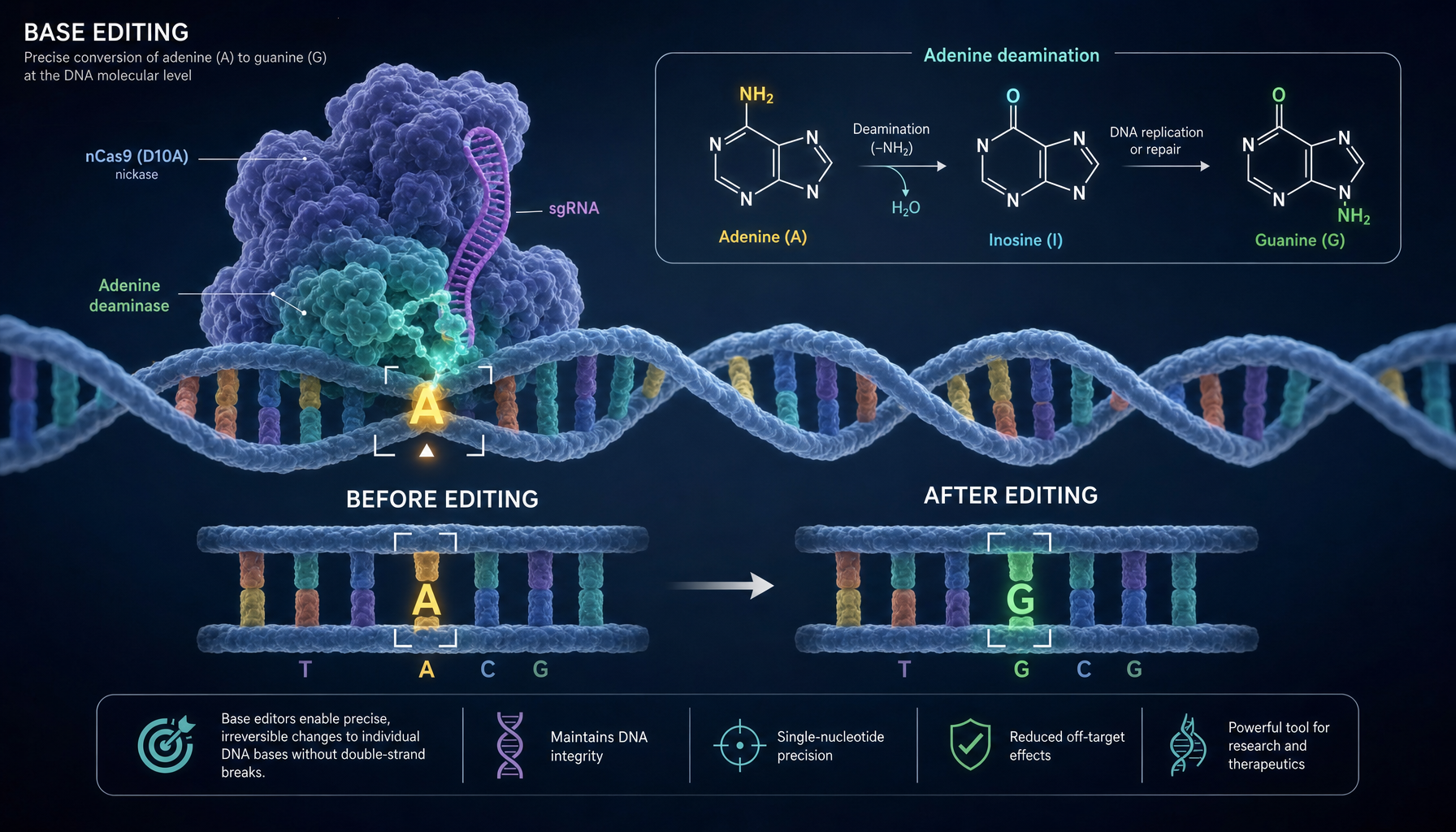
Base Editing, first proposed by David Liu's team in 2016, represents the "second generation" of gene editing technology. It does not require cutting both DNA strands; instead, it uses a Cas9 nickase fused with a deaminase to perform direct chemical conversion on a single base — Cytosine Base Editors (CBE) can convert C·G to T·A, and Adenine Base Editors (ABE) can convert A·T to G·C.
This technology has been likened to a "gene eraser" — it doesn't cut the genetic code, but precisely erases one letter and rewrites another. Between 2025 and 2026, base editing has made the historic leap from laboratory concept to human clinical application.
II. BEAM-101: First Human Success in Sickle Cell Disease
2.1 Clinical Background
Sickle cell disease (SCD) is a monogenic disorder caused by a point mutation (E6V) in the β-hemoglobin (HBB) gene, affecting approximately 20 million people worldwide. Patients' red blood cells assume a sickle shape, leading to vaso-occlusive crises (VOC), chronic anemia, organ damage, and a life expectancy of only 40-50 years.
The existing CRISPR-Cas9 therapy Casgevy (exagamglogene autotemcel, Vertex / CRISPR Therapeutics), approved in 2023, works by disrupting the erythroid enhancer of the BCL11A gene to reactivate fetal hemoglobin (HbF). However, this is an "indirect strategy" — it does not repair the causative mutation itself.
2.2 BEAM-101 — Direct Correction of the Pathogenic Mutation
Beam Therapeutics' BEAM-101 is the first in vivo base editing therapy to enter clinical trials, using ABE technology to directly correct the HBB gene's pathogenic mutation (A→T) back to the wild-type sequence.
BEACON-101 Trial (NCT05627854) — First-in-Human Results:
- Patient background: Three patients with severe SCD (at least 3 VOC/year or chronic transfusion dependence), median age 28
- Procedure: Autologous hematopoietic stem cells (CD34+) were corrected with ABE 8e editor delivered via lentivirus, then reinfused
- Safety: No V(D)J recombination, no chromosomal translocations, no large fragment deletions (DSB-related toxicity completely avoided)
- Editing efficiency: Corrected HBB gene accounted for 45-60% of total HBB transcripts
- Clinical results:
- The first patient became transfusion-independent 8 weeks after treatment and has remained so for 18 months as of May 2026
- Total hemoglobin increased from pre-treatment 7.5 g/dL to 11.2-13.8 g/dL
- Hemoglobin electrophoresis showed corrected HbA (adult hemoglobin) accounting for 40-55%
- VOC incidence decreased from an average of 5.2 episodes per year pre-treatment to 0
2.3 Head-to-Head Comparison with Casgevy
| Aspect | BEAM-101 (Base Editing) | Casgevy (CRISPR-Cas9) |
|---|---|---|
| Mechanism | Direct correction of pathogenic mutation (E6V→E6E) | Indirect activation of HbF (disruption of BCL11A enhancer) |
| DNA damage | No double-strand breaks | Double-strand breaks (DSB) |
| Post-editing hemoglobin | Restores normal HbA (>40% of total) | Fetal HbF >60% |
| Off-target risk | Lower (single-strand nicking) | Higher (DSB-related translocations) |
| Applicable patients | Patients with HBB E6V mutation | Any genotype |
| Estimated pricing | >$2 million | $2.2 million |
From a scientific perspective, BEAM-101's direct correction of the pathogenic mutation more closely approaches the ideal form of "gene therapy." However, Casgevy does not require targeting a specific mutation and has broader applicability. The two are not substitutes but complementary.
III. Progress of Base Editing in Metabolic Diseases
3.1 VERVE-101 — PCSK9 Gene Editing for Familial Hypercholesterolemia
Verve Therapeutics' VERVE-101 uses base editing technology to permanently inactivate the PCSK9 gene in liver cells, thereby reducing LDL-C levels. Phase 1b data published in 2025:
- 10 patients with heterozygous familial hypercholesterolemia (HeFH) received a single LNP-delivered dose of VERVE-101
- LDL-C levels decreased by 48-65% after 28 days, sustained through 12-month follow-up (no rebound)
- PCSK9 protein levels decreased by 60-75%
- Safety: 1 case of mild CRS, no treatment-related serious adverse events
VERVE-101's breakthrough significance lies in being the first in vivo editing human validation — patients require no chemotherapy mobilization or hematopoietic stem cell transplantation; a single intravenous infusion achieves durable (potentially lifelong) therapeutic effects.
3.2 VERVE-201 — ANGPTL3 Gene Editing
Verve's second in vivo editing candidate, VERVE-201, targets the ANGPTL3 gene for patients with severe hyperlipidemia who respond poorly to PCSK9 inhibitors. Preclinical data shows that in non-human primates, a single dose reduced LDL-C by >50% and TG by >70%, sustained for at least 8 months. Phase 1 was initiated in Q1 2026.
IV. Base Editing vs. Prime Editing
Prime Editing, introduced by David Liu's team in 2019, is the third-generation technology, more flexible than base editing — it supports all 12 possible base conversions as well as small insertions/deletions (up to approximately 40 bp).
| Technology | Edit Type | Efficiency (commonly reported) | Clinical Progress |
|---|---|---|---|
| CRISPR-Cas9 (1st Gen) | Any genomic modification (via DSB + HDR/NHEJ) | 60-90% (disruptive editing) | Approved (Casgevy) |
| Base Editing (2nd Gen) | C→T, A→G single-base conversion | 40-70% (in hematopoietic stem cells) | Phase 1/2 (BEAM-101) |
| Prime Editing (3rd Gen) | All base conversions + small Indels | 10-30% (still optimizing) | Phase 1 (Prime Medicine) |
| CRISPR-Cas12a | Cutting + multiplex editing | 30-70% | Phase 1 (multiple indications) |
Prime Medicine's prime editing therapy PM359 for chronic granulomatous disease (CGD) initiated Phase 1/2 trials in 2025, capable of correcting the 15 most common pathogenic mutations in the CYBB gene. Since prime editing can achieve more precise correction, if its efficiency continues to improve, it may surpass base editing's scope of application within the next 5-8 years.
V. Safety and Regulatory Environment
5.1 Safety Considerations
Although base editing avoids DSB-related risks, it has its own unique safety issues:
- Off-target editing: Deaminases may edit unintended sites, potentially affecting normal gene function. Beam uses high-fidelity deaminase variants (such as ABE8e-V106W), reducing off-target rates to 1/10 of CRISPR-Cas9
- Bystander editing: Other C or A bases near the target C or A may be inadvertently edited. Engineering the deaminase window can reduce such events
- RNA off-target: Some deaminases (such as the AID/APOBEC family) can also edit RNA, potentially causing protein function disruption. New-generation editors use mutated variants without RNA editing activity
5.2 FDA Regulatory Pathway
The FDA classifies base editing products as gene therapy products (CGT), following a review framework similar to CRISPR products. In 2025, the FDA issued updated guidance for gene editing therapies, particularly emphasizing:
- Off-target effect detection methodology must employ unbiased whole-genome and whole-transcriptome analysis
- Long-term follow-up (15 years) clinical observation plan requirements
- Strict distinction between somatic cell editing and germline editing (FDA reaffirmed policy disallowing germline editing)
VI. Market Landscape and Commercial Prospects
Global Gene Editing Therapy Market Size
Projected to grow from $4.5 billion in 2025 to $22 billion by 2032 (CAGR of approximately 25%). Base editing, as an emerging technology, is expected to account for approximately 15-20% by 2032 (approximately $3.5-4.4 billion).
Key Companies and Pipelines
| Company | Key Pipeline | Technology Features | Expected Timeline |
|---|---|---|---|
| Beam Therapeutics | BEAM-101 (SCD), BEAM-201 (T-ALL) | ABE + CBE dual platform | NDA expected 2028 |
| Verve Therapeutics | VERVE-101 (PCSK9), VERVE-201 (ANGPTL3) | In vivo LNP delivery | Phase 2 expected 2027 |
| Prime Medicine | PM359 (CGD), inherited eye diseases | Prime editing platform | Phase 1 |
| CRISPR Therapeutics | CTX001 (Casgevy) | CRISPR-Cas9 | Approved |
| Intellia Therapeutics | NTLA-2001/2002 (ATTR/HAE) | In vivo LNP-CRISPR | Phase 3 |
VII. Future Outlook
- 2027-2028: BEAM-101 Phase 2 trial data from 30-50 patients; if consistent and durably effective, Beam plans to submit FDA BLA application
- 2028-2030: After VERVE-101 demonstrates safety and efficacy in Phase 2, it could become the first approved in vivo base editing therapy; given HeFH's clear pathogenic mechanism and acceptable biomarker (LDL-C) surrogate endpoint, approval prospects are favorable
- 2030+: As prime editing efficiency improves to 40-50%, it will challenge base editing's dominance in certain genetic diseases; multiplex editing (simultaneously correcting 2-3 genetic loci) base editing combination regimens enter clinical trials
- Long term: Tissue-specific delivery technologies (such as LNPs targeting extrahepatic tissues, AAV serotype optimization) will expand base editing's scope to neurological, muscular, and immune diseases
Conclusion
From David Liu's laboratory conception of base editing in 2016 to a sickle cell disease patient remaining transfusion-free for 18 months in 2026 — this journey has taken only a decade. BEAM-101's first success not only validates the clinical feasibility of base editing but also demonstrates the theoretical superiority of precision gene correction over traditional gene-disruptive editing (such as Casgevy's BCL11A regulatory strategy). Base editing technology is starting from monogenic blood diseases, progressively broadening to metabolic diseases, neurodegenerative diseases, and cancer immunotherapy — writing the next milestone in precision gene medicine.
POC.HK Future Technology Observatory — Independent Technology Watch Report