Axiom Space Raises $175M More: Commercial Space Station Race Accelerates
On June 4, 2026, Axiom Space announced an additional raise of over $175 million in its latest funding round. New investors in this round include Japan's largest bank — Mitsubishi UFJ Financial Group (MUFG) — signaling that international financial institutions' interest in the commercial Low Earth Orbit (LEO) economy is expanding from venture capital into the traditional banking system.
Funding Details and Significance
Axiom Space's cumulative fundraising has surpassed $1 billion, making it one of the best-funded commercial space station developers. MUFG's participation carries symbolic weight: this is not a typical VC firm or space fund, but Japan's largest commercial bank. This move indicates that Axiom's business model — providing "space real estate" services through modular space stations — has received credit endorsement from traditional financial institutions.
MUFG also aims to position Japan's role in the LEO economy through this investment, potentially helping arrange more Japanese companies to lease Axiom's modules in the future.
The Axiom Station Plan
Axiom's commercial space station is advancing in phases:
Phase One (Current): Launch two pressurized modules — Axiom Hab One (AxH1) and Axiom Hab Two (AxH2) — initially docking to the International Space Station's Harmony node. AxH1 is expected to launch in 2027, with AxH2 following shortly after.
Phase Two (Around 2030): When Axiom possesses four main modules, it will separate from the ISS to form the independently flying Axiom Station. By that time, with the ISS set to retire (US government target is 2030), Axiom will become one of the only commercial space stations in orbit.
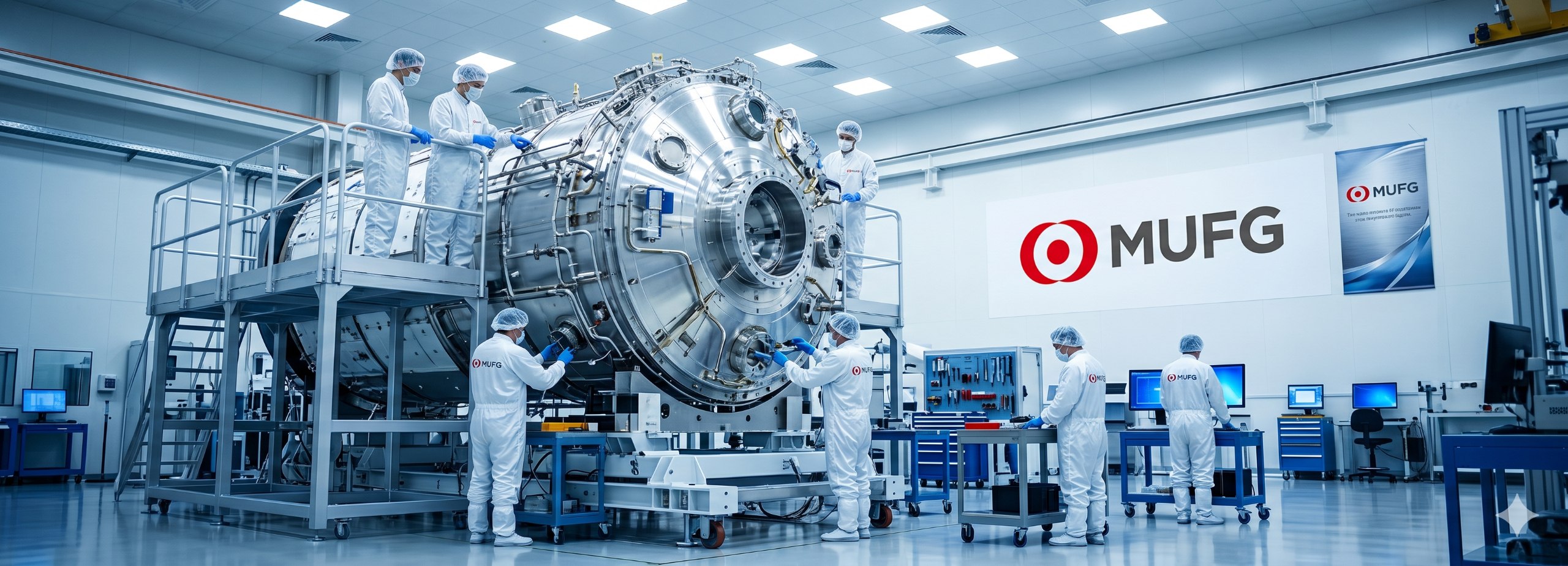
AxH1's structural welding is already complete and pressure testing is underway. The manufacturing facility in Houston, Texas operates three shifts per day. NASA awarded Axiom a $350 million contract in 2020 and has approved the AxH1 formal construction milestone.
ISS Transition and LEO Commercialization
The core of NASA's "LEO Commercialization" strategy is to foster at least one commercial space station to take over before the ISS retires. Axiom is currently the most advanced participant, but not the only one. NASA launched the Commercial LEO Destination (CLD) Phase 2 solicitation in late 2025, with final selection expected in 2027.
Axiom's unique challenge lies in its dual role: it simultaneously acts as a hitchhiker during the ISS transition period and as a final competitor — initially relying on the ISS reduces risk, but if the ISS retires early, Axiom must be capable of standing independently.
Competitive Landscape
Beyond Axiom, at least three other major commercial space station programs are in development:
-
Vast Space (Haven-1): Plans to launch a single-module space station by end of 2026, targeting the earliest operational purely commercial outpost. It has signed a contract with SpaceX for Starship launch.
-
Blue Origin (Orbital Reef): A large multi-module design with partners including Sierra Space and Boeing. Sierra Space's LIFE inflatable module is undergoing burst testing; overall progress lags Axiom by about 2-3 years.
-
Starlab (Voyager Space / Airbus): Approximately one-third the volume of the ISS, focused on modular leasing, with launch targeted for 2028.
Japan's Strategic Involvement
MUFG's investment is not an isolated move. JAXA operates the Kibo Japanese Experiment Module on the ISS but lacks a budget for independently building a space station. Japan's strategy runs on two parallel tracks:
- Direct Investment: Securing priority module space and experiment hours for Japanese companies on Axiom Station
- Technical Cooperation: JAXA is evaluating the transfer of Japanese experiment equipment from Kibo to Axiom modules
If successful, Japanese companies could become the largest non-US customer cluster on Axiom Station.
Timeline and Outlook
- End of 2026: Complete AxH1 thermal vacuum testing
- Mid-2027: AxH1 launch and ISS docking
- 2028: AxH2 launch
- 2029-2030: AxH3 and AxH4 launch
- Post-2030: Separation from ISS, full commercial operation
According to industry estimates, Axiom spends approximately $400-600 million annually. NASA's FY2026 budget faces pressure to cut commercial LEO programs, making private funding even more critical. MUFG's participation symbolizes that commercial space has transitioned from "risk subsidy" to "capital allocation."