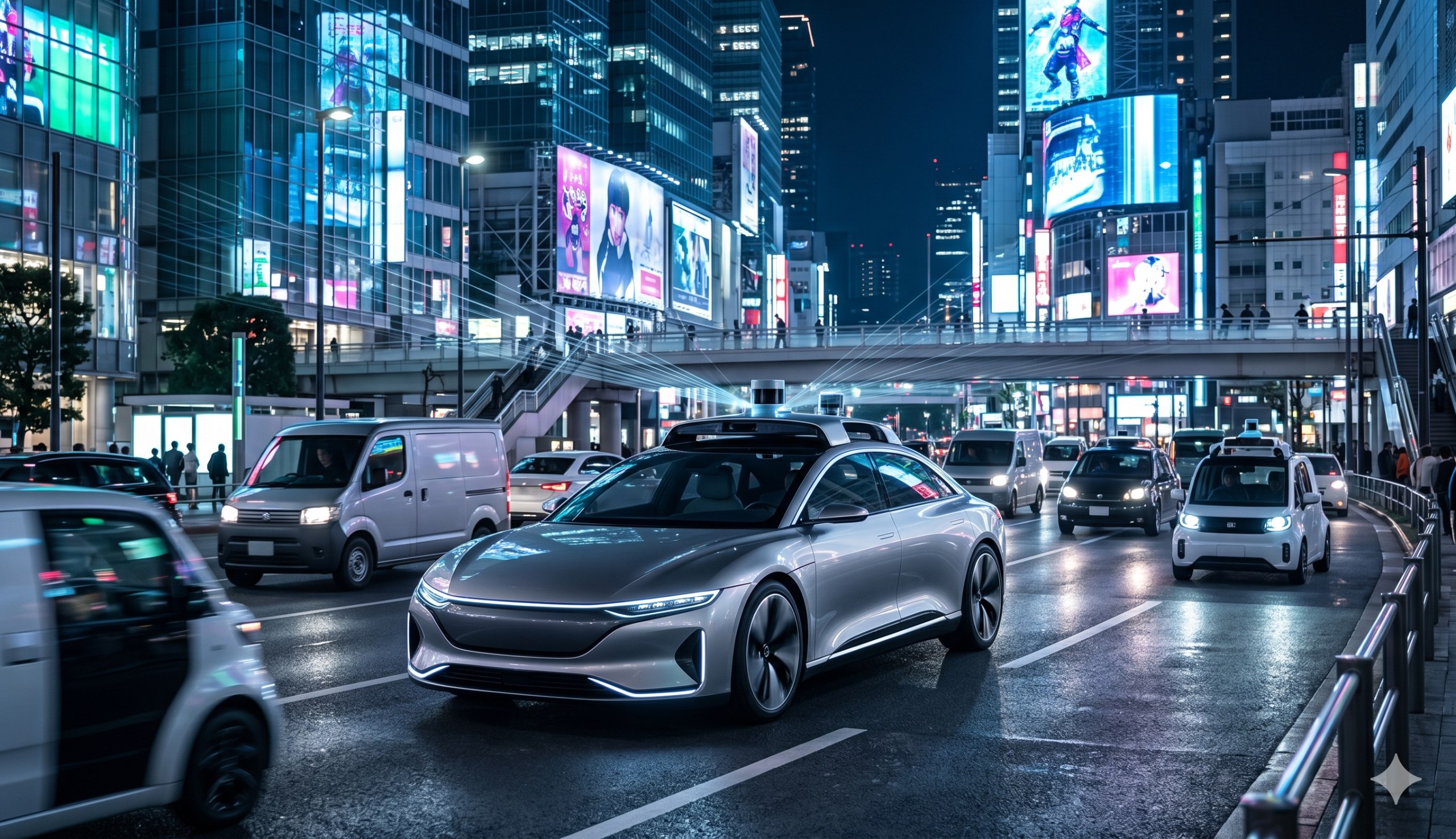
Waymo Robotaxi Expansion Strategy and the Autonomous Driving Commercialization Roadmap
Since fully opening its driverless taxi service in San Francisco in late 2024, Waymo has become the global bellwether for autonomous driving commercialization. Its 2025 annual safety report shows that its fleet has accumulated over 50 million miles across four cities — Phoenix, San Francisco, Los Angeles, and Austin — with an accident rate 65% lower than human drivers. Behind this figure lies fifteen years of technology development and over $10 billion in investment.
Sixth-Generation System: From Hardware Redundancy to Software Scale
Waymo's sixth-generation autonomous driving system (Waymo Driver Gen 6) represents the most production-ready solution currently available. Three major technology upgrades deserve attention: first, a new 4D imaging radar with detection range increased from 200 meters to over 300 meters, capable of directly measuring objects' vertical motion trajectories; second, the introduction of self-supervised learning models that use vast amounts of unlabeled driving data for feature learning, reducing manual annotation requirements by approximately 80% and significantly compressing map update time and cost; third, a redundant dead-reckoning system integrating inertial measurement units (IMU) and wheel odometry, allowing the vehicle to safely pull over even if GPS and LiDAR both fail simultaneously.
The cumulative effect of these technologies is reflected in operational metrics: Waymo's intervention rate per million miles has steadily declined, from 0.8 in 2023 to below 0.2 in 2025, approaching human driver levels.
Observatory Analysis: The Bottleneck Is Not Technology, But Cost
A long-standing misconception in the autonomous driving industry is that technological maturity is the sole prerequisite for commercialization. In reality, Waymo's greatest challenge is unit economics. While the sensor suite cost per Waymo vehicle has dropped from an early $200,000 to approximately $40,000, covering all major US cities would require a fleet of tens of thousands of vehicles, with upfront capital expenditure still reaching billions of dollars.
Another underestimated barrier is operational complexity. Every time Waymo enters a new city, it requires 6-12 months for high-definition mapping, weather adaptation calibration, and negotiations with local regulators. This "one-city-one-policy" model limits scaling speed. By contrast, Tesla's reliance on a pure vision approach and consumer-owned vehicles for data collection, while questionable in safety redundancy, offers enormous advantages in data scale and coverage.
International Competition: Baidu Apollo Go's Pursuit
Baidu Apollo Go has become Waymo's most direct competitor in the Chinese market. As of mid-2025, Apollo Go operates over 1,000 driverless taxis across 10 cities including Wuhan, Beijing, and Shenzhen, with Wuhan alone running 500 vehicles. Apollo Go's advantages include lower vehicle costs (sensor costs controlled within $20,000) and a more permissive policy environment — Wuhan has approved fully driverless taxis citywide.
However, the two differ fundamentally in technical route: Waymo focuses on building its own fleet and developing its own hardware; Baidu adopts a "automaker partnership + autonomous driving platform" model (partnering with Toyota, Voyah, Arcfox, among others). This asset-light model offers greater flexibility in scale expansion but weaker control over the supply chain.
Outlook
Looking ahead to 2026-2028, autonomous robotaxis will undergo a true commercialization stress test. We predict three key changes: First, Waymo will reduce vehicle costs from the current $80,000-100,000 to below $50,000 through large-scale production partnerships with automakers, achieving positive margins; second, operational range will expand from desert-climate cities (Phoenix) to winter cities (New York, Chicago), where snow and ice's impact on sensors will become a technological dividing line; third, at the regulatory level, the National Highway Traffic Safety Administration (NHTSA) is expected to introduce federal-level autonomous vehicle safety standards before 2027, ending the current state-by-state patchwork.
The commercialization of autonomous robotaxis is not a sprint but a marathon testing capital endurance, technological depth, and policy wisdom. Waymo currently holds the lead, but the true outcome may not be clear until after 2028.