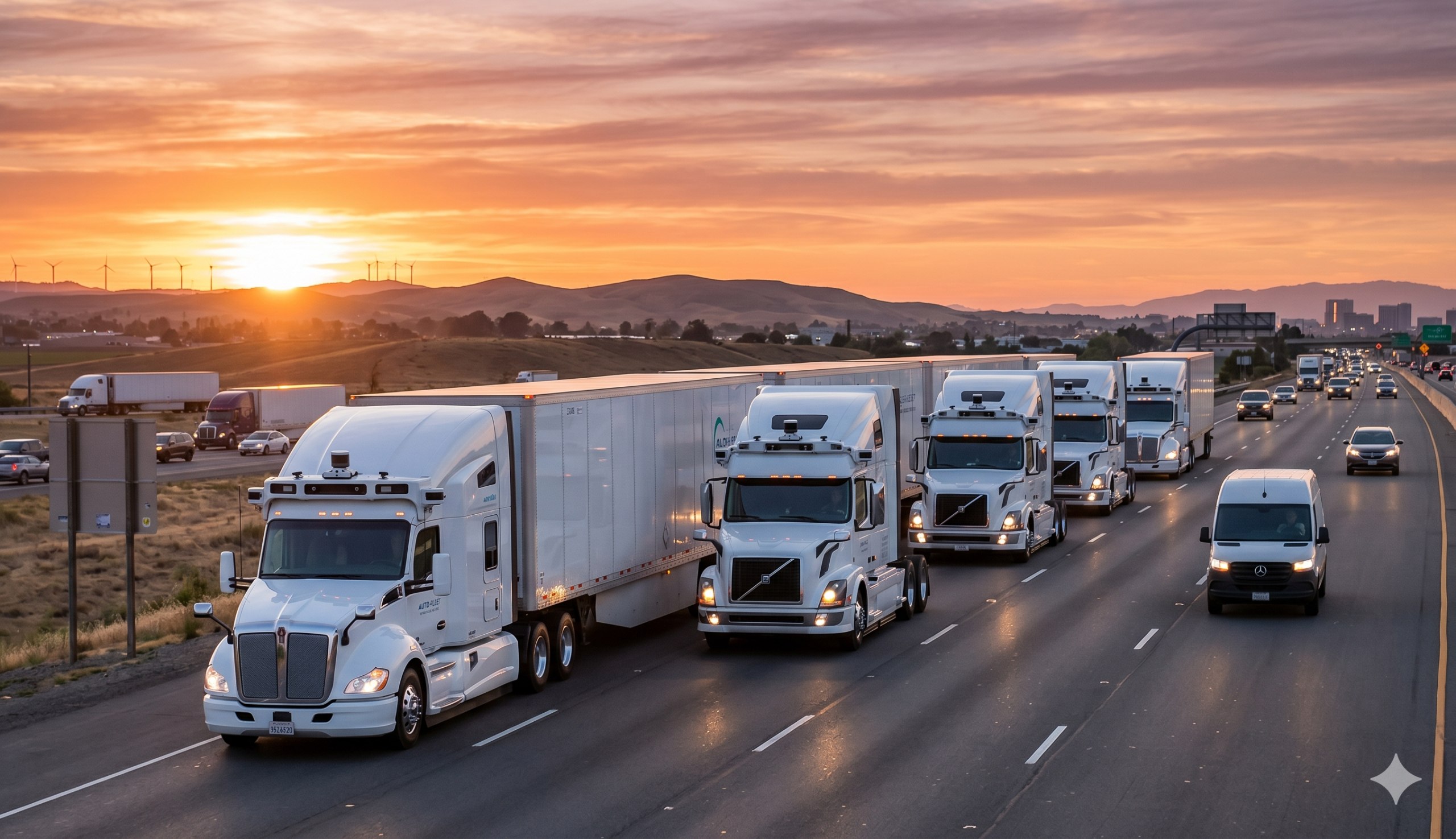
Highway Autonomous Driving: The Night Before Trucking Commercialization
Among all autonomous driving application scenarios, highway trucking is widely regarded as the clearest path to commercialization. The reasoning is straightforward: highway environments are highly structured, lacking the pedestrians, unprotected left turns, traffic signals, and other high-complexity scenarios found in urban driving. This makes the technological threshold for autonomous trucks relatively lower while the economic benefits are extremely compelling.
Technology Maturity Curve
2025 was a watershed year for the autonomous trucking industry. Aurora Innovation and Uber Freight's partnership in Texas has achieved over 100 autonomous delivery trips per week on the Houston-to-Dallas route (approximately 240 miles). Kodiak Robotics has established a transportation network spanning seven states in the southeastern US, securing long-term contracts with major enterprises including IKEA and Pilot.
From a technical metrics perspective, autonomous truck disengagement rates have improved dramatically. Aurora's latest data shows its system's average miles per disengagement (MPD) on highways has exceeded 9,000 miles, approximately 5 times better than 2023 levels. While still far below human driver performance, this figure, combined with safety redundancy design and remote monitoring, has reached an acceptable range for commercial operations.
Observatory Analysis: The Endgame of the Business Model Debate
The autonomous trucking industry currently features two opposing business models. The first is "Driver-as-a-Service" (DaaS): fleet operators purchase the autonomous system from the technology company and bear their own vehicle maintenance and operational costs. The second is "Transport-as-a-Service" (TaaS): autonomous driving companies charge shippers directly for "driverless truck capacity," building their own fleets and bearing all operational responsibility.
Most leading companies favor the latter. The reason: when autonomous systems have not yet reached Level 4 (requiring no monitoring), fleet operators lack the technical capability to manage the system's safety boundaries. The TaaS model allows autonomous driving companies to accumulate edge-case data during operations, feeding it back into model iteration and forming a positive feedback loop. Aurora, Kodiak, and TuSimple have all adopted this strategy.
However, this model is extremely capital-intensive. Converting a Class 8 truck for autonomous operation costs approximately $100,000-150,000. Combined with remote monitoring center staffing, annual operating costs per vehicle reach approximately $120,000-180,000 — far higher than a human driver's $60,000-80,000 annual salary. In the short term, autonomous truck costs are not competitive — the true value lies not in saving driver salaries but in achieving 24/7 continuous operations, improving asset utilization.
The Economic Reality
Eliminating driver costs can reduce per-trip transportation expenses by 30-45%, but this is only a static calculation. More important dynamic benefits manifest at two levels:
First is time compression. Human drivers are limited by federal safety regulations to a maximum of 11 hours of driving within 14 hours, with a mandatory 30-minute rest after 8 consecutive hours. Autonomous trucks, operating in a "relay" mode (swap truck, not driver), can compress Los Angeles-to-Dallas transport time from two days to 28 hours. For time-sensitive goods such as fresh produce and express delivery, the inventory turnover improvement from shorter transit times may be more valuable than direct transportation cost savings.
Second is accident costs. Over 5,000 people die annually in US trucking accidents, with the average economic cost of a commercial truck accident around $180,000 per incident. If autonomous systems can reduce accident rates by 50%, fleet operators could save approximately $20,000-30,000 per vehicle per year in accident-related costs (insurance, repairs, litigation, downtime losses).
Outlook
2026-2027 will be a critical window for the autonomous trucking industry. We expect to see commercialized "Autonomous Freight Corridors" emerging in states with stable climate conditions and dense highway networks, such as Texas, New Mexico, and Arizona. The driving forces come from three directions: first, accelerated legislation for autonomous trucks at the state level, with federal safety standards also under development; second, the continuing decline in LiDAR costs, with solid-state LiDAR already below $1,000, further lowering system barriers; third, accumulated regulatory confidence in Level 4 autonomous driving, with maturity of remote monitoring and automatic fallback mechanisms.
The real challenge lies in last-mile connection — how autonomous trucks complete loading and unloading without drivers. The industry is exploring standardized "Autonomous Truck-to-Dock" solutions, including wireless communication protocols between vehicles and loading platforms, and automated handling equipment.
Autonomous trucks will not replace all truck drivers overnight, but they will be the first to carve an opening in the long-haul freight sector. That opening may prove larger than many expect.