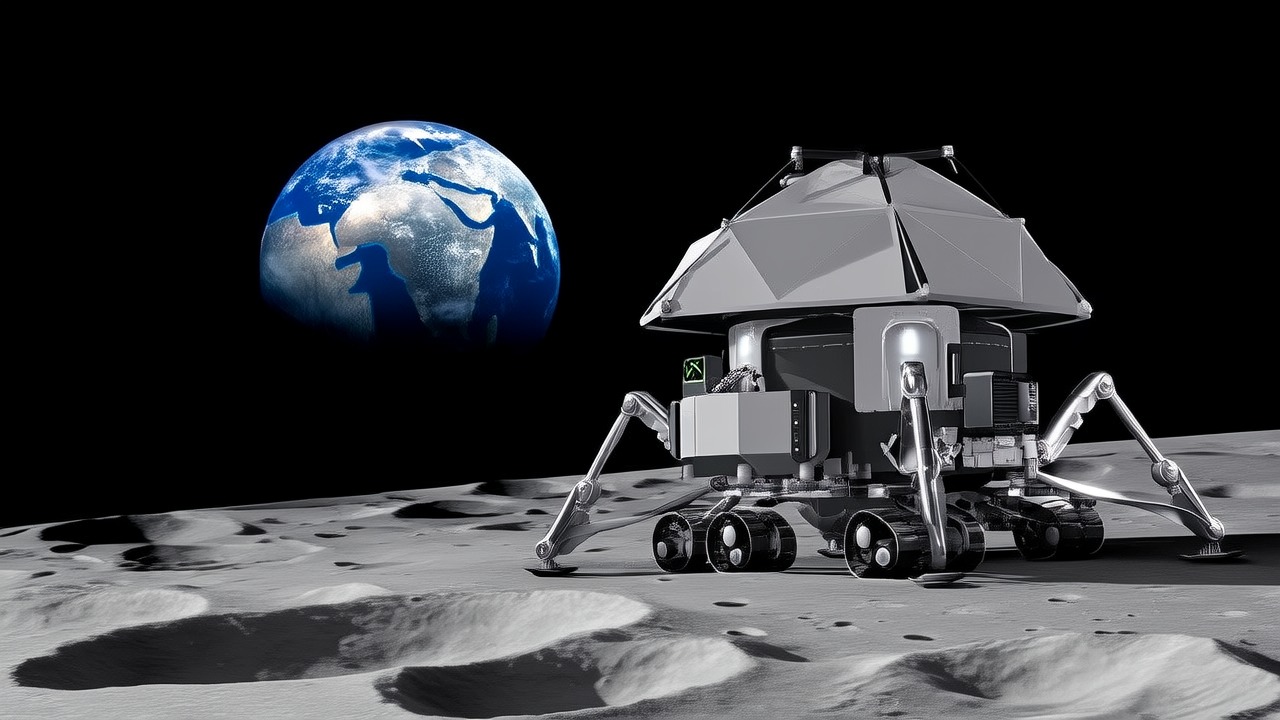
The lunar surface is covered by a layer of fine, powdery rock 2 to 15 meters deep — lunar regolith. This rough, electrostatically charged, abrasive dust has long been viewed as an environmental hazard for human lunar exploration: it clogs equipment, abrades spacesuits, and contaminates cabin air. But for a new generation of space architects, regolith is not the problem — it is the answer.
As NASA's Artemis program sets its sights on establishing a permanent lunar base in the 2030s, and as China and Russia advance the International Lunar Research Station (ILRS), a fundamental engineering question emerges: how do you build human habitats beyond Earth? Transporting construction materials from Earth to the Moon costs tens of thousands of dollars per kilogram. A single prefabricated pressurized module could incur billions of dollars in shipping costs alone. The solution lies in In-Situ Resource Utilization (ISRU) — using the Moon's own soil to build humanity's lunar home.
Core Challenges of In-Situ Construction
Lunar construction faces extreme conditions unknown to terrestrial architecture.
Temperature extremes top the list. The lunar surface experiences a diurnal temperature swing exceeding 300 degrees Celsius — 123 degrees Celsius during the day to minus 247 degrees Celsius at night. Any lunar habitat's exterior must withstand this thermal cycling while maintaining internal pressurization, air sealing, and temperature stability.
Cosmic radiation and micrometeoroids present the second challenge. With no atmosphere or magnetosphere, the lunar surface is directly exposed to galactic cosmic rays (GCR) and solar energetic particles (SEP). A safe habitat requires at least 50 centimeters to 1 meter of regolith shielding to reduce radiation doses to acceptable levels. Simultaneously, the exterior must stop micrometeoroids traveling at 20 kilometers per second.
Third is low gravity — one-sixth of Earth's. This affects material settling behavior, heat conduction during sintering processes, and structural mechanics under pressurization. Terrestrial concrete and steel design experience does not directly transfer to the Moon.
Fourth is regolith's physicochemical nature. Lunar surface regolith is rich in silicon dioxide (SiO2) and oxides of aluminum, iron, calcium, and magnesium, but lacks organics and water (except at polar ice deposits). Its sintering and melting behavior under vacuum differs significantly from terrestrial materials.
Three Major Technical Pathways
Three parallel technical routes for lunar in-situ construction are at varying stages of maturity.
Route One: Sintering and Melt Solidification
Sintering technology uses high temperatures (typically 1,000 to 1,500 degrees Celsius) to partially melt regolith particles below their melting point, forming sintering necks between particles that generate mechanical strength. This approach's advantage lies in relatively controllable energy requirements and no need for imported binders.
NASA's MMPACT (Moon to Mars Planetary Autonomous Construction Technology) project leads this route. It explores large-scale robotic 3D printing using in-situ materials. One approach uses concentrated solar sintering — Fresnel lenses focus sunlight onto regolith surfaces, melting it layer by layer. Between 2024 and 2025, the project completed multiple ground simulation tests verifying solar-sintered regolith simulant's ability to form construction-grade structural components.
ICON — the Austin, Texas-based 3D-printed construction startup — is pushing sintering technology to its highest readiness level. ICON's Olympus Construction System uses Laser Vitreous Multi-material Transformation, employing high-power lasers to melt regolith into ceramic-like structures upon cooling. In 2022, ICON received NASA's $57 million Phase III Small Business Innovation Research (SBIR) award — one of NASA's largest single SBIR contracts — to develop Artemis-era lunar surface infrastructure construction capabilities.
In February 2025, ICON's Duneflow experiment flew aboard a Blue Origin suborbital rocket. During approximately two minutes of simulated lunar gravity, ICON and NASA researchers compared simulant behavior under lunar versus terrestrial gravity — the first key data validating lunar construction processes in suborbital flight.
Route Two: Polymer-Regolith Composites
NASA Kennedy Space Center's Regolith-Polymer 3D Printing System takes a different approach: mixing regolith with polymer binders for extrusion and solidification. This method's advantage is significantly lower process temperatures (polymers melt at 200-300 degrees Celsius), lower energy consumption, and simpler extruder head design compared to high-power laser systems.
The system's patented print head includes a heated hopper, screw extruder, and a wrist-mountable robotic arm connector. Between 2024 and 2025, the system completed multiple ground prototype tests, demonstrating compatibility with varying regolith simulant particle sizes. The inherent limitation, however, is the need to import polymer binders from Earth, partially undermining ISRU's ideal of complete local self-sufficiency.
Route Three: Sulfur Concrete
A more elegant solution exploits elements naturally present in regolith — specifically sulfur. Lunar surface regolith contains approximately 0.1% to 0.3% sulfur. Though dilute, sulfur can be extracted by heating and used as a binder. Mixing liquid sulfur (heated above 130 degrees Celsius) with regolith aggregate, then cooling, produces sulfur concrete with compressive strength of 30 to 50 MPa — comparable to ordinary Portland cement concrete.
Sulfur concrete's advantages include low process temperature (130 degrees versus 1,500 degrees Celsius), no water requirement (the Moon's scarcest resource), and raw materials extracted in situ. Disadvantages include unverified long-term stability under extreme thermal cycling, vacuum sublimation rates, and micrometeoroid impact behavior.
BIG's Architectural Vision
Danish architecture firm Bjarke Ingels Group (BIG), in collaboration with NASA's Project Olympus, offers a rare architectural perspective on lunar habitat design. BIG's habitat concept employs egg-shaped (rounded) structural modules — the optimal form for pressurized loading, while remaining within 3D printing overhang limits (approximately 70 degrees) to maximize internal volume.
The design features a multi-layer structural section: an outer layer of sintered regolith (micrometeoroid protection), a middle layer of loose regolith fill (thermal insulation and radiation shielding), and an inner elastomeric sealing membrane (air-tightness and pressure containment). This "loose regolith bucket" design cleverly exploits regolith's granular properties — during moonquakes or landing/takeoff vibrations, the structure constrains loose regolith within exterior walls, preventing dispersion.
2025-2026 Key Developments
Between 2025 and 2026, several significant signals emerged in lunar in-situ construction.
ICON's Olympus system is transitioning from ground testing toward space validation. Duneflow suborbital flight data is guiding next-generation process parameters. If schedules hold, ICON expects its first lunar surface construction demonstration between 2028 and 2030 — likely a landing pad and basic shelter.
ESA's REGOLITH project, developed with German construction partners, follows a similar solar sintering approach but with different focusing and scanning strategies. ESA aims to deploy an autonomous construction unit on the lunar surface within a decade, prioritizing landing pads — critical infrastructure for preventing dust dispersal and protecting other surface facilities.
China's Chang'e-8 mission, scheduled around 2028, plans to test regolith 3D printing technology. The China Aerospace Science and Technology Corporation (CASC) completed multiple ground sintering-printing tests on simulants between 2024 and 2025, achieving compressive strengths exceeding 40 MPa. China plans to integrate in-situ construction as a standard infrastructure module within the ILRS framework.
From a competitive landscape perspective, lunar in-situ construction remains in a "technology validation" phase, not yet "commercial operations." The only construction-related equipment to have reached the lunar surface is NASA's Lunar Subsurface Drilling — a sampling tool, not a true construction system.
POC.HK Observatory Analysis
Lunar in-situ construction's structural significance extends far beyond engineering. It represents a core technology pillar for humanity's ability to establish self-sufficient settlements beyond Earth.
Economically, the key metric is "mass shipped from Earth ratio." A lunar habitat built entirely from Earth-delivered materials has a payload-to-total-mass ratio of approximately 1:100 (the payload being the habitat itself versus total delivered mass including rocket, fuel, structures). In-situ construction's goal is to approach 1:1 — only astronauts and critical electronics need Earth-sourced delivery.
The development timeline spans three phases. Phase 1 (2024-2028): ground testing and suborbital validation, verifying process parameters and determining optimal technical routes. Phase 2 (2028-2032): lunar surface engineering demonstration, constructing simple structures (landing pads, roads, shelters). If ICON's Olympus system or ESA's REGOLITH progresses as planned, we may see the first non-Earth-manufactured artificial structure on the Moon around 2030. Phase 3 (2032-2038): habitat construction and operations, with pressurized habitable structures supporting permanent lunar presence.
The critical technical signal to watch: how Duneflow results affect next-generation process design. If sintering behavior under lunar microgravity differs significantly from terrestrial simulations (highly likely), the entire process parameter set must be recalibrated, impacting the entire timeline.
A frequently overlooked factor is "how the construction robot itself lands." Construction equipment typically masses several tons, requiring reliable soft landing capability. Current Artemis lander solutions (SpaceX Starship HLS, Blue Origin Blue Moon) may meet payload capacity requirements, but landing engine exhaust plume erosion of regolith — and resulting dust contamination of construction equipment — remains an unsolved engineering problem.
Disclaimer: The information contained in this article is for reference purposes only and does not constitute investment advice or business decision-making basis. Data and time-sensitive information are current as of the publication date and may change with subsequent developments. Neither the author nor POC.HK assumes any responsibility for losses resulting from the use of this information.