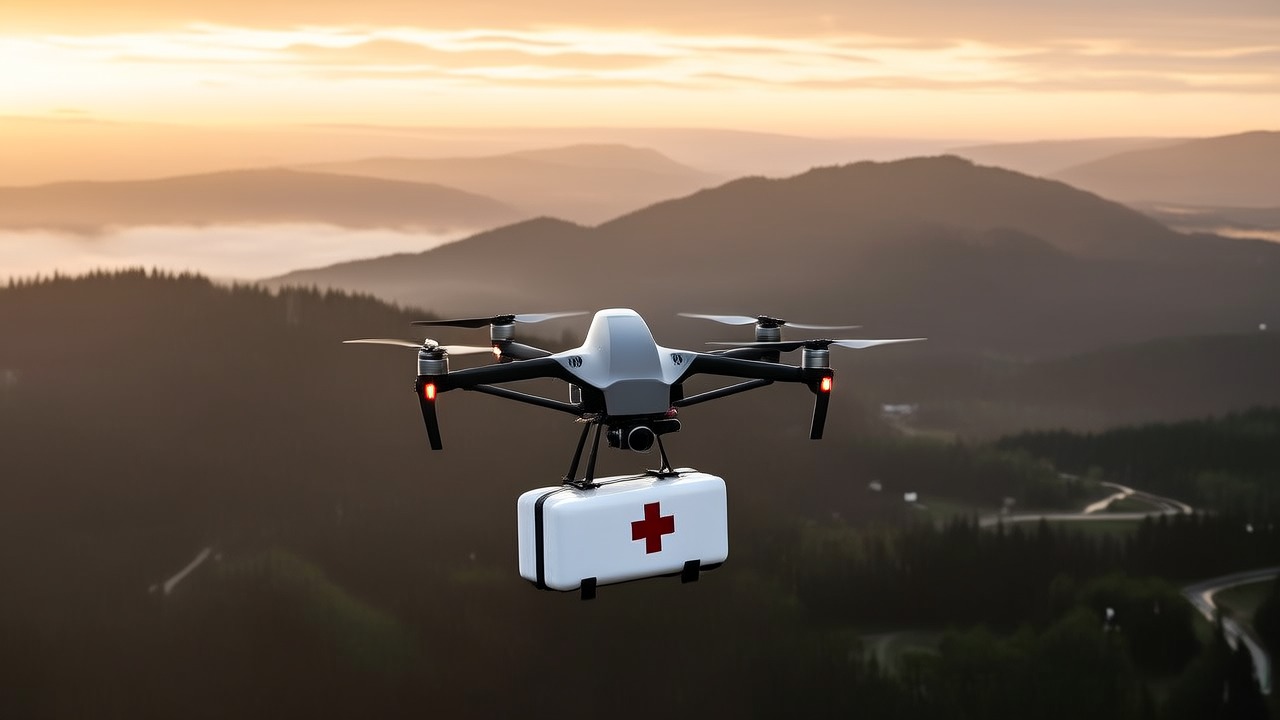
In February 2026, a 74-year-old woman living in a remote Appalachian community received her insulin delivery in 12 minutes—not from a driver navigating winding mountain roads, but from a Zipline autonomous drone flying 18 miles over rugged terrain at 70 miles per hour. The same week, Wing—Alphabet's drone delivery subsidiary—completed its 500,000th commercial delivery in Dallas-Fort Worth, delivering everything from prescriptions to tacos in under 10 minutes.
These are no longer pilot programs or publicity stunts. In 2026, autonomous drone delivery has crossed the threshold from experimental technology to substantive logistics infrastructure. Wing has surpassed 400,000 global commercial deliveries, Amazon Prime Air is expanding to more cities, and Zipline has extended from its origins in African medical supply delivery to consumer goods, food, and pharmaceuticals across multiple US markets. The FAA has issued over 30 Part 135 air carrier certificates to drone operators, up from single digits just two years ago.
The Regulatory Dam Breaks
Drone delivery history has proven a critical thesis: the primary bottleneck was never technology, but regulation. The FAA required drones to operate within the operator's visual line of sight (VLOS), effectively limiting delivery distances to a few hundred meters. The gradual issuance of Beyond Visual Line of Sight (BVLOS) waivers—and the expected finalization of permanent BVLOS rules in 2026—has fundamentally unblocked commercialization.
The economics before and after regulatory change:
| Metric | VLOS | BVLOS |
|---|---|---|
| Maximum delivery distance | ~500 meters | 20+ km |
| Operators per drone | 1:1 | 1:many (up to 1:10) |
| Cost per delivery | $8-15 | $1-3 |
| Coverage area | Single neighborhood | Entire urban area |
| Weather restrictions | Severe | Moderate (advanced drones operate in wind/rain) |
BVLOS rules enable one operator to manage dozens of drones simultaneously, transforming unit economics from "loss-making demonstration" to "theoretically profitable"—with further improvement at scale.
Three Strategic Approaches
The global drone delivery market is dominated by three companies with distinctly different strategies:
Wing (Alphabet). Wing's strategy is platform-based. It does not own the entire delivery chain but partners with local pharmacies, cafes, and convenience stores, offering "drone delivery as a service." This asset-light model enables rapid expansion into new markets. Wing's hybrid-wing drones combine VTOL and fixed-wing cruising, covering up to 10 km per flight.
Amazon Prime Air. Amazon's drone delivery strategy is deeply tied to its e-commerce empire. Unlike Wing's open platform model, Amazon positions drone delivery as an extension of Prime membership—upgrading two-day delivery to two-hour or even 30-minute delivery. Amazon's MK30 drone uses a hexacopter design with proprietary sensing and obstacle avoidance. While Amazon has expanded more slowly than Wing, its logistics infrastructure and user base are unmatched.
Zipline. Zipline has taken the most distinctive path. Originally focused on medical supply delivery in Africa (blood, vaccines, medicines), it accumulated tens of thousands of real-world operations in Rwanda and Ghana. By 2026, Zipline has expanded to multiple US markets and shifted from pure medical delivery to comprehensive consumer goods delivery while retaining its high-speed, long-distance technical character. Zipline's fixed-wing drones fly at 110 km/h, carry approximately 2 kg, and have an 80 km delivery radius—far exceeding competitors.
Observatory Analysis: From Logistics Infrastructure to Social Infrastructure
When Wing completed its 500,000th delivery, the milestone represented more than commercial achievement—it marked drones transitioning from "a novel delivery method" to a component of social infrastructure. Like highways, power grids, and the internet, once a low-altitude drone logistics network is built, it will enable countless applications that cannot be foreseen today.
POC.HK observes a deeper structural change: drone delivery is not about "replacing vans with flying machines" but upgrading logistics from a two-dimensional ground network to a three-dimensional spatial network. Ground logistics is constrained by road topology and traffic; a three-dimensional logistics network has theoretical capacity dozens of times greater. When delivery times compress from days to minutes, the entire supply chain—inventory strategy, warehouse layout, consumption patterns—will shift.
Challenges remain: community noise complaints, privacy concerns, airspace safety, and potential job displacement in economically vulnerable communities all require social-level negotiation. But the signal from 2026 is clear: drone delivery is not a question of "if" but "how fast."
Market Size and Projections
The global autonomous last-mile delivery market was valued at approximately $30 billion in 2024 and is projected to reach $185.3 billion by 2033, growing at a 22.4% CAGR. North America currently holds over 56% of the market share, supported by strong technological infrastructure, regulatory backing, and major industry players.
More than 15,000 autonomous delivery robots and drones are actively deployed across the US, Western Europe, and East Asia as of early 2026, with the majority concentrated in metropolitan zones like Los Angeles, London, and Shanghai. Commercial drone delivery flights in North America now exceed 2,500 per day.
The Technology Stack Behind Scale
Several enabling technologies have reached the maturity needed for scaled operations:
Precision positioning systems such as Trimble's PX-1 RTX enable centimeter-level accuracy in challenging environments like urban canyons, critical for safe landing in confined spaces.
AI-powered perception and obstacle avoidance systems based on deep learning can now identify power lines, tree branches, birds, and changing weather conditions in real time, making autonomous flight substantially safer.
Fleet management platforms allow a single operator to manage dozens of drones, integrating route planning, weather monitoring, and airspace conflict management into a unified interface.
UAS Traffic Management (UTM) infrastructure analogous to air traffic control for low-altitude airspace is being built across multiple countries, providing the management framework for大规模 operations.
Limitations and Open Challenges
Despite the rapid progress, drone delivery faces fundamental constraints. Current payload limits (typically 5-10 pounds) restrict the addressable market to lightweight, time-sensitive items. High winds, heavy rain, and extreme temperatures ground drones or reduce operational reliability. Urban environments require suitable landing zones—a challenge in dense cities without dedicated infrastructure.
These limitations mean drone delivery will not fully replace traditional ground logistics. Instead, it will occupy a specific but lucrative niche: instant, lightweight, high-value deliveries where speed premium justifies the infrastructure cost.
Disclaimer: This article is for informational purposes only and does not constitute investment advice or business decisions. Data and time-sensitive information are current as of the publication date and may change. Neither the author nor POC.HK assumes any liability for losses arising from the use of this information.