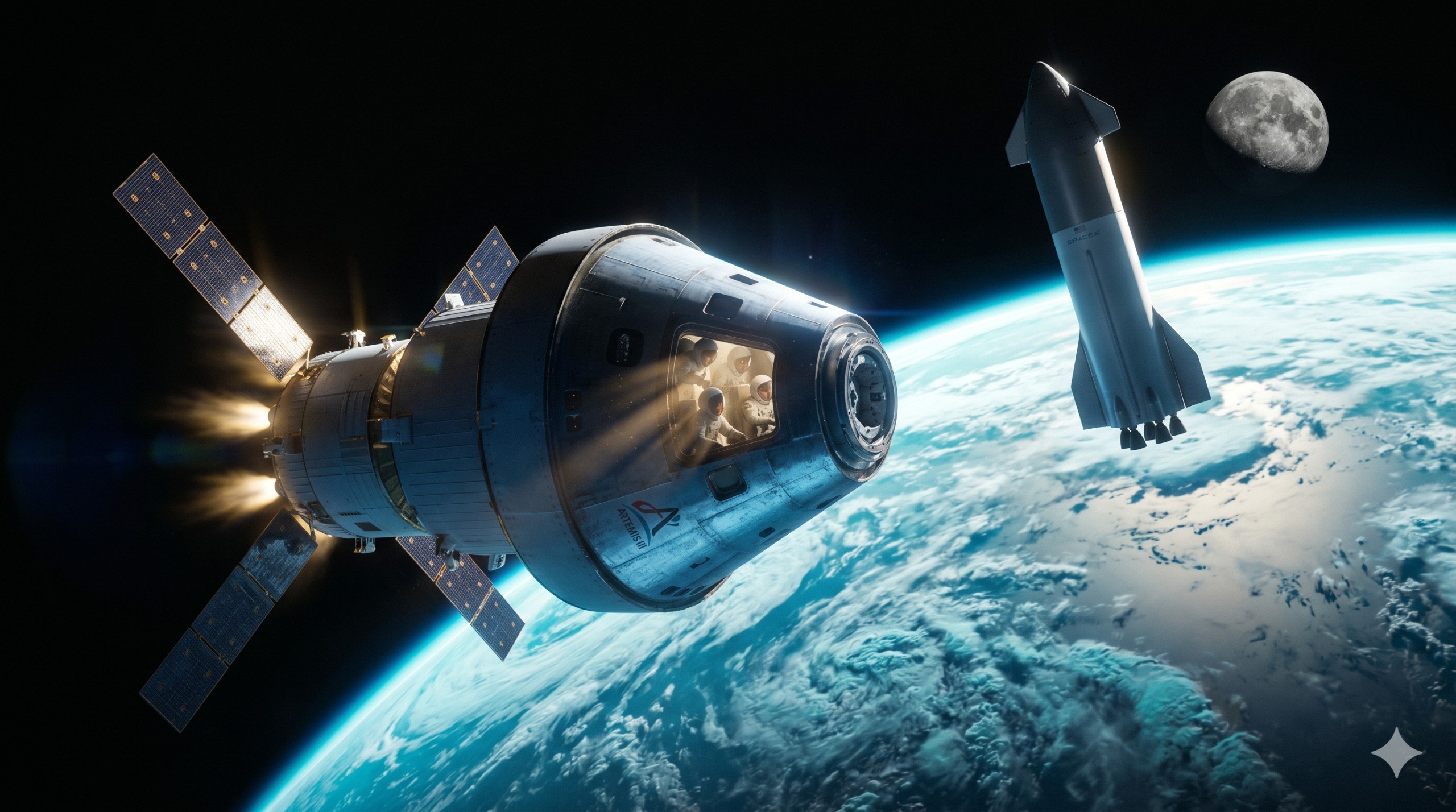
On June 9, 2026, NASA officially announced the Artemis III crew: Commander Randy Bresnik (NASA), Pilot Luca Parmitano (ESA), and Mission Specialists Frank Rubio (NASA) and Andre Douglas (NASA). This announcement — following the successful Artemis II crewed test flight in April 2026 — represents the most critical step yet in NASA's return-to-the-Moon program. Artemis III is scheduled for mid-2027, marking the first human mission to the lunar vicinity since Apollo 17 in December 1972, 55 years ago.
Artemis III Mission Overview
Unlike the Apollo-era direct-to-surface model, Artemis III represents an entirely new lunar exploration architecture. This is not a landing mission — it is a comprehensive integrated test in low Earth orbit of all the critical technologies required for future lunar landings.
| Mission Element | Specification |
|---|---|
| Launch vehicle | SLS Block 1 + Orion capsule |
| Launch site | Kennedy Space Center LC-39B |
| Mission type | LEO rendezvous and docking test |
| Mission duration | ~10-14 days |
| Crew | 4 (officially announced) |
| Core objectives | Orion-HLS docking, EVA rehearsals, communication and navigation calibration |
| Follow-on mission | Artemis IV (2028) — first lunar surface landing (South Pole) |
Artemis III's core mission is to complete Orion-to-commercial Human Landing System (HLS) rendezvous and docking tests in low Earth orbit. Both HLS providers — SpaceX's Starship HLS and Blue Origin's Blue Moon Mark 2 — will participate in testing. The mission will also include simulated extravehicular activities, lunar communication system calibration, and comprehensive navigation accuracy verification.
Crew Deep Dive
Randy Bresnik (Commander): 59, retired US Marine Corps Colonel with over 6,000 flight hours. A veteran of two space missions — STS-129 Atlantis (2009) and Expedition 52/53 to the ISS (2017) — he has logged 296 days in orbit. Bresnik is noted for three spacewalks (totaling 20 hours 36 minutes) during his ISS tenure. He was selected as Artemis III commander primarily for his high-pressure decision-making capability and EVA experience.
Luca Parmitano (Pilot): 49, Italian Air Force Colonel, ESA's most experienced active astronaut. Two space missions: Expedition 36/37 (2013, Venere mission) and Expedition 60/61 (2019, Beyond mission), totaling 367 days in orbit. Parmitano was the first European astronaut to perform four spacewalks, most notably his leadership of the 2019 Alpha Magnetic Spectrometer cooling system repair — widely considered one of the most complex EVAs in ISS history.
Frank Rubio (Mission Specialist): 50, NASA astronaut, US Army helicopter pilot, and physician. Rubio is known for his single continuous 371-day spaceflight — an unplanned extended mission in 2022-2023 caused by the Soyuz MS-22 coolant leak, during which he spent nearly a year aboard the ISS. This experience gives Rubio unique insights into long-duration spaceflight physiology and emergency response.
Andre Douglas (Mission Specialist): 42, NASA astronaut class of 2021, the youngest member of this crew. Douglas holds a PhD in mechanical engineering from Johns Hopkins University and a master's in ocean engineering from MIT. He previously worked at NASA's Jet Propulsion Laboratory on systems engineering for the Mars 2020 mission. As the first Artemis generation representative, Douglas's focus areas include evaluating human factors performance of new crewed exploration technologies.
Artemis Program Structural Inflection
The Artemis III crew announcement must be understood in a broader context — it marks NASA's transition from the "hardware development" phase to "flight operations."
Artemis I (November 2022): Uncrewed SLS/Orion lunar flyby. Successfully validated SLS rocket performance, Orion's thermal protection system, and atmospheric reentry capability. Milestone achievement: Orion flew 430,000 km beyond the lunar far side — farther than any spacecraft designed for humans.
Artemis II (April 2026): Four-person crew orbital mission with Commander Reid Wiseman, Pilot Victor Glover, Mission Specialists Christina Koch (NASA) and Jeremy Hansen (CSA). The crew orbited the Moon for 10 days, observing the lunar surface at close range and testing all life support and navigation systems under crewed conditions. The mission was declared a "complete success."
Artemis III (mid-2027): As described, a LEO docking test phase. A notable change from original plans — Artemis III was initially scheduled as a crewed landing mission, but due to Starship HLS and Blue Moon Mark 2 development delays, NASA made a pragmatic adjustment in 2025: deferring the first landing to Artemis IV (2028) and inserting an LEO test mission to reduce overall program risk.
Artemis IV (2028): First crewed lunar surface landing, targeting the Shackleton Crater region at the lunar South Pole. Two crew members will spend approximately 6-8 days on the surface for geological sampling, environmental monitoring, and infrastructure deployment testing. If successful, this will mark humanity's first footsteps on another celestial body since 1972, 56 years later.
Commercial HLS Provider Status
The mission's critical path depends on two commercial lander development schedules:
SpaceX Starship HLS: The Artemis III test vehicle remains the lunar-modified Starship variant. As of mid-2026, Starship experienced a Flight 12 anomaly — the Super Heavy booster failed to reignite for its boostback burn, resulting in a hard splashdown. The FAA has required a mishap investigation, and the planned Flight 13 (first V3 Starship flight) has been delayed to late July. If the FAA investigation remains open beyond end of 2026, the Artemis III 2027 timeline will face pressure.
Blue Origin Blue Moon Mark 2: Following New Glenn's successful debut flight, the April 2026 NG-3 mission experienced an anomaly, but the FAA closed its investigation on May 22, clearing New Glenn for return to flight. Blue Moon Mark 2 development is proceeding on schedule, though uncrewed test flights have not yet occurred.
Observatory Analysis: The Structural Significance of Lunar Exploration Entering Operations
The Artemis III crew announcement is less a milestone event than a signal of a broader transition — lunar exploration is shifting from the "can we return?" technical validation phase to the "how do we stay?" operational phase.
From Flagship Missions to Reusable Architecture: Each Apollo landing was an independent mission built from scratch. Artemis is fundamentally different — SLS, Orion, Gateway, HLS, and ground systems are designed as reusable infrastructure. Artemis III, though not a landing mission, is the critical test validating this ecosystem's compatibility.
Deepening Commercialization: Artemis III integrates commercial HLS into the crewed mission chain for the first time — marking the first time commercial entities play a core role in a flagship crewed deep-space mission in human exploration history. If Starship HLS or Blue Moon Mark 2 successfully completes its mission, it will establish a precedent for future commercial deep-space transportation services — similar to how SpaceX's Dragon changed the business model for LEO transportation.
The Strategic Value of the Lunar South Pole: All Artemis landing targets are concentrated at the lunar South Pole — not for technical convenience, but for water ice. Water ice in the permanently shadowed regions (PSRs) can not only support human survival but, more importantly, can be electrolyzed to produce liquid oxygen and hydrogen fuel — transforming the Moon into a refueling station for solar system exploration. Artemis IV's South Pole landing selection clarifies NASA's strategic priority: the Moon is not a destination, but a waystation on the path to Mars.
Disclaimer: The information in this article is for reference purposes only and does not constitute investment advice or commercial decision-making basis. Data and time-sensitive information are current as of the publication date and may change with subsequent developments. Neither the author nor POC.HK assumes any liability for losses arising from the use of this information.