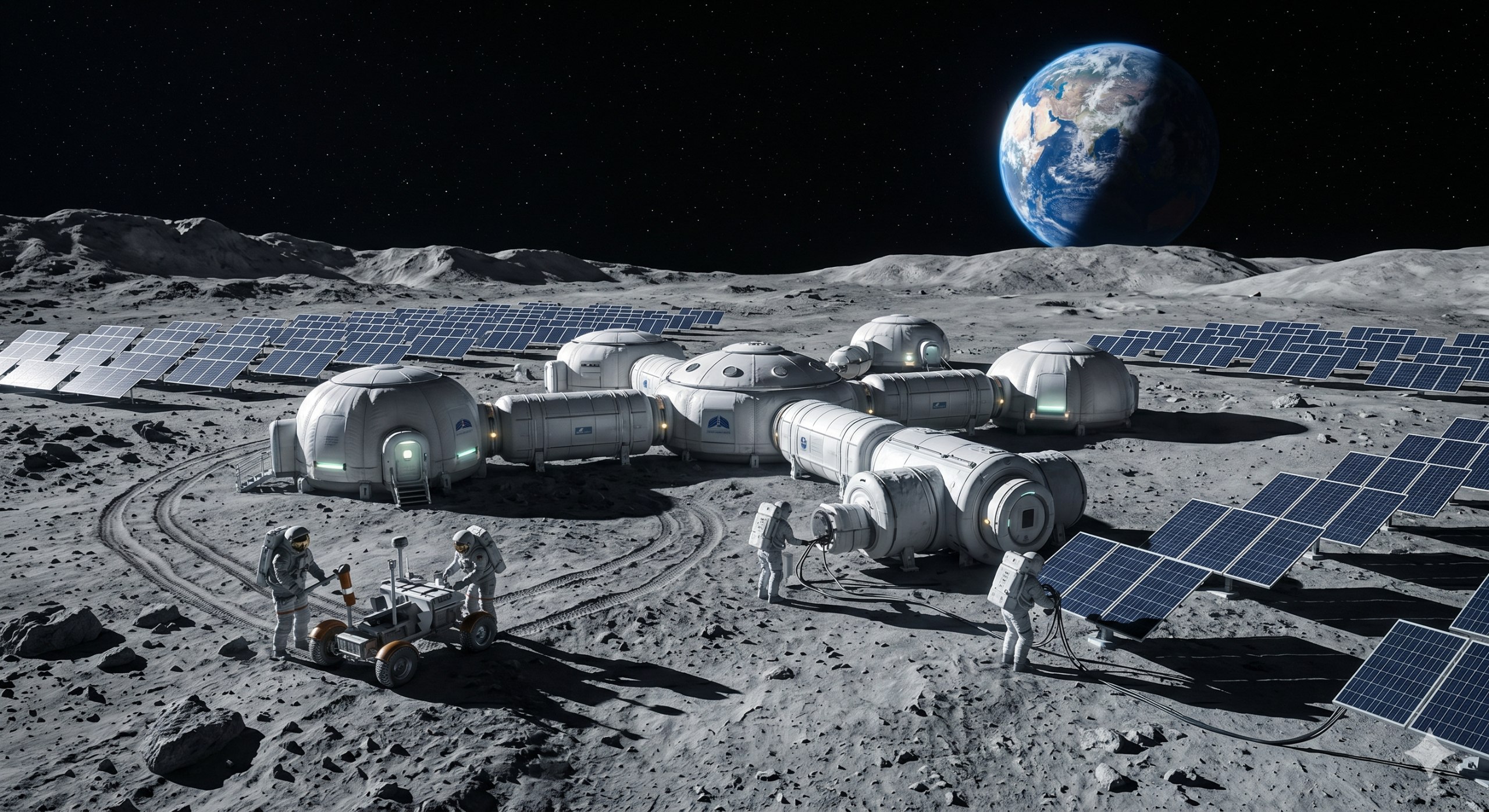
Artemis Lunar Base Camp: A Paradigm Shift from Brief Visits to Permanent Presence
The Apollo program left humanity not only footprints and flags but also a profound lesson: brief exploration cannot sustain continuous scientific discovery. NASA's Artemis program was designed from the outset for "sustainable presence" — and the core of this goal is establishing a permanent base camp at the Moon's south pole. In 2026, as final preparations for the Artemis III mission enter their concluding phase, the design details and deployment plan for this base camp have come into clear focus.
Site Selection Logic: Why the South Pole?
The edge of Shackleton Crater at the lunar south pole was selected as the default base camp location based on a combination of multiple scientific and engineering factors. This area is almost continuously illuminated — approximately 80% to 90% of the year in sunlight — providing ideal conditions for solar power generation. At the same time, the permanently shadowed regions (PSRs) inside the crater have been confirmed to contain substantial water ice deposits.
Combined survey data from the Lunar Reconnaissance Orbiter (LRO) and China's Chang'e-7 mission in 2025 show that water ice content in the Shackleton Crater region is approximately 30% higher than previously estimated, with burial depths of only 0.5 to 1.5 meters. This means the engineering difficulty of extraction is far lower than expected. Additionally, the region's geological features — including ancient impact melts and potentially exposed deep lunar crustal material — offer a unique scientific window into the Moon's early evolution.
Modular Design of the Base Camp
The Artemis base camp adopts a "prefabricated modules, on-site assembly" strategy. The entire base consists of four core functional modules, each delivered by Starship HLS (Human Landing System) or the Blue Moon lander. The Habitation Module provides approximately 80 square meters of living space, containing 4 private sleep compartments, a kitchen, exercise area, and hygiene facilities, capable of supporting 4 astronauts for up to 30 days. The Science Module is equipped with microscopes, spectrometers, geological sample processing stations, and a small biological incubator for lunar geology, physics, and biology experiments.
The Airlock Module is the busiest node in the lunar base. It serves not only as a transition zone between interior and exterior activities but is also equipped with a lunar dust removal system — using a combination of electrostatic and airflow technologies to remove sharp, electrostatically charged lunar dust from spacesuits. The Logistics Module holds 30 days of backup consumables, spare parts, and emergency equipment.
In-Situ Resource Utilization: From Concept to Practice
The sustainability of the lunar base depends entirely on in-situ resource utilization (ISRU) technology maturity. The Artemis base camp is equipped with a multi-function ISRU demonstration unit called the "Polar Resource Miner" (PRIME). The device's design capacity is to extract approximately 100 kg of water ice per day, splitting it into hydrogen and oxygen through electrolysis. Oxygen is used for base life support systems and propellant, while hydrogen is partially stored and partially reacted with carbon dioxide to produce methane.
Ground validation tests completed by NASA's Glenn Research Center in 2024 demonstrated that using a "stepwise heating sublimation method" to extract water ice from lunar simulant regolith achieves efficiency exceeding 85%. This validation result supports PRIME's engineering design parameters. According to plan, PRIME will arrive at the Moon during the Artemis IV mission (2028) and begin continuous operation. If successful, this will be humanity's first industrial-scale resource production on a celestial body beyond Earth.
Communications and Navigation Infrastructure
A base without infrastructure support is isolated, and an isolated base cannot operate. The Artemis base camp's communications solution is based on the LunarLink lunar communications constellation — a network of 12 to 18 satellites distributed across Near-Rectilinear Halo Orbit (NRHO) and Low Lunar Orbit (LLO). This system provides continuous coverage of any lunar surface location, with Earth data transmission rates up to 1 Gbps and latency controlled within 100 milliseconds.
For navigation, NASA is working with the European Space Agency (ESA) to deploy a "Lunar GNSS" system, placing 4 to 6 navigation satellites in elliptical lunar orbit to provide GPS-like positioning services for lunar surface mobility and operations. The first lunar navigation satellite is planned for launch via Falcon Heavy in 2027.
Observatory Analysis
From an independent observer's perspective, the greatest risk facing the Artemis base camp plan is not technical but rather geopolitical and budgetary uncertainty. Cumulative investment in the Artemis program had exceeded $93 billion by 2026, but complete base camp deployment is estimated to require an additional $40 billion to $60 billion. Congressional review of Artemis's annual budget has become increasingly politicized, and the direction of space policy after the 2028 presidential election also carries uncertainty.
Another turning point worth monitoring is the deepening of commercial partnership models. NASA has outsourced part of the base camp's logistics support to commercial partners — SpaceX's Starship cargo missions handle large module delivery, Blue Origin's Blue Moon handles medium and small supply transport, and Sierra Space's Dream Chaser provides emergency cargochannel. This "multi-supplier, competitive contract" model effectively disperses risk but also increases system integration complexity.
From a scientific value perspective, the establishment of a lunar south pole base camp will unlock core questions that Apollo and sample return missions could not answer: What is the water cycle mechanism in the lunar polar regions? Do organic compounds exist in permanently shadowed regions? What are the effects of long-duration low-gravity exposure on human physiology? The answers to these questions are not only relevant to lunar science but directly impact humanity's ability to establish a permanent presence on Mars.
Looking Ahead
The next five years are the critical period for the Artemis base camp to transition from blueprint to reality. The Artemis III mission in the second half of 2026 will achieve the first crewed lunar south pole landing — though only a short-duration mission of approximately 6.5 days for 4 astronauts, it will provide first-hand field data for base camp site selection. Artemis IV and V missions from 2027 to 2028 will begin delivering the base camp's core modules, with the PRIME resource extractor also deployed in this phase.
Around 2030, the Artemis base camp is expected to reach Initial Operating Capability (IOC): 4 astronauts can sustain a continuous 30-day presence on the lunar surface, the ISRU system provides some life support consumables, and communications and navigation infrastructure operates fully. By 2035, the base camp will expand into a permanent research station accommodating 8 to 12 people, equipped with a self-sufficient Closed Ecological Life Support System (CELSS).
The lunar base camp is not merely a scientific outpost — it is humanity's proof of concept for establishing a permanent presence on another celestial body, a springboard to Mars and deep space, and the historical starting point for Earth civilization's expansion into the solar system.
Disclaimer: This article is written by POC.HK Future Technology Observatory based on publicly available information and independent analysis. The technical parameters, timelines, and budget data mentioned are from public disclosures by NASA, ESA, and related contractors; actual progress may differ due to technical, regulatory, and funding factors.