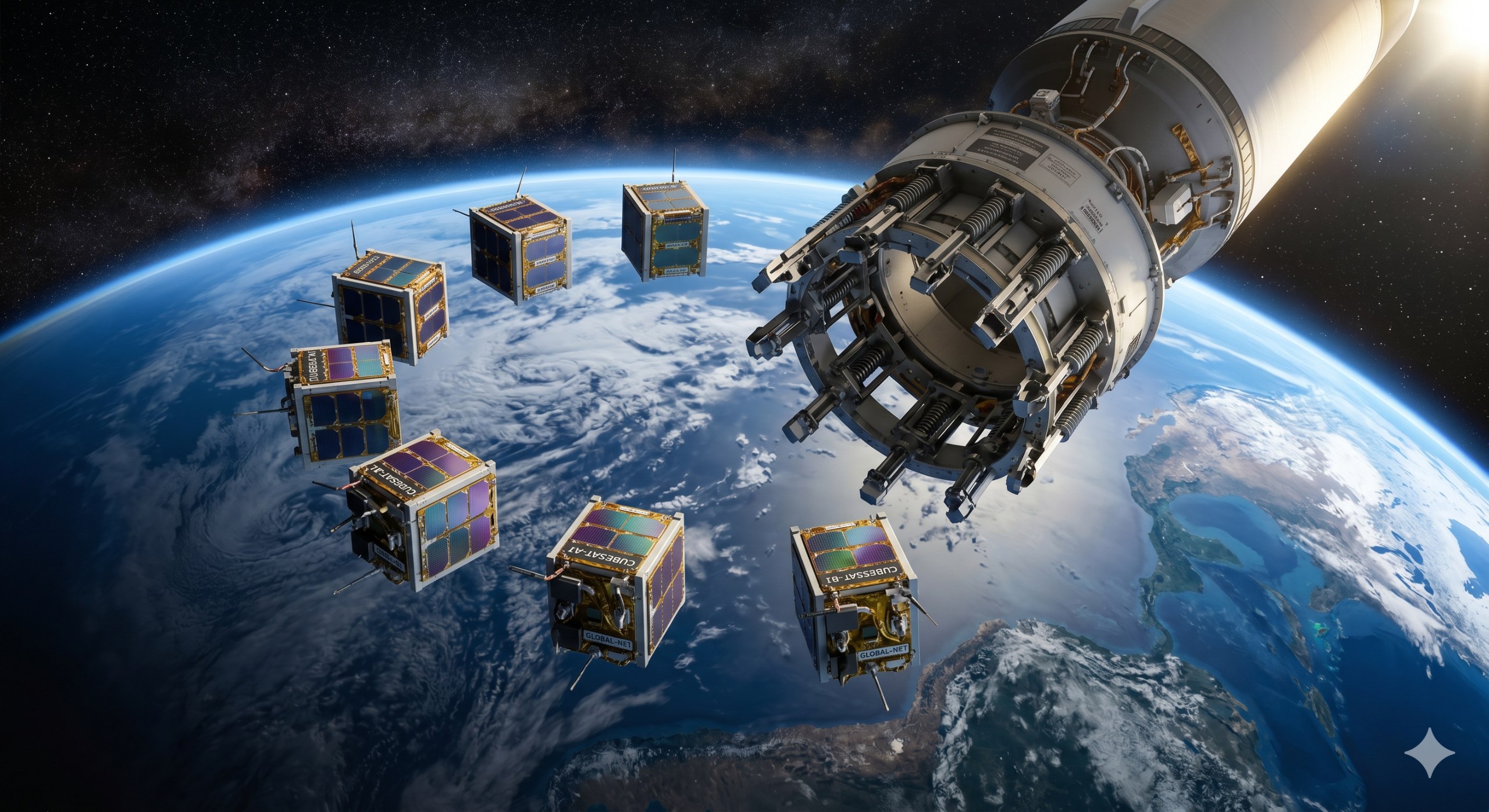
Amazon Kuiper Production Satellites: First 27 Launch into Orbit
Amazon has taken a major step toward building its space-based internet constellation. The company successfully launched its first 27 production satellites for Project Kuiper in early 2026, marking the transition from testing to full-scale deployment in one of the most ambitious satellite internet projects ever conceived.
The satellites lifted off aboard an Atlas V rocket from Cape Canaveral Space Force Station. Each satellite carries advanced phased-array antennas, optical inter-satellite links, and onboard processing capabilities designed to deliver low-latency broadband connectivity to customers worldwide. The launch brings Amazon significantly closer to its goal of deploying over 3,200 satellites in low Earth orbit by 2029.
From Prototype to Production
This launch follows two successful prototype missions in 2023 and 2024. Those earlier satellites — KuiperSat-1 and KuiperSat-2 — validated the core technology, including the radio frequency design, thermal management systems, and propulsion subsystems. The production satellites incorporate lessons from those prototypes, along with several key improvements.
The production design features upgraded solar arrays with higher efficiency cells, allowing each satellite to handle more user traffic simultaneously. The inter-satellite laser links, which allow data to travel between satellites without touching ground stations, have been refined for faster acquisition and handoff. Amazon says the production satellites can sustain data rates of up to 1 terabit per second across the optical mesh network.
Manufacturing at Scale
One of the biggest questions surrounding Project Kuiper has been whether Amazon can manufacture satellites at the scale required. The company's facility in Kirkland, Washington, is designed to produce up to five satellites per day using an assembly-line approach adapted from automotive manufacturing. Amazon has invested over $2 billion in satellite production infrastructure, including automated test equipment that can validate an entire satellite in under 24 hours.
The supply chain is equally ambitious. Amazon has contracted with multiple launch providers — including United Launch Alliance, Blue Origin, and Arianespace — for up to 92 launches to deploy the full constellation. The company has also developed custom dispensing mechanisms that can release 30 to 40 satellites per launch, minimizing the number of missions required.
Competition with Starlink
Project Kuiper enters a market dominated by SpaceX's Starlink, which already has over 6,000 satellites in orbit and more than 4 million subscribers. Amazon's strategy differentiates on two fronts: pricing and enterprise services.
For residential customers, Amazon has priced its standard terminal at $299 — significantly less than Starlink's standard terminal. The company is also offering a "Kuiper Plus" tier with higher speeds and lower latency for small businesses. Amazon's vast logistics and e-commerce infrastructure gives it a distribution advantage, as Kuiper terminals can be shipped through Amazon's existing fulfillment network.
On the enterprise side, Kuiper is targeting government, maritime, aviation, and telecommunications backhaul customers with dedicated bandwidth and service-level agreements. Amazon Web Services (AWS) integration is a key selling point: enterprise customers can connect Kuiper directly to AWS data centers with sub-10 millisecond latencies, enabling edge computing and IoT applications that were previously impractical in remote locations.
Service Timeline
Amazon has announced that commercial service will begin in select regions by late 2026, with initial coverage focused on North America, parts of South America, and Europe. Global coverage is expected by 2028, contingent on completing the first 1,600-satellite tranche.
Beta testing is open for customers in the United States, Canada, Mexico, and several European countries. Early testers have reported download speeds of 100-400 Mbps with latencies under 30 milliseconds, competitive with terrestrial fiber in many areas.
The Bottom Line
Amazon Kuiper's first production satellite launch is a milestone, but the real test lies ahead. Building and launching over 3,000 satellites in three years is an unprecedented manufacturing and logistics challenge. Amazon has the financial resources — Jeff Bezos has pledged $10 billion to the project — but success will depend on execution.
If Amazon delivers on its promises, Kuiper will provide a crucial competitive alternative in the satellite broadband market, driving down prices and improving service quality. For consumers in rural and remote areas with few connectivity options, that competition cannot come soon enough.
Disclaimer: This article is for informational purposes only and does not constitute financial, technical, or investment advice. The views expressed are based on publicly available information as of the date of publication. Readers should conduct their own research and consult with qualified professionals before making any decisions based on this content.