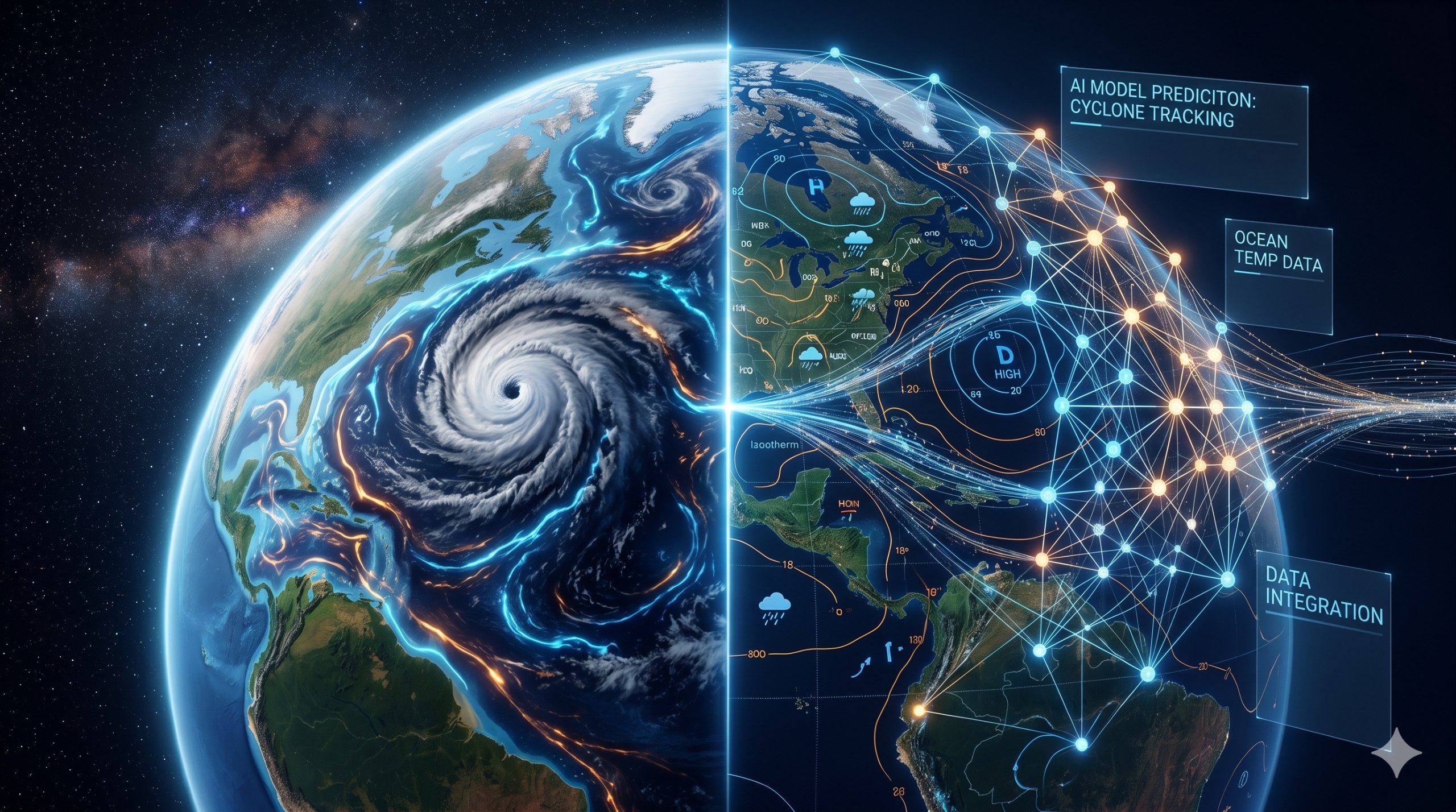
AI is fundamentally transforming weather forecasting and climate simulation. Traditionally, weather forecasting relied on Numerical Weather Prediction (NWP) models based on physical equations simulating atmospheric motion. However, over the past two years, machine learning-based meteorological models have achieved breakthroughs, with prediction speed and accuracy redefining the field.
From GraphCast to AIMIP: The Evolution of AI Weather Models
In 2023, Google DeepMind released GraphCast, the first AI system to surpass the traditional ECMWF (European Centre for Medium-Range Weather Forecasts) model in medium-range weather forecasting (3-10 days). GraphCast can complete a 10-day global weather forecast in under a minute, whereas traditional models require supercomputers running for hours. This breakthrough opened the door to AI meteorology.
Between 2024 and 2026, multiple AI weather models emerged:
FourCastNet (NVIDIA): Based on Fourier neural networks, it completes a week-long global forecast in 2 seconds, saving over 99% of computational energy compared to traditional models. FourCastNet has been applied to extreme weather event tracking, providing unprecedented speed advantages for hurricane path prediction.
Pangu-Weather (Huawei): Using a 3D Transformer architecture, it performs exceptionally well in typhoon path prediction. During the 2024 typhoon season, Pangu-Weather's 72-hour path prediction error for Northwest Pacific typhoons was approximately 25% lower than traditional models.
AIMIP (Allen AI): Launched in June 2026, the AI Model Intercomparison Project borrows the framework of the traditional CMIP (Coupled Model Intercomparison Project), aiming to systematically evaluate the performance of AI climate models. The launch of AIMIP marks AI meteorology's transition from individual model showcases to standardized evaluation.
The Fundamental Advantages of AI Models
The core advantage of AI weather models is not that they are "smarter," but that they are "faster" and "cheaper."
Traditional NWP models need to solve the Navier-Stokes equations. On a 9 km resolution global grid, a 10-day forecast requires approximately 10^16 floating-point operations. This requires top-tier supercomputers running continuously for 3-6 hours. AI models, by learning patterns from historical reanalysis data, can complete the same task on a GPU in 1-2 minutes.
From an energy perspective, a single ECMWF 10-day forecast consumes approximately 3000 kWh of electricity, while GraphCast requires only about 3 kWh — a three-order-of-magnitude reduction in energy consumption. This makes high-resolution, high-frequency update forecasts feasible.
Limitations of AI Models
However, the latest research shows that AI weather models are not without shortcomings. A 2026 authoritative study pointed out that traditional models still "outperform AI models" in forecasting extreme weather events.
Extreme weather (such as severe tornadoes, torrential rain, and rapid intensification of tropical cyclones) is inherently low-probability, high-impact events, with very few such samples in training data. AI model predictions tend toward "averages," potentially underestimating the intensity of extreme events. This is particularly concerning in the context of climate change, which is increasing the frequency and intensity of extreme events.
Bias Issues
AI weather models also suffer from systematic biases. A University of California research team found that certain AI models "learned" the temperature distribution from historical climate data during training, leading to a "temperature bias" in future climate predictions. Specifically, AI models tend to underestimate the frequency of extreme heat events, posing challenges for climate adaptation planning.
The Rise of "Hybrid Approaches"
Recognizing the respective strengths of AI and traditional models, the meteorological community is shifting toward a "hybrid approach" — combining AI's computational efficiency with the scientific foundation of physics-based models.
The ECMWF's "AIFS" (AI Integrated Forecast System), announced in 2025, represents this direction. AIFS does not completely replace traditional models but serves as a complement — using AI to generate initial fields for large-scale ensemble forecasts, with physical models performing refined simulations. This hybrid system maintains physical consistency while expanding the number of ensemble members from 50 to over 1000, greatly improving the reliability of probabilistic forecasting.
NVIDIA's "FourCastNet v2" adopts a different hybrid strategy — introducing physical constraint terms into the AI model's loss function, ensuring that predictions satisfy fundamental physical principles like conservation laws. This significantly reduces the "non-physical" prediction phenomena of AI models.
A New Paradigm for Climate Simulation
Beyond weather forecasting, AI is changing the approach to long-term climate simulation. Traditional climate models operate at 9-25 km resolution, simulating 100 years of climate evolution in weeks of computation time. This limits scientists' ability to conduct large-scale parameter sensitivity experiments and high-resolution regional climate predictions.
AI "downscaling" technology, by learning the mapping relationship between high-resolution and low-resolution simulations, can "restore" coarse-resolution climate model outputs to 1 km-level urban scales. This has direct application value for urban planning, agricultural adaptation, and infrastructure design.
In 2025, Microsoft Research, in collaboration with ECMWF, developed the "ClimaX" model, demonstrating another possibility: a unified atmosphere-ocean-land surface coupled AI model capable of simultaneously performing weather forecasting, seasonal prediction, and climate prediction within a single framework. Such generalization ability is difficult for traditional models to achieve.
Commercialization and Policy Impact
The commercialization of AI weather models is accelerating. Multiple startups (such as Atmo AI and Jua Technologies) are developing AI weather services targeted at specific industries — route wind prediction for aviation, wind and solar power generation forecasting for renewable energy, and regional precision weather forecasting for agriculture.
At the policy level, the World Meteorological Organization (WMO) released the "Guidelines for the Application of AI in Meteorological Operations" in 2026, providing a standard framework for meteorological departments worldwide to adopt AI technology. The guidelines emphasize that AI models should complement rather than replace traditional models, especially in the realm of extreme weather warnings that affect human life and safety.
Meanwhile, a noteworthy development is the budget cuts for the U.S. National Oceanic and Atmospheric Administration (NOAA) in fiscal years 2025-2026. The Trump administration's budget cuts have reduced funding for maintaining meteorological data collection networks, causing interruptions at some weather stations and ocean buoys. This objectively highlights a paradox: AI models require large amounts of high-quality training data, yet the weakening of data collection infrastructure could become a bottleneck for AI meteorology development.
Case Study: Successful Industry Applications of AI Weather
Aviation was one of the early beneficiaries of AI weather models. Lufthansa partnered with Atmo AI, using AI high-resolution wind field predictions to optimize transatlantic flight route planning. Traditional meteorological services provide wind field predictions with 6-12 hour update intervals, while AI models can generate updates every 15 minutes, allowing airlines to dynamically adjust routes mid-flight to take advantage of tailwinds. Preliminary statistics show this optimization reduced fuel consumption per transatlantic flight by approximately 3-5%, equivalent to saving millions of tons of aviation fuel annually.
The renewable energy sector has also seen significant gains. UK National Grid began using Jua Technologies' AI weather service for wind and solar power generation forecasting in 2025, reducing the 72-hour forecast RMSE from approximately 12% with traditional models to about 7%. This has direct economic implications for grid dispatching — more accurate generation forecasts mean less reserve capacity. At the scale of the UK electricity market, every 1% reduction in forecast error saves approximately £80 million in annualized operating costs.
In agriculture, India's Ministry of Agriculture partnered with Microsoft in early 2026, using the ClimaX model to provide personalized 10-day weather forecasts for 20,000 villages. Model outputs include precipitation probability, soil moisture changes, and pest risk indicators, delivered directly to farmers via SMS. During India's 2026 southwest monsoon season, this helped farmers optimize planting and irrigation timing, with preliminary estimates showing approximately 15% reduction in monsoon-related agricultural losses.
Looking Ahead
AI meteorology is in a transitional period from "showing off" to "real-world application." In the short term (1-2 years), AI models will dominate routine weather forecasting, particularly in medium-range forecasting (3-10 days) and ensemble forecasting. In the medium to long term (3-5 years), AI and hybrid models will become the new standard for climate simulation, but breakthroughs in pure AI models for extreme event prediction still require more research.
Climate change is increasing the frequency and intensity of extreme weather, and AI meteorology offers the possibility of obtaining higher-frequency forecasts at lower cost. This is not just technological progress but also an enhancement of climate adaptation capacity. When millions of people worldwide depend on the accuracy of weather forecasts every second, the addition of AI is not a luxury — it is a necessity.
Disclaimer: This article is for informational purposes only and does not constitute investment advice or a basis for business decisions. Data and time-sensitive information are accurate as of the publication date and may change with subsequent developments. Neither the author nor POC.HK assumes any liability for losses arising from the use of this information.