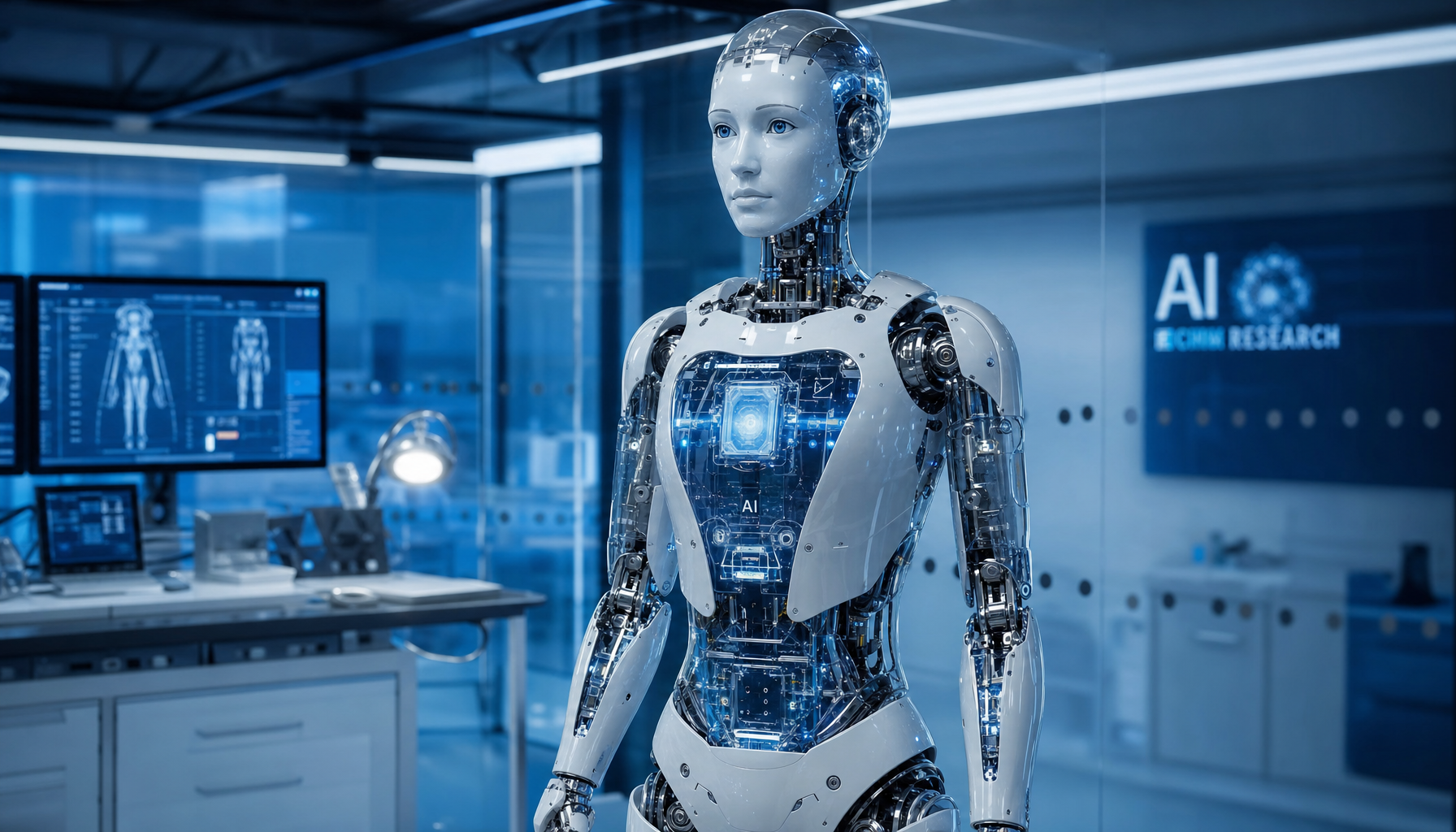
From Language Models to Bodies: The 2025 Industrialization Inflection Point of Embodied AI
Large language models can not only write poetry and code — they are now learning to control robots. This is perhaps the most exciting and challenging frontier in AI. Between 2024 and 2025, Google DeepMind's RT-2, Microsoft's ChatGPT for Robotics, and Figure AI's collaboration with OpenAI have collectively pushed "Embodied AI" from academic laboratories to industrialization pilot phases.
Observatory Analysis
Core Technical Path: LLM as the Robot Brain
The core proposition of embodied AI is: how to combine the common-sense reasoning, language understanding, and planning capabilities of LLMs with a robot's perception, motion control, and physical interaction abilities? The emerging consensus is a "layered architecture":
- Top layer: LLM understands human instructions ("bring me that cup of coffee"), decomposing them into high-level sub-goals (walk to the coffee machine, pick up the cup, identify the coffee, navigate back)
- Middle layer: Vision-Language Model (VLM) handles scene understanding — locating the coffee machine, identifying the cup, planning obstacle avoidance paths
- Bottom layer: Specialized motion controllers execute precise joint angle and force control
Google DeepMind's RT-2 demonstrates the potential of this architecture. RT-2 is trained directly on internet-scale image-text data, so it knows "coffee cup handles are typically used for gripping," even though its training data never included images of robot manipulation. This ability to learn from observation (emergent affordance understanding) is unmatched by traditional robots.
Real-world Deployment Data
Figure AI reached a cooperation agreement with BMW in 2024, deploying 10 Figure 02 robots at its South Carolina factory. These robots primarily handle body weld point quality inspection — using vision systems to scan weld points, compare against standard patterns, and mark anomalous areas. According to Figure's first-quarter data, robot inspection accuracy reached 99.3%, surpassing human workers' 97.8%. However, speed remains a bottleneck — humans inspect 12 weld points per minute, while robots manage only 5.
Agility Robotics' Digit robot has found initial product-market fit in logistics. Amazon began trialing Digit in 2024 for "last 50 feet" material handling — moving packages from the end of conveyor belts to shipping areas. Although Digit currently can only handle standardized cardboard boxes (unable to adapt to irregular packaging), Amazon Robotics reports this has already reduced manual handling needs by 30%.
Hardware Costs and Commercialization Path
The biggest constraint on embodied AI is not software, but hardware costs. The manufacturing cost of a Figure 02 is approximately $150,000, and Digit about $250,000. Compared to the annual cost of a human worker of approximately $50,000-80,000 (including benefits), the ROI calculation requires robots to work at least 2-3 years to break even.
The supply chain is shifting. NVIDIA launched the Isaac for Robotics platform in 2024, providing a complete toolchain from simulation training to edge inference. Unitree has pushed the price of humanoid robots down to the $20,000 level — though functionality is limited, this is spawning large developer communities and experimental applications.
Looking Ahead
The industrialization path for embodied AI is becoming clearer, but the timeline still carries significant uncertainty.
Short-to-medium term (2025-2027): Industrial scenarios will be the primary deployment domain. Specific tasks in structured environments (factories, warehouses, laboratories) — handling, inspection, assembly — will gradually be taken over by robots. A key driving force is the rise of the "leasing model": companies like Figure and Agility no longer sell robots but offer "Robotics as a Service" (RaaS) by the hour, lowering the upfront investment barrier for customers.
Long term (2028-2033): True general-purpose home robots — capable of folding laundry, washing dishes, and cleaning rooms — remain the holy grail. The challenge lies not only in software generalization but also in hardware dexterity. In DROID (the robot manipulation dataset jointly released by Google, Stanford, CMU, and others), even with the most advanced models, the success rate for the simple task of "picking up a pen from a table" in unstructured scenes is still below 60%.
An underestimated variable is the theoretical bottleneck of simulation environments. Current robot training relies heavily on physics simulators like Isaac Sim and MuJoCo, but the sim-to-real gap remains significant — friction, object inertia, and joint flexibility in simulations cannot perfectly reflect the real world. Until the sim-to-real problem achieves fundamental breakthroughs, the generalization of embodied AI will always face theembarrassment of "easier said than done."
But the trend is clear: AI is moving from the virtual world to the physical world. After language models mastered language, images, and code, their next frontier is the "body."