Proteins are the catalytic machinery of life. From the amylase that digests your food, to PETase that breaks down plastic, to CRISPR-Cas9 that edits genomes — enzymes govern virtually every chemical reaction in biological systems. Yet nature took billions of years of evolution to arrive at today's enzyme repertoire. When humans need a new enzyme that degrades microplastics, or a therapeutic enzyme that precisely cleaves a specific tumor antigen, traditional methods amount to searching for a needle in a haystack.
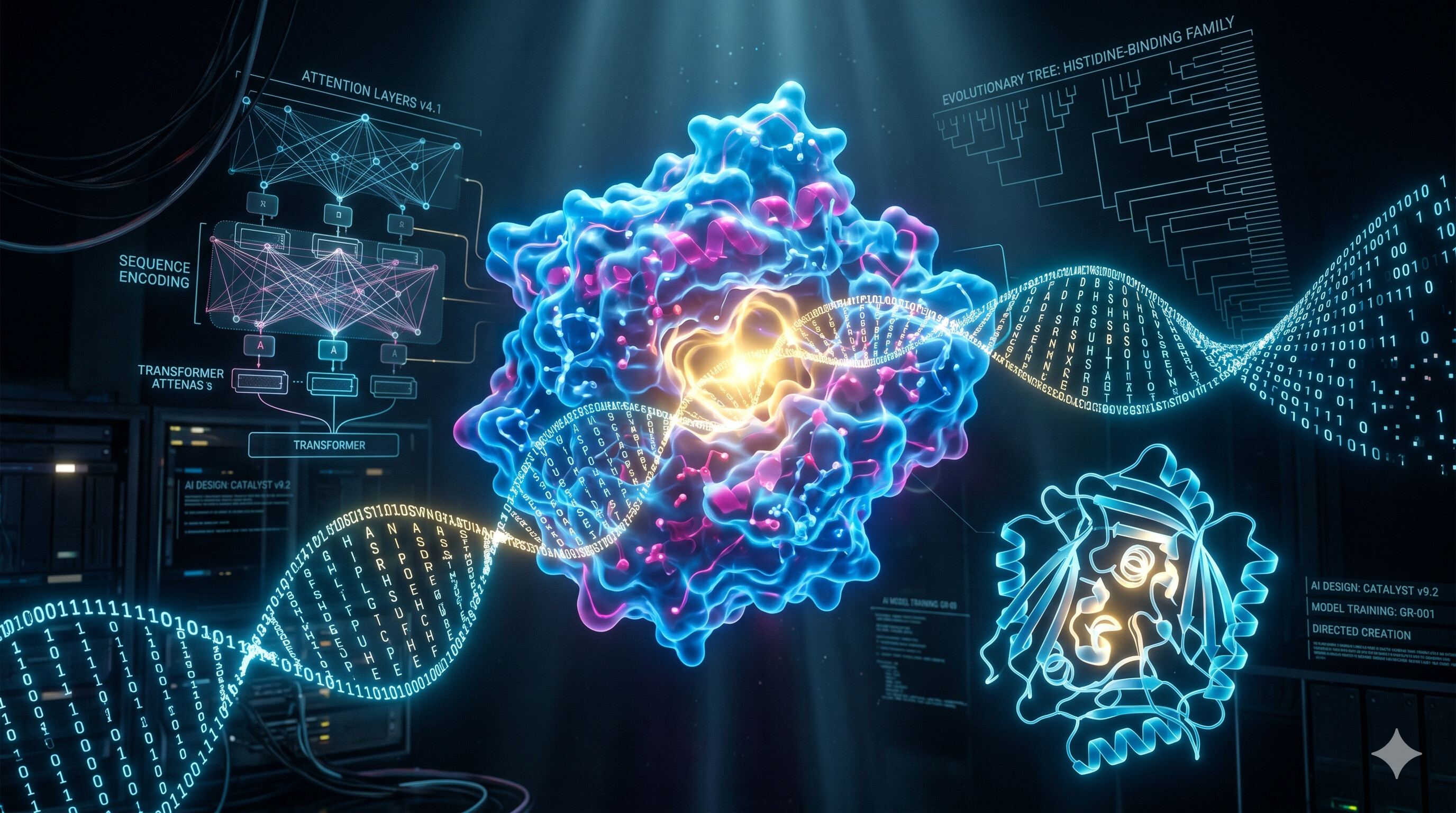
Between 2025 and 2026, protein language models (PLMs) have triggered a fundamental transformation in enzyme engineering. These Transformer-based AI systems learn the "evolutionary grammar" from hundreds of millions of protein sequences. Today, they can design entirely new catalytically active enzymes from scratch, with activities that in some cases surpass natural enzymes. This is not merely an efficiency improvement — it represents a paradigm shift from "screening what nature already provides" to "designing what we need."
The Technical Foundation of AI Enzyme Design
The core insight of protein language models is that protein sequences are, at their essence, a biological language. The order of amino acids determines how a protein folds, how it interacts with other molecules, and how it catalyzes chemical reactions. Just as large language models learn syntax and semantics from text, protein language models learn "evolutionary grammar" from vast databases of known protein sequences.
ProGen was one of the pioneers in this field. In 2023, Salesforce Research and the University of California, San Francisco published the ProGen model, demonstrating artificial enzyme generation based on next-token prediction. The team generated millions of novel lysozyme sequences, some of which showed activity comparable to natural lysozyme — even though their amino acid sequences diverged more than 30% from any known protein. The significance: AI was not imitating nature's existing designs but, after learning the underlying physicochemical principles of protein folding and catalysis, performing original molecular design.
In 2025, this trajectory experienced a qualitative leap. The team of David Baker at the University of Washington's Institute for Protein Design (IPD) — winner of the 2024 Nobel Prize in Chemistry — deeply integrated deep learning with protein design pipelines, achieving a closed-loop "design-build-test-learn" cycle. In March 2026, the Washington Research Foundation (WRF) awarded IPD a $7 million, four-year grant specifically to accelerate AI-assisted enzyme design development, targeting computational tools capable of precisely predicting protein properties.
The CRISPR enzyme engineering domain witnessed parallel breakthroughs. In 2025, Ben Kleinstiver's team at Massachusetts General Hospital (MGH) published research in Nature, combining high-throughput protein engineering with machine learning to create customized CRISPR-Cas9 enzymes with dramatically expanded PAM (protospacer adjacent motif) recognition. Traditional Cas9 can only recognize NGG sequences, limiting accessible genomic editing positions. Kleinstiver's AI-assisted method not only produced hundreds of novel Cas9 variants but also identified versions with higher specificity, addressing CRISPR's long-standing off-target challenge.
Three Parallel Technical Pathways
Current AI enzyme design encompasses three parallel technical routes, each with distinct advantages and applicable scenarios.
The first is evolution-based protein language models (PLMs), represented by ProGen, ESM-2 (Meta), and ProtGPT2. These models undergo self-supervised pretraining on large-scale unlabeled protein sequence datasets, learning amino acid co-occurrence patterns and evolutionary constraints. Generated sequences typically retain natural protein foldability and thermostability because the model implicitly learns the physicochemical constraints of protein structure. This approach is best suited for generating starting points for directed evolution — providing high-quality initial sequence libraries for experimental screening.
The second is structure-based deep learning design, represented by ProteinMPNN and RFdiffusion. These models take a target protein backbone structure as input and predict the amino acid sequence best suited to fill that structure. ProteinMPNN, published by the Baker team in 2022, far exceeds traditional Rosetta methods in inverse folding accuracy. Between 2024 and 2025, RFdiffusion further introduced diffusion models to protein backbone generation, enabling researchers to design protein scaffolds from scratch for specific functional requirements.
The third is function-driven end-to-end generation, the newest and most ambitious route. It bypasses the two-step "design structure, then evaluate function" process, directly mapping catalytic function requirements to amino acid sequences. This approach depends on large-scale enzyme function datasets (including activity, selectivity, thermostability indicators) and more complex multi-task learning architectures. While current success rates remain below the first two routes, this represents the ideal direction for enzyme design — telling AI "I need an enzyme that degrades PET plastic at 80 degrees Celsius" and having AI output the corresponding sequence directly.
Real Applications in 2025-2026
AI-designed enzymes have moved beyond computer simulation into laboratory validation and practical application.
In medicine, AI-designed therapeutic enzymes are progressively entering preclinical evaluation. Traditional enzyme replacement therapy faces core challenges: natural human enzymes have poor in vitro stability, short half-lives, and high immunogenicity. AI design tools address these from three directions: computationally optimizing surface charge distribution to reduce immunogenicity, remodeling folding pathways to improve thermostability, and introducing non-natural amino acids to extend in vivo half-life.
In industrial biotechnology, AI optimization of PET plastic-degrading enzymes is among the fastest-advancing cases. FAST-PETase, discovered in 2022, has undergone multiple rounds of AI-assisted evolution, achieving over 100-fold improvement in PET degradation rate at 50 degrees Celsius. Between 2025 and 2026, Japanese teams and France's Carbios reported preliminary validation results of AI-designed PETase variants in industrial-scale production lines, with degradation rates exceeding 90%.
In agriculture, AI is being deployed to design more efficient cellulase enzymes for converting agricultural waste into biofuels. Traditional cellulase cost remains a primary barrier to cellulosic ethanol commercialization. In 2025, a Technical University of Denmark (DTU) team used protein language models to redesign the cellulase active site, improving catalytic efficiency 5-fold. If industrialized, biofuel production costs could drop by over 30%.
The Competitive Landscape
The AI enzyme design competitive landscape spans academic pioneers, large technology companies, and specialized startups.
Academically, the Baker team at UW is the undisputed leader. IPD maintains world-leading positions at every technology node — from RoseTTAFold (structure prediction) to ProteinMPNN (sequence design) to RFdiffusion (backbone generation). The $7 million WRF grant strengthens its advantages in therapeutic enzyme and sensor design.
Among large technology companies, Meta (ESM-2/ESM-3) and Google DeepMind (AlphaFold3) each possess powerful foundation models. ESM-3 demonstrated impressive multimodal protein generation capabilities in 2024 — generating not just sequences but simultaneously controlling structure and function. DeepMind's AlphaFold3 extends prediction capability from static structures to protein-small molecule and protein-nucleic acid interactions, providing unprecedented input precision for structure-based enzyme design.
Multiple specialized startups are bridging the gap between computational design and commercial products. EvolutionaryScale (developing ESM3), Profluent, and Cradle Bio are transforming AI protein design from a research tool into a drug development platform. Between 2025 and 2026, these companies established partnerships with major pharmaceutical and chemical enterprises, signaling that AI-designed enzymes are entering real product pipelines.
Outlook: When Will Enzyme Design Have Its ChatGPT Moment?
Despite exciting progress, significant challenges remain. Data sparsity is foremost — protein function data (kcat, Km, optimal temperature, pH stability) comes from expensive, time-consuming experiments, with dataset sizes far below typical AI training sets. Current database coverage of enzyme function parameters is below 0.01% of known sequences. Generalization boundaries also persist — AI excels at designing enzymes similar to known structures but degrades in reliability when creating entirely novel catalytic mechanisms. The experimental validation bottleneck — gene synthesis, protein expression, purification, activity assays — remains expensive and low-throughput, lagging computational generation speed by orders of magnitude.
Yet these challenges do not diminish AI enzyme design's structural significance. Like the scaling laws observed in large language models, protein language models are following similar trajectories. ESM-3 has reached 9.8 billion parameters trained on 771 million protein sequences and 330 million structure predictions. As parameter scales and functional label datasets grow, precision is expected to continue improving.
From POC.HK's Observatory perspective, AI enzyme design represents more than a biotechnological advance. It embodies a deeper transformation: humanity is shifting from discovering biological functions through evolutionary screening to rationally creating them through computational understanding of biological principles. This paradigm shift from "discovery" to "design" will progressively reshape pharmaceuticals, materials science, chemical manufacturing, and agriculture over the coming decade.
The most significant signal: between 2025 and 2026, AI-designed enzymes entered industrial pilot projects and preclinical pipelines for the first time. Not all will succeed, but even a few AI-designed enzymes achieving clinical validation or industrial-scale testing will fundamentally transform protein engineering economics and timelines. The field's "ChatGPT moment" — when an AI-designed enzyme first proves superior to traditionally screened enzymes in real-world applications — may arrive between 2027 and 2028.
Disclaimer: The information contained in this article is for reference purposes only and does not constitute investment advice or business decision-making basis. Data and time-sensitive information are current as of the publication date and may change with subsequent developments. Neither the author nor POC.HK assumes any responsibility for losses resulting from the use of this information.