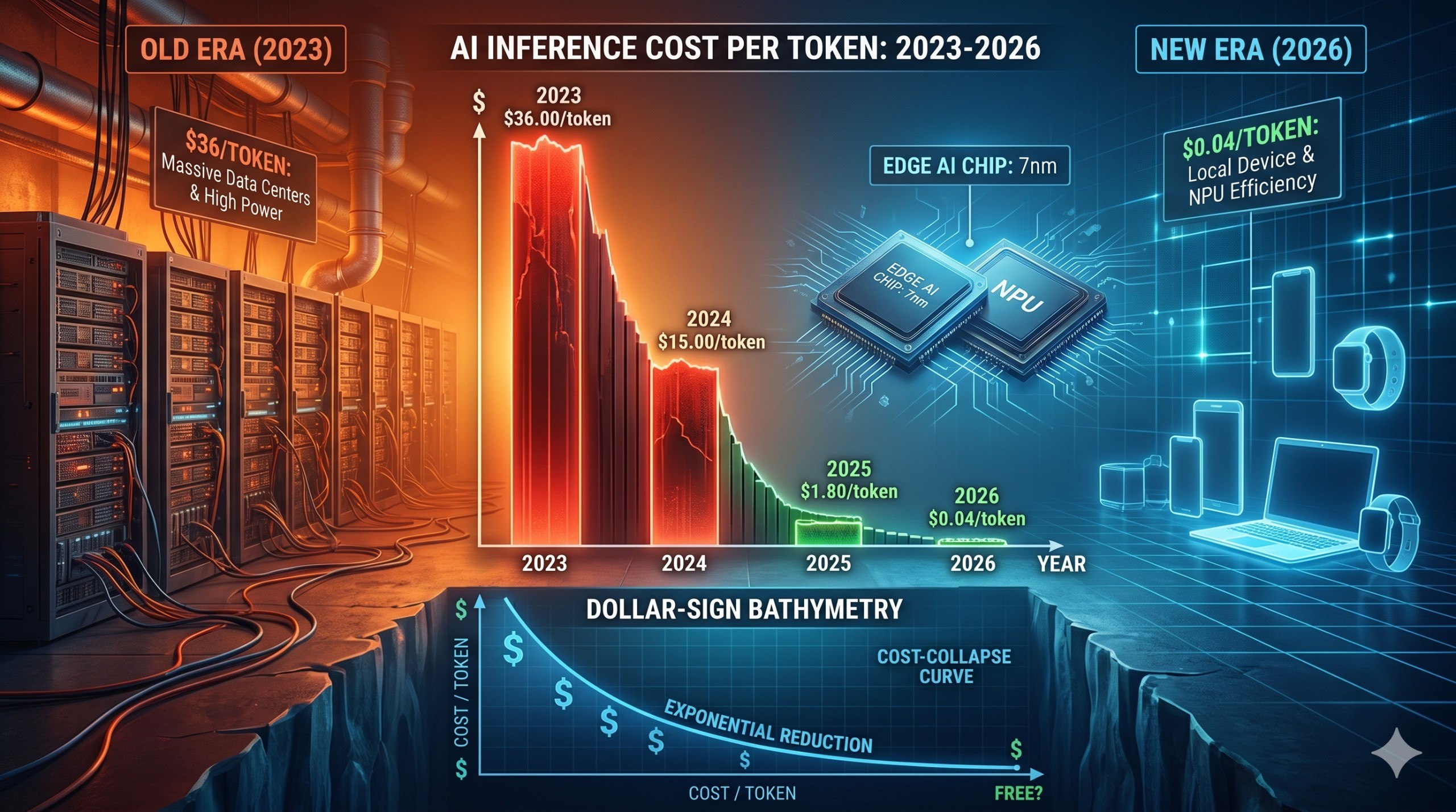
In late 2022, running GPT-4-class models cost approximately $20 per million tokens. By early 2026, equivalent performance costs approximately $0.40 per million tokens — a 1,000× reduction in just over three years. This is one of the fastest cost declines in computing history. Yet paradoxically, total AI inference spending is not decreasing — it is exploding. Behind this lies a profound structural shift: AI's computational center of gravity is shifting from training to inference, and this transition is reshaping the entire industry landscape from chip design to business models.
THE GREAT INVERSION: TRAINING VERSUS INFERENCE ECONOMICS
Understanding AI inference economics requires recognizing a fundamental computational spending inversion. In 2023, approximately two-thirds of AI compute resources were dedicated to training large models, with only one-third for inference. By 2026, this ratio has completely reversed: inference now accounts for two-thirds of all AI compute, and the proportion continues to rise.
The reason is straightforward: training is a fixed cost. Training frontier models like GPT-5 or Claude Opus 4 requires hundreds of millions to billions of dollars in compute, but this cost is one-time — it stops when training finishes. Inference is the opposite: it starts when the model ships and never stops as long as users are hitting the API, using the application, or relying on AI-driven services.
Consider a concrete example: a 70B-parameter model serving 1,000 daily active users averaging 1,000 requests per user per day at 500 tokens per request. Daily token volume is 500 million tokens, at approximately $950/day on on-demand H100 SXM5 configuration — annualized to roughly $347,000/year in compute alone, before egress and infrastructure overhead. And this is a small deployment. For global products like ChatGPT or Claude, inference costs can reach hundreds of millions per month.
This leads to a critical insight: for any team with real production traffic, inference costs will exceed training costs within weeks of launch. Most teams underestimate this because they plan around training budgets and treat inference as an afterthought until the bill arrives.
THE FOUR DRIVERS OF THE 1,000× COST COLLAPSE
The 1,000× reduction in AI inference costs was not driven by a single factor but by the compounding of four simultaneous improvements.
First, hardware efficiency gains. Each GPU generation delivers 2-3× more inference throughput per dollar. The H100 processes roughly 3× more tokens per second than the A100 at a similar price point. The Blackwell architecture pushes this further.
Second, software and compiler optimization. Inference frameworks like vLLM, TensorRT-LLM, and SGLang improved GPU utilization from 30-40% to 70-80% through techniques like continuous batching, PagedAttention, and speculative decoding. These innovations more than doubled the output from the same hardware at the same power consumption.
Third, model architecture efficiency. Mixture-of-Experts (MoE) models like DeepSeek V3 activate only a fraction of total parameters per token, delivering frontier-quality output at 3-5× lower compute cost per token than equivalent dense models. DeepSeek V4 Flash pushes this trend further.
Fourth, the rise of inference-specialized chips. GPUs were originally designed for training — inference was an afterthought. By 2026, Groq's LPU, Cerebras' wafer-scale engine, and inference-specific ASICs from multiple startups are achieving 3-5× better tokens-per-dollar throughput than general-purpose GPUs. This has profound implications for GPU market demand structure.
FRONTIER API PRICING LANDSCAPE IN 2026
As of June 2026, major AI provider API pricing reveals a clear structure. Frontier models are priced at $10-75 per million output tokens, while lightweight models have dropped to $0.10-4. Input tokens are typically 3-5× cheaper than output tokens — meaning controlling output length is the single highest-leverage cost decision.
| Provider | Model | Input $/M | Output $/M | Cache $/M |
|---|---|---|---|---|
| Anthropic | Claude Opus 4 | $15.00 | $75.00 | $1.50 |
| Anthropic | Claude Sonnet 4 | $3.00 | $15.00 | $0.30 |
| OpenAI | GPT-5 (frontier) | $5.00 | $20.00 | $0.50 |
| Gemini 2.5 Pro | $2.50 | $10.00 | $0.31 | |
| DeepSeek | V4 Flash | ~$0.50 | ~$2.00 | ~$0.05 |
| Gemini 2.5 Flash | $0.30 | $1.20 | $0.04 | |
| Open weight | Llama 4 (self-hosted) | ~$0.10 | ~$0.40 | N/A |
Key pattern: the price gap between top-tier and lightweight models is widening. Anthropic's Claude Opus 4 is over 60× more expensive than Gemini 2.5 Flash. This means intelligent routing — assigning simple tasks to cheap models and only invoking frontier models when needed — can reduce inference costs by 80-95% while maintaining overall output quality.
SELF-HOSTING VS. API: THE BREAK-EVEN ANALYSIS
For large-scale deployments, the choice between self-hosting and API is a critical economic decision. By 2026, the break-even point for self-hosting a 70B-parameter model is approximately 500 million to 1 billion tokens per month — below this, API is more economical; above this, self-hosting offers better cost per token.
However, the definition of "cost-effective" is evolving. Self-hosting involves not only GPU costs but also: engineering team time for maintaining inference infrastructure, availability and reliability SLAs, model update and version management, and capacity planning and elastic scaling. For many organizations, even when self-hosting is cheaper on a per-token basis, the total cost of ownership may favor API solutions.
ECOSYSTEM IMPACTS OF FALLING INFERENCE COSTS
The collapse of inference costs creates profound ripple effects across the entire AI ecosystem.
At the application layer, lower inference costs directly unlock new application categories. Real-time voice conversation — requiring under 300ms latency — was economically infeasible when inference was expensive. But when cost drops below $1 per million tokens, real-time voice inference costs under $0.01 per minute of conversation, suddenly becoming commercially viable. Similarly, code generation, document analysis, customer service automation, and personalized learning applications shift from "too expensive per user" to "effectively free."
At the business model layer, falling inference costs enable AI companies to transition from token-based pricing to outcome-based pricing. If inference is cheap enough, AI services can charge per task (e.g., $0.05 per code review) rather than per token. This simplifies customer purchasing decisions and positions AI services as predictable-cost tools rather than variable overhead.
At the hardware market layer, inference's dominance in AI compute is reshaping the GPU market. Inference-related revenue now exceeds training in NVIDIA's data center GPU revenue. This drives investment in inference-optimized hardware — lower TDP, higher throughput-per-watt, smaller form factors — increasingly diverging from the trajectory of training GPUs.
OBSERVATORY ANALYSIS: THE STRATEGIC IMPLICATIONS OF COST COLLAPSE
POC.HK Observatory assesses that the structural decline in inference costs is the single most important trend in the AI industry of 2026 — more transformative than any individual model release. The reason is that inference cost is the ultimate constraint on AI adoption. When inference is expensive, AI applications are limited to high-value use cases — medical diagnostics, financial trading, legal analysis. When inference approaches zero, AI becomes ubiquitous — embedded in every application, every search, every device.
But this trend harbors a paradox. While per-token costs are plummeting, total AI inference spending is exploding — because usage volume is growing faster than unit cost is declining. This means:
For AI companies, unit margins are compressing, but market size is expanding rapidly. Winners will not be the providers with the cheapest models, but those that can convert low costs into high adoption and scalable revenue.
For infrastructure investors, the growth curve for inference capacity demand remains steep — even as hardware efficiency improves. The doubling time for data center AI inference capacity may shorten from 12 months to 6 months.
For developers, falling inference costs are removing the marginal cost constraint on "whether to use AI." The question shifts from "can we afford to use AI" to "where should we NOT use AI." The latter is no longer a technical or economic decision but a product and strategic one.
Looking ahead, the threshold of $0.01 per million tokens — projected for 2027-2028 — will further transform the landscape. At this cost level, AI inference is effectively free, and AI embedding will become as ubiquitous and indispensable as network connectivity is today. But reaching this point requires continued innovation at every layer — from chips through architecture to optimization frameworks. The story of inference economics is only beginning.
免責聲明:本文所載資料僅供參考,不構成任何投資建議或商業決策依據。數據及時間資訊以發布當日為準,可能隨後續發展而有所變動。作者及POC.HK不對因使用本文資訊而導致的任何損失承擔責任。