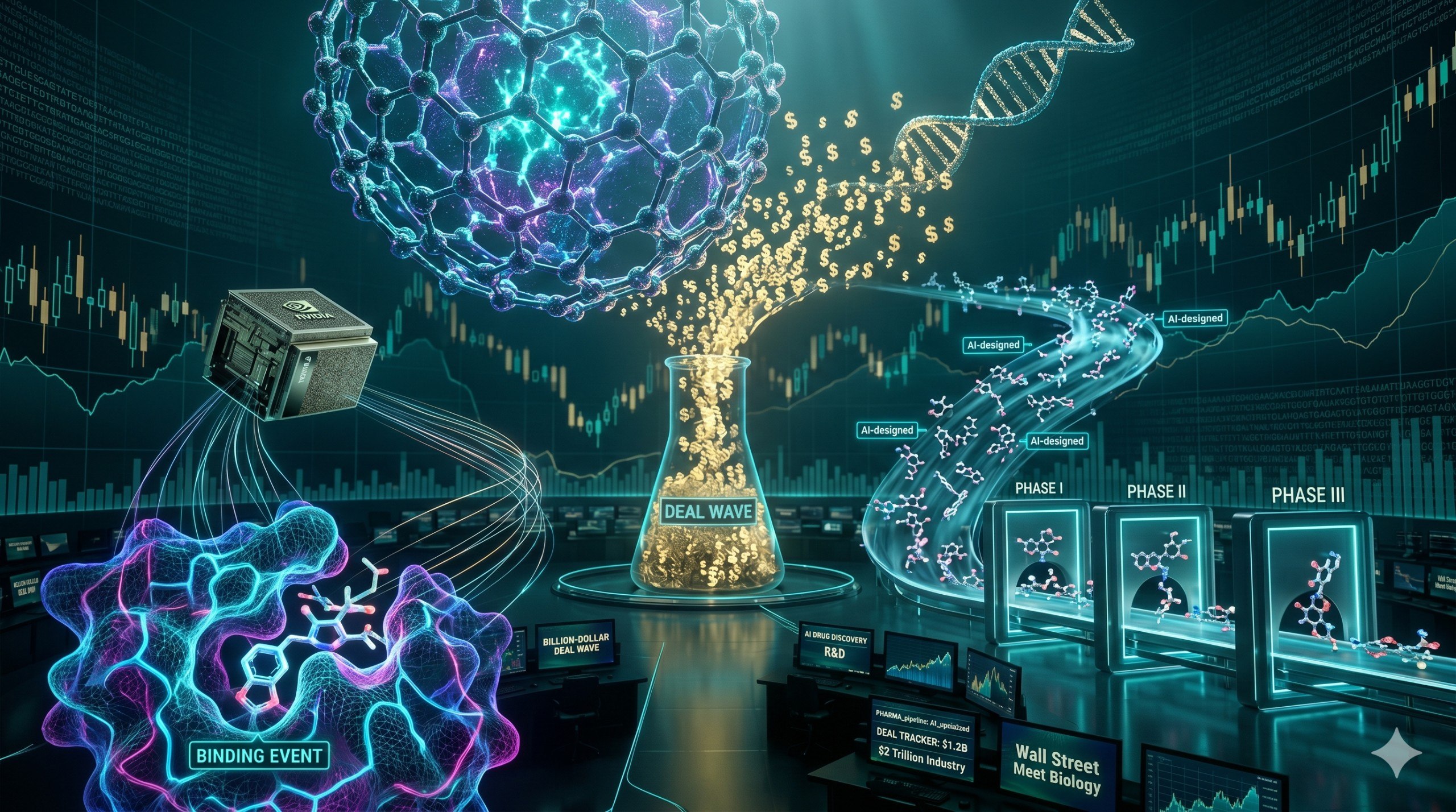
The first half of 2026 witnessed an unprecedented wave of billion-dollar deals in AI drug discovery. Eli Lilly and NVIDIA jointly announced a $1 billion Co-Innovation Lab, while Lilly signed a landmark agreement with Insilico Medicine totaling up to $2.75 billion ($115 million upfront plus milestones); Merck partnered with Protillion Biosciences for up to $510 million in AI antibody discovery; and Earendil Labs raised $787 million at its founding stage. These numbers represent not merely a surge of capital into the sector, but a fundamental paradigm shift in pharmaceutical R&D — from "chemical intuition-driven" to "computational prediction-driven" discovery.
Deal Landscape: Top AI Drug Discovery Transactions, H1 2026
| Deal | Buyer | AI Partner | Total Value | Upfront | Domain |
|---|---|---|---|---|---|
| Lilly-NVIDIA Co-Innovation Lab | Eli Lilly | NVIDIA | $1B | — | AI compute infrastructure |
| Lilly-Insilico Medicine | Eli Lilly | Insilico Medicine | $2.75B | $115M | AI small molecule discovery |
| Merck-Protillion Biosciences | Merck | Protillion | $510M | Undisclosed | AI antibody discovery |
| Earendil Labs | — | — | $787M (funding) | — | AI biologics design |
| Pfizer-AI Platform | Pfizer | Multiple | Undisclosed | — | AI clinical trial optimization |
| Novartis-Generative AI | Novartis | Multiple | Undisclosed | — | Generative AI lead compounds |
| Roche-AI Protein Degraders | Roche | Multiple | Undisclosed | — | AI PROTAC design |
| Other deals (aggregate) | Multiple | Multiple | ~$8B est. | — | Various |
According to industry analysis, total global AI drug discovery deal value in H1 2026 is estimated at nearly $15 billion, approximately 3x growth over H1 2025. Some 85% of global big pharma companies now list AI as an "immediate priority," and approximately 50% of pharma/biotech companies use AI or big data in R&D.
Eli Lilly's Double Bet on AI
Eli Lilly has been the most aggressive Big Pharma deployer of AI in 2026. Its $1 billion Co-Innovation Lab with NVIDIA is not a traditional drug development partnership, but a strategic move to reshape the entire R&D pipeline from the computing infrastructure layer up.
Lilly-NVIDIA Co-Innovation Lab: This five-year AI Factory collaboration establishes a dedicated AI supercomputing center at Lilly's headquarters in Indianapolis. The facility will be equipped with NVIDIA's latest DGX and GB200 computing platforms, with an estimated FP8 compute capacity exceeding 1 exaflop. Core objectives: (1) transforming Lilly's 150-year compound database and small-molecule interaction data into trainable structured datasets; (2) developing proprietary generative AI models for de novo design of molecules with specific pharmacological properties; (3) predicting drug ADMET (absorption, distribution, metabolism, excretion, toxicity) properties in virtual environments, aiming to reduce preclinical candidate failure rates from the current ~90% to below 50%.
Lilly-Insilico Medicine Collaboration: One of the largest-ever AI drug discovery partnerships. The $115 million upfront plus up to $2.635 billion in development and commercial milestones creates a total potential value of $2.75 billion. The collaboration focuses on using Insilico's Pharma.AI platform (including the Chemistry42 molecular generation engine and Biology42 target discovery module) to develop small-molecule drugs against multiple therapeutic targets identified by Lilly. Insilico's rentosertib (ISM001-055) — the world's first AI-designed drug to complete Phase IIa clinical validation — was the core reason behind Lilly's decision to commit substantial capital. Rentosertib targets idiopathic pulmonary fibrosis (IPF), and positive Phase IIa safety and efficacy signals were announced in early 2026, with pivotal Phase III readouts expected within the next 12 months.
Merck-Protillion: Pushing the Boundaries of AI Antibody Discovery
On June 16, 2026, Merck signed a collaboration with Protillion Biosciences worth up to $510 million for AI-powered antibody discovery. Protillion's core Prot-MaP (Protillion Massively Parallel) platform integrates three technology layers:
Ultra-High-Throughput Experimentation: The Prot-MaP platform can screen over 1 billion antibody variant sequences in a single experiment — over 1,000x the throughput of traditional phage display technology. This capability enables researchers to explore regions of antibody sequence space previously inaccessible.
AI Sequence-Function Prediction: Deep learning models trained on vast screening datasets can predict antibody variant binding affinity, specificity, and developability before any wet-lab experiment is conducted. This dramatically reduces the number of candidate molecules requiring experimental validation.
Iterative Design Loop: AI prediction → experimental validation → data feedback → model update → next-generation design — this closed loop enables Protillion to complete in one week what traditional methods would require months to achieve in antibody optimization.
Earendil Labs: A $787 Million Bet on AI Biologics
In March 2026, Earendil Labs raised $787 million from top-tier venture capital investors at its founding stage, marking the largest seed/early-stage financing in AI biologics. The company's core thesis: current AI drug discovery is overly focused on small molecules — yet the biologics market (antibodies, fusion proteins, gene therapy vectors) is far larger, and its sequence space presents an even harder search problem than chemical space, making AI intervention even more necessary.
Earendil's platform focuses on de novo design of large-molecule drugs, using deep generative models to create protein sequences with specific functional properties from scratch — rather than merely screening naturally occurring protein variants. The company's founding technology originates from protein design laboratories at Stanford University and the University of Washington, and its models have demonstrated the ability in preliminary tests to design antibody-like proteins with stability and expressibility comparable to natural antibodies.
Clinical Validation: AI-Designed Drugs From Theory to Reality
The most important event in AI drug discovery in 2026 is non-financial — it comes from clinical data.
Insilico Medicine's rentosertib: The world's first fully AI-discovered and designed drug to reach Phase IIa and achieve positive clinical results. Although Phase III for IPF is still ongoing, rentosertib's Phase IIa data provides the strongest proof-of-concept for AI drug discovery — if a molecule designed from scratch by a computer can demonstrate predicted pharmacological activity in humans, the entire industry paradigm shifts from "screen first, then design" to "design first, then validate."
Clinical Pipeline Scale: As of mid-2026, over 200 AI-designed drug programs have entered clinical development globally, spanning oncology, immunology, metabolic diseases, fibrotic diseases, and rare diseases. Approximately 35 of these are in Phase II or later, with the first wave of AI drug approvals expected in 2027-2028.
Observatory Analysis: Structural Transformation Beneath the Deal Wave
The 2026 AI drug discovery deal wave is not merely an influx of capital — it represents a fundamental shift in the operating model of pharmaceutical R&D.
From Trial-and-Error to Prediction: Traditional drug discovery is essentially large-scale trial-and-error — screening millions of molecules hoping to find one viable candidate. AI is restructuring this process from "screening" to "design." When an AI model can predict molecule-target binding patterns, ADMET properties, and synthesizability, the medicinal chemist's work shifts from "designing experiments to explain results" to "designing experiments to explain predictions." The far-reaching implications of this repositioning are comparable to genomics' impact on biology.
Structural Signals from Deal Terms: In 2026 deals, upfront payments have risen significantly. The Lilly-Insilico partnership's $115 million upfront rivals traditional drug licensing deal sizes. This indicates that Big Pharma now views AI platform-generated data and predictions as assets with genuine value — not merely "impressive but unreliable" theoretical speculation.
The True Bottleneck is Data, Not Models: All major AI drug discovery platforms — whether Insilico's Pharma.AI, Protillion's Prot-MaP, or others — are in some way addressing data generation and standardization. Drug discovery's unique challenge is that high-quality biological data is extremely difficult and expensive to obtain. Companies capable of producing high-quality biological data at low cost and high throughput will gain the greatest structural advantage in the next competitive phase.
Disclaimer: The information in this article is for reference purposes only and does not constitute investment advice or commercial decision-making basis. Data and time-sensitive information are current as of the publication date and may change with subsequent developments. Neither the author nor POC.HK assumes any liability for losses arising from the use of this information.